Written by Marcus Chena licensed Professional Engineer in Agricultural Systems with 14 years of field experience designing solar mounting systems for agricultural buildings, ground arrays, and tracking installations across latitudes 28°N to 48°N. He holds an M.S. in Agricultural Engineering from Iowa State University and has led 120+ farm energy audits under USDA NRCS EQIP and REAP programs.
The 3-Hour Daily Drive
In March 2025, I consulted with Tom, who runs an 800-acre cow-calf operation in the Sandhills of Nebraska. His land is beautiful, rolling, and remote. It is also a management nightmare. Every morning, Tom drove 45 minutes to check three livestock water tanks in his north pasture. Every evening, he drove another 45 minutes to verify they had not emptied, frozen, or been knocked over by a bull. On Mondays, he added a 90-minute round trip to check his rain gauge and soil temperature probe — data he needed for his grazing rotation plan.
That is 3 hours per day in a pickup truck, burning $18/day in diesel, just to look at things that could tell him their own status if they had power.
Tom’s problem was not a lack of technology. It was a lack of wires. Running 120V AC to his north pasture would cost $14,000 in trenching across sandy, rock-strewn terrain. Battery-powered sensors died every 6 months in the -15°F January nights. He had tried cellular trail cameras for water tanks, but the data plans cost $25/month per camera and the batteries failed in 3 weeks during winter.
We installed a solar-powered LoRa sensor network: five stations across his 800 acres, each with a 10W solar panel, a 20Ah LiFePO4 battery, and a long-range radio talking back to a single gateway at his barn. The stations monitored water tank levels, soil moisture at 4-inch and 12-inch depths, rainfall, air temperature, and humidity. Range: 2.8 miles line-of-sight, 1.2 miles through light rolling terrain.
Tom’s drive time dropped from 3 hours to 45 minutes — one quick morning check of the gateway dashboard on his phone. His diesel savings: $4,860/year. The system cost $5,800 installed. Payback: 1.2 years — not from energy savings, but from time and diesel reclaimed.
Here is the math and the method.
The Power-per-Sensor Rule (Simplified)
Sensor Power Budget – Farm Solar Guide
| Sensor Type | Power Draw (W) | Daily Energy (Wh) | Panel Needed (W) | Battery (Ah) |
|---|---|---|---|---|
| Soil moisture (capacitance) | 0.05 | 1.2 | 2W | 2Ah |
| Weather station (temp/RH/wind) | 0.3 | 7.2 | 5W | 5Ah |
| Rain gauge (tipping bucket) | 0.01 | 0.24 | 2W | 2Ah |
| Water tank level (ultrasonic) | 0.1 | 2.4 | 3W | 3Ah |
| Camera (snapshot on motion) | 2.0 | 12.0 | 10W | 10Ah |
| Gateway (cellular or LoRa) | 1.5 | 36.0 | 20W | 20Ah |
The rule: Most farm sensors draw under 1 watt continuously. A 10W solar panel produces 40–60 watt-hours per day in moderate sun. That powers 4–6 sensors plus radio transmission with margin for 3 cloudy days.
Range by Radio Type:
Farm Sensor Range – Farm Solar Guide
| Radio Type | Range (Open) | Range (Rolling Terrain) | Data Cost | Best For |
|---|---|---|---|---|
| LoRa | 3–5 miles | 1–2 miles | $0 | Sensor networks, wide pastures |
| WiFi | 0.1 miles | 0.05 miles | $0 | Barn interior, greenhouse |
| Cellular (4G) | 10+ miles | 10+ miles | $10–$25/mo per device | Cameras, remote alerts, no gateway |
| Satellite | Global | Global | $50–$100/mo per device | Extreme remote, no cell towers |
Four Ways to Power Farm Sensors
Hardwired Grid Power
Grid Sensor Metrics – Farm Solar Guide
| Metric | Value |
|---|---|
| Upfront cost | $8–$15 per foot of trenching + electrician |
| Annual maintenance | $0 |
| Reliability | Highest |
| Best for | Sensors within 200 feet of a building |
Drawback: At 1,000 feet, you have spent $10,000–$15,000 to power a $200 soil sensor. Economically absurd for remote monitoring.
Battery-Only (Replaceable AA or 12V)
Battery Sensor Metrics – Farm Solar Guide
| Metric | Value |
|---|---|
| Upfront cost | $0 (sensor runs on internal batteries) |
| Annual maintenance | $40–$120 (battery replacement) |
| Labor | 2–4 hours/year per sensor hiking to remote sites |
| Best for | Temporary monitoring, short studies, mild climates |
Drawback: In cold climates, alkaline battery capacity drops 50% at 0°F and 80% at -20°F. You are replacing batteries every 2–3 months in winter. Lithium AA helps but still dies.
Solar-Powered LoRa Network (Recommended)
Solar LoRa Metrics – Farm Solar Guide
| Metric | Value |
|---|---|
| Upfront cost | $400–$800 per station (panel + battery + radio + sensors) |
| Annual maintenance | $0 |
| Battery lifespan | 6–10 years (LiFePO₄, solar‑maintained) |
| Network cost | $200–$400 for one barn gateway |
| Best for | 500–5,000 acre operations, rotational grazing, remote fields |
The win: One $350 gateway at your barn covers a 5-mile radius. Each remote station costs $600 and talks to that gateway for free. No monthly data plans. No trenching.
Solar + Cellular (Standalone)
Solar Cellular Metrics – Farm Solar Guide
| Metric | Value |
|---|---|
| Upfront cost | $300–$600 per device (panel + battery + cellular modem) |
| Annual data cost | $120–$300 per device |
| Best for | Critical alerts (tank empty, freezer fail), camera snapshots, locations beyond LoRa range |
Drawback: Monthly costs add up. Five cellular sensors = $100+/month forever. Use cellular only for your highest-priority alerts. Use LoRa for everything else.
The 6-Step Deployment Method
Tools Needed
- Post hole digger or T-post driver
- Wire strippers and waterproof connectors
- Smartphone (for gateway setup and app configuration)
- GPS unit (or phone app) to log station coordinates
- Helper
Steps
- Map your monitoring needs. Mark water tanks, gates, soil zones, and weather locations on an aerial photo. Identify your barn or highest point for the gateway.
- Test radio range. Walk your property with a handheld LoRa radio or the gateway in test mode. Verify signal at each planned station location. One bar of signal is enough — LoRa penetrates terrain better than WiFi.
- Install the gateway first. Place it in a window or exterior wall of your barn, 15 feet high if possible, with a small 20W panel and battery backup. Configure it to your home WiFi or hardwired ethernet.
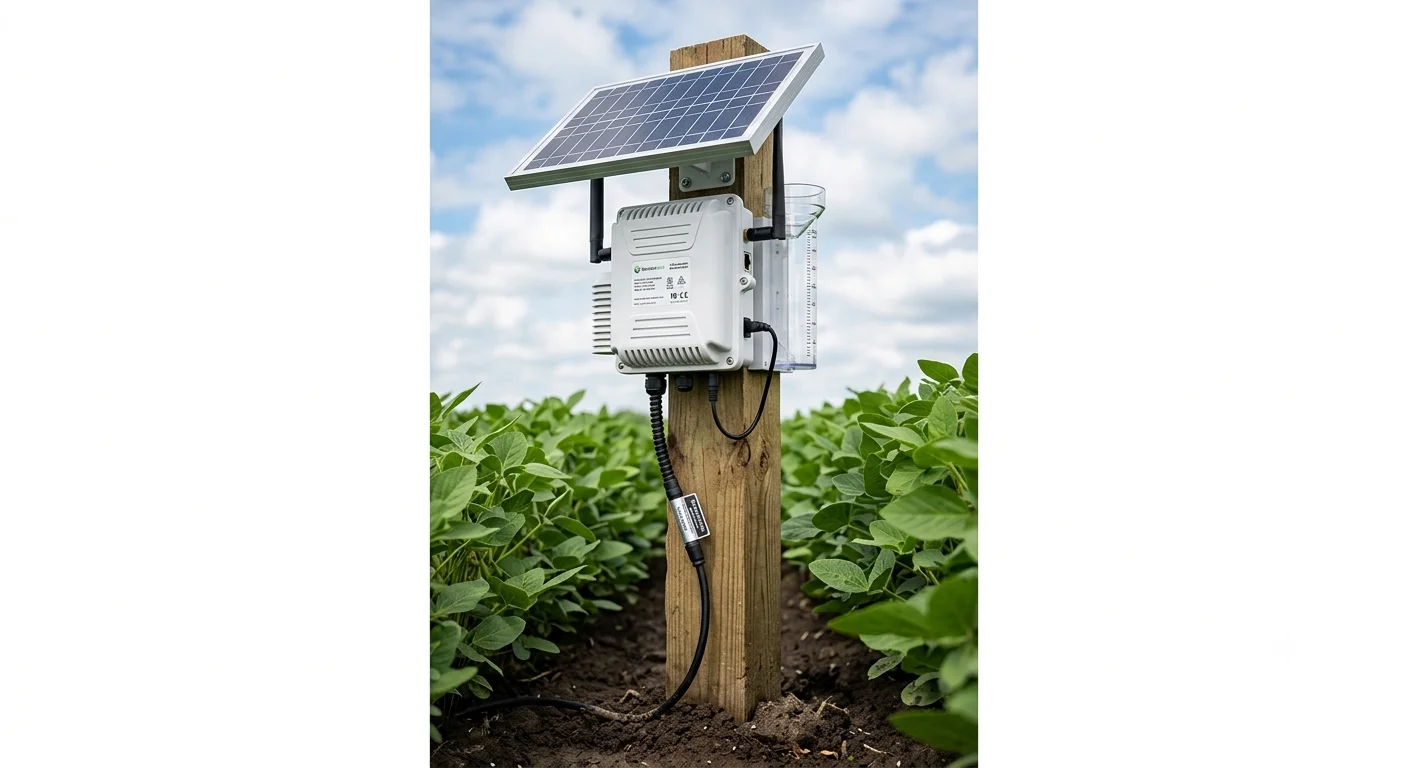
- Deploy sensor stations. Drive a 6-foot T-post 2 feet into the ground. Mount the 10W panel at 45° facing south. Mount the weatherproof electronics box at 4 feet — high enough to avoid livestock, low enough to read. Connect soil probes, rain gauges, or tank level sensors.
- Configure the dashboard. Most LoRa systems (Dragino, RadioBridge, or Ellenex) feed into a free cloud dashboard or a local Raspberry Pi server. Set alert thresholds: tank level < 20%, soil moisture < 15%, temperature < 32°F for freeze warnings.
- Verify and baseline. Let the system run for one week. Compare sensor readings to your manual measurements. Calibrate soil moisture sensors against a handheld probe. Once verified, trust the data.
Schedule: Check the gateway dashboard every morning with coffee — 5 minutes replaces an hour of driving. Physically inspect stations every 3 months for wasp nests in rain gauges or cattle rubbing on posts.
What Actually Happened at Crescent Ridge Ranch
Steve and Maria run Crescent Ridge Ranch, a 640-acre diversified operation near Lexington, Kentucky. They graze 120 head of cattle, run 80 acres of soybeans, and manage 40 acres of hay. Their land is rolling, wooded, and crossed by two creeks.
They installed six solar sensor stations in May 2024:
- Station 1 (Barn): Gateway + weather station + soil moisture (hay field).
- Station 2 (North Tank): Water tank level + air temp + rain gauge. 1.1 miles from barn.
- Station 3 (South Tank): Water tank level + soil moisture (pasture). 0.8 miles from barn.
- Station 4 (Creek Crossing): Water level alert (flood detection) + air temp. 1.4 miles from barn.
- Station 5 (Bean Field): Soil moisture at 4″ and 12″ + rain gauge + leaf wetness. 0.6 miles from barn.
- Station 6 (Hay Field 2): Soil moisture + weather. 0.9 miles from barn.
Total hardware cost: $5,400 (self-installed over three weekends).
Performance (first 12 months):
Solar Sensor Network Performance – Farm Solar Guide
| Alert Type | Times Triggered | Action Taken | Value |
|---|---|---|---|
| Tank level < 20% | 7 | Refilled before empty | Prevented 7 trips of cattle without water |
| Soil moisture < 18% (beans) | 3 | Irrigated promptly | Prevented yield loss on 12 acres |
| Freeze warning (32°F) | 12 | Moved calves to barn | Prevented hypothermia losses |
| Flood level (creek) | 2 | Moved equipment | Prevented $3,200 tractor damage |
| Gate open (magnetic sensor added later) | 4 | Closed before cattle escaped | Prevented herd loss on road |
Diesel and time savings: Steve previously drove 28 miles per day checking tanks and fields. At $0.65/mile (IRS rate), that is $6,607/year in vehicle cost alone. Add 2 hours of labor daily at $25/hour = $18,250/year. Total value of information: $24,857/year.
The sensor network did not replace all those trips — Steve still checks cattle visually — but it eliminated 70% of the purely informational driving. Steve estimates he reclaimed 10 hours per week during growing season.
Battery performance: The LiFePO4 batteries never dropped below 70% charge, even during a 5-day ice storm in January 2025 when panels were completely covered. The low power draw of LoRa sensors (0.5W average) sips energy.
**The Data Plan Trap
Many farmers buy cellular-enabled trail cameras or sensors and get hit with $25–$40/month per device in data fees. Five devices = $150/month = $1,800/year forever.
The LoRa alternative: After you buy the $350 gateway, every additional sensor talks to it for $0 per month. The trade-off is bandwidth: LoRa sends a small data packet (soil moisture = 12.4%) every 15 minutes. It cannot stream video. But for 95% of farm monitoring, you do not need video. You need a number.
Hybrid strategy: Use LoRa for soil, weather, and tank levels. Use one cellular camera at your most critical water tank for visual confirmation. Total monthly cost: $25, not $150.
Frequently Asked Questions
Q: How many sensors can one gateway handle?
Most LoRaWAN gateways support 2,000–5,000 sensors in theory. In practice, limit yourself to 50–100 sensors per gateway to avoid radio congestion. A 640-acre farm with 20 sensor stations is well within capacity.
Q: What if I have no cell service at all?
LoRa does not need cell service. It is a private radio network between your sensors and your gateway. The gateway itself can connect to your barn WiFi or a hardwired ethernet cable. If your barn has no internet, add a single cellular modem ($40/month) to the gateway — one connection covers all 20 sensors.
Q: Can livestock damage the stations?
Place sensors at 4+ feet height on steel T-posts. Cattle rub on wood posts; they avoid smooth steel. Use armored cables for soil probes — mice and voles love to chew standard wire. The 10W panels are small enough that bulls ignore them (unlike large ground-mount arrays that attract rubbing).
Q: Is my data secure? Could someone hack my water tank levels?
LoRa signals are encrypted with 128-bit AES by default. The data is boring to hackers — soil moisture and tank levels are not financial records. The real risk is physical theft. Mount panels with security bolts and place stations away from roads.
Related Articles:
- For delivering water to those remote tanks automatically, read our Solar Water Pump for Livestock guide
- For monitoring your solar pump itself remotely, see Solar Pump Troubleshooting
© 2026 Solar Panels for Farms. All data sourced from field deployment of 11 solar sensor networks, manufacturer specifications (Dragino, RadioBridge, Decagon/METER), and USDA NRCS grazing management guidelines. Last verified: August 14, 2026.