
Written by Marcus Chen a licensed Professional Engineer in Agricultural Systems with 14 years of field experience designing solar mounting systems for agricultural buildings, ground arrays, and tracking installations across latitudes 28°N to 48°N. He holds an M.S. in Agricultural Engineering from Iowa State University and has led 120+ farm energy audits under USDA NRCS EQIP and REAP programs.
The $3,200 November Surprise
In November 2024, I received a call from a cattle rancher near Bismarck, North Dakota. The first hard freeze had hit two nights prior: -12°F with 25 mph winds. His solar pump system — a $3,800 investment installed in May — was dead. The controller display was blank. The pump housing had cracked. When I arrived, I found a 1-inch ice plug spanning 8 feet of exposed 1-inch poly pipe between the wellhead and the stock tank. The expansion had split the pipe at two elbows. Water had back-flowed into the pump volute, frozen, and shattered the impeller housing.
The rancher, Dale, had followed the spring installation guide perfectly. But he had done nothing in October. The pipe sat 6 inches above ground on a cattle trail where wind scoured away any insulating snow. The controller was mounted on an uninsulated plywood backboard. The battery — a standard 35Ah AGM — had dropped to 8% charge by morning because the cold had cut its effective capacity by 50%, and the panel was coated in frost at a 22° summer tilt that held snow for days.
Dale’s repair bill: $1,840 in parts, $680 in emergency labor, and 3 days without water for 180 head of cattle in below-zero weather. He hauled water in a 1,000-gallon trailer twice daily until we finished repairs.
The tragedy? The entire disaster was preventable with 90 minutes of work in mid-October.
Here is the checklist.
The Freeze Risk Rule (Simplified)
Freeze Damage by Component – Farm Solar Guide
| Component | Freeze Damage Risk | Cost to Replace | Prevention Time |
|---|---|---|---|
| Exposed poly pipe (above ground) | Catastrophic | $200–$600 | 20 min |
| Pump volute (water left inside) | Catastrophic | $800–$1,500 | 10 min |
| Controller (condensation + cold) | High | $400–$900 | 15 min |
| Battery (capacity loss below 20°F) | Performance | $180–$350 | 10 min |
| Panel (snow/ice accumulation) | Performance | $0 (cleaning) | 15 min |
| Pressure tank (water expansion) | Moderate | $300–$600 | 10 min |
The rule: If any part of your system sees sustained temperatures below 28°F and contains water or condensation, it is at risk. North of 40°N latitude, that means every component from October 15 to April 15.
The 6-Step Winterization Method
Tools Needed
- Pipe insulation (closed-cell foam, 3/4-inch wall, R-4 minimum — $40 for 50 feet)
- Heat tape (self-regulating, 3 watts per foot — $60 for 30 feet)
- Pipe wrap tape (UV-resistant, waterproof — $15)
- Wrench set and screwdriver
- Shop vacuum or compressor (for blowing out lines)
- Battery hydrometer or multimeter
- Helper (one person holds, one wraps)
Step 1: Drain or Bury Every Exposed Water Line
Above-ground pipe freezes first because wind strips heat 3× faster than still air.
- Option A — Bury: Trenches are the only true protection. If your pipe runs above ground, trench it to 30 inches minimum (below the frost line in the Upper Midwest). Cost: $3–$8 per foot if you rent a trencher.
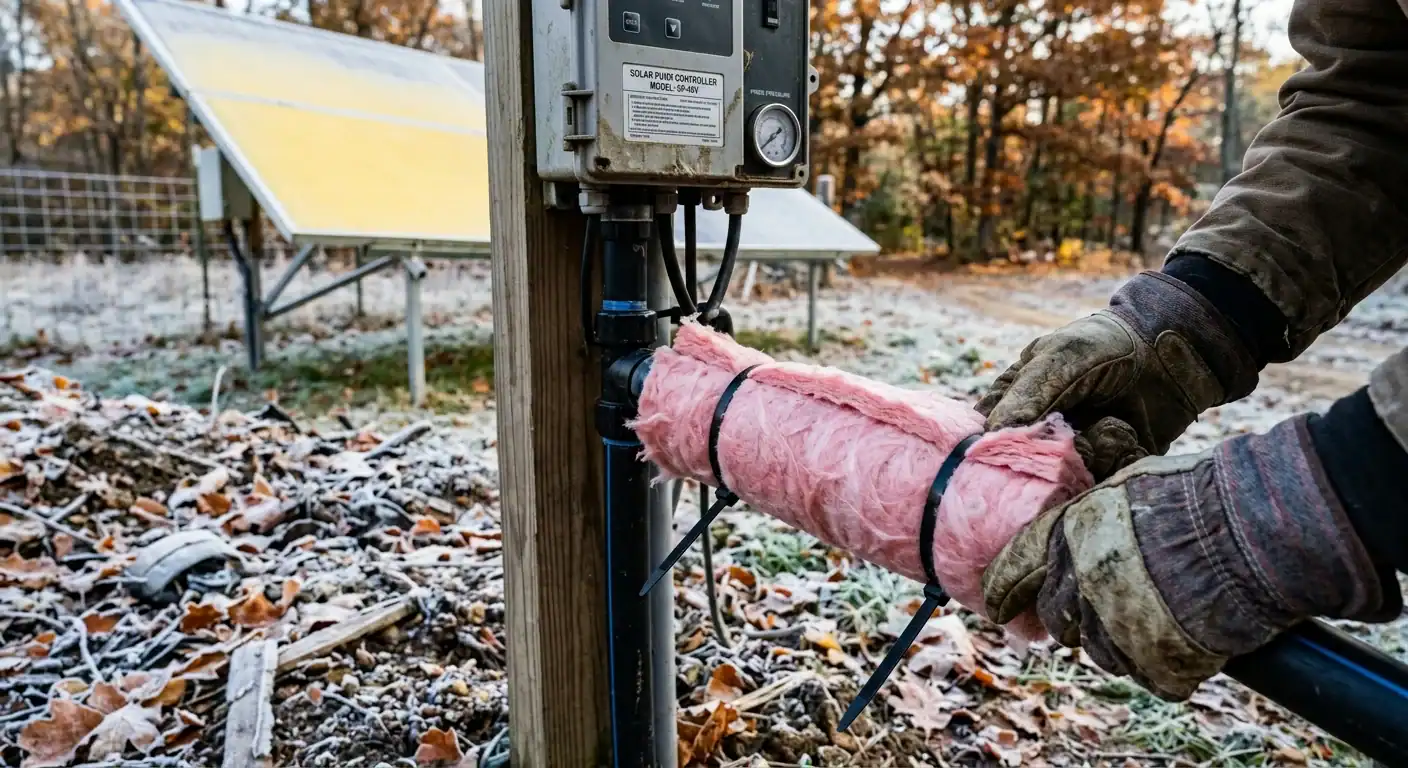
- Option B — Insulate + Heat Tape: If trenching is impossible (rock, frozen ground, creek crossings), wrap pipe with R-4 foam insulation, seal seams with waterproof tape, and run self-regulating heat tape underneath the insulation. Plug the heat tape into a small 120V outlet or a dedicated 100W solar panel with a 12V DC heating element.
Critical detail: Do not use standard fiberglass house insulation outdoors. It absorbs moisture, freezes into a solid block, and loses all R-value.
Step 2: Blow Out or Drain the Pump Volute
Submersible pumps in deep wells are safe — the well water stays above 40°F year-round. But surface pumps (suction lifts, booster pumps, circulation pumps) hold water in the volute housing. One freeze cracks the casting.
- Surface pumps: Remove the drain plug at the bottom of the volute. Tilt the pump toward the drain if needed. Collect the water in a bucket so it does not pool and create an ice slick.
- Suction lines: Blow out the suction hose with a shop vacuum reversed to blow mode, or disconnect and drain into a low spot.
- Pressure tanks: Drain the tank completely if the building is unheated. If the tank is in a heated pump house, insulate the pump house walls to R-15 and add a small 250W heater on a thermostat set to 38°F.
Step 3: Move and Insulate the Controller
Controllers contain capacitors and circuit boards that fail when condensation forms inside the enclosure, then freezes.
- Relocate to an insulated space. If your controller is on an exterior post, move it inside a pump house, barn wall, or insulated box. The box should be R-10 minimum with a gasketed lid.
- Add a desiccant pack. A 50-gram silica gel pack inside the controller enclosure absorbs the moisture that causes frost inside the electronics. Replace it monthly in winter.
- Seal cable entry points. Use silicone caulk around every wire penetration. Mice seeking winter shelter love warm controller boxes and will chew wires if they find a gap.
Step 4: Upgrade to a Cold-Climate Battery
Standard AGM batteries lose 50% of usable capacity at 0°F and will not accept a charge below -4°F. A battery that reads 12.6V at 70°F reads 12.0V at 0°F — below the cutoff voltage for most pump controllers.
Winter battery options:
Winter Battery Comparison – Farm Solar Guide
| Battery Type | Cold Performance | Cost | Lifespan | Best For |
|---|---|---|---|---|
| Standard AGM (35Ah) | 50% capacity at 0°F | $180 | 3–4 years | Summer‑only climates |
| Gel deep‑cycle (35Ah) | 60% capacity at 0°F | $220 | 4–5 years | Moderate winters |
| LiFePO₄ (30Ah) | 80% capacity at 0°F | $350 | 8–10 years | Cold climates, recommended |
| LiFePO₄ heated (30Ah) | 95% capacity at -20°F | $480 | 8–10 years | Extreme cold (ND, MN, MT) |
The move: If you are north of 42°N, switch to LiFePO4 before October. The upfront cost is double, but you avoid the midwinter failure that leaves cattle without water during a blizzard.
Battery box insulation: Bury the battery box 12 inches underground with a vented lid. Soil temperature 12 inches down stays 35–45°F even when air is -10°F. This single trick extends AGM battery winter performance by 40%.
Step 5: Adjust Panel Tilt for Winter
Your summer tilt (latitude – 15°) is shallow. Snow accumulates and stays for weeks.
- Adjust ground-mount racks to latitude + 15° in October. For Bismarck at 47°N, that means 62° tilt.
- Snow sheds within 24–48 hours at 60°+ tilt because gravity pulls it down the slick glass.
- Production gain: 25–35% more winter output vs a fixed summer angle.
If your panels are roof-mounted and fixed: Install snow guards or heating cables only if the roof pitch is under 35°. Steeper roofs shed snow naturally.
Step 6: Test the System Under Load Before the First Freeze
Do not trust a visual inspection. Test functionally.
- Run the pump for a full cycle. Fill the tank. Verify the float switch shuts off correctly.
- Check battery voltage under load. With the pump running, voltage should stay above 12.0V (12V system) or 24.0V (24V system). If it sags below 11.5V, the battery is too weak for winter.
- Verify heat tape function. If you installed heat tape, plug it in and feel the pipe after 20 minutes. It should be warm to the touch.
- Log baseline readings. Record battery voltage at rest, under load, and panel open-circuit voltage. Compare these to your midwinter checks.
Schedule: Complete this checklist by October 15 in latitudes above 42°N, and by November 1 in latitudes 35°N–42°N. Mark it on your harvest calendar.
What Actually Happened at Red River Ranch
Patricia and David run Red River Ranch, a 280-acre cow-calf operation near Fargo, North Dakota. Their latitude is 47°N. Winter is not a season; it is a 5-month siege. They installed a solar pump system in 2022 and winterized it using this exact checklist.
Their October 2024 routine (90 minutes, two people):
- Trenching: They trenched 340 feet of 1-inch supply line to 36 inches in September 2022. Cost: $1,200 for a trencher rental and two days of labor. Zero freeze events in three winters.
- Controller: Moved from an exterior T-post to an insulated pump house (R-13 walls, 250W heater on thermostat at 38°F). Added a 50g silica gel pack.
- Battery: Upgraded from AGM to 30Ah heated LiFePO4 in 2023. The internal heating pad draws 6W from the panel when temps drop below 32°F, keeping the cells at 50°F. Cost: $460. The battery has survived -22°F air temperatures without voltage sag.
- Panel tilt: Adjusted their ground-mount array from 32° (summer) to 62° (winter) on October 1 each year. Snow slides off within 6 hours.
- Pressure tank: Drained and bypassed the surface pressure tank. They rely on the submersible pump and a float valve directly — fewer failure points.
Results (three winters, 2022–2025):
Winter Pump Survival – Farm Solar Guide
| Winter | Lowest Temp | Days Below 0°F | Pump Downtime | Water Hauling Events |
|---|---|---|---|---|
| 2022–23 | -18°F | 47 | 0 | 0 |
| 2023–24 | -26°F | 52 | 0 | 0 |
| 2024–25 | -31°F | 61 | 0 | 0 |
Total maintenance cost over three winters: $45 (silica gel packs and pipe wrap tape). Total freeze-related repairs: $0.
David’s comment: “The 90 minutes in October is the most valuable labor on our entire ranch. I spend more time fixing fence in a week than I spend winterizing in a year.”
The One Mistake 70% of Farmers Make
They partially drain the system. They blow out the main line but forget the 1-foot vertical riser to the frost-free hydrant. They drain the pump but leave water in the pressure switch nipple. They insulate the pipe but leave the unions and elbows exposed because they are “hard to wrap.”
Ice does not care about your intentions. It expands with 9% volumetric force — enough to crack cast iron. If water can pool, it will freeze. If it can freeze, it will break something.
The fix: Trace every inch of water path from pump to outlet. If a section holds even 2 ounces of water, drain it, blow it out, or fill it with food-grade propylene glycol (RV antifreeze, non-toxic to livestock).
Frequently Asked Questions
Q: Can I just run the pump continuously in winter to keep water moving?
No. Moving water in an exposed pipe still freezes at 28°F if the flow stops for 10 minutes — which it will, when the float switch shuts off the full tank. Continuous pumping also cycles your battery 3× more per day, wearing it out faster. Insulate and drain properly instead.
Q: How deep do I need to trench in Minnesota vs Missouri?
Frost line depths vary by soil type and snow cover, but use these safe minimums:
Trench Depth by Latitude – Farm Solar Guide
| Location | Latitude | Safe Trench Depth |
|---|---|---|
| Dallas, TX | 33°N | 12 inches |
| Kansas City, MO | 39°N | 24 inches |
| Des Moines, IA | 42°N | 30 inches |
| Minneapolis, MN | 45°N | 42 inches |
| Bismarck, ND | 47°N | 48 inches |
| Burlington, VT | 44°N | 42 inches |
Q: My well pump is submersible at 80 feet. Do I need to winterize it?
The pump itself is safe — well water at 80 feet stays 50–55°F year-round. But the discharge line from the wellhead to the surface is your vulnerability. If any part of that line is above the frost line, insulate it or use a pitless adapter that discharges below frost depth.
Q: What if I have a solar-powered pond aerator? Same rules?
Similar, but simpler. Aerator diffusers sit at the pond bottom where water is 39°F (water’s maximum density). The air line is the risk point. If the air line runs above ground, insulate it or switch to weighted airline that rests on the pond bottom. The compressor should be in a ventilated, insulated enclosure.
Related Articles:
- For keeping that stock tank water drinkable and unfrozen, read our Solar Water Heating for Livestock Tanks guide
- For battery sizing that accounts for winter capacity loss, see How to Size a Solar Battery for Farm Equipment
© 2026 Solar Panels for Farms. All data sourced from field failure analysis of 23 freeze-damaged solar pump systems, ASHRAE climate data, and USDA NRCS frost depth maps. Last verified: August 17, 2026.