
Written by Dr. Robert Kowalski — Ph.D. in Agricultural and Biological Engineering from Penn State University, with 18 years of experience in on-farm electrical systems and controlled-environment agriculture. He has designed solar and heating systems for greenhouse, dairy, and poultry operations across the Midwest and Northeast. He is a licensed Professional Engineer and a member of the American Society of Agricultural and Biological Engineers.
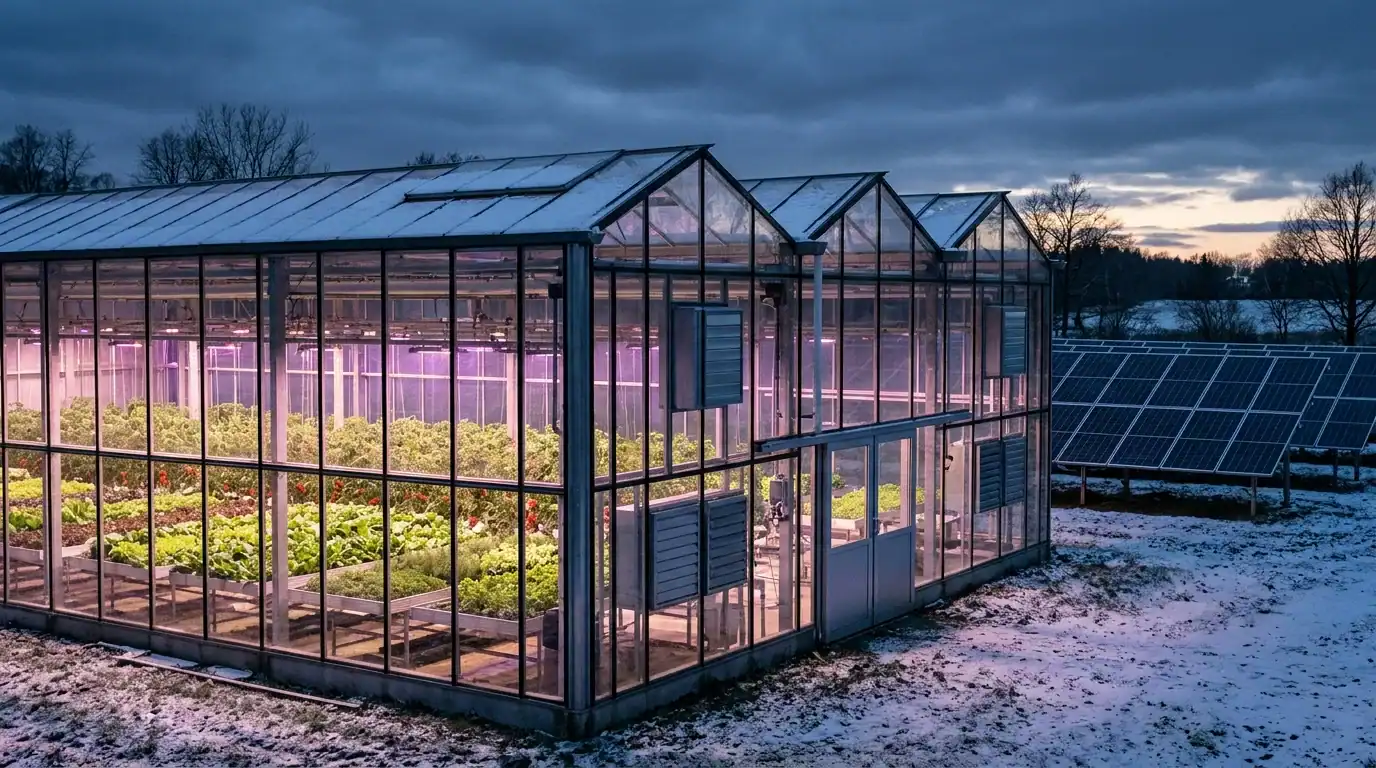
A heated greenhouse spends $4 to $9 per square foot per year on energy — more than any other building on the farm, under the largest unshaded roof on the property. Here is how to size solar for greenhouse production, and why the winter question decides whether the project works at all.
The Problem
Greenhouse energy economics are brutal and backwards at the same time.
Brutal, because the loads are enormous and simultaneous: heating (the dominant cost, 60–80% of the energy budget), supplemental lighting for winter production, ventilation and circulation fans, irrigation pumps, and CO₂ systems. A 30×96 ft heated greenhouse in Zone 5 burns 12,000–12,000–26,000 per year in propane or electricity.
Backwards, because the load peaks exactly when solar produces least. December brings your highest heating demand, your longest lighting hours, and 40–50% less solar production than June. A naive annual-kWh sizing — the kind most installers will happily sell you — produces a system that exports a fortune in July and leaves you buying peak-price power in January.
The greenhouse is the farm building where the load-versus-production mismatch matters most. Solve that mismatch, and solar works. Ignore it, and you own an expensive July generator.
The Greenhouse Load, Dissected
| Load | Share of annual energy | Timing | Can it shift? |
|---|---|---|---|
| Heating (propane or electric) | 60–80% | Night-weighted, winter-peaked | Yes — thermal storage |
| Supplemental lighting (LED) | 10–20% | 4–6 hr morning + evening blocks, winter | Partially |
| Ventilation + circulation fans | 8–15% | Afternoon, summer-peaked | No |
| Irrigation + fertigation pumps | 2–5% | Daytime | Yes |
| Controls, motors, misc. | 2–5% | Flat | No |
Note the one summer-peaked load — ventilation — aligns perfectly with solar. The winter loads do not. That is the whole design problem, stated in one table.
The Sizing Method
Step 1 — Electrify the heat first, or the solar math never closes. If you heat with propane, your largest load never touches your electric bill. A cold-climate heat pump delivers 2.5–3.5 BTU per BTU of electricity in (covered in detail in our heat pump guide) and converts your heating bill into an electric load solar can actually serve. This single conversion is what makes greenhouse solar viable.
Step 2 — Size to the shoulder seasons, not the year. Pull monthly kWh (post-electrification). Size the array to cover roughly the March and October consumption. You will overproduce in summer — that surplus is worth your export rate, accept it — and underproduce in deep winter, which Step 3 handles.
Step 3 — Move winter heat into the ground or the water, not the battery. Storing December heating energy in lithium is financial suicide: the capacity would be cycled 60–90 times per year and never pay back. Instead, store heat: a 1,000–2,500 gallon insulated water buffer, or a climate-battery system that banks daytime heat in the soil under the greenhouse. Water stores a kWh of heat for roughly 1/20th the cost of storing a kWh in batteries.
Step 4 — Schedule lighting to the solar window where crops allow. Many crops tolerate lighting anytime within their photoperiod. Moving a 4-hour lighting block from 4–8 AM to 10 AM–2 PM self-consumes production directly and can cut the required battery capacity to zero for the lighting load.
The Numbers: 30×96 ft Greenhouse, Zone 5, Worked Example
| Parameter | Value |
|---|---|
| Annual propane heating cost (before) | $18,500 |
| Heat pump conversion (COP 2.8 avg.) | ~$7,900/yr electricity equivalent |
| Post-conversion annual electric load (all uses) | 38,000 kWh |
| Blended electric rate | $0.15/kWh |
| Array sized to shoulder months | 15 kW |
| Installed cost (2026) | 2.10–2.50/W → $31,500–$37,500 |
| After 30% ITC + 50% REAP (stacked) | ~$11,000–$13,000 |
| Thermal buffer tank (1,500 gal, installed) | $6,000–$9,000 |
| Annual savings vs. propane status quo | ~$12,000–$14,000 |
| Simple payback (solar + heat pump + buffer) | 3.5–5 years |
Without REAP the payback stretches to 6–8 years — still ahead of propane, which has never once sent a dividend check.
Expert Tips
1. The greenhouse roof itself is usually wrong for panels. Glass and poly roofs are not structural mounting surfaces, and shading the crop defeats the purpose. Ground-mount or an adjacent barn roof is almost always the right answer — keep the glass for the sunlight.
2. Energy curtains pay back before panels do. A retractable thermal screen cuts nighttime heat loss 30–45% for 3–3–5 per square foot. Every dollar of conservation removes $3–4 of required solar and heating capacity. Curtains first, generation second.
3. LEDs only — and check the efficacy spec. Modern horticultural LEDs deliver 2.5–3.5 µmol/J; older HPS fixtures deliver ~1.7. If you are still running HPS, the lighting retrofit alone cuts the lighting load 40–50% and shrinks the array you need.
4. Do not battery-size for heating. Ever. A battery sized to carry a December heating night would cost more than the heat pump, the array, and the greenhouse combined. Batteries are for fans, controls, and lighting continuity — 10–20 kWh, not 200.
5. Ventilation is your free solar alignment. Summer ventilation peaks land directly on peak production hours. A greenhouse that is 80% self-consuming in July is common; design your rate structure and net metering around that fact.
6. Check REAP eligibility carefully. Greenhouses qualify as agricultural operations for REAP when they produce crops — but energy audits must document the baseline rigorously. Mixed-use structures (retail garden center + production) may be only partially eligible.
Conclusion
Greenhouse solar works when you solve the winter mismatch with the right storage medium: electrify the heat with a heat pump, store heat as hot water or warm soil rather than in lithium, size the array to the shoulder months, and move lighting into the solar window. Do those four things and the most energy-hungry building on the farm becomes one of the best solar investments you own.
Frequently Asked Questions
Q: Can solar panels power a greenhouse in winter?
A: Not alone — December production runs 40–50% below June while heating demand peaks. The working design pairs a shoulder-season-sized array with a heat pump (which triples the value of every winter kWh) and thermal storage (water buffer or soil climate battery) that banks daytime heat for the night. Batteries cover fans and controls, never space heating. Sized this way, solar covers 60–75% of annual greenhouse energy in Zone 5.
Q: Is it better to put panels on the greenhouse roof or on the ground?
A: Ground-mount, almost always. Greenhouse glazing is not a structural mounting surface, every panel shadow costs you crop light, and roof penetrations risk the thermal envelope. A ground array beside the structure — or an adjacent barn roof — gives you full production without touching the growing environment. The exception is purpose-built PV greenhouses with semi-transparent panels, which remain a niche with real yield trade-offs.
Q: What is the biggest greenhouse energy mistake?
A: Sizing solar to the annual kWh total. That produces a system that exports heavily in summer and leaves you buying peak-price electricity all winter. The second-biggest is keeping propane heat and trying to solar-power the rest — your largest load stays invisible to the array. Electrify the heat, size to the shoulder months, store heat thermally, and the economics close.
Related Articles
- Solar Heat Pump for Greenhouses and Barns: The 3-Ton System That Cuts Propane by 70% — The heating electrification that makes greenhouse solar viable.
- Solar Compost Heat Recovery: Warm Your Greenhouse Water with Decomposing Manure — A biological complement to thermal storage for winter heat.
- Farm Solar Battery Sizing: The 2026 Complete Guide — Where batteries belong in a greenhouse design (fans and controls), and where they do not (heating).
© 2026 Farm Solar Guide. All data sourced from ASAE standards, USDA energy audit data, extension service greenhouse energy budgets, and documented US greenhouse operations. Last verified: November 2, 2026