
Written by Dr. Robert Kowalski — Ph.D. in Agricultural and Biological Engineering from Penn State University, with 18 years of experience in on-farm water systems and solar pumping retrofits. He has converted dozens of AC well pumps to solar power across the Midwest and Northeast. He is a licensed Professional Engineer and a member of the American Society of Agricultural and Biological Engineers.
Your 240V well pump works fine, and it is sitting 150 feet down a hole that costs $400 in labor to open. The good news: in most cases you do not pull it. You keep the pump, add an inverter, and size for one number that decides everything — the startup surge. Here is when the retrofit wins, when replacement wins, and the math for both.
The Problem
Every farm with a working well pump faces the same fork when going solar:
- Path A — Retrofit: keep the existing AC pump, power it from a solar array through an inverter (grid-tied, off-grid hybrid, or a dedicated pump inverter with VFD).
- Path B — Replace: pull the AC pump, drop in a purpose-built DC solar pump with its own controller.
Installer quotes often push Path B — more hardware, more labor, more margin. But pulling a healthy pump to replace it with a smaller DC unit is frequently 2,000–2,000–4,000 spent solving a problem you did not have. The honest answer depends on three numbers: the pump’s horsepower, its startup surge, and your well’s depth.
The Surge Is the Whole Question
An AC pump motor draws 2–4× its running watts for a fraction of a second at startup. That surge is why retrofits fail when sized casually:
| Pump size | Running load | Startup surge | Inverter needed (continuous/surge) |
|---|---|---|---|
| 1/2 HP, 240V | 550–750W | 1,800–2,800W | 2 kW / 4+ kW |
| 1 HP, 240V | 900–1,200W | 3,000–4,500W | 3 kW / 6+ kW |
| 1.5 HP, 240V | 1,400–1,800W | 4,500–6,500W | 4 kW / 8+ kW |
| 2 HP, 240V | 1,800–2,400W | 6,000–9,000W | 5 kW / 10+ kW |
Two devices shrink every row. A soft starter (200–200–400) cuts the surge 50–70%, often dropping you a full inverter size. A VFD (variable frequency drive) or a dedicated solar pump inverter ramps the motor up over 2–3 seconds, eliminating the surge almost entirely — and it can run the pump slower in weak sun instead of not at all. In retrofit design, the VFD is the single most valuable component in the system.
Retrofit or Replace? The Decision Table
| Your situation | Verdict |
|---|---|
| Pump is under 8 years old, healthy, correctly sized | Retrofit — keep it |
| Pump is 1 HP or smaller, shallow-to-mid well | Retrofit — surge is manageable |
| Grid power exists at the well; goal is bill reduction | Retrofit, grid-tied — simplest and cheapest |
| Pump is 15+ years old or already struggling | Replace — do not solar-power a dying pump |
| Pump is badly oversized for the well (cycles constantly) | Replace — right-size once, in DC |
| Deep well (300+ ft) with low daily volume | Replace — DC pumps are more efficient per watt at high head |
| No grid, want simplest off-grid system | Either — DC is simpler; retrofit keeps your capacity |
The Numbers: Retrofit vs. Replace, Same Well
Scenario: 1 HP AC pump, 150 ft water level, 1,200 gallons/day, no grid at the well, 5 peak sun hours.
The retrofit wins on cost and capacity; the DC replacement wins on efficiency and simplicity. For a working 1 HP pump, the retrofit typically saves 1,000–1,000–1,500 upfront and keeps full pumping capacity — the DC path pays off mainly when the old pump is near end of life anyway.
The Retrofit Recipe (Off-Grid, No Batteries)
- Array: size for power hours, not daily energy — same logic as our 1 HP panel guide. A 1 HP retrofit typically wants 2.5–3.5 kW.
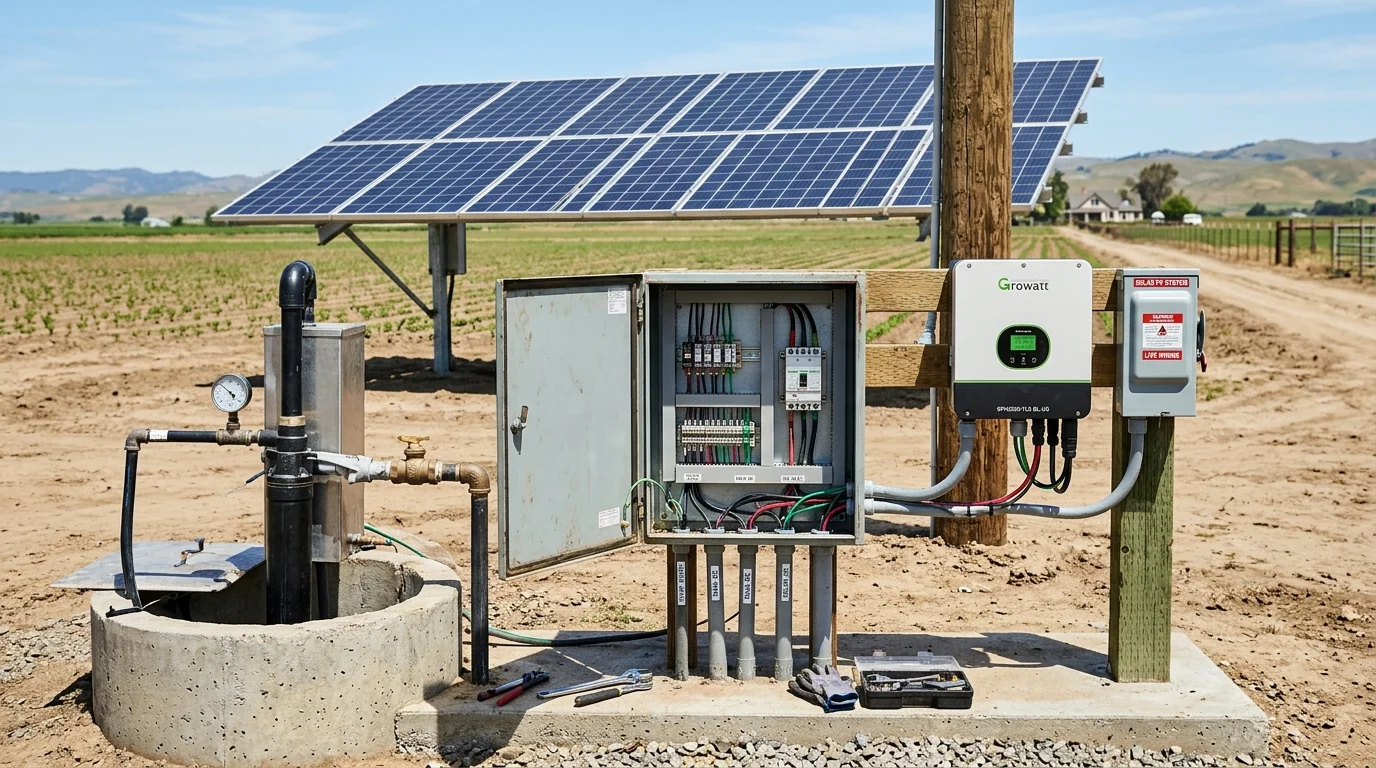
- Solar pump inverter / VFD: converts DC to 240V AC, ramps the motor, and accepts tank-full float switches. This is the component that makes direct-drive AC retrofitting practical.
- Water storage: elevated or oversized tank, exactly as with DC systems. Store water, not electrons.
- Float switch + pressure logic: pump runs when the sun shines and the tank needs it. Automation is two float switches and an afternoon.
- Surge check before buying anything: locked-rotor amps × volts = your surge; the inverter’s surge rating must exceed it, or add a soft starter.
Expert Tips
1. Read the pump’s nameplate before any quote. HP, volts, amps, and (on many) locked-rotor amps. A photo of the nameplate sent to a competent supplier gets you a real answer in one email.
2. Three-phase is a retrofit gift. If your pump is 3-phase (common on 2+ HP farm pumps), a VFD retrofit is even smoother — VFDs and 3-phase motors are made for each other.
3. Do not run a submersible motor slower than its cooling minimum. VFDs enable slow running, but submersible motors rely on water flow past the motor for cooling — most specify a minimum speed (often 30–45 Hz equivalent). The pump inverter’s minimum-frequency setting is not optional.
4. Check the drop cable while you keep the pump. A 15-year-old pump can stay; 15-year-old undersized splices should not. If the well is ever opened, the cable goes new.
5. Grid-tied retrofit beats off-grid when the grid exists. If the well already has utility power, a simple grid-tied array with net metering is cheaper than any off-grid configuration — the grid is your surge capacity and your “battery.”
6. Size the inverter for the pump, the array for the water. These are separate calculations done by different rules; confusing them is the most common DIY retrofit error.
Conclusion
A healthy AC well pump is an asset, not an obstacle. For pumps under 1.5–2 HP in decent condition, retrofitting — array plus a solar pump inverter or VFD — is cheaper, keeps your full capacity, and avoids pulling the well. Replace with DC when the pump is dying, badly oversized, or the well is deep and the demand small. Either way, the surge math comes first: that one number decides whether the system works on day one or trips on day one.
Frequently Asked Questions
Q: Can I run my existing 220V well pump on solar panels?
A: Yes — you keep the pump and power it through a solar pump inverter or VFD that converts panel DC to 220/240V AC. The critical specification is surge capacity: a 1 HP pump that runs at ~1,000W can pull 3,000–4,500W at startup, so the inverter must cover that (or a soft starter/VFD must tame it). A typical off-grid 1 HP retrofit uses 6–8 panels (2.5–3.5 kW) plus water tank storage instead of batteries.
Q: Is it cheaper to retrofit an AC pump to solar or buy a DC solar pump?
A: Retrofitting is typically 1,000–1,000–1,500 cheaper when the existing pump is healthy and under 8–10 years old — you skip the pull, the new pump, and the labor. DC replacement wins when the pump is old, oversized, or the well is deep with modest demand, because DC solar pumps are 15–30% more efficient per watt and need smaller arrays. Never solar-power a pump that is already failing.
Q: Do I need batteries to run a well pump on solar?
A: No — and for farm water you should avoid them. The standard design is direct-drive: the pump runs when the sun shines and fills an elevated or oversized storage tank, and the stored water covers nights and cloudy spells. Water storage costs roughly 10–20 times less per usable unit than battery storage. Batteries only enter the picture when you need pressurized water on demand, 24/7, off-grid.
Related Articles
- How Many Solar Panels to Run a 1 HP Well Pump? (The Exact Math, No Salesman) — The sizing calculation this retrofit starts from.
- Solar Pump Runs Slow or Stops? The 7-Cause Troubleshooting Flowchart — Diagnose before you retrofit: is the current pump actually healthy?
- Solar vs Diesel Water Pumping: The Updated 2026 Breakdown at $6/Gallon — The full economics of the pumping decision.
© 2026 Farm Solar Guide. All data sourced from ASAE water system standards, manufacturer pump and inverter specifications, and documented US farm operations. Last verified: November 16, 2026