
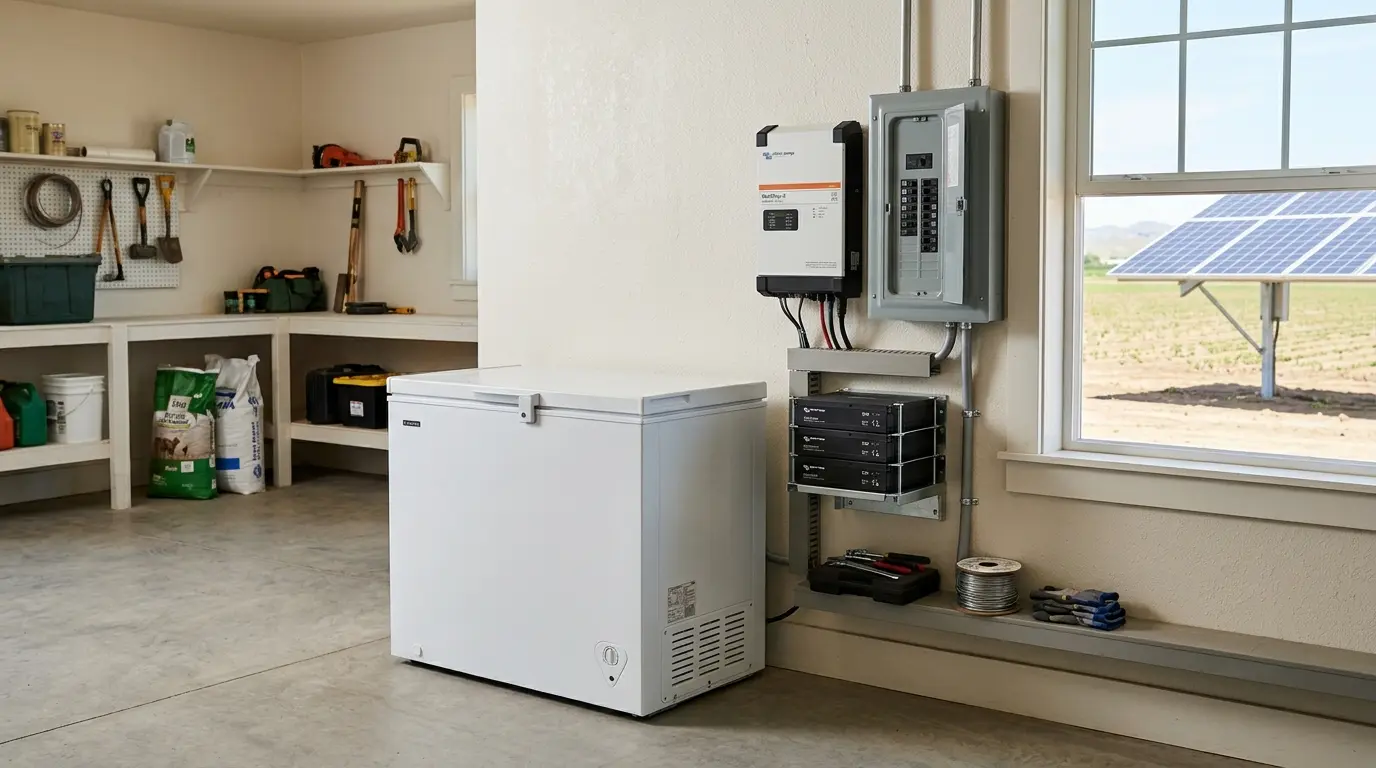
Written by Dr. Robert Kowalski — Ph.D. in Agricultural and Biological Engineering from Penn State University, with 18 years of experience in on-farm electrical systems and off-grid refrigeration. He has sized solar refrigeration systems for farms, cabins, and remote operations across the Midwest and Northeast. He is a licensed Professional Engineer and a member of the American Society of Agricultural and Biological Engineers.
A chest freezer draws only about 100 watts while running — less than a bright light bulb. Yet it routinely forces farmers to buy inverters three times bigger than expected. The reason is the startup surge, and a $30 device often fixes it. Here is the exact math for running a freezer or refrigerator on solar, 24 hours a day, all year.
The Problem
Refrigeration is the gateway load of off-grid solar — the first appliance everyone wants, and the one whose specifications mislead. The nameplate says 100–150W, so a farmer sizes a 150W system and discovers three things the hard way:
- The surge. A compressor drawing 100W running pulls 600–900W for a half-second every time it starts — 15 to 25 times a day. An inverter that cannot cover the surge trips, every time, forever.
- The duty cycle. A freezer runs 30–50% of the day (more in a hot barn, less in a cold room). The nameplate watts times 24 hours overstates consumption; the watts times nothing understates the surge. You need the real daily kWh.
- The night. Unlike pumps or fans, a freezer cannot take the night off. This is the load that actually requires batteries — which is why it deserves careful sizing and nothing else on the same small system.
Real Daily Consumption
| Appliance | Running watts | Startup surge | Duty cycle | Daily kWh (real) |
|---|---|---|---|---|
| Chest freezer, 5 cu ft | 80–100W | 500–700W | 30–40% | 0.6–0.9 kWh |
| Chest freezer, 7 cu ft | 90–120W | 600–900W | 35–45% | 0.8–1.2 kWh |
| Upright freezer, 14 cu ft | 120–180W | 800–1,200W | 40–50% | 1.2–1.8 kWh |
| Standard fridge-freezer, 18 cu ft | 120–200W | 900–1,500W | 40–50% | 1.2–2.0 kWh |
| Efficient 12V DC chest fridge | 45–60W | Minimal (soft-start built in) | 30–40% | 0.4–0.6 kWh |
Two lines in that table change design decisions. The last row: purpose-built 12V/24V DC compressor fridges use half the energy and have no meaningful surge — expensive to buy (600–600–1,200), cheap to power. And every AC row: a hard-start/soft-start kit (30–30–50 installed on the compressor) tames the surge enough to drop one inverter size class.
The Sizing Math
Step 1 — Daily energy. Take the real daily kWh from your appliance (table above, or measure with a $25 plug-in watt-meter — one week of measurement beats any estimate).
Step 2 — Battery. Battery usable capacity = daily kWh × autonomy days × 1.2. For a 7 cu ft freezer (1 kWh/day) with 2 days of autonomy: 1 × 2 × 1.2 = 2.4 kWh usable → roughly 3 kWh of LiFePO₄ (85% DoD). Refrigeration is the farm load where 2 days of autonomy is the sensible minimum — food does not forgive a cloudy weekend.
Step 3 — Inverter. Continuous rating ≥ 3× running watts; surge rating ≥ the measured surge (or running watts × 3 with a soft-start kit fitted). For a 120W freezer: 600–1,000W pure sine inverter. Pure sine only — modified sine inverters run compressor motors hot and short their lives.
Step 4 — Panels. Array watts = daily kWh ÷ (worst-month sun hours × 0.7). Because refrigeration runs in December, size on winter sun: 1 kWh/day ÷ (3 × 0.7) ≈ 480W of panels — call it 2 × 430W for the freezer alone. Summer gives you margin; winter is the design month.
The Complete System, Priced
| Component (7 cu ft chest freezer, off-grid) |
Cost (2026) |
|---|---|
| 2 × 430W panels | 460–560 |
| 3 kWh LiFePO₄ battery | 700–1,000 |
| 1,000W pure sine inverter (surge 2,000W) | 200–350 |
| 40A MPPT charge controller | 120–220 |
| Soft-start kit for the compressor | 30–50 |
| Mounting, wiring, fuses | 150–250 |
| Total | 1,660–2,430 |
Add a second freezer or a fridge and the battery and array scale almost linearly; the inverter usually does not — one hard lesson: start only one compressor at a time. Two compressors starting simultaneously is the classic small-system trip.
Expert Tips
1. Chest beats upright, every time. Chest freezers lose far less cold per opening and run 20–30% less energy. For solar, form factor is an energy decision.
2. Location is a sizing input. A freezer in a 100°F barn works nearly twice as hard as one in a 60°F basement. Moving the appliance can be worth more than a third panel.
3. Full freezers coast longer. Thermal mass again: a full chest freezer holds safe temperatures 24–48 hours unplugged; an empty one, under 12. Water jugs in empty space are free batteries.
4. A freezer alarm is mandatory equipment. A $25 temperature alarm turns an inverter failure into an inconvenience instead of a $400 meat loss. Cheap insurance on the load that cannot forgive.
5. DC fridges win below ~2 kWh/day of total cold load. Above that, AC appliances plus a good inverter win on purchase price. The crossover is real — run both totals before falling in love with either.
6. Do not share the small system. The barn freezer circuit should not also run the welder “just this once.” One surge stacking on another is how inverters die and freezers thaw.
Conclusion
A solar freezer is a solved problem: 1 kWh a day, 3 kWh of battery, 2 panels, a 1,000W pure sine inverter, and a $30 soft-start kit so the surge stops dictating terms. Size on December sun, give it 2 days of autonomy, fit the alarm — and the cheapest, most reliable load in off-grid living will run untouched for a decade.
Frequently Asked Questions
Q: Can a solar panel run a freezer?
A: Yes — a 7 cu ft chest freezer uses 0.8–1.2 kWh per day, which two 430W panels generate even in winter across most of the US. But panels alone cannot do it: the freezer runs at night and its compressor pulls a 600–900W startup surge, so you also need roughly 3 kWh of battery and a 1,000W pure sine inverter. A $30 soft-start kit on the compressor often halves the inverter requirement.
Q: How many batteries do I need to run a refrigerator on solar?
A: For a standard 18 cu ft fridge-freezer (1.2–2 kWh/day), plan on 4–5 kWh of LiFePO₄ for two days of autonomy — roughly two 12V 200Ah batteries. An efficient 12V DC chest fridge needs less than half that. The sizing rule: daily kWh × 2 days × 1.2, divided by your battery’s usable depth of discharge. Refrigeration is the one small load where battery margin is not optional — food does not wait for the sun.
Q: Is a 12V DC fridge better than a regular fridge on solar?
A: For small loads, yes: purpose-built DC compressor fridges use 40–60W, have no meaningful startup surge, skip inverter losses, and run on 0.4–0.6 kWh per day — half the energy of an AC equivalent. The catch is purchase price (600–600–1,200). Below about 2 kWh/day of total refrigeration, DC wins on system cost; above that, standard AC appliances plus a good inverter usually win on purchase price.
Related Articles
- Solar-Powered Cold Storage and Walk-In Coolers: Sizing for the Load That Cannot Fail — The big sibling: walk-in coolers, same surge physics, bigger stakes.
- Farm Solar Battery Sizing: The 2026 Complete Guide — The four-step battery method used in this article.
- How to Replace Your Solar Charge Controller: MPPT vs PWM Upgrade Guide — The small component that decides how much of your panel power actually reaches the battery.
© 2026 Farm Solar Guide. All data sourced from manufacturer appliance and battery specifications, and documented US farm operations. Last verified: November 17, 2026