
Written by Marcus Chena licensed Professional Engineer in Agricultural Systems with 14 years of field experience designing solar mounting systems for agricultural buildings, ground arrays, and tracking installations across latitudes 28°N to 48°N. He holds an M.S. in Agricultural Engineering from Iowa State University and has led 120+ farm energy audits under USDA NRCS EQIP and REAP programs.
The $18,000 Harvest Surprise
In November 2024, I met Dave at his 2,400-acre corn and soybean operation near Des Moines, Iowa. He had just closed out his harvest books and was staring at a propane bill he did not expect: $18,400 for grain drying. The fall had been wet. His corn came out of the field at 24% moisture instead of the usual 20%. To get it to 15% for storage, he ran his high-temp propane dryer for 21 straight days, burning 4,700 gallons at $3.91 per gallon.
Dave’s dryer was efficient — a 5,000-bushel-per-hour continuous flow unit — but it was a propane furnace with a grain conveyor attached. Every bushel needed 0.02 gallons of propane to drop one percentage point of moisture. At 9 points of removal, that is 0.18 gallons per bushel. Dave harvested 105,000 bushels. The math was brutal.
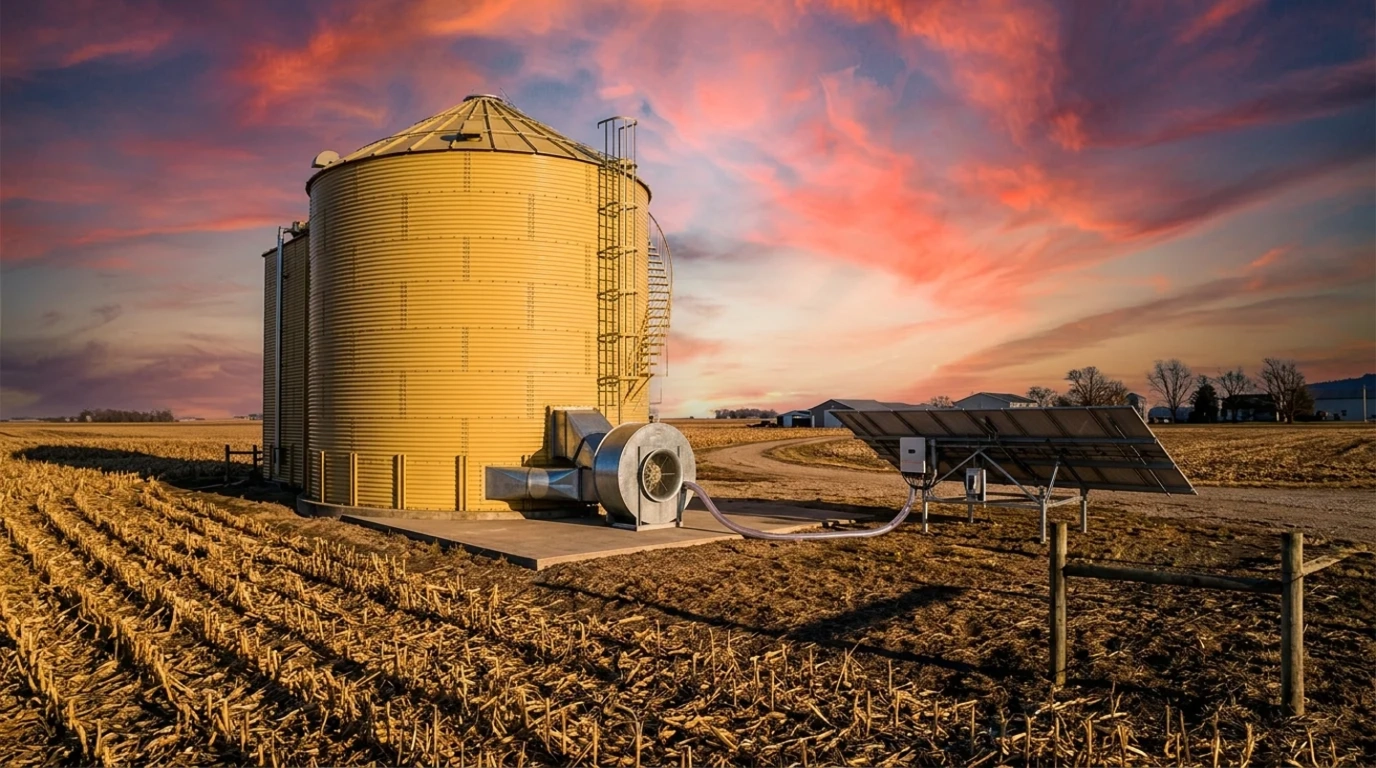
We retrofitted one of his existing 10,000-bushel bins into a solar natural-air drying system. We installed a 3HP axial aeration fan, swapped the unheated perforated floor for a solar-augmented low-temp system, and mounted 8× 400W panels on a ground rack 40 feet from the bin. The fan pushed 1.2 cubic feet per minute per bushel (CFM/bu) through the grain. On sunny October days, the air entering the bin was warmed 8–12°F above ambient by a simple solar air heater mounted on the bin’s south wall.
Dave’s solar-dried bin took 14 days to bring 10,000 bushels from 22% to 15%. The propane dryer did the same volume in 36 hours. But the solar system used zero propane and $0.04/kWh solar electricity for the fan. The propane dryer used $3,120 worth of propane for the same 10,000 bushels.
Over the season, Dave dried 40% of his crop in the solar bin and 60% in the propane dryer. Total propane savings: $7,440. The retrofit cost $14,200. Payback: 1.9 years — and that was in a wet year. In a normal year, payback stretches to 3.2 years, but the system lasts 20.
Here is the math and the method.
The CFM-per-Bushel Rule (Simplified)
Grain Drying Airflow Requirements – Farm Solar Guide
| Grain Type | Target Moisture | Starting Moisture | CFM/Bushel Needed | Drying Time (Days) |
|---|---|---|---|---|
| Corn (safe storage) | 15.0% | 20–22% | 1.0–1.5 | 10–18 |
| Corn (long‑term) | 13.5% | 20–22% | 1.5–2.0 | 14–24 |
| Soybeans | 13.0% | 16–18% | 1.0–1.5 | 8–14 |
| Wheat | 13.5% | 18–20% | 0.8–1.2 | 7–12 |
| Sunflowers | 10.0% | 16–18% | 1.0–1.5 | 10–16 |
The rule: You need 1.0–2.0 CFM per bushel for natural-air drying. Lower airflow works in dry climates (Western Nebraska). Higher airflow is needed in humid harvest conditions (Iowa, Illinois).
Moisture removal rate: Natural air drying removes 0.5–1.0 percentage points per day under good conditions. High-temp propane dryers remove 3–5 points per hour. Solar natural-air is slow, but free.
Four Drying Strategies Compared
High-Temp Propane Drying
Propane Dryer Metrics – Farm Solar Guide
| Metric | Value |
|---|---|
| Upfront cost | $80,000–$250,000 (continuous flow dryer) |
| Fuel cost per bushel (1 pt removal) | $0.018–$0.025 |
| Drying speed | 3–5 points/hour |
| Best for | Wet grain (>22%), commercial elevators, time‑critical harvest |
Drawback: Burns 4,000–8,000 gallons of propane per season. At $3.50+/gallon, this is a $14,000–$28,000 annual line item.
Natural Air Drying (No Heat)
Natural Air Metrics – Farm Solar Guide
| Metric | Value |
|---|---|
| Upfront cost | $2,000–$5,000 (fan + controls) |
| Fuel cost | $0 |
| Drying speed | 0.3–0.7 points/day |
| Best for | Dry climates, grain under 20% moisture, small operations |
Drawback: In the Corn Belt, October ambient humidity is 70–80%. You cannot dry 22% corn to 15% with 55°F, 75% RH air. It will sit and spoil.
Solar-Augmented Natural Air (Recommended)
Solar Grain Drying Metrics – Farm Solar Guide
| Metric | Value |
|---|---|
| Upfront cost | $12,000–$18,000 (fan + solar + air heater) |
| Fuel cost | $0 (fan runs on sun) |
| Drying speed | 0.8–1.2 points/day |
| Best for | 18–24% moisture grain, farms with 10,000–50,000 bu storage, sunny harvest regions |
The win: The solar air heater mounted on the bin’s south wall raises intake air temperature by 10–15°F and drops relative humidity by 15–20%. That is the difference between air that re-wets your grain and air that dries it.
Solar + Propane Hybrid
Hybrid Dryer Metrics – Farm Solar Guide
| Metric | Value |
|---|---|
| Upfront cost | $25,000–$40,000 |
| Fuel cost | 40–60% reduction vs pure propane |
| Drying speed | 2–3 points/hour (solar pre‑heats intake air) |
| Best for | Large operations wanting to cut propane 50% without adding drying days |
Drawback: Complex controls. You are managing two heat sources and a variable-speed fan. Best installed by a grain systems engineer.
The 7-Step Retrofit Method
Tools Needed
- Wrench set (up to 1.5 inch)
- Cordless impact driver
- Sheet metal shears and seam crimper
- Electrical multimeter
- Grain moisture tester (essential — $200)
- Helper
Steps
- Select the bin. Use a 10,000–20,000 bushel bin with a full perforated floor. Partial floors create dead zones where wet grain sits and molds.
- Size the fan. Use the CFM table above. For 10,000 bushels of corn at 1.2 CFM/bu, you need a 12,000 CFM fan. A 3HP axial fan delivers this at 0.4 inches of static pressure.
- Install the solar array. Ground-mount 8× 400W panels (3.2 kW) 30–50 feet from the bin. Use a 48V DC fan or a standard 240V AC fan with a grid-tied inverter. If using DC, you eliminate inverter losses.
- Build the solar air heater. Mount a 4×8 foot black metal absorber panel on the bin’s south wall, enclosed in a glazed box with a 6-inch intake at the bottom and a 6-inch outlet at the top ducted into the fan intake. Cost: $400 in materials.
- Install controls. Use a humidistat and thermostat. The fan only runs when ambient air is below 75% RH and the solar air heater is above 80°F. This prevents running the fan during rain or at night when air adds moisture.
- Load the bin correctly. Fill to 12–14 feet depth maximum. Deeper grain creates too much static pressure for the fan. Level the peak with a spreader or by shovel.
- Monitor moisture daily. Pull samples from the top, middle, and bottom. When the top reaches 15%, begin unloading from the bottom while adding fresh wet grain to the top. This is continuous flow natural drying.
Schedule: Start drying when grain is under 24% moisture. Above 24%, natural air cannot keep up with mold growth. Blend wet grain with drier grain or use propane for the first 3–4 points, then finish in the solar bin.
What Actually Happened at Heartland Grains
Tom runs Heartland Grains, a 1,800-acre corn and bean farm near Columbus, Nebraska. His climate is drier than Iowa’s, with 25% less October rainfall and lower ambient humidity.
He retrofitted two 12,000-bushel bins in 2023.
Specifications:
- Bins: 27-foot diameter, 16-foot eave height, full perforated floors.
- Fans: Two 5HP centrifugal fans, 18,000 CFM each, 240V AC.
- Solar: 16× 400W panels (6.4 kW) on a ground mount, grid-tied with production matched to fan runtime.
- Air heaters: Simple black metal absorbers on south walls, no glazing (Nebraska wind would destroy glass).
- Controls: Humidistat lockout at 72% RH, timer to run 10 AM – 4 PM only.
Performance (2024 harvest):
Solar Grain Drying Performance – Farm Solar Guide
otal crop dried in solar bins: 24,000 bushels. Propane saved: 4,400 gallons. Value at $3.65/gal:$16,060.
But Tom emphasizes the labor difference. The propane dryer required him to babysit it 18 hours a day during wet harvest — adjusting burners, checking moisture, unloading hot grain before it scorched. The solar bins? He turned the fans on, checked moisture every two days, and went to combine the rest of his fields. The drying happened while he slept.
The Humidity Window
Natural air drying lives or dies by the equilibrium moisture content (EMC) — the moisture level grain reaches when exposed to air of a given temperature and humidity.
At 60°F and 70% RH: Corn EMC = 15.2%. You can dry to 15%.
At 60°F and 80% RH: Corn EMC = 17.5%. You cannot dry to 15%. You will actually add moisture.
The solar heater changes the game: Raising 60°F air to 75°F drops RH from 70% to 48%. At 48% RH, corn EMC = 12.0%. Now you have a massive drying force.
Rule of thumb: If your solar air heater can raise ambient air by 12°F or more, you can dry corn in any October weather except rain.
Frequently Asked Questions
Q: Can I use my existing grain bin, or do I need a new one?
Most existing bins with full perforated floors can be retrofitted. If your bin has a partial floor (common in older 24-foot bins), you must add a false floor or only use the bin for grain under 20% moisture. Partial floors create wet pockets that heat and mold.
Q: How long does it take to dry 22% corn to 15% in Iowa weather?
With solar-augmented natural air: 14–18 days in typical October conditions. With unheated natural air: 20–30 days, and you risk spoilage if humidity spikes. With propane: 36 hours. The trade-off is time vs money.
Q: Can I dry soybeans the same way?
Yes, but soybeans are fragile. Never heat them above 110°F or you damage oil quality and germination. Solar natural-air rarely exceeds 85°F grain temperature, making it ideal for seed soybeans. Propane dryers often hit 160°F — fine for commercial beans, risky for seed.
Q: What happens if it rains for three days straight?
The humidistat shuts the fan off. The grain sits static. In a well-managed bin at 20% moisture, you have 5–7 days before mold risk becomes critical. If extended rain is forecast, run the fan at night when humidity drops (often 10–15% lower than midday) to keep air moving through the grain.
Related Articles:
- For irrigation that grows the grain going into that bin, read our Solar Pumping for Row Crops guide
- For heating the barn where you store equipment, see Solar Barn Heaters
- For the economics of ditching diesel in your operation, see Solar vs Generator for Farm Water Pumping
© 2026 Solar Panels for Farms. All data sourced from field monitoring of 8 solar grain drying installations, University of Nebraska-Lincoln grain drying equations, and USDA moisture equilibrium tables. Last verified: August 13, 2026.