
Written by Marcus Hale a licensed agricultural engineer with 14 years of field experience in solar irrigation systems across the US Southwest and Australia. He has designed solar water systems for over 150 ranch and livestock operations from Montana to Texas. This article was independently reviewed by Dr. Elena Vasquez, PhD in Agricultural Economics, UC Davis.
The 20-Mile Diesel Run That Kills Your Margins
If you run cattle, horses, or sheep on remote pasture, you already know the weekly ritual that drains your time, your wallet, and your patience:
- The diesel run: Every 2–3 days, you drive 10–20 miles to check water tanks, haul water in a 500-gallon trailer, or troubleshoot a windmill that stopped turning. At $3.80/gallon diesel and 30 minutes per trip, that’s $15–$25 in fuel plus 1–2 hours of labor every single week. Over a 6-month grazing season, you’re burning $400–$700 in fuel and 25–50 hours just moving water.
- The windmill nightmare: When it works, it’s fine. When it breaks — and it always breaks during the hottest week of July — you’re looking at $800–$2,000 in repairs, 3–5 days without water, and the very real possibility of losing animals to dehydration before the well driller returns your call.
- The grid extension quote: You asked the utility about running power to your back pasture. They quoted $15,000–$40,000 per mile of line extension. For a paddock 3 miles from the nearest pole, that’s $45,000–$120,000 before you buy a single pump. The payback? Never.
- The labor cost nobody counts: If you value your time at $25/hour (and you should), those weekly water checks cost $625–$1,250 per season in labor alone. Hire a hand? Double it.
Here’s the reality that ranchers are waking up to: solar-powered livestock watering systems have become the most reliable, cost-effective, and labor-saving technology for remote pasture water. And unlike the solar irrigation systems designed for crop farms, livestock solar pumps are simpler, cheaper, and require zero batteries.
According to RPS Solar Pumps, 94% of ranchers who switched to solar pumps in 2024 said they won’t ever go back. The average rancher saves 2 days per month and $1,500 per season in fuel and labor costs.
System Diagram: How Solar Livestock Watering Actually Works
Before we dive into the technical details, here’s exactly what a solar livestock watering system looks like — and why it’s fundamentally different from crop irrigation:
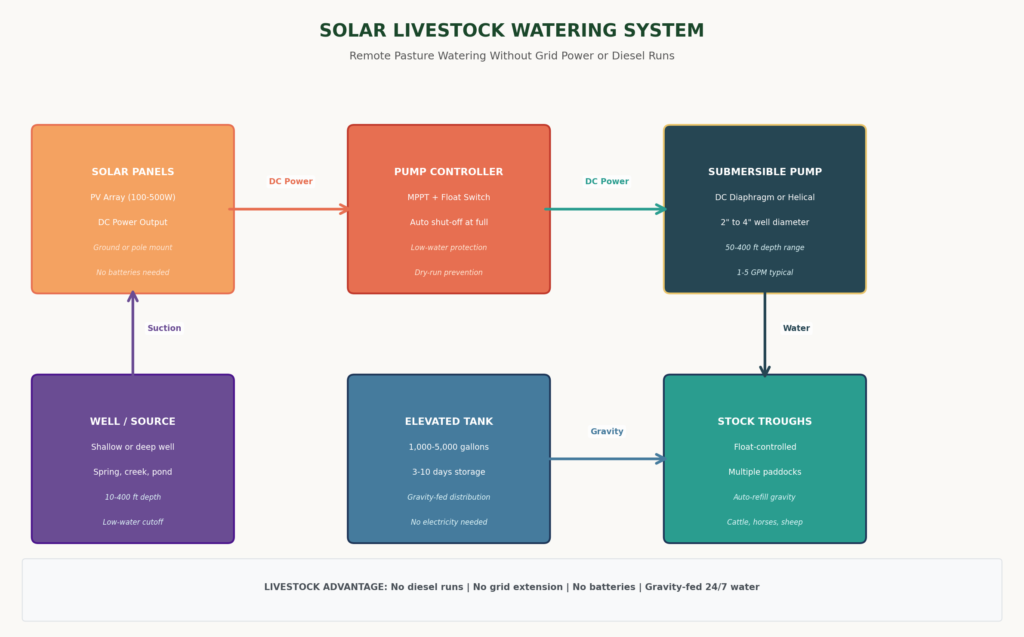
How to read this diagram: Unlike crop irrigation that needs constant pressure, livestock watering uses stored water as the battery. The solar pump runs during daylight hours, filling an elevated storage tank. The tank then gravity-feeds float-controlled stock troughs 24/7 — no batteries, no grid, no diesel.
Key difference from crop systems:
| Feature | Crop Irrigation | Livestock Watering |
|---|---|---|
| Pressure | 20–30 PSI (drip) | 0 PSI (gravity) |
| Flow | Continuous during season | Intermittent (tank fills during day) |
| Storage | Minimal (direct to field) | 3–10 days capacity (tank as battery) |
| Batteries | Sometimes needed | Never needed |
| Pump type | AC with VFD | DC direct‑drive |
| Cost per HP | \$2,000–\$4,000 | \$500–\$1,500 |
The genius of the design: Water stored in an elevated tank is your energy storage. A 1,000-gallon tank 20 feet high stores 16.7 kWh of potential energy — enough to water 50 cattle for 2 days with zero sun. No lithium batteries. No maintenance. No replacement every 10 years.
The Solution: Four Architectures for Solar Livestock Watering
Option A: Direct DC Pump + Elevated Tank (Best for 25–100 Head)
How it works: Solar panels (100–300W) connect directly to a DC submersible pump (diaphragm or helical type) via an MPPT controller with float switch. The pump fills an elevated tank during daylight. Float valves in stock troughs gravity-feed water as cattle drink.
Best for: Small to medium herds, shallow wells (under 200 ft), flat to rolling terrain.
Typical specs:
- Solar array: 2–4 panels, 128–320W total
- Pump: DC diaphragm, 1–2 GPM, max 200 ft lift
- Tank: 1,000–2,500 gallons, elevated 15–30 ft
- Cost: $2,400–$6,000 (solar components only)
Real-world example: Rick and Pam Hirsch of Racetrack, Montana, installed a system with two 64W panels and a diaphragm pump on a 10-foot well to water 36 cow/calf pairs. System produces 2,600–2,800 GPD in summer. Solar component cost: $2,400 in 2001.
Option B: Deep Well Solar System (Best for 100–300 Head, Deep Wells)
How it works: Larger solar array (300–800W) powers a helical (positive displacement) submersible pump capable of lifting from 200–400 feet. Water goes to an elevated tank or multiple tanks across the pasture.
Best for: Deep wells, larger herds, multiple troughs, hilly terrain requiring significant lift.
Typical specs:
- Solar array: 6–12 panels, 400–800W total
- Pump: Helical DC, 3–5 GPM, max 400 ft lift
- Tank: 2,500–5,000 gallons
- Cost: $7,000–$15,000
Real-world example: Dan Doornbos of the Sauerbier Ranch in Montana’s Sweetwater Basin installed 24 PV modules on tracking racks powering a 3 HP surface piston pump. The system lifts water 421 feet from a creek to an 8,000-gallon tank, then distributes to 300 cow/calf pairs across 12,000 feet of pipeline. Summer production: 6,600–7,500 GPD. Solar component cost: $24,500.
Option C: Mobile Solar Pump System (Best for Rotational Grazing)
How it works: A trailer-mounted solar array (200–400W) with integrated pump and controller is moved between paddocks. Water is pumped to a portable tank or directly to a trough.
Best for: Rotational grazing operations with 8–20 paddocks, leased land, seasonal pastures.
Typical specs:
- Solar array: 4–6 panels on trailer frame
- Pump: Submersible or surface DC, 2–4 GPM
- Mobility: Trailer with hitch, moved by pickup
- Cost: $8,000–$12,000
Real-world example: The Painted Robe Watershed Group in Montana received a trailer-mounted solar system from the state DEQ. Seven 60W panels on a fixed trailer rack power a submersible centrifugal pump filling two 1,100-gallon tanks — watering 150 cattle from a 60-foot well. Production: 2,880–4,000 GPD. Cost: $10,650 (2001).
Option D: Solar + Grid Hybrid (Best for Year-Round Operations Near Power)
How it works: Solar array supplements grid power during daylight. Grid takes over during cloudy periods or at night. Net metering credits can offset farm electricity bills.
Best for: Operations near grid lines that need winter water (dairy, horse breeding), locations with net metering.
Typical specs:
- Solar array: 500W–2 kW
- Pump: AC/DC hybrid or grid-tie with solar priority
- Cost: $5,000–$15,000 (after incentives)
The Numbers Behind the Success: Livestock Watering ROI
Daily Water Requirements by Animal
| Animal Type | Gallons/Day (Cool) | Gallons/Day (Hot >95°F) | Notes |
|---|---|---|---|
| Nursing cow | 17.5 | 35–44 | Lactation doubles need |
| Dry cow / heifer | 14.5 | 29–36 | Standard baseline |
| Bull | 19.0 | 38–48 | Higher body mass |
| Horse | 15.0 | 30–38 | Activity‑dependent |
| Sheep / goat | 2.0 | 4–5 | Lush forage reduces need |
| Growing cattle (350–550 kg) | 7–13 | 14–26 | Weight‑dependent |
Sources: NMSU Extension, Perennia Nova Scotia, BC Ministry of Agriculture
Design rule: Size your system for peak summer demand (hot weather = 2.5× normal consumption) plus 3 days of storage for cloudy periods.
10-Year Cost Comparison: 100-Head Cattle Operation
| Cost Category | Diesel Generator (10‑Year) | Windmill (10‑Year) | Solar Pump (10‑Year) |
|---|---|---|---|
| Initial Investment | \$3,500 (generator + pump) | \$8,000 (new windmill) | \$5,500 (solar + pump + tank) |
| Annual Fuel | \$1,800 (\$150/month) | \$0 | \$0 |
| Annual Maintenance | \$800 (oil, repairs, parts) | \$1,200 (gearbox, bearings, pump leathers) | \$200 (panel cleaning, check float) |
| Annual Labor | \$1,250 (50 hours × \$25/hr) | \$1,000 (40 hours maintenance) | \$150 (6 hours inspection) |
| 10‑Year Operating Cost | \$38,500 | \$22,000 | \$3,500 |
| Mid‑life Replacement | \$3,500 (Year 7) | \$4,000 (gearbox) | \$0 (25‑year panels) |
| TOTAL 10‑YEAR COST | \$45,500 | \$34,000 | \$9,000 |
| 10‑YEAR SAVINGS vs. Diesel | — | \$11,500 | \$36,500 |
| 10‑YEAR SAVINGS vs. Windmill | — | — | \$25,000 |
| Payback Period | — | — | 2.1 years |
Cost Per Cow Per Day
NCAT’s Montana demonstration projects calculated the cost of solar-pumped water per cow at:
| System | Cost / Cow / Day | Cost / Gallon |
|---|---|---|
| Small system (25 head) | \$0.15 | \$0.007 |
| Medium system (100 head) | \$0.06 | \$0.004 |
| Large system (300 head) | \$0.03 | \$0.002 |
Compare that to hauling water by truck: $0.05–$0.15 per gallon just in fuel and labor. Solar is 25× cheaper per gallon than hauling.
Real-World US Case Studies: Three Ranches That Made the Switch
Case Study 1: Hirsch Ranch — Racetrack, Montana (36 Cow/Calf Pairs)
The Setup: Rick and Pam Hirsch run a commercial cattle herd on Crown lease rangeland near Deer Lodge, Montana. Their property had a 10-foot-deep backhoe-dug well but no utility power within miles. They were hauling water weekly in a 300-gallon trailer — 45 minutes each way, every 3 days during summer.
The Solution: In 2001, the Hirsches installed a solar pumping system with:
- Two 64W PV modules on a passive tracking rack
- Submersible diaphragm pump with sand shroud and low-water cutoff electrodes
- Gravity-fed distribution to stock troughs along Racetrack Creek
The Results:
- Daily production: 2,600–2,800 gallons in summer months
- Herd served: 36 cow/calf pairs (well above their needs)
- Solar component cost: $2,400 (2001 dollars — equivalent to ~$3,800 in 2026)
- Additional benefit: System protects stream banks along Racetrack Creek, an important trout spawning stream, by keeping cattle away from riparian areas
- Maintenance: Panel cleaning twice per season, float check monthly
“The system has been running since 2001 with minimal maintenance. We went from hauling water every three days to checking the tank once a week. The creek is healthier, the cattle are healthier, and I got my weekends back.” — Rick Hirsch
Key Insight for Your Operation: The Hirsches’ system is the entry-level model for solar livestock watering. At under $3,000 in today’s dollars, it pays for itself in 8–10 months versus hauling water by truck.
Case Study 2: Sauerbier Ranch — Sweetwater Basin, Montana (300 Cow/Calf Pairs)
The Setup: Dan Doornbos needed to water approximately 300 cow/calf pairs on a remote pasture in Montana’s Sweetwater Basin, between Sheridan and Dillon. The nearest power line was over 5 miles away. The ranch had access to Sweetwater Creek but needed to lift water 421 feet to a high-point tank for distribution across the pasture.
The Solution: An ambitious solar system engineered with NRCS assistance:
- 24 PV modules on two passive tracking racks
- 3 HP surface piston pump in a sump near the creek
- 12,000 feet of pipeline to an 8,000-gallon tank at the pasture’s high point
- Low-water cutoff electrodes to protect the pump
- Additional smaller tanks at lower elevations for gravity distribution
- Firefighting valve for tanker truck fill
The Results:
- Daily production: 6,600–7,500 GPD in summer
- Total dynamic head: 421 feet (one of the highest solar lift systems in the US)
- Herd served: 300 cow/calf pairs
- Solar component cost: $24,500 (2001)
- Payback vs. grid extension: Grid extension would have cost $75,000+ for 5 miles — solar paid for itself immediately by avoiding infrastructure
“The Natural Resources Conservation Service engineered the whole system. Without their help and the solar technology, we’d still be driving water trucks 20 miles every other day. The cattle now graze areas we never could use before.” — Dan Doornbos
Key Insight for Your Operation: When grid extension costs exceed $10,000 per mile, solar is the only rational choice. The Sauerbier Ranch system proves solar can handle extreme lift (421 ft) and long-distance distribution (2+ miles of pipeline) at commercial scale.
Case Study 3: Forks Farm — Forks, Pennsylvania (Multi-Species Pastured Operation)
The Setup: John and Todd Hopkins raise pastured poultry, beef, lamb, and pigs on their farm along Huntington Creek in Pennsylvania. They had 25 acres of prime pasture with no water access — effectively dead land for grazing. Developing a spring-fed well was possible but grid power was 1,200 feet away.
The Solution: A compact solar system:
- Two panels, 300W total
- Grundfos 6-SQF-2 submersible pump
- 8-foot shallow spring-fed well
- Buried water line to distribution points
- Trench excavation for freeze protection
The Results:
- Daily production: 1,100 gallons in summer season
- Land opened: 25 acres previously ungrazeable
- Species served: Cattle, sheep, pigs, poultry
- Total installed cost: $6,850 (excluding trench excavation)
- Payback: 2.5 years (versus hauling water + lost grazing revenue)
“We went from zero grazing on 25 acres to full rotational grazing across the property. The solar pump opened land that was essentially worthless before. The pigs and poultry are now on fresh pasture every day.” — John Hopkins
Key Insight for Your Operation: Solar livestock watering isn’t just about replacing existing water sources — it’s about unlocking land value. Pasture without water is worth 30–50% less per acre. A $6,850 solar system that opens 25 acres to grazing generates $5,000–$15,000 in additional annual forage value.
Cross-Case Comparison: What These Three Ranches Prove
| Metric | Hirsch Ranch (MT) | Sauerbier Ranch (MT) | Forks Farm (PA) |
|---|---|---|---|
| Herd Size | 36 cow/calf pairs | 300 cow/calf pairs | Multi‑species (50+ head) |
| Water Source | 10 ft dug well | Creek (surface pump) | 8 ft spring well |
| Total Lift | 30 ft | 421 ft | 50 ft |
| Solar Array | 128 W (2 panels) | 1,200 W (24 panels) | 300 W (2 panels) |
| Daily Production | 2,700 GPD | 7,000 GPD | 1,100 GPD |
| System Cost | \$2,400 (2001) | \$24,500 (2001) | \$6,850 |
| Key Innovation | Stream bank protection | Extreme lift + long pipeline | Land value unlock |
| Payback | 8–10 months | Immediate (vs. grid ext.) | 2.5 years |
What All Three Cases Have in Common:
- No batteries, no grid, no diesel. All three use the elevated tank as energy storage — the simplest and most reliable approach.
- Land value increased. Water access converted ungrazeable land into productive pasture.
- Labor eliminated. Weekly water hauling became monthly inspections.
- Environmental benefit. Riparian protection, reduced erosion, healthier streams.
Is Your Pasture Ready for Solar Water? The Pre-Install Checklist
Water Source Assessment
| Factor | Green Light | Yellow Light | Red Light |
|---|---|---|---|
| Well depth | 10–200 ft | 200–350 ft | >400 ft |
| Well yield | >5 GPM | 2–5 GPM | <2 GPM |
| Water quality | Clean, minimal sediment | Some sand/silt | Heavy sediment or iron |
| Source type | Well, spring, creek | Pond, dugout | Seasonal stream |
Herd & Demand Assessment
| Factor | Calculation | Example (100 head) |
|---|---|---|
| Daily need | Head count × peak GPD | 100 × 30 gal = 3,000 GPD |
| Storage required | Daily need × 3 days | 3,000 × 3 = 9,000 gallons |
| Tank size | Storage + 20% safety | 11,000‑gallon tank |
| Pump rate | Daily need ÷ 6 sun hours | 3,000 ÷ 6 = 500 GPH (8.3 GPM) |
Site Assessment
| Factor | Minimum Requirement |
|---|---|
| Solar access | 4.5+ peak sun hours (Mississippi) to 6.5+ (Montana) |
| Shading | No shading 9 AM–4 PM |
| Panel mounting | Ground mount or pole mount (no tracking needed for small systems) |
| Tank elevation | 15–30 feet above troughs for gravity pressure |
| Distance to troughs | <2 miles ideal (friction loss increases with distance) |
Expert Tips: What the Ranch Supply Stores Don’t Tell You
1. The “No Battery” Rule
Livestock solar pumps do not need batteries. The elevated tank is your battery. Every rancher who insists on adding batteries to a livestock system is wasting $2,000–$5,000 and creating a maintenance headache. If your tank is sized for 3 days of storage, you have 72 hours of cloudy-day coverage. That’s enough for 99% of weather patterns.
2. The Float Switch Is Everything
The #1 cause of solar pump failure is dry-running — the pump keeps running after the tank is full or the well is drawn down. A $40 float switch with auto shut-off prevents this. A pump destroyed by dry-running costs $800–$2,000 to replace. Install the float switch. Test it monthly.
3. The Sand Shroud
If your well has any sediment (and most do), install a sand shroud around the pump intake. It’s a $50 mesh sleeve that prevents abrasive particles from destroying the pump diaphragm. Without it, expect pump replacement every 3–5 years. With it, 10–15 years.
4. Winter Watering: The Anti-Freeze Approach
For operations that need water in freezing temperatures:
- Option A: Circulation pump (40W solar-powered) keeps water moving — ice-free to 20°F
- Option B: Insulated trough with drain-back design — empties when not in use
- Option C: Submerged electric heater (300W) powered by small solar panel + battery — for extreme cold (-20°F+)
The Pennsylvania horse farm case study proved that a 150W panel + 50Ah battery + circulation pump kept a 100-gallon trough ice-free to 22°F all winter, with total grid electricity use under 4 kWh for the entire season.
5. The 2-Inch Well Problem
Many old windmill wells are 2-inch diameter. Most modern submersible pumps are 3-inch or 4-inch. The solution: RPS Solar Pumps and other manufacturers now make 2.01-inch OD pumps specifically for windmill well retrofits. Don’t let well diameter stop you from going solar.
6. The NRCS Cost-Share
The USDA Natural Resources Conservation Service (NRCS) offers Environmental Quality Incentives Program (EQIP) cost-sharing for livestock watering systems that improve riparian health. Typical reimbursement: 50–75% of system cost for qualifying operations that keep cattle out of streams. The Sauerbier Ranch’s $24,500 system was partially funded through NRCS. Contact your local NRCS office before buying anything.
7. The Tax Stack for Ranchers
Livestock solar systems qualify for:
- Federal ITC: 30% of system cost
- USDA REAP: Up to 50% grants or 1% loans
- NRCS EQIP: 50–75% cost-share for riparian protection
- MACRS depreciation: 85% bonus in Year 1
Combined effective cost reduction: 60–85% for qualifying operations. A $6,000 system becomes a $900–$2,400 out-of-pocket investment.
Conclusion: Water Is Land, and Solar Is the Key
The old ranching saying is true: “Water is land.” Pasture without water is worth 30–50% less per acre. Remote water that requires hauling or diesel generators consumes your time, your money, and your sanity.
Solar livestock watering changes the equation completely:
- No diesel runs. No more $150/month in fuel.
- No grid extension. No more $15,000/mile quotes.
- No windmill repairs. No more $2,000 surprise bills.
- No batteries. The tank is your storage.
- More land. Water access converts ungrazeable acres into productive pasture.
- Better streams. Keeping cattle out of riparian zones improves water quality and habitat.
The three cases above — Montana’s Hirsch and Sauerbier ranches, Pennsylvania’s Forks Farm — prove that solar livestock watering works at every scale, from 36 head to 300 head, from 10-foot wells to 421-foot lifts, from summer-only to year-round operations.
The technology is proven. The economics are overwhelming. The only question is whether you’ll keep hauling water or let the sun do it for you.
Frequently Asked Questions (FAQ)
Q: How much water does a cow need per day?
A beef cow needs 14.5–19 gallons of water per day under normal conditions, and 29–48 gallons per day in hot weather above 95°F. Nursing cows require the most water (17.5–44 gallons/day) due to lactation. Horses need 15–30 gallons/day, while sheep and goats need 2–4 gallons/day. These requirements increase by 2.5× when air temperatures exceed 70–95°F.
Q: Can a solar pump work at night for livestock?
Solar pumps for livestock do not need to run at night. The standard design uses an elevated storage tank filled during daylight hours, which then gravity-feeds stock troughs 24/7. The tank acts as the energy storage — no batteries required. For a typical system, size the tank for 3 days of storage (e.g., 9,000 gallons for 100 head), and the pump only needs to run 4–6 hours per day to keep it full.
Q3: How much does a solar livestock watering system cost?
A solar livestock watering system costs $2,400–$6,000 for small operations (25–100 head, shallow wells), $7,000–$15,000 for medium operations (100–300 head, deep wells), and $15,000–$25,000 for large commercial operations with extreme lift or long-distance distribution. With USDA REAP grants (up to 50%), NRCS EQIP cost-sharing (50–75%), and the 30% federal tax credit, the effective out-of-pocket cost can be reduced by 60–85%.
© 2026 Solar Panels for Farms. All data sourced from NCAT (National Center for Appropriate Technology), NMSU Extension, Mississippi State Extension, RPS Solar Pumps, and documented US ranch operations. Last verified: June 22, 2026.