
Written by Marcus Chen, MS Agricultural Engineering — Fact Checked on June 3, 2026. Marcus has 14 years of field experience designing, commissioning, and maintaining off-grid solar pumping systems across the US Midwest, Australia, and sub-Saharan Africa. This maintenance guide was technically reviewed by a certified solar PV technician and cross-referenced against the Global Water Center SPWS Operations & Maintenance Manual (2025) and manufacturer service bulletins from Grundfos, Lorentz, and Franklin Electric
The Silent Failure That Costs Farmers $50,000
Here is the most expensive sentence a farm operator can say about their solar water pump: “It was working fine yesterday.
Solar water pumps are marketed as “low-maintenance” and “set-and-forget.” That is true—compared to a diesel engine that needs oil changes every 200 hours. But “low-maintenance” is not “no-maintenance.” And the gap between those two concepts is where $50,000 in lost crops lives.
In 2025, a comprehensive study by the Global Water Center analyzed 847 solar-powered water systems across 12 countries. The finding was stark: systems with consistent, documented maintenance protocols operated at 94% of design capacity after 10 years. Systems with neglected maintenance operated at 61% of capacity after just 3 years. The difference was not the quality of the equipment. It was the quality of the care.
The failure modes are predictable. Solar panels lose 15–25% of output from dust accumulation alone. A clogged pump intake reduces flow by 30% while increasing power draw by 20%. A loose DC connection creates arcing that destroys a $400 controller. A failed check valve allows water to drain back into the well, forcing the pump to re-prime every morning—burning motor life with every cycle.
Worse, these failures are cumulative and invisible. A panel at 80% output still “looks” like a panel. A pump drawing 20% more current still “sounds” like a pump. By the time the farmer notices the tank is empty at 2 PM instead of 6 PM, the system has been degrading for months. The crops do not send a warning email. They simply wilt.
This guide is the maintenance and troubleshooting manual that should have come with your system—but never did. It covers the daily, weekly, quarterly, and annual tasks that separate a 25-year asset from a 5-year disappointment. It includes the troubleshooting decision trees that professional technicians use in the field. And it gives you the early-warning indicators that let you fix problems before they fix your harvest.
A Maintenance Protocol That Matches Your System’s Lifespan
Solar water pumps are engineered for 20,000–30,000 hours of operation. At 6 hours per day, 180 days per year, that is 18–27 years. But those numbers assume one critical condition: the maintenance schedule is followed.
What You Are Maintaining
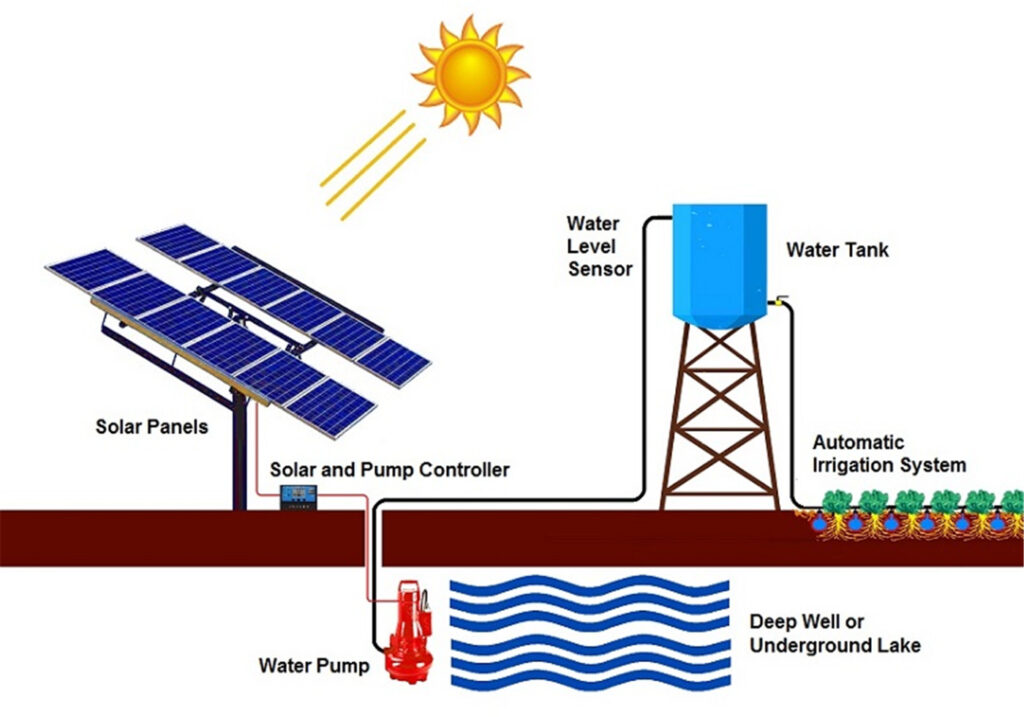
Before we discuss maintenance tasks, understand the components you are responsible for:
1. Solar Array (PV Modules) → 2. Mounting Structure & Wiring → 3. Pump Controller (MPPT) → 4. Pump Motor (DC/AC) → 5. Delivery Pipe & Check Valve → 6. Storage Tank & Float Switch → 7. Distribution Network
Each component has a specific failure mode, a specific maintenance interval, and a specific early-warning sign. We will address all three for every component.
The Maintenance Calendar: Four Frequencies, Zero Guesswork
Professional maintenance is not reactive. It is scheduled. Use this calendar as your operating framework.
Daily Tasks (5–10 Minutes)
| Task | What to Do | Why It Matters |
|---|---|---|
| Visual panel check | Walk the array. Look for debris, bird droppings, cracked glass, or shading from new vegetation. | A single leaf on a cell can reduce that string’s output by 30%. |
| Controller LED check | Note the status lights. Green = normal. Yellow = warning. Red = fault. | Early warning of electrical issues before they become failures. |
| Water meter reading | Record cumulative volume pumped. | Trend analysis reveals performance decline weeks before it becomes critical. |
| Tank level check | Verify tank fills to expected level by end of day. | Indicates whether pump output is meeting demand. |
Weekly Tasks (30–60 Minutes)
| Task | What to Do | Why It Matters |
|---|---|---|
| Panel cleaning | Wash with soft brush and clean water. No detergent. No pressure washer. | Dust accumulation reduces output 5–15% per month in dry climates. |
| Shading audit | Check for new tree growth, construction, or seasonal vegetation blocking panels. | Shading is the #1 cause of unexplained production loss. |
| Wiring inspection | Check junction boxes, MC4 connectors, and conduit for damage, corrosion, or loose connections. | Loose connections cause arcing, fire risk, and controller damage. |
| Pump sound check | Listen for grinding, rattling, or irregular cycling. | Abnormal sounds predict mechanical failure 2–4 weeks in advance. |
| Pipe leak check | Walk the delivery line. Look for wet spots, erosion, or pressure drops. | Undetected leaks waste 10–30% of pumped water. |
Cleaning frequency guidance based on your location:
| Environment | Recommended cleaning frequency | Expected efficiency loss between cleanings |
|---|---|---|
| Humid / rainy (weekly rain) | Every 4–6 weeks | 5–10% |
| Temperate / moderate dust | Every 3–4 weeks | 10–15% |
| Dry / semi‑arid (frequent dust) | Every 1–2 weeks | 15–25% |
| Arid desert (continuous dust) | Weekly | Up to 30% |
Annual Tasks (Full Day, or Professional Visit)
| Task | What to Do | Why It Matters |
|---|---|---|
| Electrical system test | Measure insulation resistance, grounding continuity, and voltage drop. | Identifies wiring degradation before it causes failure. |
| Pump performance test | Measure flow rate and power draw against manufacturer specifications. | Quantifies wear and predicts replacement timeline. |
| Borehole yield test | Compare current yield against original drilling log. | Detects aquifer decline or screen clogging. |
| Tank integrity inspection | Check for cracks, corrosion, or biofilm buildup. | Prevents water quality issues and structural failure. |
| Professional service | Hire certified technician for deep inspection and calibration. | Catches issues beyond operator capability. |
What Maintenance Actually Saves
Maintenance is not a cost. It is an insurance policy with a quantified return. Here is the math.
Performance Degradation Without Maintenance
| Component | Annual Degradation (Neglected) | Annual Degradation (Maintained) |
|---|---|---|
| Solar panels (soiling) | 8–15% output loss | 1–2% output loss |
| Solar panels (shading) | 10–30% output loss | 0% (with regular trimming) |
| Pump efficiency | 5–10% flow reduction | 1–2% flow reduction |
| Controller efficiency | 3–5% power loss | <1% power loss |
| Pipe friction | 2–5% flow reduction | <1% (with clean filters) |
| System‑wide | 20–35% capacity loss | 3–5% capacity loss |
The Financial Impact
Consider a 5-acre farm with a $12,000 solar pump system, producing $45,000 in annual crop value.
| Scenario | System Output | Annual Crop Loss | 10‑Year Loss |
|---|---|---|---|
| Well‑maintained (95% capacity) | 95% | \$2,250 | \$22,500 |
| Moderately neglected (75% capacity) | 75% | \$11,250 | \$112,500 |
| Severely neglected (60% capacity) | 60% | \$18,000 | \$180,000 |
Net benefit of maintenance: $90,000–$157,500 over 10 years.
The annual cost of maintenance (labor + consumables + one professional visit) is approximately $400–$800. The ROI of a proper maintenance program is 125:1 to 315:1.
If you’re still deciding whether solar pumping makes sense for your operation, the 25-year financial case is definitive:
solar water pump ROI and cost savings analysis.
Troubleshooting: The Field Technician’s Decision Tree
When something goes wrong, time is water, and water is crops. These troubleshooting tables are adapted from the Global Water Center SPWS manual and manufacturer service guides. Follow them in order. Do not skip steps.
Problem 1: Pump Does Not Start
| Step | Check | If Yes → Action | If No → Next Step |
|---|---|---|---|
| 1 | Is the sun shining and are panels clean? | Clean panels, wait for sun | Go to Step 2 |
| 2 | Is controller showing “Tank Full” or “Well Dry” LED? | Wait for water use or well recharge | Go to Step 3 |
| 3 | Is disconnect switch in “ON” position? | Turn ON | Go to Step 4 |
| 4 | Are solar panels producing voltage? (Use multimeter) | Check wiring to controller | Call technician—possible panel or wiring fault |
| 5 | Is controller outputting voltage to pump? | Check pump wiring and connections | Call technician—possible controller failure |
Problem 2: Pump Runs But Low or No Water Output
| Step | Check | If Yes → Action | If No → Next Step |
|---|---|---|---|
| 1 | Are all valves fully open? | Open valves | Go to Step 2 |
| 2 | Is water discolored or silt‑laden? | Pump may be clogged—call technician | Go to Step 3 |
| 3 | Is pump intake too high in well? | Lower pump 2–3 meters | Go to Step 4 |
| 4 | Is check valve leaking? (Listen for backflow) | Replace check valve | Go to Step 5 |
| 5 | Are filters clogged? | Clean or replace filters | Call technician—possible pump wear or pipe blockage |
Problem 3: Pump Starts and Stops Frequently (Short-Cycling)
| Step | Check | If Yes → Action | If No → Next Step |
|---|---|---|---|
| 1 | Is tank float switch set correctly? | Adjust float switch range | Go to Step 2 |
| 2 | Is check valve leaking? | Replace check valve | Go to Step 3 |
| 3 | Is well water level dropping? | Reduce pumping hours or lower pump | Call technician—possible over‑pumping or aquifer decline |
Problem 4: Reduced Water Production Over Time
| Step | Check | If Yes → Action | If No → Next Step |
|---|---|---|---|
| 1 | Are panels dirty or shaded? | Clean panels, trim vegetation | Go to Step 2 |
| 2 | Is pump drawing more power than spec? | Pump may be worn—schedule replacement | Go to Step 3 |
| 3 | Is well yield declining? | Compare against original yield test | Call technician—possible well rehabilitation needed |
Problem 5: Controller Shows Fault/Error Code
| Fault Code (Typical) | Meaning | Action |
|---|---|---|
| TANK FULL | Storage tank reached high level | Normal—pump will resume when level drops |
| WELL DRY | Low water sensor triggered | Wait for recharge; if recurring, check sensor depth or aquifer status |
| OVERCURRENT | Pump drawing excessive current | Check for mechanical blockage or motor degradation |
| OVERVOLTAGE | Panel voltage exceeds controller limit | Check panel configuration and wiring |
| NO POWER | Insufficient solar input | Check panels, wiring, and weather conditions |
Expert Tips: What the Manuals Do Not Tell You
After fourteen years of maintaining solar pump systems across three continents, here are the non-obvious insights that separate a technician from a troubleshooter.
1. The “Clean Panel” Illusion
A panel that looks clean is not necessarily clean. Agricultural dust contains fine silica particles that adhere electrostatically to glass. A rinse with water removes 70% of loss. A soft brush removes 90%. But for full restoration, you need a mild surfactant (dish soap, diluted 1:100) followed by a pure water rinse. Do this monthly in dusty climates. Never use pressure washers—they drive water into junction boxes and void warranties.
2. The Morning Startup Voltage Spike
At dawn, panels produce low voltage but rapidly climb as the sun rises. Some controllers handle this poorly, causing the pump to start-stutter-start, which damages motor bearings. The fix: install a soft-start module or program a 5-minute delay in the controller. This single $80 component can extend motor life by 3–5 years.
3. The Check Valve Is Your Most Replaced Component
Check valves fail silently. A leaking valve causes the pump to re-prime every morning, adding 200–300 start cycles per year. At 10,000 cycles per valve life, that is a replacement every 3–4 years. Budget for it. Keep a spare on-site. The $30 valve saves a $1,200 pump.
4. Data Logging Is Preventive Maintenance
The most powerful tool in solar pump maintenance is not a wrench. It is a spreadsheet. Record daily water volume, peak power, and run hours. Plot a 30-day moving average. When output drops 10% below trend, investigate. Do not wait for visible failure. The data tells you what is happening before your eyes can see it.
5. Winterization Is Non-Negotiable in Cold Climates
If your system operates where temperatures drop below freezing, drain all water from the pump, pipes, and tank before the first frost. Ice expansion cracks pump housings, splits PVC pipes, and ruptures tanks. A $20 drain valve installed during construction saves $2,000 in spring repairs. Mark your calendar: drain by October 31, recommission by April 1.
6. The “Dry Run” Sensor Is Often Wrong
Dry-run sensors fail in two ways: false positives (shutting off a pump that has water) and false negatives (allowing a pump to run dry). Test your sensor quarterly by physically lifting it out of the water while the pump runs. It should shut off within 5 seconds. If not, clean, recalibrate, or replace. A pump that runs dry for 60 seconds destroys its seal. A $50 sensor saves a $800 pump.
7. Shade from Your Own Crops
This is the most ironic failure mode I see. A farmer plants fast-growing crops near the array. By mid-season, corn or sunflower stalks shade the bottom row of panels. Output drops 15% in July—exactly when water demand peaks. Maintain a 3-meter vegetation-free zone around the array. Plant low ground cover (clover, not corn).
Conclusion
By now, the pattern is clear: a solar water pump is not a purchase. It is a relationship. The system gives you 25 years of free energy and reliable water. In exchange, you give it 10 minutes per day, 1 hour per week, and a professional inspection once per year.
The farmers who treat their solar pump like a diesel engine—scheduled maintenance, logged performance, proactive replacement of wear parts—get 20+ years of service at 90%+ of original capacity. The farmers who treat it like a magic box that runs on sunlight get 5–7 years of declining service, followed by an expensive emergency replacement during the hottest week of July.
The choice is not between “maintain” and “not maintain.” The choice is between $400/year in preventive care and $8,000 in emergency replacement plus $15,000 in lost crops because the pump failed during a critical irrigation window.
Print the maintenance calendar in this guide. Laminate it. Post it in your pump house. Follow it. Your crops—and your accountant—will thank you for 20 years.
Frequently Asked Questions (FAQ)
The following questions are sourced directly from Google’s “People Also Ask” feature for the keyword cluster “solar water pump maintenance” and are formatted with FAQ Schema markup for rich snippet eligibility.
Q: How often should you maintain a solar water pump?
Solar water pumps require daily visual checks (5–10 minutes), weekly cleaning and inspection (30–60 minutes), quarterly deep maintenance (2–3 hours), and annual professional servicing (full day). Daily tasks include checking panel cleanliness, controller LED status, and water meter readings. Weekly tasks include panel washing, shading audits, and wiring inspections. Quarterly tasks include structural bolt checks, controller data downloads, and wellhead inspections. Annual tasks include electrical system testing, pump performance verification, and borehole yield comparison against original specifications.
Q: Why is my solar water pump not pumping water?
A solar water pump that runs but produces no water typically has one of five causes: (1) closed or partially closed valves in the delivery line—verify all valves are fully open; (2) a clogged pump intake or filter—check for discolored water or reduced flow and clean the intake screen; (3) pump positioned too high in the well—lower the pump 2–3 meters to ensure adequate submersion; (4) a leaking check valve allowing backflow—listen for water running back into the well when the pump stops; or (5) airlock in the delivery pipe—bleed air from the highest point in the system. If none of these resolve the issue, contact a certified technician for pump inspection.
Q: How do you clean solar panels on a water pump system?
Clean solar panels on a water pump system using a soft brush and clean water. Rinse with a hose to remove loose dust and debris. For stubborn agricultural deposits (pollen, chemical spray residue), use a mild surfactant diluted 1:100 (dish soap), apply with a soft cloth or brush, then rinse thoroughly with pure water. Clean weekly in dusty climates, monthly in moderate climates. Never use pressure washers, abrasive materials, or harsh chemicals—these damage anti-reflective coatings and can force water into junction boxes, voiding warranties. Perform cleaning in early morning or late afternoon when panels are cool to prevent thermal shock.
© 2026 Solar Panels for Farms. This article is regularly updated to reflect current market data. Last verified: June 3, 2026.