
Written by Dr. Robert Kowalski — Ph.D. in Agricultural and Biological Engineering from Penn State University, with 18 years of experience in on-farm electrical systems and livestock fencing. He has specified and diagnosed solar fencing systems for cattle, sheep, and wildlife exclusion across the Midwest and Northeast. He is a licensed Professional Engineer and a member of the American Society of Agricultural and Biological Engineers.
Your fence reads 2,000 volts instead of 8,000. The energizer is almost certainly fine — in the field, roughly 9 out of 10 weak-fence cases trace to grounding, vegetation, or a single shorted insulator. Here is the 15-minute, three-tool test sequence that finds the fault without replacing anything.
The Problem
Electric fence troubleshooting fails in the same place solar pump troubleshooting fails: people replace the expensive box first. The solar energizer gets swapped — $150 to $400 — and the fence still reads 2,000V, because the energizer was never the problem.
An electric fence is a circuit, and the circuit closes through the soil: pulse out on the wire, through the animal, into the ground, back to the energizer’s ground rods. That return path is invisible, unglamorous, and the source of the majority of real-world voltage failures — especially in dry August soil and frozen January ground, exactly when people blame the panel or the battery.
The Tools ($85 Total, Once)
| Tool | Cost | Job |
|---|---|---|
| Digital fence voltmeter (with ground probe) | 25–45 | Reads kV at any point; the only number that matters |
| AM radio or fault finder | 15–40 | Locates shorts by the click |
| Clamp-on jumper leads (insulated) | 10–20 | Isolates fence sections safely |
The three-tool test below assumes a solar energizer with a small panel and 12V battery — the standard farm setup covered in our sheep and goat fencing guide.
The 15-Minute Test Sequence
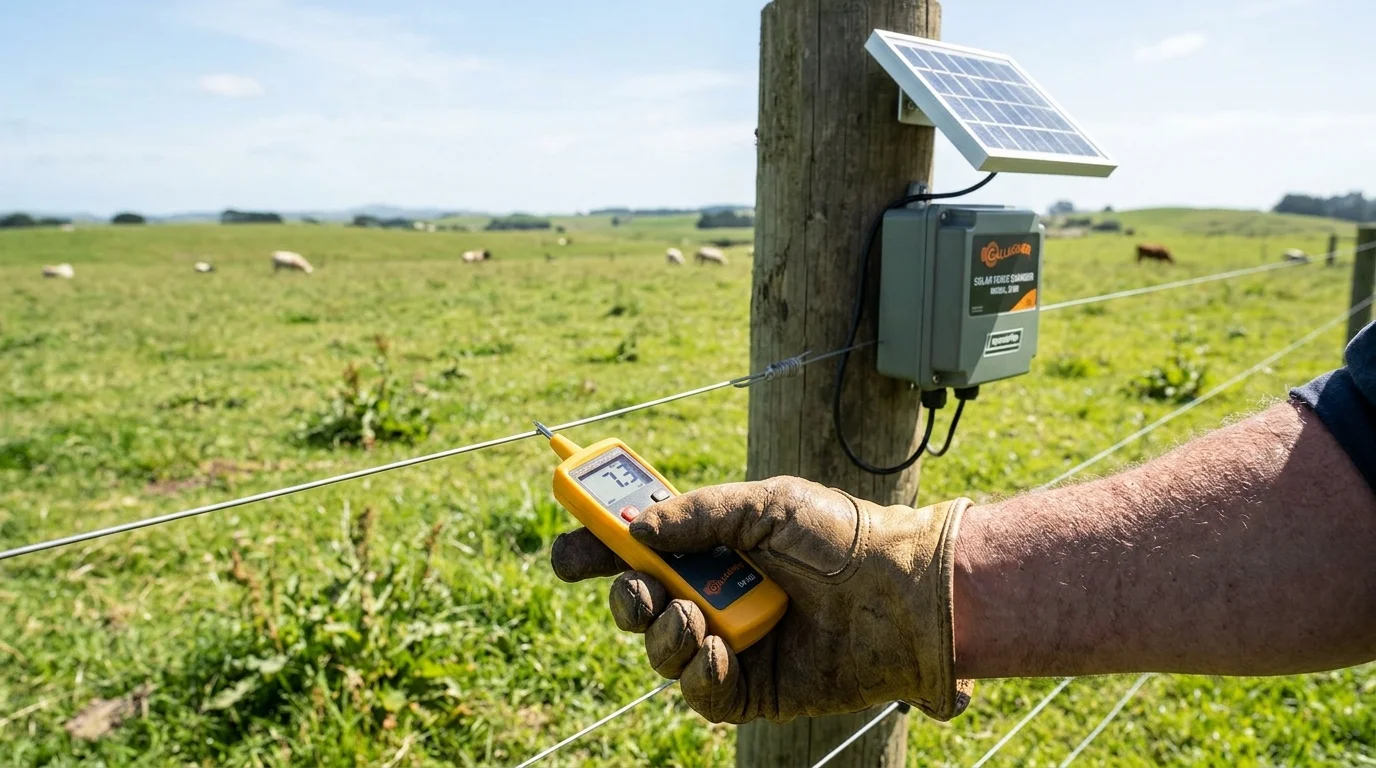
Test 1 — The energizer itself (3 minutes). Disconnect the fence wire AND the ground rods from the energizer. Measure open-circuit output directly across the energizer terminals. A healthy unit pulses 6,000–9,000V+ open-circuit. If it reads low here: now you may suspect the box — but check its 12V battery first (below 11.8V under pulse load = battery, not energizer), and check the panel is actually charging (13V+ at the battery in full sun).
Test 2 — The grounding system (5 minutes). This is where 90% of faults live. Reconnect everything. Push the fence to a dead short: lay a steel rod against the fence wire 100 ft from the energizer to drop fence voltage under 1,500V. Now measure voltage between the energizer’s last ground rod and the soil (voltmeter probe in the earth 3 ft away). Reading above 400–600V = your grounding is failing. The ground system is supposed to absorb nearly zero volts; whatever reads here is being stolen from the animal’s shock. Fix: add ground rods. Three 6-ft galvanized rods, 10 ft apart, in moist soil, is the minimum for a farm energizer — and dry-summer or frozen-winter soil may demand more. Also check: rods corroded, clamps loose, one rod bent to a 2-ft nub by a rock.
Test 3 — The fence line (7 minutes). Energizer output good, grounding clean, fence still weak? A short is on the line. Walk it with the AM radio tuned low between stations: a loud rhythmic click-click that gets louder as you approach the fault. The usual suspects, in order: vegetation contact (grass and weeds bleed 1,000–3,000V invisibly), a cracked insulator arcing to a steel post, a staple driven through wire insulation on wood posts, a gate handle loop touching its post, deer damage — broken wire arcing to itself. Use jumper leads to isolate fence sections and halve the search each time.
The Diagnostic Table: Reading → Cause
| Reading pattern | Cause | Fix cost |
|---|---|---|
| Low open-circuit at energizer, battery under 11.8V | Dead/shorted 12V battery | 40–90 |
| Low open-circuit, battery at 12.4V+, panel good | Energizer output stage failed | 150–400 (the rare one) |
| Good open-circuit, 300V+ at ground rods under short | Grounding insufficient | 30–80 (rods) |
| Good at energizer, drops along line, radio clicks | Vegetation or arcing insulator | 0–40 |
| Voltage fine near energizer, dies past a gate | Gate wiring/handle fault | 10–25 |
| Whole fence low only in dry/frozen spells | Soil return path, seasonal | More rods, bentonite, or ground-return wire |
Winter and Drought: The Seasonal Fence Killers
Solar fence systems fail twice a year on schedule. Drought: dry soil is a poor conductor; the animal’s shock weakens even with a perfect energizer — which is why containment mysteriously degrades in August. Frozen ground: same physics, worse — frost is an excellent insulator. The fix for both is the same: more ground rods in deeper, moist soil, or a ground-return wire system (alternating hot and ground wires on the fence), which makes the shock independent of soil conditions entirely.
On the solar side: December’s short days starve the panel exactly when frozen ground demands full energizer output. A panel sized for summer is undersized for January — the seasonal logic is identical to our winter production benchmarks. Check battery voltage on a gray December morning; under 12.0V at dawn means the panel-battery balance is wrong for winter.
Expert Tips
1. Ground rods out, not down. Three rods 10 ft apart outperform three rods 3 ft apart dramatically — the return field needs elbow room. Galvanized only; copper-clad steel in corrosive soils.
2. Never skimp the energizer’s own ground wire. A corroded clamp at the rod costs exactly like a missing rod. Wire-brush every connection each spring.
3. Vegetation is a voltage leak with a monthly bill of zero. A fence at 8,000V in May reads 4,500V in July from grass alone. A fence-weeder pass or herbicide strip under the lowest wire recovers it — cheaper than a bigger energizer.
4. Buy the voltmeter before you need it. The first fence emergency at 9 PM pays for the tool. A fence tested quarterly on a calendar never fails mysteriously.
5. Lightning is the energizer’s real predator. Diverters and proper grounding (same physics as array lightning protection, covered in our grounding guide) decide whether a storm costs you a $30 part or a $300 box.
6. Battery age lies. A 12V gel battery in a fence box lasts 3–5 years, and dies gradually — output sags for months before it fails outright. Date the battery with a paint marker; test it every fall.
Conclusion
A weak fence is almost never a dead energizer: test the box open-circuit, then test the ground system under load — the 400V rule — then walk the line with a radio. Fifteen minutes, $85 of tools, and the fault has an address. And when August drought or January frost weakens the shock on a perfect system, remember: the circuit closes through the soil, and the soil is part of the fence.
Frequently Asked Questions
Q: Why is my electric fence voltage low?
A: In roughly 90% of cases, the grounding system or the fence line — not the energizer. Test in order: energizer open-circuit output (should pulse 6,000–9,000V+), then ground-rod voltage under a dead short (above 400–600V means insufficient grounding), then walk the line with an AM radio for arcing shorts. Dry or frozen soil degrades the ground return seasonally — the most-missed cause of all.
Q: How many ground rods does a solar fence energizer need?
A: Minimum three 6-ft galvanized rods, spaced 10 ft apart, in moist soil — and more in dry or sandy ground. Energizers above ~3 joules may need five or six. The test: short the fence to under 1,500V, then measure voltage at the last ground rod; anything above 400–600V means your ground system is stealing shock from the animal, and another rod is the fix.
Q: Does an electric fence use much solar power?
A: Very little — a farm energizer draws 5–25W, so a 20–50W panel and a 12V battery run it year-round in most of the US. The winter pinch is real though: December’s short days cut charging roughly in half exactly when frozen ground demands maximum output. If dawn battery voltage falls under 12.0V in winter, add panel watts before blaming anything else.
Related Articles
- Solar-Powered Electric Fence for Sheep and Goats: The 7-Wire Height and Voltage Guide — Design the fence right and troubleshooting gets rare.
- Solar Wildlife Exclusion: Electric Fencing to Keep Deer, Hogs, and Bears Out of Your Crops — Higher stakes, higher voltage: exclusion fencing done properly.
- How to Ground and Lightning-Proof Your Ground-Mount Solar Array — The same grounding physics, applied to your array.
© 2026 Farm Solar Guide. All data sourced from manufacturer energizer specifications, extension service fencing guides, and documented US farm operations. Last verified: November 12, 2026