
Written by Dr. Robert Kowalski — Ph.D. in Agricultural and Biological Engineering from Penn State University, with 18 years of experience in on-farm electrical systems and backup power design. He has designed hybrid solar-generator systems for dairy, poultry, and irrigation operations across the Midwest and Northeast. He is a licensed Professional Engineer and a member of the American Society of Agricultural and Biological Engineers.
Solar covers 340 days a year. The generator covers the other 25 — the ice storm, the three-day November gloom, the equipment fault at the worst moment. Sized right, the pair costs less than either one sized wrong. Here is how to combine them into one system instead of two machines that ignore each other.
The Problem
Farms buy backup power in one of two broken ways.
Broken way one: the giant generator. A 25 kW diesel standby unit sized to carry the whole farm — 12,000–12,000–18,000 installed, plus $1,100/year in maintenance and fuel for 40 hours of annual runtime, as we detailed in our solar-vs-diesel comparison. The unit runs almost never, and its capital sits rusting.
Broken way two: solar + battery with no Plan B. The battery bank sized for one cloudy day meets a four-day storm. The farm discovers the difference between “backup” and “resilience” with a full cold room and dead batteries.
The hybrid fixes both: a modest solar array and battery sized for the common outages (hours to a day), and a small generator sized for the statistical tail. The battery slashes generator runtime; the generator slashes battery size. Each makes the other cheaper.
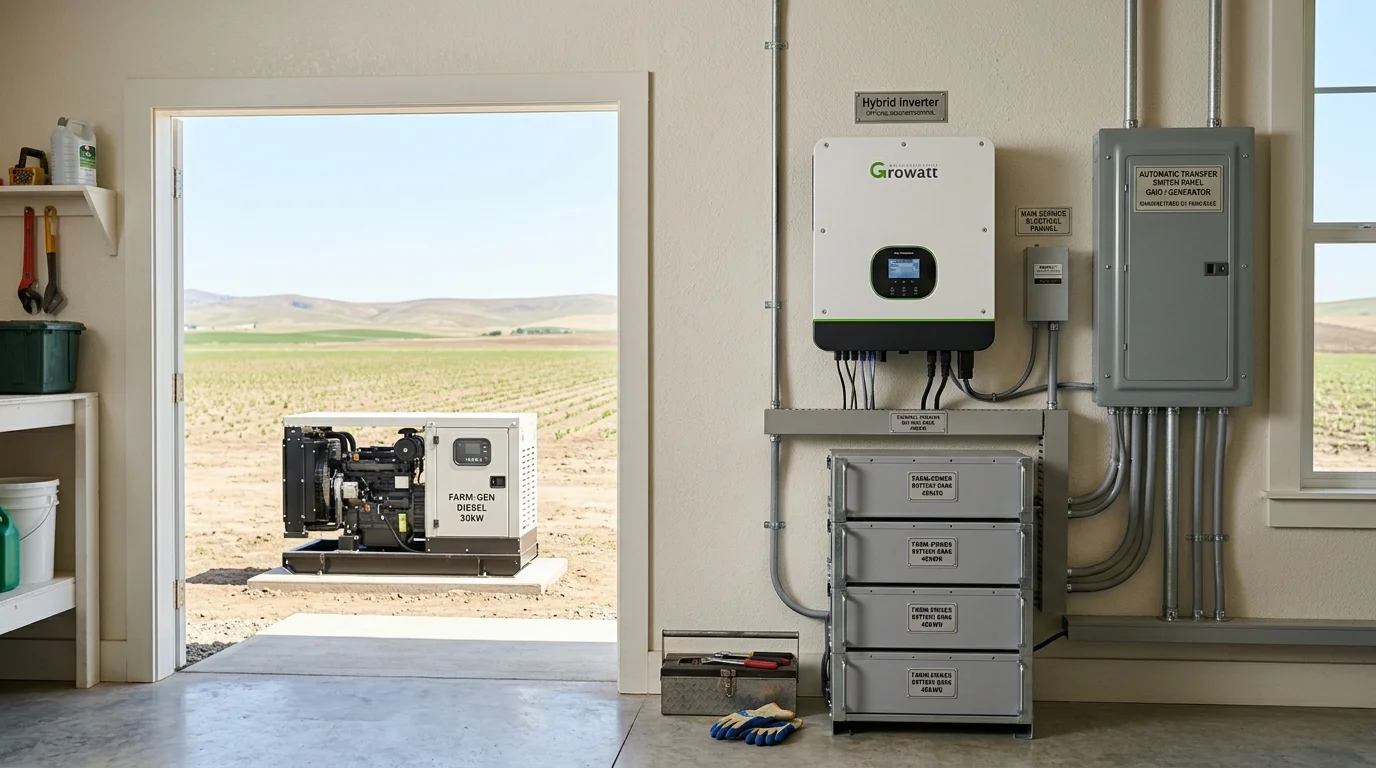
The Architecture: Who Does What
| Component | Job | Sized for |
|---|---|---|
| Solar array | Daily energy + bill savings | Your normal load profile |
| Battery bank | Outages up to ~24h; surge absorption; generator-free nights | Critical loads × 1 day |
| Hybrid inverter | The traffic cop: solar/battery/grid/generator | Largest load + surge |
| Generator (small) | Multi-day outages; battery recharge at low state of charge | Critical loads + battery charging rate |
| Automatic transfer switch / auto-start | Switches sources in seconds, starts/stops the generator itself | — |
The design principle that saves the most money: the generator only needs to cover critical loads plus battery charging — not the whole farm. A farm that “needs 25 kW of backup” often needs 8–10 kW of generator once the battery handles surges and the non-critical loads are shed.
Sizing the Three Pieces
Battery first — using the four-step method from our battery sizing guide: critical loads × 24 hours × DoD/efficiency factors. For a typical farm critical panel (well pump, freezer, furnace blower, some lights, controls): 10–20 kWh.
Generator second — sized to (critical loads in kW) + (battery charging rate in kW), with a 20% margin. A 10 kWh battery charging at 0.5C wants 5 kW of charging; add 4 kW of critical loads and you are at an 8–10 kW generator, not 25 kW. Run it at 70–80% load when it runs — generators are efficient loaded and miserable idling.
Inverter always — the hybrid inverter must pass the largest load plus motor surges, and accept generator input with proper charge control. This is the component to not economize on: it is the system.
The Automation That Makes It One System
The 500–500–1,500 of control gear is what separates a hybrid system from a pile of equipment:
- Auto-start generator control: battery hits 20–30% state of charge (or a grid outage plus low solar) → generator starts automatically, charges the battery and carries loads, stops at 80–90% charge. Runtime per storm day: 3–6 hours instead of 24.
- Transfer in seconds: critical loads never see the switch — pumps, freezers, and ventilation ride through on the inverter.
- Quiet hours: the battery carries nights; the generator runs mid-morning when noise matters least and efficiency is best.
Fuel math that surprises people: this architecture typically cuts generator fuel consumption 70–90% versus a run-continuously setup — the generator only runs at efficient load, only when needed.
The Numbers: Whole-Farm Backup, Three Ways
Scenario: critical loads 4 kW running / 12 kW surge, target 5-day worst-case outage coverage.
| Criteria | Big generator only | Big battery only | Hybrid |
|---|---|---|---|
| Generator | 25 kW diesel: $14,000 | None | 9 kW: $5,500 |
| Battery | None | 96 kWh: $45,000+ | 20 kWh: $9,500 |
| Inverter/ATS | $800 ATS | Included | $3,500 hybrid + ATS |
| Annual fuel/maintenance | ~$1,100 | ~$0 | ~$250 |
| System cost | ~$14,800 | ~$45,000+ | ~$18,500 |
| Covers 5-day outage? | Yes (with fuel) | Marginal | Yes (with modest fuel) |
The hybrid is not the cheapest line on the table — the generator-only column wins on day one. It wins on year five: $850/year less fuel and maintenance, daily bill savings from the solar+battery the generator-only setup never earns, and silent nights. Payback of the hybrid premium: typically 4–6 years, then decades of dividends.
Expert Tips
1. Separate the critical loads panel. The single best 800–800–1,500 in any backup design: a subpanel holding only what cannot stop. Everything downstream gets simpler, smaller, and cheaper.
2. Propane beats diesel for small hybrid generators. The generator runs rarely; diesel degrades in the tank. Propane stores for years, starts in the cold, and the farm tank is already there.
3. Size the generator to the battery charger, and check compatibility. The inverter’s charger draws what it draws; the generator must feed it at full rate. Confirm the pair communicates — mismatched charge settings are the most common hybrid commissioning fault.
4. Exercise automation monthly, not the generator alone. An auto-start that has never been tested is a decoration. Monthly self-test with a real load transfer catches dead starter batteries and stale fuel in peace time.
5. Let the battery eat the surges. Well pumps and compressors starting on generator alone force oversizing. With the battery online, the generator sees a smooth load — one more reason the small unit suffices.
6. Document the one-line diagram. Every electrician, inspector, and future-you will thank present-you for a laminated single-line diagram of the system at the panel.
Conclusion
Backup power on a farm is not a generator question or a battery question — it is a division of labor: solar and battery for the 340 ordinary days and the short outages, a small generator for the statistical tail, and $1,000 of automation to make them one organism. Size the generator for critical loads plus charging, let the battery absorb surges and nights, and you will spend a third of the big-generator budget for a system that is quieter, cheaper to run, and actually gets used.
Frequently Asked Questions
Q: Can solar panels and a generator work together?
A: Yes — through a hybrid inverter and an automatic transfer switch, and this combination is the most cost-effective farm backup architecture. The solar array and battery handle daily energy and short outages; the generator covers multi-day events and recharges the battery at low state of charge. The key is control: auto-start logic that runs the generator only at efficient load, typically cutting generator fuel use 70–90% versus a run-continuously setup.
Q: What size generator do I need with a solar battery system?
A: Much smaller than you’d think — the battery absorbs motor surges and carries nights, so the generator only covers critical loads plus battery charging rate, with 20% margin. A farm that looks like it needs 25 kW of backup typically needs 8–10 kW of generator once a 10–20 kWh battery is in the system. Verify the generator can feed your inverter’s charger at full rate; that charging draw often sets the minimum size.
Q: Is a hybrid solar-generator system worth it for a farm?
A: For farms with critical loads (water, refrigeration, ventilation), usually yes. Against a large standby generator, a hybrid costs more upfront (~18,500vs 18,500 vs ~14,800 in a typical 5-day-outage design) but saves roughly $850/year in fuel and maintenance, earns daily bill savings from the solar and battery, and eliminates noise for all but a few hours per storm. Payback of the premium typically lands at 4–6 years — and the system earns its keep every day, not just during outages.
Related Articles
- Solar vs Diesel Backup Generator: The True 15-Year Cost of 40 Hours/Year — The cost anatomy of the generator-only approach.
- Farm Solar Battery Sizing: The 2026 Complete Guide — Step one of the hybrid design: the critical-load battery.
- Farm Diesel Shortage? Your 72-Hour Solar Backup Plan — When fuel itself is the failure mode.
© 2026 Farm Solar Guide. All data sourced from manufacturer hybrid inverter and generator specifications, EIA fuel price projections, and documented US farm operations. Last verified: November 19, 2026