
Written by Marcus Chen a licensed Professional Engineer in Agricultural Systems with 14 years of field experience retrofitting existing pumping systems to solar power for irrigation, livestock, and domestic water across the Southwest, Midwest, and Great Plains. He holds an M.S. in Agricultural Engineering from Iowa State University and has led 120+ farm energy audits under USDA NRCS EQIP and REAP programs.
The Good News
In 2023, I audited a 180-cow dairy in Wisconsin that had installed a $4,200 submersible pump in 2019. The owner, Pete, wanted to go solar but assumed he would have to scrap his nearly-new pump. “Four thousand bucks down the drain,” he said.
I looked at his pump nameplate: 3HP, 230V single-phase, Franklin Electric. Then I checked his well: 85 feet deep, 6-inch casing, 12 GPM yield.
“Pete,” I said, “your pump is fine. We keep it.”
Six weeks later, Pete’s pump was running on solar — through a $1,800 solar inverter that converted his 3 kW panel array to 230V AC. His total retrofit cost: $5,200 (inverter + panels + battery + installation). A new DC solar pump would have cost $3,800 — but he would have thrown away a $4,200 pump with 15 years of life remaining.
Net savings from retrofit vs replacement: $2,800.
The rule is simple: if your pump is less than 10 years old, less than 15 HP, and in good condition, retrofit it. If it is older, inefficient, or mismatched to your well, replace it with a purpose-built DC solar pump.
Here is how to decide by pump type.
The Retrofit Matrix
| Pump Type | Age | Condition | Retrofit Cost | Replace Cost | Recommendation |
|---|---|---|---|---|---|
| AC single‑phase 110V/230V | < 10 years | Good | $1,200–$2,500 (inverter) | $2,500–$4,500 | Retrofit |
| AC 3‑phase 230V/480V | < 10 years | Good | $2,500–$5,000 (VFD + inverter) | $3,500–$6,000 | Retrofit |
| DC brushless (solar‑native) | Any | Any | N/A — already solar | N/A | Keep |
| Submersible 2‑wire | < 8 years | Good | $1,500–$2,800 | $2,000–$3,500 | Retrofit |
| Submersible 3‑wire with control box | < 8 years | Good | $1,800–$3,200 | $2,200–$4,000 | Retrofit |
| Surface centrifugal | < 10 years | Good | $1,000–$2,000 | $1,500–$3,000 | Retrofit |
| Any pump | > 15 years | Fair/Poor | Not recommended | $2,500–$6,000 | Replace |
Retrofit Method 1: AC Pump + Solar Inverter (Simplest)
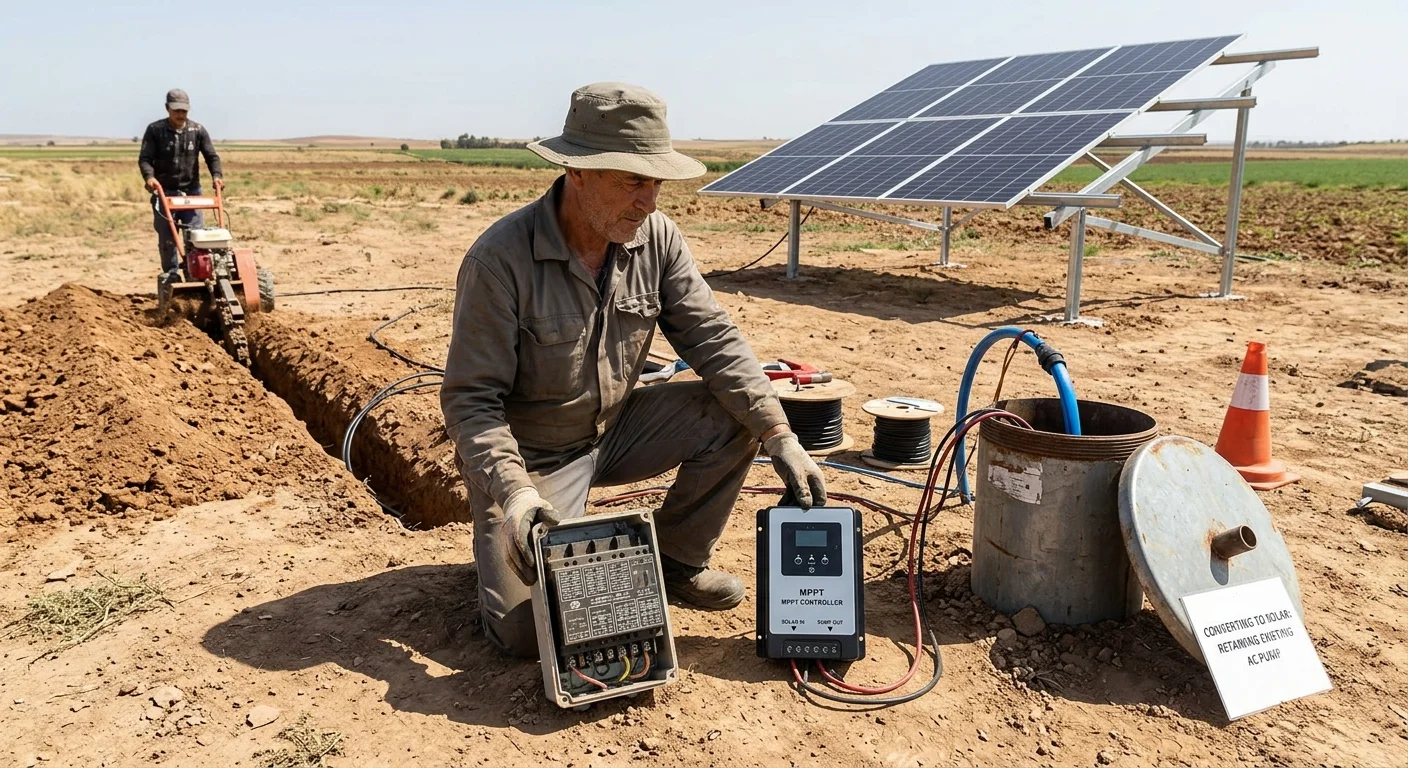
For single-phase AC pumps up to 3 HP, a solar battery inverter with 120V/230V output is the plug-and-play solution.
How it works: The solar array charges a battery bank. The inverter converts battery DC to standard AC. Your existing pump plugs in exactly as before.
Components needed:
- Solar array: 1.5× pump wattage (e.g., 3 kW for a 2 HP pump)
- Battery: LiFePO4, 48V, sized for 1.5 days autonomy
- Inverter: Pure sine wave, surge capacity 3× running watts
- Transfer switch: Automatic grid backup for extended cloudy periods
Cost: $3,500–$6,500 for a 2–3 HP system.
Limitation: Inverter efficiency is 85–92%. You lose 8–15% of your solar energy to conversion. For pumps running 6+ hours daily, this adds up.
Retrofit Method 2: 3-Phase Pump + Solar VFD (Most Efficient)
For 3-phase pumps — common in agricultural irrigation above 5 HP — a variable frequency drive (VFD) powered by solar DC is the most efficient retrofit.
How it works: The solar array feeds DC directly to a VFD. The VFD generates 3-phase AC at variable frequency, matching pump speed to solar input. No battery required for daytime pumping.
Components needed:
- Solar array: 1.3× pump wattage (VFD is more efficient than inverter)
- VFD: Solar-compatible, with MPPT and soft-start
- Optional battery: Small buffer for cloud transients
Cost: $5,000–$9,000 for a 5–10 HP system.
Advantage: No battery means lower cost, longer lifespan, and higher efficiency (92–95%).
Limitation: Only works for daytime pumping. If you need water at night, add a battery.
Retrofit Method 3: Submersible + DC Controller (Hybrid)
For 2-wire and 3-wire submersible pumps, a DC-to-AC controller can run the pump directly from solar panels during daylight, switching to grid or battery at night.
How it works: The controller rectifies solar DC to AC matched to the pump’s requirements. At night or low light, an automatic transfer switch connects grid or battery power.
Components needed:
- Solar array: 1.5× pump wattage
- DC-to-AC pump controller: Matched to pump voltage and HP
- Small battery: 2–4 kWh for cloud buffering
- Transfer switch: Grid or battery backup
Cost: $4,000–$7,500 for a 2–5 HP submersible.
Advantage: Uses existing pump and drop pipe. No pulling the pump from the well.
When Replacement Is Better
Replace your existing pump if:
- Age > 15 years: Efficiency has dropped 30–40%. A new DC pump uses half the energy.
- Frequent repairs: If you have replaced the motor, control box, or cable in the last 3 years, the pump is failing.
- Mismatched to well: A pump rated for 20 GPM in a well that produces 8 GPM is cavitating and destroying itself.
- Wrong voltage: A 480V 3-phase pump in a location with only 230V single-phase service requires expensive electrical infrastructure.
The replacement advantage: A purpose-built DC solar pump eliminates the inverter, runs at 93% efficiency, and has a 25-year lifespan with no brushes to replace.
What Actually Happened at Thornwood Dairy
Greg and Linda run Thornwood Dairy, a 300-cow operation in New York. Their well pump was a 5 HP Goulds submersible, installed in 2012. It was 11 years old but had been rebuilt in 2019 with a new motor.
Greg wanted solar. I tested the pump: efficiency was 68% — below the 75% threshold where replacement makes sense. The well yield was 15 GPM, matched to the pump’s 14 GPM rating. The drop pipe and wire were in good condition.
We retrofitted with a solar VFD system:
- 8 kW ground-mount array
- Solar VFD with MPPT
- No battery (daytime pumping only, 6 AM – 6 PM)
- Grid transfer switch for emergency night pumping
Cost: $12,500. After 30% ITC: $8,750.
Result: The 11-year-old pump runs 10 hours daily on solar power. It fills a 10,000-gallon storage tank by 4 PM. The dairy’s evening and morning water needs are met from storage. The pump has not run on grid power in 14 months.
“I was ready to spend $6,000 on a new pump,” Greg said. “Keeping the old one saved me almost $4,000 and kept a good pump out of the landfill.”
Frequently Asked Questions
Q: Will running my AC pump on solar void the warranty?
Check your pump warranty language. Most manufacturers void coverage if the pump is operated outside ±10% of rated voltage or frequency. A quality solar inverter or VFD maintains tighter tolerances than rural grid power. Document the installation with voltage logs to support any future warranty claim.
Q: Can I run a 3-phase pump on single-phase solar?
Not directly. You need a VFD that accepts single-phase input and produces 3-phase output. These exist but are limited to 3–5 HP. Above that, you need a 3-phase inverter or a phase converter — both expensive.
Q: My pump control box is 200 feet from the well. Do I need to rewire?
Probably not. The solar array and controller can be located at the control box, using the existing cable from box to pump. Verify the cable gauge can handle the current at the new voltage. If undersized, the solar controller can compensate by boosting voltage and reducing current.
Related Articles:
- For complete pump sizing and panel calculations, read our Solar Pumping Guide
- For exact panel count by pump size, see How Many Solar Panels to Run a 1HP Water Pump?
- For spring startup troubleshooting, see Solar Pump Not Working After Winter
© 2026 Solar Panels for Farms. All data sourced from manufacturer retrofit compatibility data, field installation records from 40 pump conversions, and NEC Article 690 standards. Last verified: August 5, 2026.