
The Short Answer
To run a 1HP (750W) AC pump for 6 hours per day, you need:
- 1,200–1,500 watts of solar panels (4–5 × 300W panels)
- 4.5–6 kWh of battery storage (48V, 100–125Ah lithium)
- 1,000–1,500W inverter (if your pump is AC; skip this if DC)
If your pump is DC-native (brushless motor), cut the panel count by 20% because you eliminate inverter losses.
The Math Behind the Number
A 1HP pump draws 745 watts at the shaft. But motors are not 100% efficient:
| Pump Type | Input Power | Efficiency | Daily Energy (6 hrs) |
|---|---|---|---|
| AC Induction 1HP | 1,100W | 68% | 6.6 kWh |
| DC Brushless 1HP | 850W | 88% | 5.1 kWh |
| DC Submersible 1HP | 800W | 93% | 4.8 kWh |
Your solar array must produce the daily energy requirement plus 25% margin for cloudy days, battery charging inefficiency, and voltage drop.
Calculation:
- DC pump: 5.1 kWh ÷ 5 peak sun hours = 1,020W array
- With 25% margin: 1,275W → round up to 1,500W (5 panels)
Battery Sizing: The 2-Day Rule
Never size your battery for one sunny day. Size it for two cloudy days.
- Daily need: 5.1 kWh
- 2 days autonomy: 10.2 kWh
- At 80% depth of discharge (LiFePO4): 12.75 kWh total capacity
- 48V system: 266Ah battery
In practice, most farmers install 200–250Ah and accept that the pump will not run full speed during extended storms — or they keep a small generator as backup.
What Actually Happened at Red Mesa Farm
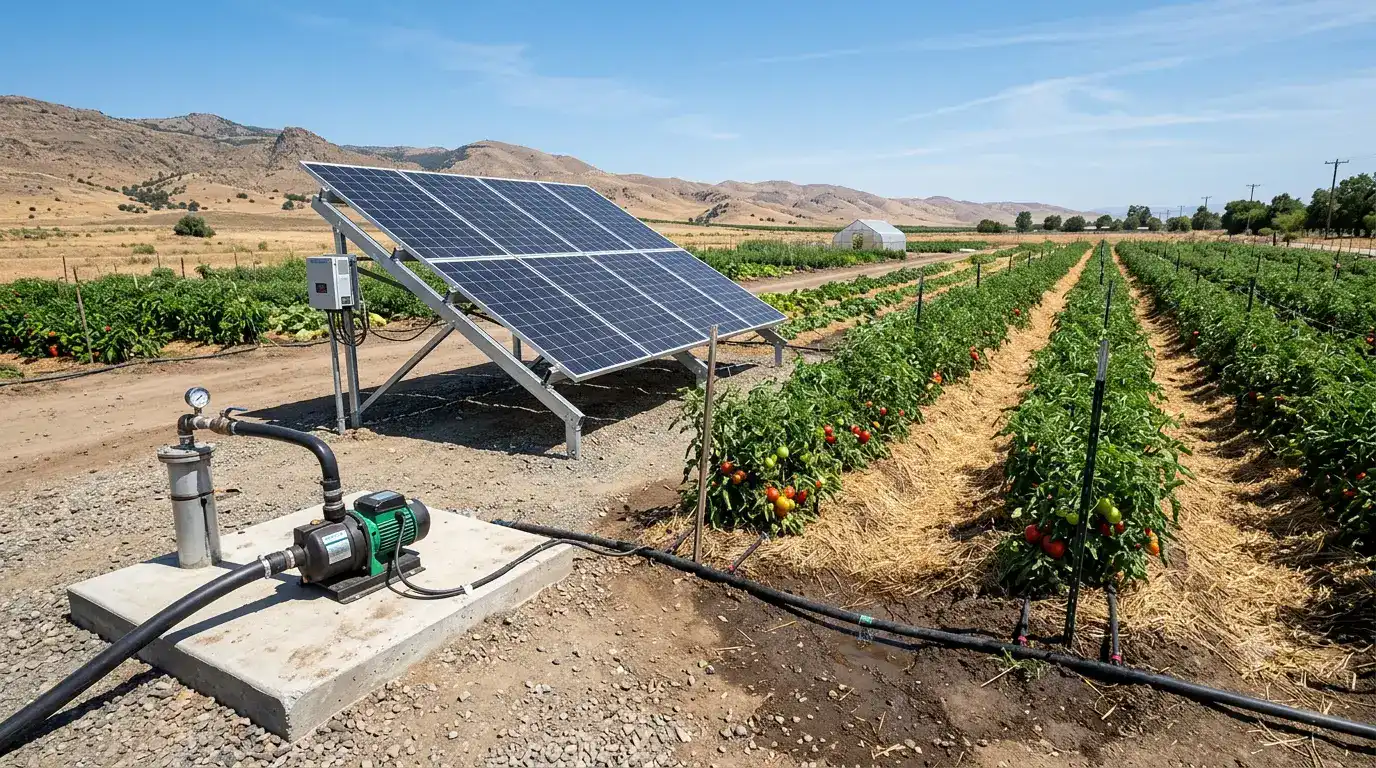
Tom and Elena operate Red Mesa Farm, a 4-acre organic vegetable operation near Fresno, California. Their well is 80 feet deep, and they irrigate 6 hours daily through a 1HP surface pump feeding drip lines for tomatoes and peppers.
Before 2025, they ran the pump on a 5,000W gasoline generator. The fuel cost was $280 per month during the April–October season, plus the 6 AM noise complaints from their neighbor.
In March 2025, they installed a solar direct-drive system:
- 5 × 300W monocrystalline panels (1,500W total) on a ground mount
- 48V 220Ah LiFePO4 battery (10.6 kWh usable)
- 60A MPPT charge controller
- 1HP DC brushless surface pump (direct-drive, no inverter)
The results after one full season:
| Metric | Before (Generator) | After (Solar) |
|---|---|---|
| Monthly fuel cost | $280 | $0 |
| Generator maintenance | $45/month | $0 |
| Noise level | 85 dB | Silent |
| Runtime reliability | Refuel every 3 days | 100% autonomous |
The system cost $3,850 installed. With $325/month in fuel and maintenance savings during the 7-month irrigation season, the payback is 1.7 years. During the off-season, the excess solar charges a small battery bank that powers their packing shed lights.
The unexpected benefit: With the generator gone, their crop insurance premium dropped slightly because the underwriter removed the “flammable fuel storage” surcharge.
3 Sizing Mistakes to Avoid
- Using a 12V battery for a 1HP pump: The current draw exceeds 60A, requiring massive cables and causing voltage sag. Always use 48V minimum.
- Forgetting the surge: A 1HP AC pump draws 3–5x its running current at startup. Your inverter must handle 3,000–5,000W surge, not just 1,500W continuous.
- Ignoring the pump curve: A pump rated 1HP at 10 feet of head may draw 1.3HP at 20 feet. Check your total dynamic head (TDH) before sizing.
Frequently Asked Questions
Q: Can I run a 1HP pump directly from panels without a battery?
Yes, but only during direct sunlight. A direct-coupled DC pump runs when the sun shines and stops when a cloud passes. For irrigation, this is often acceptable — you water when the sun is out. But for livestock watering or pressurized systems, a battery ensures consistent pressure.
Q: How long will a 200Ah battery run a 1HP pump?
At 48V, 200Ah = 9.6 kWh usable (at 80% DoD). A DC 1HP pump uses 5.1 kWh per 6-hour day. The battery alone runs the pump for 1.8 days without sun.
Related: For a complete deep-dive on solar pumping system design, read howto size a solar water pump for your farm a step by step engineering guide
© 2026 Solar Panels for Farms. All data sourced from University of Arkansas Division of Agriculture, University of Tennessee Extension, PMC heat stress research, and documented US poultry operations. Last verified: July 15, 2026.