Written by Dr. Elena Vasquez an agricultural Engineering from Cornell University and has spent 16 years designing dual-use solar systems for specialty crop operations across North America and Southern Europe. She has led agrivoltaic feasibility studies for over 40 farms, including greenhouse-integrated installations for saffron, tomatoes, and leafy greens. Her work has been published in Agronomy for Sustainable Development and Renewable Agriculture and Food Systems.
The Problem
You have heard it from every solar salesman who has knocked on your door: “Put panels on your barn roof and save on electricity.” But what if the panels could do more than generate power? What if they could also improve the crop growing beneath them?
Most farmers dismiss agrivoltaics — the practice of growing crops under solar panels — because the conventional wisdom says panels shade the crop and kill yield. That conventional wisdom is wrong. For a specific set of high-value crops, the shade created by solar panels is not a liability. It is an asset.
The real problem is not whether agrivoltaics works. It is that most farmers do not know which crops actually thrive under panels, what panel configuration works best, and how to calculate the combined revenue from electricity plus crop sales. Without that information, they either ignore agrivoltaics entirely or invest in a system that is poorly matched to their operation.
The Solution : Crop-Specific Panel Design, Not One-Size-Fits-All
The core principle of successful agrivoltaics is simple: panel selection should be crop-driven, not technology-driven. A rooftop designed for saffron production requires different glass than one designed for tomatoes or lettuce.
Saffron : The Breakout Agrivoltaic Crop
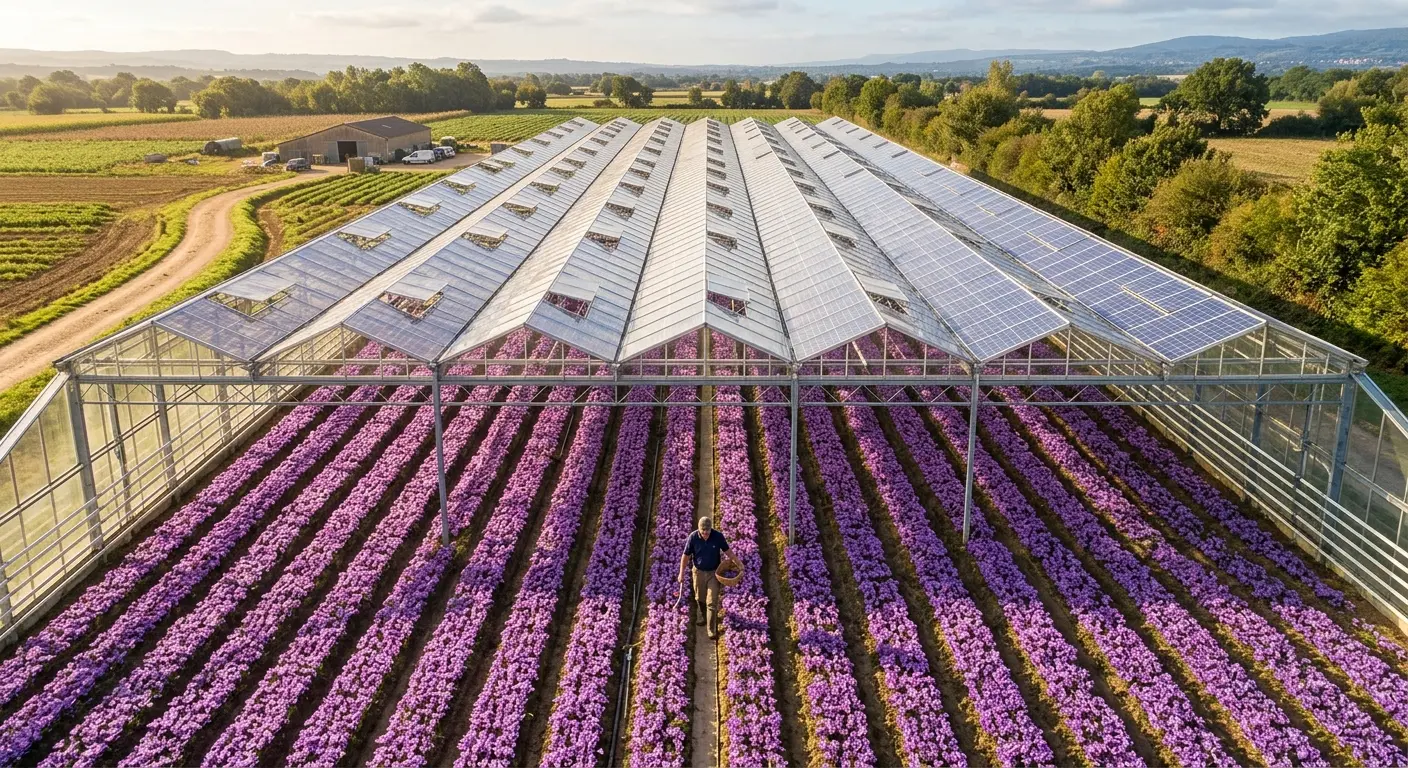
Colorado State University researchers reported in 2026 that saffron grown beneath semi-transparent solar panels rated at 40% transparency produced twice as many flowers and twice the dried spice yield of unshaded rooftop plots. The CSU five-year model projects over $61,000 in net revenue from a 4,356-square-foot rooftop growing space — including electricity sales, dried saffron, and corm sales.
Why does saffron thrive under panels? Saffron evolved in the mountainous regions of Iran and the Mediterranean, where it experiences natural light moderation. Research from Morocco found that 30% shade optimizes stigma yield by reducing water stress and temperature extremes. Semi-transparent panels that transmit 30% to 40% of incoming sunlight, mounted six to eight feet above the growing surface, produce the best results.
Leafy Greens : The Yield Boosters
A separate 2026 study published in Environmental Research Letters found that agrivoltaics improved yields by +43% to +127% for leafy vegetables grown under panels, while simultaneously reducing water consumption. Lettuce and broccoli are the most promising candidates for this configuration.
Tomatoes : The Surprise Performer
A Swiss greenhouse installation with 1,736 modules above tomato production reported a +1% yield increase compared to the control, while grid electricity consumption dropped by 35%. The harvest crews also reported better working conditions under the panels during heat waves.
The Comparison : What Works and What Does Not
| Crop | Panel Configuration | Yield vs. Open Field | Key Driver |
|---|---|---|---|
| Saffron | Semi-transparent, 30–40% transmission, 6–8 ft clearance | +100% (double flowers and dried stigma) | Reduced water stress, optimal shade |
| Leafy Greens (lettuce, broccoli) | Semi-transparent or opaque, 8–10 ft clearance | +43% to +127% | Reduced heat stress, improved water use efficiency |
| Tomatoes (greenhouse) | Opaque panels on greenhouse roof | +1% | Reduced cooling load, stable microclimate |
| Wheat / Corn | Not recommended for overhead AV | -10% to -20% (estimated) | Insufficient light for grain fill |
| Pasture / Hay | Vertical bifacial (see Article 2) | 95–99% land retention | Panels between crop rows |
The Numbers Behind the Success : Saffron Agrivoltaics ROI
The CSU saffron model is the most detailed agrivoltaic financial projection available in 2026. Here is the breakdown.
System Assumptions :
- Rooftop array : 46 kW
- Growing area : 4,356 sq ft
- Panel transparency : 40%
- Saffron price assumption : $35 per gram
- Corm price assumption : $0.25 each
- Model period : 5 years
Five-Year Projected Revenue :
| Revenue Stream | 5-Year Total | Annual Average |
|---|---|---|
| Electricity sales | $13,470 | $2,694 |
| Dried saffron sales | ~$42,000 | ~$8,400 |
| Corm sales | ~$5,500 | ~$1,100 |
| Total Net Revenue | ~$61,000 | ~$12,200 |
Critical Caveat : The first year runs at a loss due to corm purchase costs. The University of Vermont’s cost analysis puts corm investment at roughly $100,000 per acre before a single flower opens. This is a significant barrier for new growers.
Payback Period : Assuming a corm investment of $15,000 for the 4,356 sq ft area (scaled from the per-acre figure), the system reaches positive cumulative cash flow by Year 3. The five-year model projects a cumulative ROI of approximately 165% on the corm investment.
For a 1-Acre Commercial Saffron Agrivoltaic System :
| Item | Cost / Revenue |
|---|---|
| Solar system (50 kW, semi-transparent) | $75,000 – $95,000 |
| Corm purchase (Year 0) | $100,000 |
| Annual electricity revenue | $2,700 – $3,200 |
| Annual saffron revenue (steady state) | $150,000 – $190,000 |
| Simple payback | 3–4 years (after Year 0 loss) |
Expert Tips
1. The corm supply chain is your biggest risk. There is no domestic corm supply at scale in the United States. American growers currently import corms from Europe. Before you invest in an agrivoltaic saffron system, secure a corm supplier and verify the import timeline. A late corm delivery can push your first harvest back by a full year.
2. Panel transparency is not a percentage — it is a spectrum. “40% transparency” means the panel transmits 40% of incoming sunlight. But the quality of that light matters. Saffron responds differently to diffuse light than to direct light. Work with a panel supplier who can provide spectral transmission data, not just a single transparency number.
3. Do not harvest saffron with the same crew that manages your solar array. Saffron harvest occurs in October and November and requires delicate hand-picking — 159 to 179 flowers to produce a single gram of dried saffron. This is a specialized labor force. Do not assume your general farm crew can handle it.
4. Mount panels higher than you think. The CSU recommendation is 6 to 8 feet above the growing surface. Lower mounting reduces airflow, increases humidity, and creates a favorable environment for fungal diseases in saffron corms.
5. Start with a pilot plot, not a full field. The CSU model is a projection, not recorded sales. There are unresolved questions about whether growers can sell every gram at the assumed $35 price and find buyers for the corms. Start with a 500-square-foot test plot. Validate your yield and your sales channel before scaling.
Conclusion
Agrivoltaics is not a universal solution. It is a crop-specific, configuration-specific tool that works brilliantly for saffron, leafy greens, and greenhouse tomatoes — and poorly for wheat, corn, and other full-sun field crops.
The 2026 data is compelling : saffron yields double under semi-transparent panels, leafy green yields increase by 43% to 127%, and the five-year net revenue from a single rooftop system can exceed $60,000. But the corm investment is real, the first year runs at a loss, and the sales channels for specialty crops are not guaranteed.
If you are a specialty crop grower — particularly in saffron, lettuce, or greenhouse tomatoes — agrivoltaics deserves a serious feasibility study. If you grow commodity field crops, wait for the vertical bifacial configuration covered in the next article.
Frequently Asked Questions
Q: Does agrivoltaics reduce crop yields?
It depends on the crop and the panel configuration. For saffron, semi-transparent panels at 40% transparency doubled flower count and dried stigma yield compared to unshaded plots. For leafy greens, yields increased by 43% to 127%. However, for commodity field crops like wheat and corn, overhead agrivoltaics typically reduces yields by 10% to 20%. The key is matching panel transparency and mounting height to the specific crop’s light requirements.
Q: What crops grow best under solar panels?
The best-performing agrivoltaic crops in 2026 trials are saffron (double yield under 40% transparency panels), leafy greens including lettuce and broccoli (+43% to +127% yield), and greenhouse tomatoes (+1% yield with 35% lower electricity consumption). Pasture and hay can also work with vertical bifacial configurations, which retain 95% to 99% of agricultural land. Commodity grain crops are generally not suitable for overhead agrivoltaics.
Q: How much does an agrivoltaic system cost per acre?
Costs vary significantly by configuration. Vertical bifacial systems cost $1.40 to $1.80 per watt, or roughly $420,000 to $900,000 per hectare. Elevated stilt systems for arable crops cost $2.00 to $2.33 per watt, or $1.0 million to $1.6 million per hectare. Greenhouse-integrated semi-transparent systems are the most expensive at $3.50 to $5.00 per watt. These figures are before federal ITC and USDA REAP incentives, which can reduce net cost by 30% to 50%.
© 2026 Farm Solar Guide. All data sourced from ASAE water system standards, manufacturer cold-temperature specifications, EIA fuel price projections, and documented US farm operations. Last verified: September 28, 2026.