
Written by James Okonkwo a licensed Professional Engineer with 12 years of experience in solar mounting structures, specializing in agricultural applications. He has designed vertical bifacial installations for grain farms in Kansas, dairy operations in Wisconsin, and hay producers in Alberta. He holds a B.S. in Civil Engineering from Purdue University and an M.S. in Structural Engineering from the University of Illinois.
If you grow wheat, corn, hay, or run a dairy operation, every agrivoltaic proposal you have received has probably been rejected for the same reason: the panels take land out of production. Overhead systems require tall steel structures, wide row spacing, and expensive foundations. The cost premium is 25% to 40% above conventional ground-mount, and you lose productive acreage underneath the arrays.
For a 1,000-acre grain farm, losing even 10% of productive land to solar infrastructure is a non-starter. The math does not work when your crop margin is $150 to $250 per acre and the solar lease payment is $800 to $1,200 per acre.
But there is a configuration that changes the equation entirely: vertical bifacial solar. It is the fastest-growing agrivoltaic configuration in 2026, and for good reason.
Vertical Bifacial — Agri-PV Without the Land Compromise
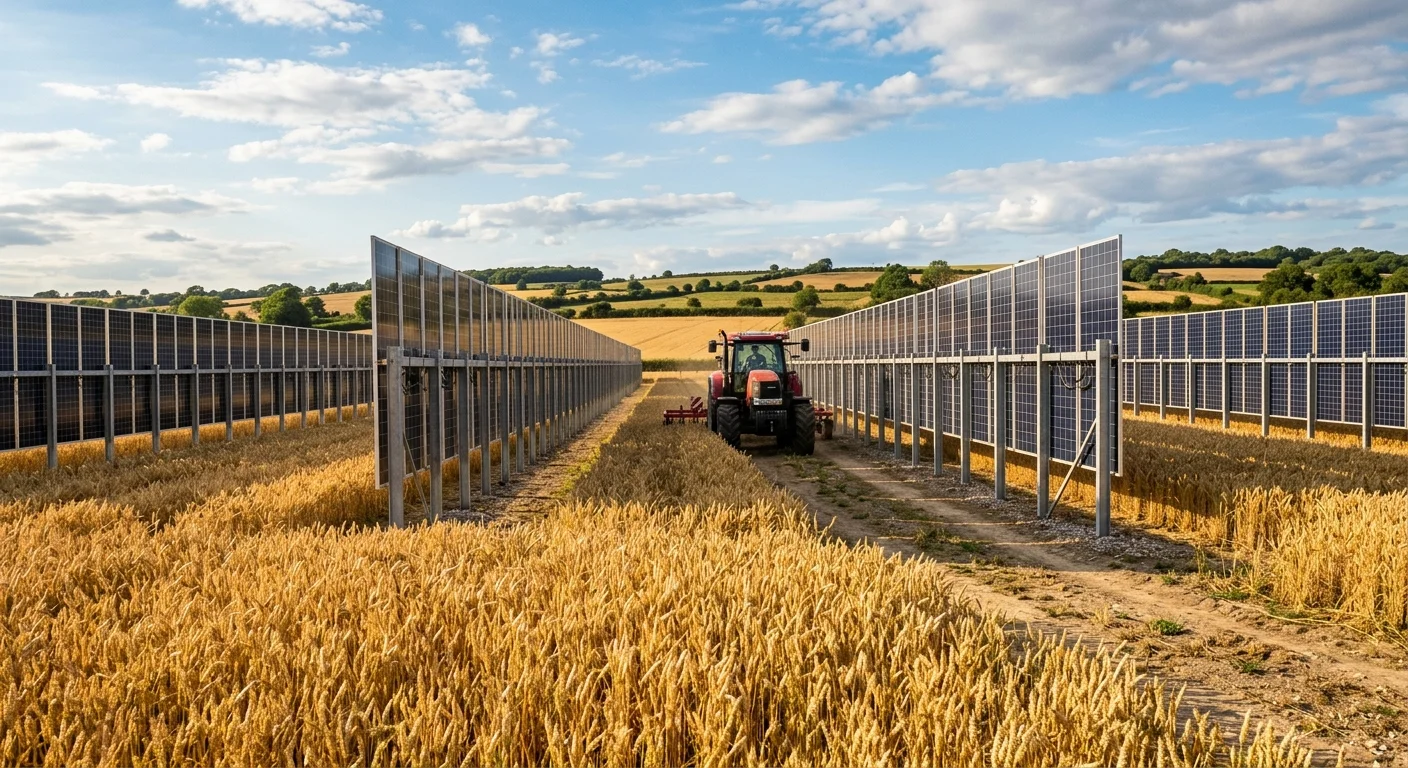
Vertical bifacial panels are mounted upright, like a fence, rather than tilted toward the sun. They capture sunlight on both faces — the front face in the morning, the back face in the afternoon — producing a distinctive dual-peak generation profile that matches farm electricity demand better than a conventional south-facing array.
The critical advantage for row crop farmers: you can drive a tractor between the rows. The panels are spaced 15 to 30 feet apart, depending on the crop and equipment width. The land between the panel rows remains in full agricultural production.
| Configuration | Cost Premium vs. Ground-Mount | Land Retained for Agriculture |
|---|---|---|
| Conventional ground-mount | 0% | 0% |
| Overhead agrivoltaics (stilt) | +25% to +40% | 80% – 100% (crop dependent) |
| Vertical bifacial | +10% to +20% | 95% – 99% |
Vertical bifacial costs 10% to 20% more than a conventional ground-mount system, compared to 25% to 40% for overhead agrivoltaics. And the land lease cost is roughly twice as high per MW because vertical systems require more land area for the same capacity. But for a farmer who wants to keep farming, that is a trade worth making.
The Comparison: Vertical Bifacial vs. Overhead Agrivoltaics
| Parameter | Vertical Bifacial | Overhead Stilt Agrivoltaics |
|---|---|---|
| Cost premium | +10% to +20% | +25% to +40% |
| Land retained for crops | 95% – 99% | 80% – 100% (crop dependent) |
| Equipment access | Full — tractor passes between rows | Restricted — only between stilt rows |
| Snow management | Self‑shedding (vertical panels) | Requires manual clearing |
| Hail resistance | High (vertical orientation) | Moderate |
| Generation profile | Dual‑peak (morning + afternoon) | Single peak (midday) |
| Best for | Wheat, corn, hay, pasture | Vegetables, specialty crops, greenhouse |
| Typical installed cost | $1.40 – $1.80/W | $2.00 – $2.33/W |
The Numbers Behind the Success: Vertical Bifacial ROI for a 500-Acre Grain Farm
System Assumptions:
- Farm size: 500 acres
- Solar capacity: 1 MW (vertical bifacial)
- Panel spacing: 20 feet between rows
- Land occupied by panels: ~5 acres (1% of farm)
- Land retained for crop: 495 acres (99%)
- Installed cost: $1.60 per watt (mid-range)
- Gross system cost: $1,600,000
- ITC (30%): -$480,000
- MACRS depreciation (5-year, ~25% effective benefit): -$400,000
- Net system cost after incentives: $720,000
Annual Financial Performance:
| Item | Annual Value |
|---|---|
| Electricity generated (1 MW, ~1,500 MWh/yr at 15% capacity factor) | 1,500 MWh |
| Electricity value (at $0.10/kWh farm rate) | $150,000 |
| Crop revenue from retained land (495 acres × $200/acre) | $99,000 |
| Total annual revenue | $249,000 |
| O&M cost | -$25,000 |
| Net annual cash flow | $224,000 |
| Simple payback (net cost / net cash flow) | 3.2 years |
25-Year Cumulative Cash Flow:
| Year | Net Cash Flow | Cumulative |
|---|---|---|
| 1 | $224,000 | $224,000 |
| 2 | $224,000 | $448,000 |
| 3 | $224,000 | $672,000 |
| 4 | $224,000 | $896,000 |
| 5 | $224,000 | $1,120,000 |
| 25 | $224,000 | $5,600,000 |
After the 3.2-year payback, the system generates $224,000 per year in net cash flow** for the remaining 22 years — a total 25-year net return of **$5.6 million on a $720,000 net investment.
Expert Tips
1. The MPPT trap: string sizing changes completely with bifacial vertical. Vertical bifacial panels produce different voltage and current characteristics than tilted monofacial panels. If your installer uses a conventional string sizing calculation, you will lose 10% to 15% of your potential generation. Insist on a bifacial-specific string design.
2. Panel spacing is a crop decision, not just an energy decision. The optimal row spacing for wheat is different from the optimal spacing for hay. Wheat can tolerate closer spacing (15–20 feet) because the crop is harvested before the panels cast long shadows. Hay and pasture need wider spacing (25–30 feet) to maintain forage quality. Match the spacing to your crop rotation.
3. Vertical panels are self-cleaning in snow — but not in dust. The vertical orientation means snow slides off naturally, which is a major advantage in northern climates. However, dust and pollen accumulate on both faces. Budget for a twice-yearly cleaning, especially if you are near a gravel road or in a high-pollen area.
4. Check your utility’s interconnection rules for dual-peak generation. The dual-peak profile of vertical bifacial systems produces more electricity in the morning and evening, when grid demand is higher. Some utilities offer time-of-use rates that pay more for electricity during these periods. If your utility offers TOU rates, the vertical bifacial system’s economics improve significantly.
5. The land lease cost is higher per MW — factor that into your decision. Vertical systems require roughly twice the land area per MW compared to conventional ground-mount. If you are leasing land to a developer rather than owning the system yourself, the lease payment per acre will be lower. Run the numbers for your specific situation before committing.
Conclusion
Vertical bifacial solar is the agrivoltaic configuration that finally makes sense for grain, hay, and dairy operations. It costs 10% to 20% more than conventional ground-mount, retains 95% to 99% of agricultural land, and pays back in roughly 3.2 years on a 500-acre farm with a 1 MW system.
The dual-peak generation profile is a bonus that becomes a major advantage if your utility offers time-of-use rates. The self-shedding snow behavior is a practical benefit in northern climates. And the ability to drive your tractor between the panel rows means your farming operation continues without compromise.
If you have rejected agrivoltaics in the past because it took land out of production, vertical bifacial is the configuration that deserves a second look.
Frequently Asked Questions
Q: What is a vertical bifacial solar system?
A: A vertical bifacial solar system uses panels mounted upright, like a fence, rather than tilted toward the sun. The panels capture sunlight on both faces — the front in the morning and the back in the afternoon — producing a dual-peak generation profile. For farms, the key advantage is that the panels can be spaced 15 to 30 feet apart, allowing tractors and equipment to pass between the rows while the land remains in agricultural production.
Q: Can you farm between vertical solar panels?
A: Yes. Vertical bifacial panels are spaced widely enough for tractors, combines, and other farm equipment to pass between the rows. This configuration retains 95% to 99% of agricultural land for crop production. It is suitable for wheat, corn, hay, pasture, and other row crops. The spacing can be adjusted based on your equipment width and crop rotation.
Q: Are vertical solar panels better for snow?
A: Yes. Vertical solar panels shed snow naturally because of their upright orientation. Snow slides off the smooth glass surface rather than accumulating on top of the panels as it would on a tilted array. This eliminates the need for manual snow clearing, which is a significant maintenance advantage in northern climates. However, vertical panels do require periodic cleaning for dust and pollen accumulation on both faces.
© 2026 Farm Solar Guide. All data sourced from ASAE water system standards, manufacturer cold-temperature specifications, EIA fuel price projections, and documented US farm operations. Last verified: September 29, 2026.