
Written by Sarah Mitchell a Certified Public Accountant with 14 years of experience in agricultural tax planning and land transactions, specializing in renewable energy leases. She has reviewed and negotiated solar lease agreements for farm landowners across the Midwest and Mid-Atlantic. She holds a B.S. in Accounting from the University of Iowa and is a member of the National Society of Accountants.
The Problem
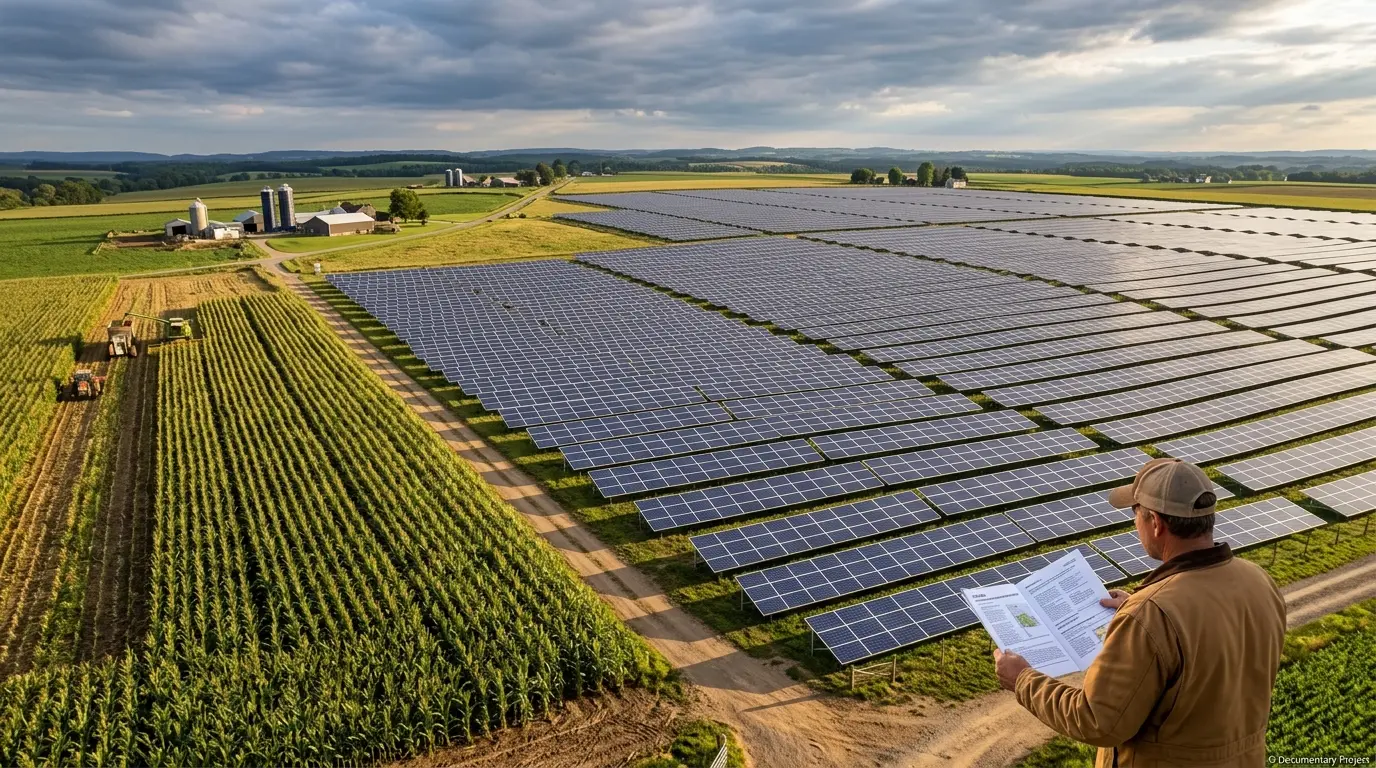
The offer arrives as a letter, or a phone call, or a knock on the door. A developer wants to lease a portion of your farmland for a utility-scale solar project. The numbers sound generous — often several times what the land earns in crop production. The term is long, but the payments are annual and the work is zero.
For many landowners, this is genuinely a good opportunity. Marginal land, land with drainage problems, land that is being farmed at a loss, or land near a substation with available interconnection capacity can generate far more income under a solar lease than under any crop rotation.
But the offer is also where the risk begins, because the lease you sign will govern the use of that land for 25 to 40 years. That is longer than most farm operating careers. The terms you accept in a moment of enthusiasm will outlast the developer who signs them, the project manager who negotiated them, and possibly the utility that buys the power.
Three problems recur in nearly every farm solar lease I review.
First, the initial offer is almost always below market. Developers begin with an anchor number designed to be accepted, and landowners who do not know the range of current rates routinely accept 30% to 50% less than they could have negotiated.
Second, the reclamation and decommissioning terms are usually inadequate. The lease describes what happens if the project is built — rarely what happens if it is abandoned, and almost never with a secured financial mechanism to guarantee cleanup.
Third, the land use restrictions are frequently broader than the project requires. Easements, access roads, and buffer zones can consume far more acreage than the array itself, reducing the land you can still farm and the land you can sell.
The Solution: The Five Clauses That Determine Everything
Lease agreements are long, technical, and full of boilerplate. But the financial outcome is determined by five clauses.
1. Rent escalation and rate structure.
Rent is typically quoted as a per-acre annual payment, sometimes with an escalation clause. The key questions: What is the starting rate? What is the escalation percentage, and is it fixed or tied to an index? Is the rate paid on the full leased acreage, or only on the acreage actually occupied by equipment?
The last point matters enormously. A lease that pays on 40 acres but grants access to 120 acres is a much worse deal than it appears.
2. Term and renewal options.
A 30-year initial term with two 10-year renewal options is effectively a 50-year commitment. Renewal options are usually exercisable at the developer’s sole discretion, which means the landowner bears the risk that the project is no longer economic while having no ability to reclaim the land.
Negotiate limits on renewals, require notice periods, and consider whether renewal should be at the developer’s option or subject to renegotiation.
3. Decommissioning and financial assurance.
What happens when the project reaches the end of its life? Who removes the panels, foundations, and cabling? Who restores the topsoil? And — critically — how is that obligation financially secured?
A decommissioning clause without a bond, letter of credit, or escrow account is a promise from a company that may not exist in 30 years. Insist on a secured financial mechanism, with the amount reviewed periodically, and with the landowner named as a beneficiary.
4. Topsoil protection and restoration standards.
Solar construction involves heavy equipment, trenching for cabling, and pile driving for racking. Topsoil can be compacted, mixed with subsoil, or removed entirely. Specify that topsoil be stripped and stockpiled separately during construction, that compaction be remediated, and that restoration return the land to its prior agricultural capability — not merely to a visually acceptable state.
5. Dual-use and land access rights.
If the project leaves open acreage between or around arrays, who controls it? Can you continue to graze livestock, plant crops, or harvest hay? A well-negotiated dual-use clause can preserve agricultural income on land the project does not physically occupy. A poorly negotiated one gives the developer the right to restrict your access to land you are no longer being paid for.
The Numbers Behind the Success: 2026 Lease Rates and 30-Year Comparison
2026 estimated lease rate ranges (per acre, per year):
| Land Class | Typical Range | Notes |
|---|---|---|
| Prime row crop (high yield, flat, drained) | $1,000 – $1,400 | Highest rates near transmission with available capacity |
| Average row crop | $800 – $1,100 | The most common negotiated band |
| Pasture and hay ground | $600 – $900 | Lower rates, but often the best relative improvement over current income |
| Marginal or problem ground | $500 – $800 | Best candidates for lease; current income may be near zero |
| Land requiring significant grading or drainage | $400 – $700 | Developer costs reduce the rate offered |
30-year comparison: continued farming vs. solar lease on 100 acres of average row crop land
Assumption A — Continued farming:
- Net return after all costs: $200 per acre per year
- 100 acres × $200 = $20,000 per year
- 30-year total: $600,000
Assumption B — Solar lease at $950 per acre:
- 100 acres × $950 = $95,000 per year
- With 2% annual escalation, Year 30 payment = $95,000 × (1.02)^29 = $169,000
- 30-year total (escalating): approximately $3,850,000
| Scenario | Year 1 Annual Income | 30-Year Total |
|---|---|---|
| Continued row crop farming | $20,000 | $600,000 |
| Solar lease (no escalation) | $95,000 | $2,850,000 |
| Solar lease (2% escalation) | $95,000 | ~$3,850,000 |
The gap is real — but so is the commitment. That 30-year total assumes the developer honors the lease, the project is built, the payments escalate as agreed, and the land is restored at the end. Every one of those assumptions is a contract term. The rate on the front page is the least important number in the document.
Tax note: Solar lease income is generally treated as rental income, not farm income, which means it may not be eligible for certain agricultural tax treatments and may affect your eligibility for farm programs. Consult your CPA before signing.
Expert Tips
1. Never sign the first offer, and never sign without a landowner-side attorney. Solar lease negotiation is a specialized area. A general practice attorney may not have seen enough of these agreements to identify the traps. Retain counsel who has negotiated solar leases specifically, and factor the legal cost into your decision — it is typically a few thousand dollars against a contract worth millions.
2. The reclamation clause is the one to fight hardest for. Developers resist secured decommissioning obligations because it ties up capital. Landowners who accept an unsecured promise are accepting the risk that they inherit a field of abandoned equipment. A bond, letter of credit, or escrow account is the only meaningful protection.
3. Watch the acreage definition carefully. Distinguish between “leased acreage,” “occupied acreage,” and “access easement acreage.” The payment should be based on the full acreage you are giving up, not just the footprint of the panels. Access roads, buffer zones, and setback areas are all land you can no longer farm.
4. Negotiate the dual-use clause before construction, not after. Once the array is built, you have no leverage. Before construction, you can require that open acreage remain available for grazing, haying, or specialty crop production — and that the developer not restrict your access.
5. Consider the resale implications before you sign. A property encumbered by a 30-year lease with renewal options is harder to sell and may appeal to a narrower set of buyers. If you intend to sell the farm within the lease term, understand that the lease transfers with the land and becomes part of the buyer’s decision.
6. Ask about interconnection capacity before you negotiate rate. A project only proceeds if the developer can secure grid interconnection. If the local substation has limited capacity, the project may never be built, and you will have spent time and legal fees for nothing. Ask the developer directly: has interconnection been secured, and at what capacity?
7. If the project is never built, what happens? Many leases include a development period before construction. What are you paid during that period? Can you still farm the land? How long does the developer have before the lease terminates automatically? These terms matter if the project stalls.
Conclusion
Leasing farmland to a solar developer can be an excellent financial decision. On average row crop land, a solar lease may generate four to six times the net income of continued crop production over a 30-year horizon, with dramatically lower risk and no labor requirement. For marginal land, the relative improvement can be even larger.
But the rate on the first page of the offer is not the deal. The deal is the escalation clause, the term and renewal structure, the decommissioning security, the topsoil restoration standard, and the land access terms. Those five clauses determine whether you have a durable income stream and recoverable land, or a long-term encumbrance with uncertain cleanup obligations.
Get your own attorney. Negotiate the reclamation security. Define the acreage precisely. And remember that the developer’s first number is a starting position, not a market rate.
Frequently Asked Questions
Q: How much do solar companies pay to lease farm land?
A: In 2026, estimated lease rates range from roughly $400 to $1,400 per acre per year depending on land class, location, and interconnection availability. Prime row crop land near available transmission capacity is at the high end, often $1,000 to $1,400 per acre. Average row crop land typically negotiates in the $800 to $1,100 range. Pasture and hay ground ranges from $600 to $900. Marginal or problem ground, which is often the best candidate for leasing, ranges from $500 to $800. These are market estimates for planning purposes; actual rates are negotiated and vary widely by project.
Q: How long do solar land leases last?
A: Most utility-scale solar land leases run 25 to 40 years for the initial term, frequently with one or two renewal options of 5 to 10 years each. Renewal options are typically exercisable at the developer’s discretion, which means the effective commitment can extend to 50 years or more. Landowners should negotiate limits on renewals, require advance notice periods, and consider whether renewal terms should be subject to renegotiation rather than fixed in advance.
Q: Can I farm around solar panels on leased land?
A: It depends on the lease terms, and this must be negotiated before construction. If the project is a traditional utility-scale array, most of the leased acreage is occupied or restricted. If the project is an agrivoltaic design, open acreage between or beneath arrays may remain available for grazing, haying, or certain crops. A dual-use clause should specify what activities remain permitted, who controls access, and whether the developer can restrict your use of land that is not physically occupied by equipment. Negotiate this before signing, because after construction you have no leverage.
Related Articles
- Agrivoltaics 2026: Which Crops Actually Thrive Under Solar Panels? — Dual-use options for land under lease.
- Vertical Bifacial Solar for Farms: The 2026 ROI for Grain & Dairy — The configuration most compatible with continued farming.
© 2026 Farm Solar Guide. All data sourced from ASAE water system standards, manufacturer cold-temperature specifications, EIA fuel price projections, and documented US farm operations. Last verified: October 7, 2026