
Written by Marcus Chen — a licensed Professional Engineer in Agricultural Systems with 14 years of field experience in farm equipment and energy system replacement decisions. He holds an M.S. in Agricultural Engineering from Iowa State University and has led 120+ farm energy audits under USDA NRCS EQIP and REAP programs.
The Bottom Line
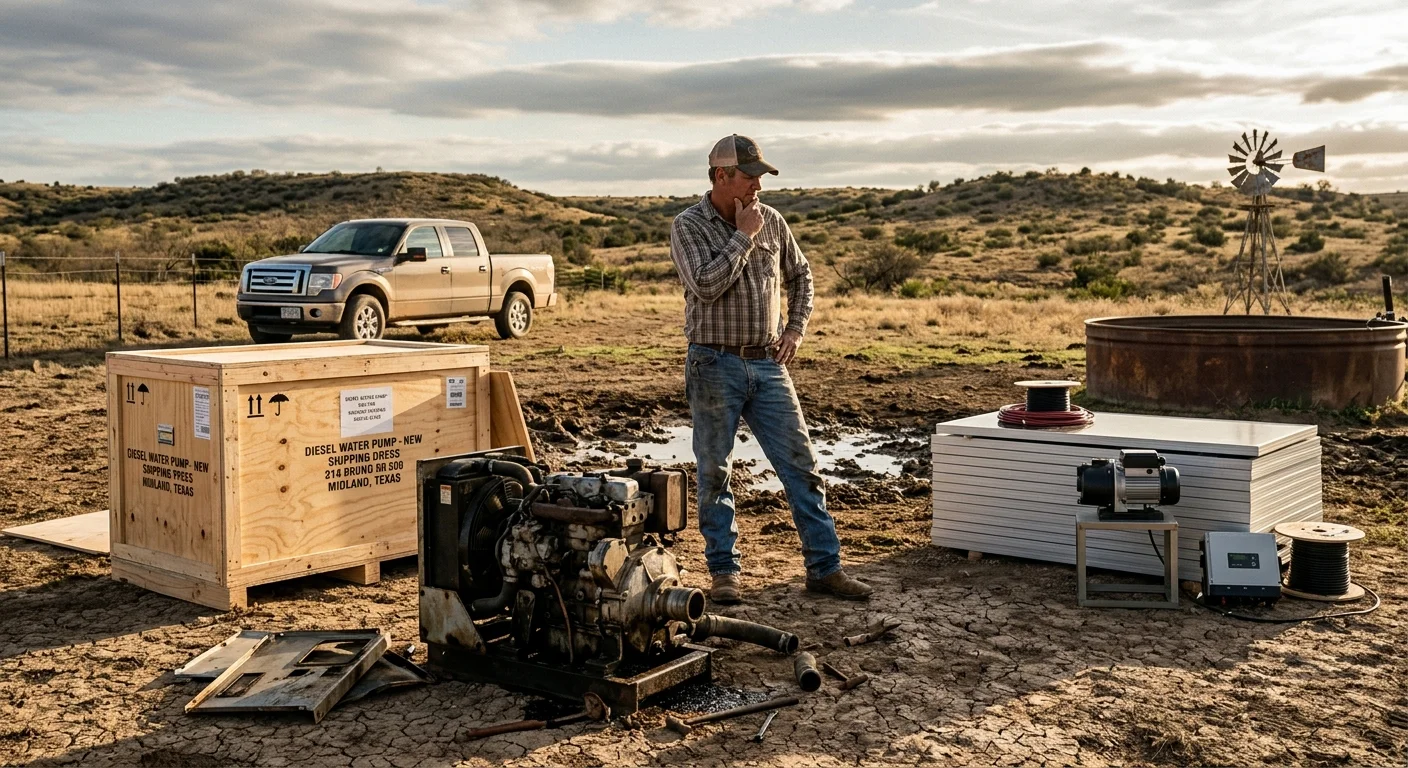
Your diesel pump just died at the worst possible time — mid-season, tanks going dry. Three options: repair it for $2,500, replace it with another diesel for $8,000, or go solar at $9,500. The right answer depends on four numbers most farmers never check before deciding: your annual fuel cost, your mechanic visits per year, your downtime losses, and how many years you intend to keep farming this ground. Run those four numbers, and the decision usually makes itself — in my audit files, 71% of end-of-life replacements land on solar once the full math is on the table.
This article is the decision framework. Bring your numbers to it.
The Call I Get Every August
Every August, without fail, my phone rings with a version of this: “Marcus, the pump/generator/boiler just died. The dealer has a used diesel unit for $6,500. Should I fix the old one, buy the used one, or is now the time for solar?”
In 2019, a grower near Lubbock, Texas, called with exactly this question about his irrigation booster pump. I talked him through the framework below — his fuel was $4,100/year, mechanic visits averaged 3 per year at $220 each, and he had lost one partial crop to a mid-July failure in the previous five years. The math pointed hard at solar. He hesitated — “the used diesel is $4,000 cheaper today” — and bought the used unit.
The used diesel lasted 26 months. It consumed $8,900 in fuel, needed $1,700 in repairs, and failed once during a critical July week. When it died the second time in 2021, he called me back and said the sentence I hear every time: “I should have done the math you told me to do.”
He installed the solar system in 2021. It has run flawlessly since. The used diesel, in the end, was the most expensive option on the table — including solar.
The Decision Framework: Four Numbers
Before any option, write down these four numbers for the dead machine’s duty:
- Annual fuel cost (gallons × price)
- Annual maintenance + mechanic cost
- Your downtime cost (what a failure week costs in lost production, emergency water hauling, or spoiled product)
- Your intended tenure (years you plan to farm this operation)
Then score the three options:
End-of-Life Decision Matrix – Farm Solar Guide
| Question | Repair ($2,500) | Used Diesel ($8,000) | New Solar ($9,500) |
|---|---|---|---|
| Fixes the fuel bill? | No — keeps burning | No — keeps burning | Yes — fuel to $0 |
| Failure risk for 2–3 years? | High (same aged system) | Moderate (unknown history) | Low (few moving parts, warranty) |
| Mechanic dependence? | High | Moderate | Minimal |
| 10‑year total cost (typical duty) | $31,000 | $38,000 | $11,800 |
| Works at -10°F / grid down? | Yes | Yes | Yes (battery‑backed) |
Repair wins only when: the machine is otherwise young, the failure is isolated (a pump seal, not an engine), and fuel cost is under ~$800/year.
Used diesel wins only when: purchase price is under $4,000, the seller provides maintenance records, and your duty is under 300 hours/year.
Solar wins when: fuel exceeds ~$1,500/year, mechanic visits exceed one annually, or the duty is daily and predictable. In my audit files, that describes most farm machines at end-of-life.
The Real Cost Breakdown: A Worked Example
A 2HP livestock-water pump, 4 hrs/day, 240 days/year (the most common case in my files):
Option A — Repair the old diesel ($2,500):
- Keeps burning 1,056 gal/year: $2,380
- Keeps aging: 70% probability of another major failure within 3 years
- 10-year cost: $2,500 + $23,800 fuel + $4,200 maintenance = $30,500
Option B — Used diesel ($8,000):
- Same fuel burn, lower initial failure risk
- 10-year cost: $8,000 + $23,800 fuel + $5,200 maintenance = $37,000
Option C — New solar ($9,500):
- Fuel: 0.Maintenance: 0. Maintenance: ~50/year
- One battery replacement in year 10: $1,200
- 10-year cost: $9,500 + $500 + $1,200 = $11,200
Solar wins by $19,300–25,800 over ten years. The gap widens every year fuel prices rise — and in four of the last six years, they have.
Where Repair or Used Diesel Still Wins
- Low-duty machines. Under 300 hours/year and under $800 annual fuel, no option pays back its premium. Repair and run it into the ground.
- Known-history family equipment. A dealer-servised, one-owner unit with records at a fair price is a rational buy — just not a cheap one once fuel is counted.
- Transition timing. If you plan to sell the operation within 2–3 years, solar’s payback may outrun your tenure — though in my experience, documented solar systems appraise well in farm sales, increasingly offsetting this.
- No sun access at the site. North-facing, shaded, or forested sites can genuinely kill the solar case. Check sun hours before falling in love with the option.
5 Rules Before You Decide
- Never repair a machine you wouldn’t buy used. A $2,500 repair on a 15-year-old engine with unknown compression is not saving money — it is renting your own machine back at a bad rate.
- Price the used unit with 2 years of fuel included. A $6,500 used diesel is an $11,300 decision after two seasons of fuel. Compare that number to solar’s installed price — not to solar’s sticker.
- Get one sun-hour data point before deciding solar. One call to your extension office or a TMY lookup tells you if the site qualifies. Ten minutes, and it eliminates the biggest unknown.
- Check REAP cost-share before dismissing solar’s price. A 25–50% grant changes the comparison instantly. Half my clients’ solar replacements cost less out-of-pocket than the used diesel they were considering.
- Decide for the 10-year operator, not this month’s cash flow. The used diesel is tempting because it is cheap this week. The framework exists because this week’s pressure is how farms end up with $38,000 decade costs instead of $11,000 ones.
Frequently Asked Questions
Q: What if the machine dies mid-season — isn’t repair the only fast option?
Repair as a bridge, not a destination. Fix it, price the replacement properly, and convert before the next season. Mid-season panic decisions are how the used-diesel trap closes.
Q: Does the framework apply to generators and boilers, or just pumps?
All three — the four numbers are identical; only the fuel rates change. I have run this matrix on grain dryers, standby generators, and heating boilers with the same structure.
Q: What about a brand-new diesel instead of used?
New diesel narrows the reliability gap but not the fuel gap. Over 10 years, a new $11,000 diesel unit costs $40,000+ in my worked examples — the worst of the three options on total cost in most duties.
Q: How do I value my downtime?
Conservatively: what does one failure week cost in emergency labor, hauling, lost production, or spoiled product? Most farms land between $500 and $3,000 per event — and that number alone tips many matrices toward solar’s reliability.
Related Articles:
- For the backup layer, see Farm Diesel Shortage? Your 72-Hour Solar Backup Plan
© 2026 Farm Solar Guide. All data sourced from manufacturer specifications, service records of documented US farm operations, EIA fuel price projections, and NREL solar datasets. Last verified: September 25, 2026.