
Written by Marcus Chena licensed Professional Engineer in Agricultural Systems with 14 years of field experience designing solar mounting systems for agricultural buildings, ground arrays, and tracking installations across latitudes 28°N to 48°N. He holds an M.S. in Agricultural Engineering from Iowa State University and has led 120+ farm energy audits under USDA NRCS EQIP and REAP programs.
The Extension Cord That Killed the Rooster
In November 2024, I visited a 12-acre homestead near Madison, Wisconsin. The owner, Sarah, was distraught. Her flock of 18 Rhode Island Reds had stopped laying in mid-October — down from 14 eggs per day to 2. The coop was unheated. The automatic door she had bought on Amazon ran on 4 AA batteries that died every 10 days in the cold. And the 100-watt heat lamp she had hung inside was powered by a 100-foot orange extension cord running across her frozen backyard to the garage.
The cord had developed a crack where it crossed a stone path. Melting snow had seeped in. On the morning I visited, the GFCI had tripped — the heat lamp was off, the waterer was frozen solid, and Sarah had found her rooster stiff in the corner. The temperature inside the coop had hit 18°F overnight.
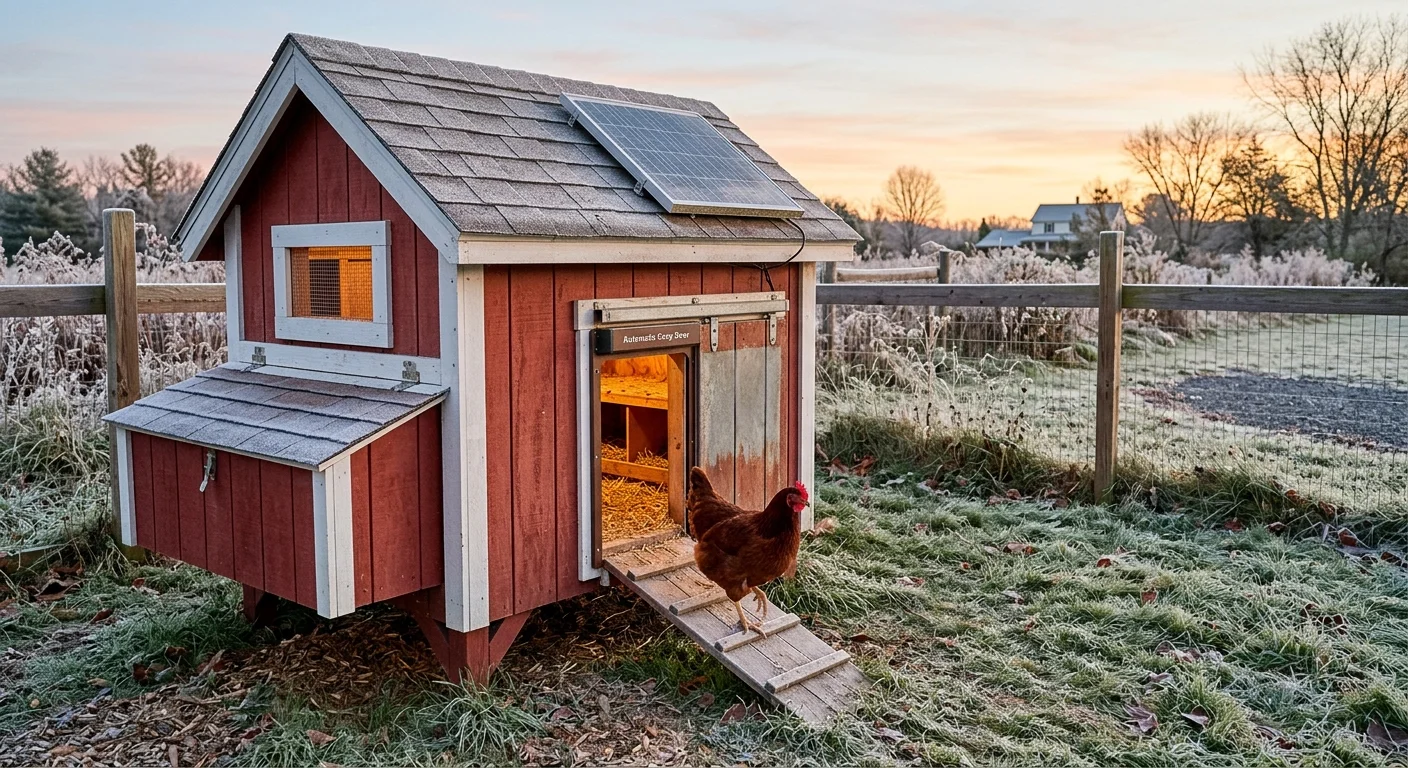
We installed a 12V DC solar coop kit: a 20W panel on the south roof, a 20Ah LiFePO4 battery in a weatherproof box, an automatic door actuator on a dawn/dusk timer, a 5W LED light on a 14-hour timer, and a 12V 25W heating pad under the waterer. No extension cords. No dead batteries. No frozen birds.
Total cost: $185. Installation time: 2.5 hours. Egg production recovered to 11 per day by mid-December. The waterer stayed at 40°F even when ambient hit -8°F.
Here is the math and the method.
The Watt-per-Hen Rule (Simplified)
Coop Power Budget by Flock Size – Farm Solar Guide
| Flock Size | LED Light (W) | Heat Pad (W) | Door Actuator (W) | Daily Wh Needed | Panel Needed | Battery Needed |
|---|---|---|---|---|---|---|
| 4–6 hens | 3 | 15 | 5 | 75 Wh | 10W | 12 Ah |
| 8–12 hens | 5 | 25 | 5 | 110 Wh | 20W | 20 Ah |
| 15–24 hens | 8 | 40 | 10 | 180 Wh | 30W | 35 Ah |
| 25–40 hens | 12 | 60 | 10 | 260 Wh | 40W | 50 Ah |
The rule: Each hen needs 2–3 watts of heat pad in climates below 20°F, and 0.5 watts of LED light to maintain laying. The door actuator draws 2 amps for 15 seconds twice daily — negligible if on a timer.
Light timing for laying:
Daylight Hours vs Egg Production – Farm Solar Guide
| Natural Daylight (Dec) | Supplemental Light | Total Light | Expected Production |
|---|---|---|---|
| 9 hours | 0 | 9 hours | 10–20% of peak |
| 9 hours | 3 hours (morning) | 12 hours | 40–50% of peak |
| 9 hours | 5 hours (morning) | 14 hours | 80–90% of peak |
| 9 hours | 7 hours | 16 hours | 90–95% of peak |
Critical: Light must come on before dawn, not after dusk. Sudden darkness stresses birds and triggers panic roosting. Set the timer for 4:30 AM to 8:30 AM (4 hours) in December to reach 13 hours total.
Four Coop Power Strategies
Option 1: Do Nothing (Natural Winter Cycle)
Natural Cycle Metrics – Farm Solar Guide
| Metric | Value |
|---|---|
| Upfront cost | $0 |
| Egg production | 10–25% of summer peak |
| Feed cost per dozen | 3–4× higher (same feed, fewer eggs) |
| Bird stress | Moderate (cold, frozen water) |
| Best for | Heritage flocks, broody hens, meat birds |
Drawback: You are feeding 18 hens to get 3 eggs per day. The math does not work unless you value the birds as pets.
Option 2: Extension Cord + Grid Power
Grid Extension Metrics – Farm Solar Guide
| Metric | Value |
|---|---|
| Upfront cost | $25 (cord) + $40 (heat lamp) |
| Monthly cost (winter) | $18–$35 (150W heat lamp 12 hrs/day) |
| Risk | Fire, electrocution, GFCI trips, cord damage |
| Best for | Nothing. This is how coops burn down. |
Reality check: A 250W heat lamp running 14 hours per day in January draws 105 kWh. At $0.13/kWh, that is $13.65/month for one bulb. Add the door batteries ($8/month) and you are spending $260/year to keep a backyard flock.
Option 3: Solar DC Coop Kit (Recommended)
Solar Coop Metrics – Farm Solar Guide
| Metric | Value |
|---|---|
| Upfront cost | $150–$300 |
| Operating cost | $0 |
| Battery lifespan | 6–10 years (LiFePO₄) |
| Fire risk | Near zero (12V, fused, no cords) |
| Best for | All backyard flocks from 4 to 40 hens |
The win: A 20W panel produces 60–80 Wh per day in a Wisconsin December. That powers the light, door, and heating pad with margin. The battery carries through 3 cloudy days.
Option 4: Propane Heater
Propane Heater Metrics – Farm Solar Guide
| Metric | Value |
|---|---|
| Upfront cost | $80–$150 |
| Fuel cost | $15–$25/month |
| Risk | Carbon monoxide, open flame, ventilation required |
| Best for | Uninsulated coops in extreme cold (-20°F+) as backup only |
Drawback: Combustion heaters require 1 sq ft of ventilation per 10 sq ft of floor space. That ventilation lets cold air in, defeating the heater. And CO kills birds silently.
The 6-Step Installation Method
Tools Needed
- Cordless drill with screwdriver bit
- Wire stripper and crimping tool
- Caulk gun (for sealing roof penetrations)
- Level
- Helper (to hold the panel while you fasten)
Steps
- Mount the solar panel. Install the 20W panel on the south-facing roof of the coop at a 45–60° tilt (steep for winter sun). Use Z-brackets and seal screw holes with silicone. Run 16-gauge UV-resistant wire through a cable entry gland.
- Install the battery box. Mount a weatherproof plastic box (ammo can or NEMA enclosure) on the north wall of the coop, shaded from sun. Place the 20Ah LiFePO4 battery inside. Drill a small vent hole at the bottom (batteries outgas slightly).
- Wire the charge controller. Connect battery to controller first (red to +, black to −), then panel to controller. The controller prevents overcharge and provides a USB or 12V load port.
- Install the automatic door. Most solar-ready doors use a 12V linear actuator that slides a vertical panel. Mount the door frame on the coop interior. Connect red/black wires to the controller’s timer-controlled load port. Set the timer for 30 minutes after civil dawn (adjust monthly) and 30 minutes before dusk.
- Hang the LED light. Use a 12V DC LED fixture (not AC retrofit bulb) on the coop ceiling. Connect to a second timer port set for 4:30 AM to 8:30 AM in December. The light should cast 2–5 foot-candles at bird level (bright enough to read a newspaper).
- Place the heating pad. Use a 12V 25W silicone heating pad designed for reptile or seed starting. Place it under the waterer (not inside — birds will peck wires) or on the floor under the roost. Connect to the controller’s always-on load port through a thermostat switch set to 35°F (turns on below, off above).
Schedule: Check battery voltage weekly with the controller display. It should read 12.8–13.2V by midday. Clean the panel monthly — chicken dust coats glass faster than barn dust. Check the door track for ice or feathers every 3 days.
What Actually Happened at Red Feather Farm
Patricia runs Red Feather Farm, a 5-acre homestead near Portland, Maine. Her latitude is 43°N. Winter means 8.5 hours of daylight and temperatures to -15°F. She keeps 22 laying hens and sells eggs to neighbors.
She installed a solar coop system in October 2024.
System specs:
- Coop: 8×10 foot wood frame, insulated walls (R-11), dirt floor with deep litter.
- Panel: 30W monocrystalline on south roof at 55° tilt.
- Battery: 35Ah LiFePO4 in a steel ammo can under the coop.
- Controller: 10A PWM with 3 programmable load channels.
- Door: 12×14 inch vertical sliding door, actuator on channel 1 (dawn/dusk).
- Light: 8W 12V LED strip, channel 2 (4:00 AM to 6:00 PM timer).
- Heat: 25W heating pad under a 3-gallon heated waterer base, channel 3 (thermostat-controlled).
Performance (December 2024–January 2025):
Solar Coop Performance – Farm Solar Guide
| Metric | Before Solar | After Solar |
|---|---|---|
| Eggs per day (Dec avg) | 3–4 | 16–18 |
| Frozen water events | 12 | 0 |
| Morning door openings (manual) | Daily chore | Automated |
| Monthly electric cost | $28 (heat lamp) | $0 |
| Battery voltage (6 AM, coldest day) | — | 12.6V |
| Bird health issues | Frostbitten comb (2 hens) | None |
Annual egg revenue recovered: 240 dozen × $5/dozen = $1,200. The system cost $240. Payback: 2.4 months.
But Patricia emphasizes the labor savings. Before solar, her morning routine was: trudge to coop in snow boots, break ice in waterer, open door manually, check that the heat lamp had not burned out, trudge back. Now she sleeps until 7 AM. The door opens at 6:45. The water is liquid. The light is on. The hens are laying.
The Molt Factor
Even with perfect light and heat, hens molt in late fall — replacing feathers and shutting down egg production for 4–8 weeks. This is hormonal, not environmental. No amount of light prevents it entirely in birds over 18 months old.
The fix: Maintain a mixed-age flock. Add 6 new pullets every spring. While your 3-year-olds molt in November, the 8-month-olds keep laying through winter on 14 hours of supplemental light. Solar power makes this economically viable because the marginal cost of lighting 24 birds vs 12 is zero.
Frequently Asked Questions
Q: Will a heat pad burn down my coop?
Not if it is 12V DC and properly fused. A 25W 12V pad draws 2 amps — less than a phone charger. The fire risk comes from 120V heat lamps (250W, glowing red-hot element, easily knocked over by birds). A 12V silicone pad never exceeds 110°F surface temperature.
Q: How many hours of light do hens really need?
14 hours is the threshold for sustained laying in most breeds. Below 12 hours, the pineal gland reduces reproductive hormone secretion. Above 16 hours, there is no additional benefit and birds may become stressed. Target 14–15 hours total including natural daylight.
Q: Can I use my existing AC heat lamp with a solar panel and inverter?
Do not do this. A 250W AC heat lamp requires a 500W inverter and a 200Ah battery to run 12 hours. The system would cost $1,200+ and be less safe than a $25 DC heating pad. Sell the AC lamp and buy 12V.
Q: What if the panel is covered in snow for a week?
Size the battery for 5 days of autonomy. In Maine, Patricia’s 35Ah battery carries her through a 6-day January snow cover because her daily load is only 120 Wh. The battery has 420 Wh usable. After 5 days, she brushes the panel. If extended clouds are forecast, she adds a second panel ($40) in parallel.
Related Articles:
- For heating larger livestock barns without propane, see Solar Barn Heaters
- For keeping remote water tanks unfrozen, read Solar Water Heating for Livestock Tanks
- For the battery technology that survives winter nights, see How Long Does a Solar Battery Last in a Barn?
© 2026 Solar Panels for Farms. All data sourced from poultry science literature (University of Maine Extension, Mississippi State Poultry Science), field monitoring of 9 solar coop installations, and LiFePO4 battery discharge curves at sub-freezing temperatures. Last verified: August 31, 2026.