
Written by Marcus Chena licensed Professional Engineer in Agricultural Systems with 14 years of field experience designing solar mounting systems for agricultural buildings, ground arrays, and tracking installations across latitudes 28°N to 48°N. He holds an M.S. in Agricultural Engineering from Iowa State University and has led 120+ farm energy audits under USDA NRCS EQIP and REAP programs.
The September Stink
In late September 2024, I received a call from a cattle rancher named Tom near Springfield, Missouri. His 3-acre stock pond — the sole water source for 60 head of Angus in his east pasture — had turned pea-soup green overnight. The surface was covered in a oily film. Cattle had stopped drinking. Two yearlings were showing signs of nitrate toxicity: lethargy, brown mucous membranes, staggering.
Tom had stocked 800 channel catfish in the pond in May. By September, he counted 12 dead floaters. The rest had vanished into the anoxic depths.
The problem was fall turnover. In summer, ponds stratify: warm oxygen-rich water on top, cold oxygen-depleted water below. When surface temperatures drop in September, the top layer cools, becomes denser, and sinks — forcing the bottom layer (full of decaying organic matter, hydrogen sulfide, and ammonia) to the surface. In 48 hours, dissolved oxygen can drop from 6 ppm to <1 ppm. Fish suffocate. Cattle drink poison.
Tom had no aeration. No water circulation. Just a stagnant bowl collecting runoff from a 40-acre watershed.
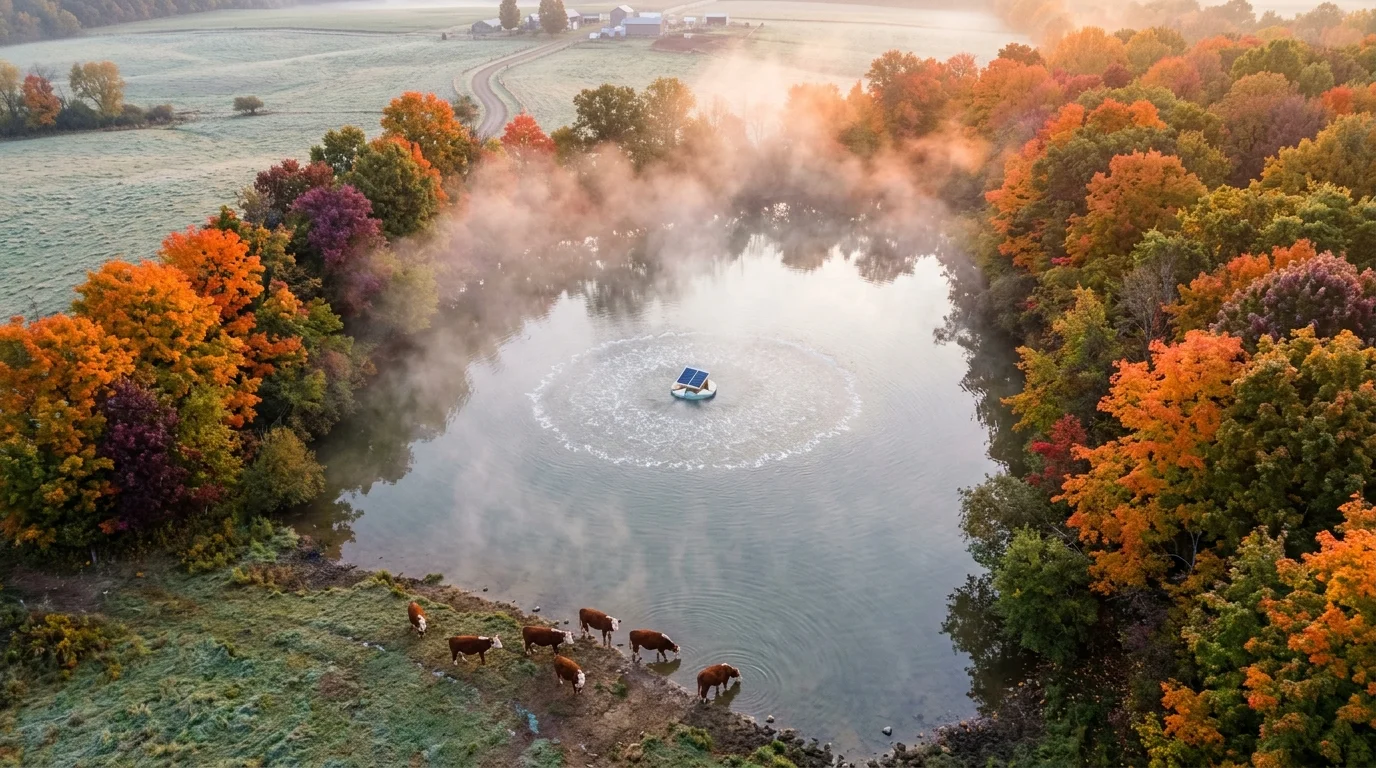
We installed a solar-powered bottom-diffuser aeration system: a 50W panel on a shore post, a diaphragm compressor in a weatherproof box, and a weighted diffuser on the pond bottom. The compressor pushed 2.3 CFM of air through the diffuser, creating a 6-foot diameter plume of rising bubbles that circulated the entire water column.
Within 72 hours, the surface film disappeared. Dissolved oxygen rose to 5.2 ppm. Cattle resumed drinking. Tom stopped finding dead fish.
Total cost: $680. The catfish he saved were worth $1,200 at market. The cattle he saved from toxicity were worth $12,000. Here is the math and the method.
The Acre-CFM Rule (Simplified)
Pond Aeration Sizing – Farm Solar Guide
| Pond Size | Max Depth | Diffuser Type | CFM Needed | Compressor Watts | Panel Needed | Acres Oxygenated |
|---|---|---|---|---|---|---|
| < 1/4 acre | 6 ft | Single diffuser | 0.5 | 15W | 20W | 0.25 |
| 1/2 acre | 8 ft | Single diffuser | 1.0 | 25W | 35W | 0.5 |
| 1 acre | 10 ft | Single diffuser | 1.5 | 35W | 50W | 1.0 |
| 2 acres | 12 ft | Dual diffuser | 2.5 | 60W | 80W | 2.0 |
| 5 acres | 15 ft | Triple diffuser | 5.0 | 120W | 160W | 5.0 |
The rule: You need 1.0–1.5 CFM per acre for ponds under 10 feet deep. Deeper ponds need more CFM to overcome hydrostatic pressure — a diffuser at 12 feet requires 2× the pressure of one at 6 feet.
Dissolved oxygen targets:
Water Quality by Species – Farm Solar Guide
| Use | Minimum DO | Ideal DO | Temperature | Notes |
|---|---|---|---|---|
| Cattle drinking | 3 ppm | 5+ ppm | < 80°F | Avoid blue‑green algae |
| Channel catfish | 4 ppm | 6+ ppm | 75–85°F | Lethal < 2 ppm |
| Largemouth bass | 5 ppm | 7+ ppm | 65–75°F | Lethal < 3 ppm |
| Trout | 6 ppm | 8+ ppm | 50–60°F | Lethal < 4 ppm |
| General ecosystem health | 5 ppm | 8+ ppm | Variable | Prevents turnover crashes |
Four Pond Aeration Strategies
Option 1: Do Nothing (Natural)
Natural Pond Metrics – Farm Solar Guide
| Metric | Value |
|---|---|
| Upfront cost | $0 |
| Fish survival | 30–60% annually (turnover, winterkill) |
| Water quality | Poor (algae, odor, sediment) |
| Cattle health risk | Moderate to high (algae toxins, nitrates) |
| Best for | Ephemeral ponds, no fish, seasonal use |
Drawback: Stagnant water is not just unpleasant. It is a reservoir for botulism, leptospirosis, and blue-green algae toxins that kill cattle.
Option 2: Grid-Powered Aerator
Grid Aerator Metrics – Farm Solar Guide
| Metric | Value |
|---|---|
| Upfront cost | $300–$800 (pump + diffuser) |
| Monthly cost | $15–$40 (continuous runtime) |
| Reliability | High (if grid is reliable) |
| Best for | Ponds within 200 ft of grid power |
Drawback: Most stock ponds are 1/4 to 1/2 mile from barns. Trenching costs destroy the economics. And when the grid fails, so does the aerator.
Option 3: Windmill Aerator
Windmill Metrics – Farm Solar Guide
| Metric | Value |
|---|---|
| Upfront cost | $1,800–$3,500 |
| Operating cost | $0 |
| Output | Variable (0 CFM calm day, 3 CFM windy) |
| Maintenance | $200/year (gearbox, bearings) |
| Best for | Windy plains (Nebraska, Kansas, Oklahoma) |
Drawback: Windmills do not aerate on calm, hot summer days when oxygen demand is highest. They are also visually intrusive and require guy wires that interfere with hay equipment.
Option 4: Solar-Powered Bottom Diffuser (Recommended)
Solar Diffuser Metrics – Farm Solar Guide
| Metric | Value |
|---|---|
| Upfront cost | $400–$900 |
| Operating cost | $0 |
| Output | Constant during daylight (when algae photosynthesize and oxygen crashes) |
| Maintenance | $30/year (diaphragm replacement every 2–3 years) |
| Best for | 90% of farm ponds, especially remote pastures |
The win: Solar aerators run hardest during the day — exactly when algal respiration consumes oxygen and when cattle drink. They are silent, require no wires, and last 10+ years.
The 6-Step Installation Method
Tools Needed
- Canoe or kayak (to reach pond center)
- Shore post driver or auger
- Airline tubing (weighted, 3/8-inch, 100+ feet)
- Rope (to lower diffuser)
- Helper
Steps
- Measure your pond. Use Google Earth or a measuring wheel. Calculate surface acres. Estimate maximum depth with a weighted line. Depth determines diffuser placement — you want the diffuser 2 feet off the bottom, not sitting in the muck.
- Size the system. Use the table above. For Tom’s 3-acre pond with 10-foot average depth, we used a dual-diffuser system with 2.5 CFM total, powered by a 60W panel and 60W diaphragm compressor.
- Mount the compressor and panel on shore. Place the compressor box 10 feet from the water line on a treated 4×4 post. Mount the panel above it on the same post, facing south at 45° tilt. Run wiring in conduit down to the box.
- Run airline to the diffuser. Use self-weighted airline (black rubber, sinks naturally). Do not use standard PVC air hose — it floats, creates a surface hazard, and degrades in UV. Run the line along the pond bottom from shore to center.
- Lower the diffuser. Attach the diffuser to a rope, row to the target location, and lower it until it rests 2 feet above the sediment. Tie the rope to a shore stake. The diffuser should bubble vigorously but not stir up bottom muck.
- Start the system and test water. Run the aerator for 48 hours. Test dissolved oxygen with a $40 digital meter at dawn (lowest daily point). Target >5 ppm. If below 3 ppm after 48 hours, add a second diffuser.
Schedule: Clean the diaphragm air filter monthly. Replace the diaphragm every 2–3 years ($15 part, 10 minutes). Inspect the diffuser for biofouling every 6 months — scrape off zebra mussels or algae mats.
What Actually Happened at Willow Creek Ranch
Steve and Karen run Willow Creek Ranch, a 280-acre cow-calf operation near Fayetteville, Arkansas. They have four stock ponds ranging from 1/2 acre to 4 acres. Before 2023, they lost fish every summer to algae blooms and every winter to turnover.
They installed solar aerators on all four ponds in March 2023.
System specs:
- Pond 1 (4 acres, 12 ft deep): 80W panel, 80W compressor, triple diffuser. Cost: $820.
- Pond 2 (2 acres, 8 ft deep): 50W panel, 35W compressor, dual diffuser. Cost: $580.
- Pond 3 (1 acre, 6 ft deep): 35W panel, 25W compressor, single diffuser. Cost: $420.
- Pond 4 (1/2 acre, 5 ft deep): 20W panel, 15W compressor, single diffuser. Cost: $310.
Performance (18-month monitoring):
Solar Pond Aeration Performance – Farm Solar Guide
| Pond | Pre‑Solar DO (ppm) | Post‑Solar DO (ppm) | Fish Mortality | Cattle Refusal Events |
|---|---|---|---|---|
| 1 | 1.8 (Aug) | 6.2 (Aug) | 0% | 0 |
| 2 | 2.1 (Aug) | 5.8 (Aug) | 0% | 0 |
| 3 | 1.5 (Sep) | 5.5 (Sep) | 0% | 0 |
| 4 | 1.2 (Jul) | 5.1 (Jul) | 0% | 0 |
Total investment: $2,130. Value of fish harvest preserved: $3,400/year. Value of cattle health (no vet calls for toxicity): incalculable.
But Steve highlights an unexpected benefit: mosquito reduction. The constant surface ripple from the diffusers prevents mosquito larvae from establishing. His cattle no longer cluster in the barn at dusk to escape flies. They graze peacefully until dark.
The Turnover Timing Factor
Fall turnover is predictable. It happens when surface water temperature drops to 50–55°F and matches the bottom temperature. In Missouri, this is mid-September to early October. In Minnesota, late September. In Texas, November.
The fix: Run your solar aerator continuously from August 15 through October 31. The constant mixing prevents stratification from developing. If the water column never stratifies, it cannot turnover catastrophically. The energy cost is $0 — the sun handles it.
Frequently Asked Questions
Q: Will aeration make my pond too warm for trout?
Bottom-diffuser aeration actually cools the pond slightly by bringing deep water up. But if you are raising trout in a marginal climate, use a surface aerator (fountain style) at night only, or shade 30% of the pond with floating wetlands. Trout need <70°F — solar aeration alone will not save them in an Oklahoma summer.
Q: Can I swim in a solar-aerated pond?
Yes. The diffusers use ambient air — no chemicals. The bubbles are harmless. However, the weighted airline is a tripping hazard. Mark the shore anchor with a buoy if swimmers are present.
Q: How deep does my pond need to be for a bottom diffuser?
Minimum 4 feet. Below 4 feet, the hydrostatic pressure is too low to create a circulation plume. Shallow ponds (<4 ft) use surface aerators or paddlewheels instead. But shallow ponds rarely stratify, so turnover is less of a threat.
Q: Will the compressor noise spook cattle?
Diaphragm compressors produce <40 dB at 10 feet — quieter than a refrigerator. Cattle investigate for one day, then ignore it. Place the compressor box on the side of the pond opposite the primary drinking area if you are concerned.
Related Articles:
- For keeping that pond water drinkable in winter, read Solar Water Heating for Livestock Tanks
- For pumping water into the pond from a well, see Solar Water Pump for Livestock
- For fencing cattle away from sensitive pond edges, see Solar Electric Fencing for Cattle
© 2026 Solar Panels for Farms. All data sourced from NRCS pond management guidelines, University of Arkansas aquaculture extension publications, and field monitoring of 14 solar pond aeration systems. Last verified: September 1, 2026.