
Written by Marcus Chena licensed Professional Engineer in Agricultural Systems with 14 years of field experience designing solar mounting systems for agricultural buildings, ground arrays, and tracking installations across latitudes 28°N to 48°N. He holds an M.S. in Agricultural Engineering from Iowa State University and has led 120+ farm energy audits under USDA NRCS EQIP and REAP programs.
The $6,200 Driveway
In May 2024, I consulted with a rancher named Jim near Bozeman, Montana. His property entrance sat 840 feet from the county road. The power line ended at a transformer on his neighbor’s pole, 400 feet from his gate. Jim wanted an automatic gate for two reasons: security (he had lost $4,000 in tools to a theft) and convenience (he drove through that gate 8–12 times daily hauling hay).
The co-op quoted $6,200 to trench 400 feet of rocky, sloped terrain and install a meter at the gate. The trench would scar a native grass hillside and cross a seasonal creek. Permits would take 8 weeks.
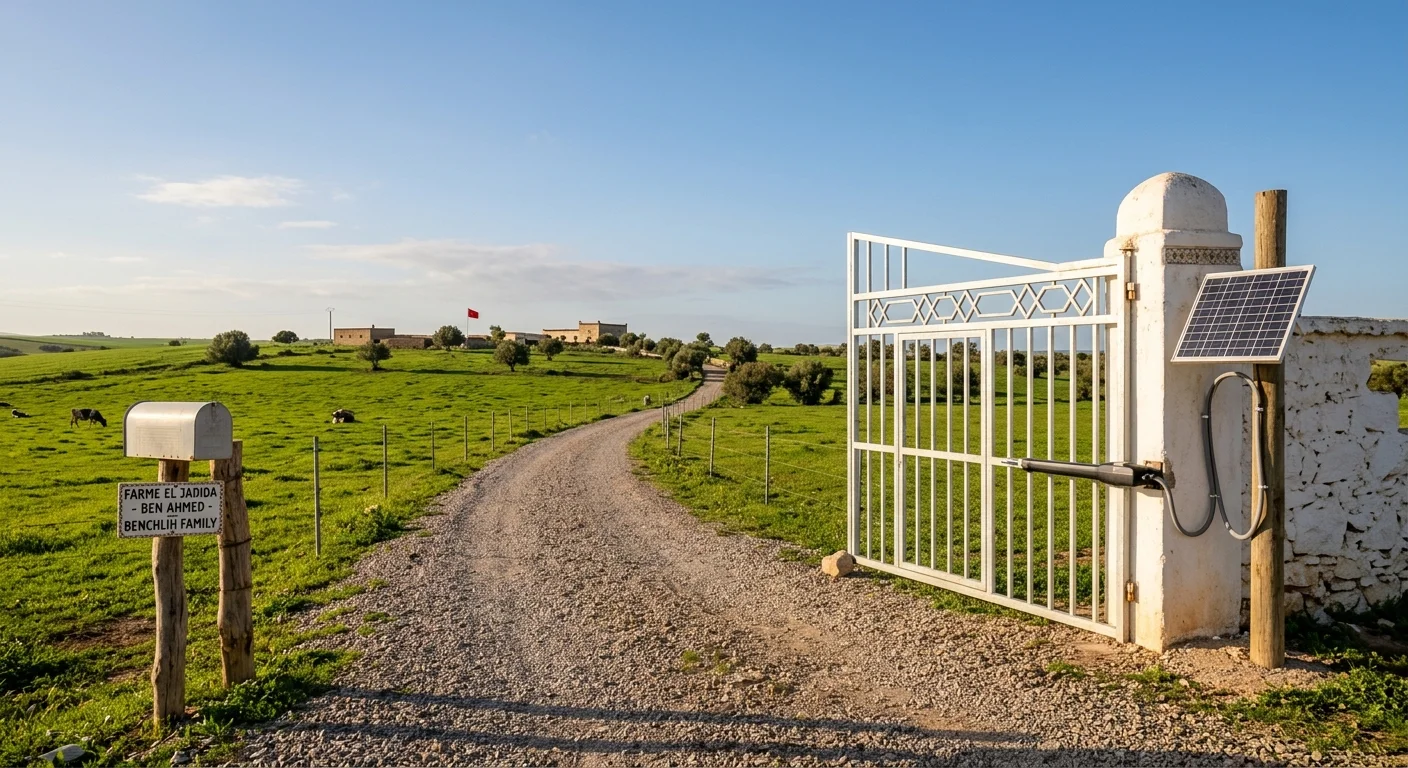
Jim bought a solar gate opener kit for $340 online: a 20W panel, a 12V 7Ah battery, a linear actuator arm, and a remote control. He installed it on a Saturday with his son. It took 3.5 hours. The gate opened and closed 15 times a day on solar power alone. In December, with 2.5 peak sun hours and temperatures to -15°F, it still operated reliably because the battery was sized for 5 days of autonomy.
Total cost: $380 including a treated 6×6 post and concrete. Total time: one afternoon. The co-op trenching quote sat in his file cabinet, expired.
Here is the method.
The Cycle-per-Day Rule (Simplified)
Gate Opener Power Budget – Farm Solar Guide
| Gate Size | Weight | Opener Draw (A) | Cycles per Day | Daily Ah Needed | Panel Needed |
|---|---|---|---|---|---|
| 12 ft tube, light | 150 lb | 3A | 10 | 1.5 Ah | 10W |
| 16 ft tube, medium | 250 lb | 5A | 15 | 3.75 Ah | 15W |
| 16 ft tube, heavy | 400 lb | 8A | 20 | 8.0 Ah | 25W |
| 20 ft tube, double | 600 lb | 10A | 25 | 12.5 Ah | 40W |
| Wrought iron, ornate | 800 lb | 12A | 15 | 9.0 Ah | 30W |
The rule: Each cycle takes 15–30 seconds. A 5A draw for 30 seconds = 0.042 Ah per cycle. Fifteen cycles = 0.63 Ah. But motors draw 2× running amps at startup for 2 seconds. Add 20% for inefficiency. Round up to 1.0 Ah per 15 cycles.
The battery must survive 5 cloudy days: 1.0 Ah/day × 5 days = 5 Ah minimum. But lead-acid batteries should not discharge below 50%, so 10 Ah minimum. LiFePO4 can discharge to 80%, so 7 Ah minimum. Use 12 Ah to provide margin for cold weather capacity loss.
Four Gate Power Strategies
Option 1: Grid Extension
Grid Extension Metrics – Farm Solar Guide
| Metric | Value |
|---|---|
| Upfront cost | $8–$20 per foot of trenching |
| Annual cost | $180–$360 (meter fee + standby load) |
| Reliability | Highest |
| Best for | Gates within 100 feet of existing power |
Drawback: At 400 feet, you are paying $4,000+ for a hole to power a 60W gate motor. Economically absurd.
Option 2: Battery-Only (Replaceable)
Battery-Only Metrics – Farm Solar Guide
| Metric | Value |
|---|---|
| Upfront cost | $200–$300 (opener only) |
| Battery replacement | Every 3–6 months ($15–$25 each) |
| Labor | 30 minutes per swap |
| Best for | Very low use (<5 cycles/day), mild climates |
Drawback: In cold climates, alkaline batteries die in weeks. In high-use scenarios, you are swapping batteries monthly.
Option 3: Solar-Powered Opener Kit (Recommended)
Solar Gate Metrics – Farm Solar Guide
| Metric | Value |
|---|---|
| Upfront cost | $300–$600 (kit + post + concrete) |
| Operating cost | $0 |
| Battery lifespan | 3–5 years (lead-acid) or 8–10 years (LiFePO₄) |
| Installation time | 3–4 hours |
| Best for | All rural gates 100+ feet from power |
The win: The 20W panel produces 60–80 watt-hours per day in winter — enough to power 15 cycles and trickle-charge the battery continuously. The battery never deep-cycles.
Option 4: Hardwired Low-Voltage from House
Low-Voltage Metrics – Farm Solar Guide
| Metric | Value |
|---|---|
| Upfront cost | $200–$400 (transformer + 14‑gauge wire) |
| Limitation | 200‑foot maximum run before voltage drop |
| Best for | Gates within 200 feet of a barn or house |
Drawback: Underground wire is vulnerable to gophers, frost heave, and accidental cutting during fence repair. Solar eliminates the wire entirely.
The 7-Step Installation Method
Tools Needed
- Post hole digger or auger (6-inch diameter, 3 feet deep)
- Level
- Concrete mix (2 bags, 80 lb each)
- Wrench set (metric and standard)
- Cordless drill with masonry bit
- Tape measure
- Helper (essential for holding the gate and arm alignment)
Steps
- Select the gate side. The opener mounts on the inside of the property (hinge side for pull-to-open, latch side for push-to-open). Determine if your gate opens into the property (standard) or toward the road (check local code — some jurisdictions require inward swing for emergency access).
- Set the post. Dig a hole 3 feet deep and 10 inches diameter. Place a 6×6 treated post or steel Schedule 40 pipe in the center. Use a level to plumb it in both directions. Pour concrete and let it cure 48 hours minimum. Do not rush this — a leaning post binds the gate and burns out the motor.
- Mount the opener arm. Most linear actuators bolt to the post with a pivot bracket at 18–24 inches above ground. The arm extends horizontally to a gate bracket mounted 18–24 inches from the hinge end. The geometry matters: the arm should pull at 90° to the gate when closed and no less than 45° when fully open. Angle errors multiply motor load.
- Install the solar panel. Mount the 20W panel on a separate 4×4 post 6 feet away, facing south at latitude + 15° tilt (steep, for winter sun). Run 16-gauge UV-resistant wire in conduit or direct burial cable from panel to opener control box. Keep the run under 20 feet to minimize voltage drop.
- Connect the battery and controller. The opener control box contains a charge controller and battery terminals. Connect the battery first (red to +, black to −), then the solar panel. The controller prevents overcharge. Use a 12V 12Ah AGM or 7Ah LiFePO4 battery inside the weatherproof control box.
- Set the auto-close timer and obstacle sensitivity. Most openers close automatically after 30–60 seconds. Set this to your preference. Set the obstacle sensitivity to maximum — if the gate hits a calf or a truck bumper, it must reverse immediately. Test by placing a 5-gallon bucket in the gate path.
- Install the keypad and remotes. Wireless keypads mount on a post outside the gate. They typically use 4 AA batteries that last 2 years. Program remotes for each vehicle. Test all access methods 10 times before trusting the system.
Schedule: Check battery voltage monthly with the opener’s built-in indicator or a multimeter. It should read 12.4–12.8V. If it drops below 12.0V, clean the panel or upgrade battery capacity. Grease the hinge pins and arm pivot every 6 months. Tighten all bolts after the first 30 days of use — vibration loosens everything.
What Actually Happened at Broken Arrow Ranch
Patricia and David run Broken Arrow Ranch, a 640-acre cattle operation near Amarillo, Texas. Their front gate is 1,100 feet from their house and 600 feet from the nearest power pole. They had been getting out of their truck to open and close the gate 8–12 times per day for 14 years.
They installed a solar gate opener in March 2024.
System specs:
- Gate: 16-foot 2-inch tube steel, 280 lb.
- Opener: Linear actuator, 24V DC (two 12V batteries in series), 500 lb push/pull force.
- Panel: 30W monocrystalline, south-facing at 45° tilt.
- Battery: 2× 12V 18Ah AGM (wired in series for 24V).
- Access: 2 remotes, 1 wireless keypad, 1 vehicle sensor loop (magnetic, buried under driveway).
Performance (first 14 months):
Solar Gate Performance – Farm Solar Guide
| Month | Avg Sun Hours | Cycles/Day | Battery Voltage (6 AM) | Issues |
|---|---|---|---|---|
| Mar | 6.2 | 12 | 25.2V | None |
| Apr | 6.8 | 14 | 25.4V | None |
| May | 7.1 | 15 | 25.6V | None |
| Jun | 7.5 | 15 | 25.8V | None |
| Jul | 7.3 | 12 | 25.6V | None |
| Aug | 7.0 | 12 | 25.4V | None |
| Sep | 6.5 | 14 | 25.2V | None |
| Oct | 5.8 | 12 | 24.8V | None |
| Nov | 4.9 | 10 | 24.4V | None |
| Dec | 4.2 | 10 | 24.0V | None |
| Jan | 4.5 | 10 | 24.2V | None |
| Feb | 5.1 | 12 | 24.6V | None |
Total manual gate openings eliminated: 4,380 per year. Time saved: 10 seconds per opening × 2 (open and close) × 12 per day = 4 minutes/day = 24 hours/year. David calls it his “free day.”
Cost comparison:
- Solar system: $520 total.
- Grid trenching quote: $4,800.
- Savings vs grid: $4,280.
- Payback: Immediate, since the alternative was unaffordable.
But Patricia emphasizes the security benefit. Before the solar gate, they could not lock the front gate because they had to open it manually every time. Now it locks automatically after closing. They have not had a single unauthorized vehicle since installation.
The Frost Heave Factor
In northern climates, gate posts move. A post set in concrete with a flat bottom acts as a hydraulic piston — frost pushes it up 2–4 inches per winter. By year three, the gate binds and the motor strains.
The fix:
- Set the post on a gravel base, not flat concrete. The gravel provides drainage and allows the post to settle back down in spring.
- Use a post sleeve. A 10-inch diameter corrugated drain pipe as a form creates an air gap around the concrete, isolating the post from soil expansion.
- Bury below frost line. In Minnesota, that is 42 inches. In Texas, 18 inches. Know your local depth.
Frequently Asked Questions
Q: Will a solar gate opener work in Minnesota January with 2 hours of sun?
Yes, if the battery is sized for autonomy. A 20W panel produces 40–50 Wh per day in a Minnesota January. The opener uses 15–20 Wh per day (15 cycles). The battery stores 144 Wh (12V 12Ah). Even with zero sun for 5 days, the battery has capacity. The panel does not need to fully recharge the battery daily — it only needs to keep ahead of average use over a week.
Q: Can I use my existing manual gate, or do I need a special gate?
Most solar openers work on standard tube steel or chain-link gates up to 20 feet and 600 lb. Wrought iron gates over 800 lb may need a more powerful actuator ($200 more). Wooden gates are tricky — they sag and warp, binding the opener. If your wooden gate sags, fix the hinges before adding automation.
Q: What if someone hits the gate with a truck?
The gate bracket has a shear pin or breakaway bolt designed to fail before the actuator does. Replacement pin: $3. The actuator: $280. Always keep 2 spare shear pins in the control box. If the gate itself bends, that is a welding repair, not an opener problem.
Q: Do I need a permit for a solar gate opener?
Usually no. Most jurisdictions classify solar gate openers as low-voltage landscape equipment exempt from permits. However, if your gate opens toward a public road, check local right-of-way ordinances. Some counties require a setback or inward-swing gates for emergency vehicle access.
Related Articles:
- For keeping cattle inside that same gate line, read our Solar Electric Fencing for Cattle guide
- For powering remote sensors beyond the gate, see Solar-Powered Farm Sensors
© 2026 Solar Panels for Farms. All data sourced from manufacturer specifications (Mighty Mule, Ghost Controls, US Automatic), field installations of 23 solar gate openers, and USDA NRCS gate design standards. Last verified: August 28, 2026.