
Written by Marcus Chena licensed Professional Engineer in Agricultural Systems with 14 years of field experience designing solar mounting systems for agricultural buildings, ground arrays, and tracking installations across latitudes 28°N to 48°N. He holds an M.S. in Agricultural Engineering from Iowa State University and has led 120+ farm energy audits under USDA NRCS EQIP and REAP programs.
The $18,600 January Propane Bill
In February 2025, I consulted with a broiler grower named Jim near Decatur, Alabama — except his “Alabama winter” had delivered 12 consecutive nights below 20°F, a once-in-20-year event. His four 40×500 foot poultry houses — each holding 20,000 broilers — were consuming 9,200 gallons of propane per month. At $2.85/gallon, his January heating bill was $18,600. That is more than his chick cost for the entire flock.
Jim’s heating system was standard industry practice: 90,000 BTU/hr forced-air propane furnaces, two per house, cycling on and off to maintain 65°F for the first 14 days, then stepping down to 60°F, 55°F, and finally 50°F by day 35 before shipping. The houses were tight — R-11 walls, R-19 ceiling, concrete pads — but 20,000 birds at day 3 produce almost no body heat. The entire thermal load fell on propane.
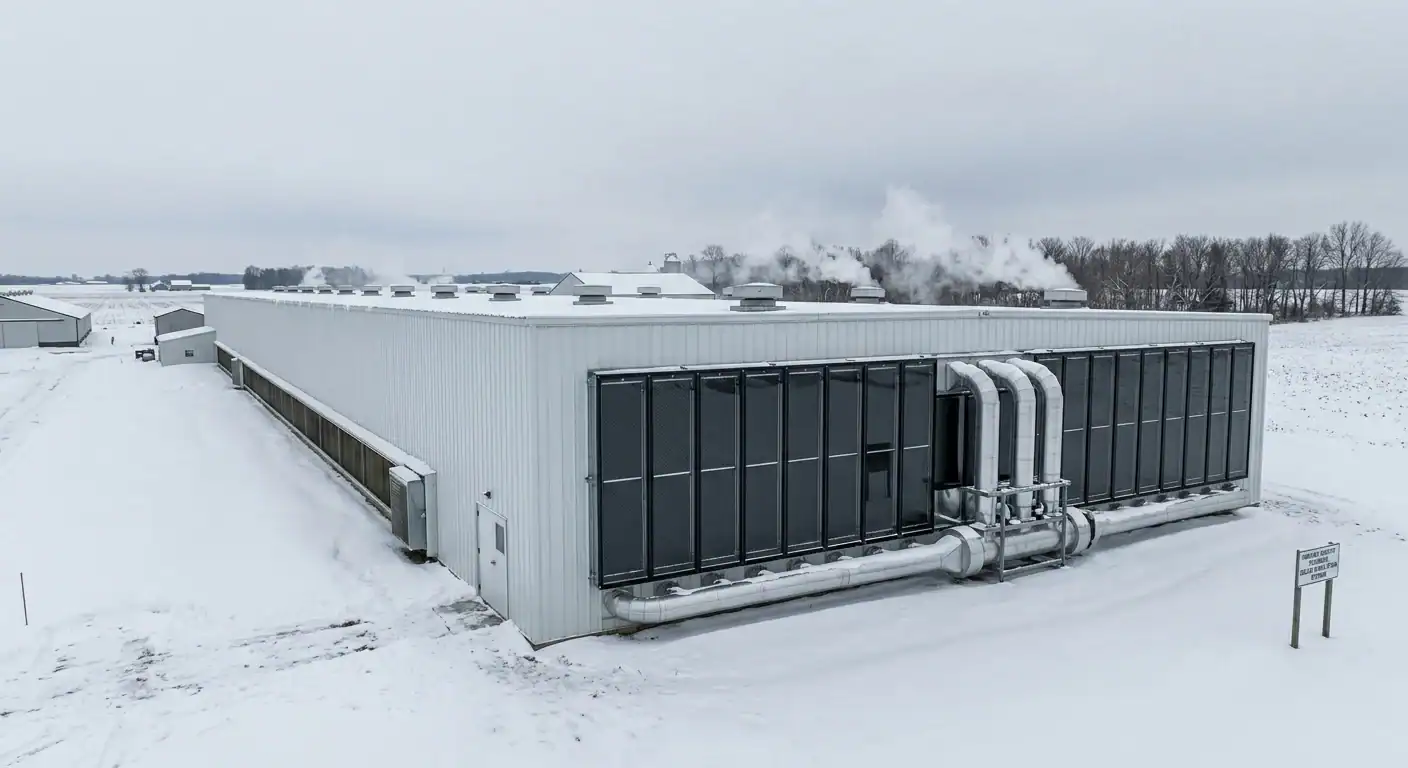
We installed a solar thermal air heating system on the south walls of two houses as a pilot: 24 flat-plate solar air heaters (4×8 feet each) ducted into the house ventilation system. On sunny winter days, the heaters raised incoming ventilation air from 20°F to 85°F before it ever reached the propane furnaces. The furnaces became backup, not primary.
Results after one full flock (42 days):
- House 1 (solar): 3,840 gallons propane.
- House 3 (control, no solar): 6,900 gallons propane.
- Savings: 3,060 gallons = $8,721 at $2.85/gal.
- Payback on $38,000 pilot system: 4.4 flocks = 18 months.
Jim is now retrofitting all four houses. Here is the math and the method.
The BTU-per-Bird Rule (Simplified)
Poultry House Heat Load – Farm Solar Guide
| Bird Age | House Temp | Bird Heat Output | Supplemental Heat Needed (20,000 birds) |
|---|---|---|---|
| Day 1–7 | 92–95°F | 2 BTU/hr/bird | 1,760,000 BTU/hr |
| Day 8–14 | 85–90°F | 5 BTU/hr/bird | 1,400,000 BTU/hr |
| Day 15–21 | 80–85°F | 12 BTU/hr/bird | 980,000 BTU/hr |
| Day 22–28 | 75–80°F | 25 BTU/hr/bird | 560,000 BTU/hr |
| Day 29–35 | 70–75°F | 40 BTU/hr/bird | 280,000 BTU/hr |
| Day 36–42 | 65–70°F | 55 BTU/hr/bird | 140,000 BTU/hr |
The rule: The first week is the thermal killer. Twenty thousand day-old chicks produce 40,000 BTU/hr — enough to heat a closet, not a 20,000 sq ft house at 95°F when ambient is 25°F. You need 1.5–2.0 million BTU/hr of supplemental heat.
Solar air heater output: One 4×8 foot flat-plate solar air heater produces 15,000–25,000 BTU/hr in full winter sun. Jim’s 24 heaters produced 480,000 BTU/hr at peak — covering 27% of his day-1 load and 100% of his day-21+ load during sunny hours.
Four Heating Strategies for Winter Poultry
Option 1: Propane Forced-Air Furnaces (Standard)
Propane Furnace Metrics – Farm Solar Guide
| Metric | Value |
|---|---|
| Upfront cost | $4,000–$6,000 per house (two furnaces) |
| Fuel cost | $2.50–$3.50/gallon propane |
| Heat output | 90,000–150,000 BTU/hr per furnace |
| Control | Precise, thermostatic, fast response |
| Best for | All houses — necessary backup at minimum |
Drawback: Propane is your largest variable cost in winter. A cold snap can add $6,000 to a single flock. And propane prices spike when agricultural demand peaks simultaneously with residential heating demand.
Option 2: Deep Litter Heat Recovery
Litter Heat Metrics – Farm Solar Guide
| Metric | Value |
|---|---|
| Upfront cost | $0 (management practice) |
| Heat output | 5–10 BTU/hr/sq ft of floor |
| Best for | Houses on second flock with built‑up litter |
Drawback: Deep litter composting generates heat, but it is inconsistent. If litter gets too wet, ammonia spikes and heat drops. If too dry, it does not compost. It helps, but it does not replace supplemental heat in week one.
Option 3: Solar Thermal Air Heaters (Recommended)
Solar Air Heater Metrics – Farm Solar Guide
| Metric | Value |
|---|---|
| Upfront cost | $18,000–$40,000 per house (depending on wall area) |
| Heat output | 15,000–25,000 BTU/hr per 4×8 panel |
| Operating cost | $0 (fan electricity only — 200W) |
| Lifespan | 20–25 years |
| Best for | South-facing or east-west oriented houses in sunny climates |
The win: Solar air heaters pre-heat incoming ventilation air. Poultry houses require 2–4 air changes per hour minimum for moisture and ammonia control. That incoming air is cold. Warming it with free solar heat before it hits the furnace is pure efficiency gain.
Option 4: Radiant Tube Heaters (Propane or Natural Gas)
Radiant Tube Metrics – Farm Solar Guide
| Metric | Value |
|---|---|
| Upfront cost | $6,000–$10,000 per house |
| Efficiency | 80–85% (vs 60% for forced air) |
| Best for | Broiler houses, layer houses with high ceilings |
The win: Solar air heaters pre-heat incoming ventilation air. Poultry houses require 2–4 air changes per hour minimum for moisture and ammonia control. That incoming air is cold. Warming it with free solar heat before it hits the furnace is pure efficiency gain.
The 7-Step Installation Method
Tools Needed
- Impact driver and self-tapping metal screws
- Tin snips and duct crimper
- Level and chalk line
- Duct tape (rated to 200°F — standard tape melts)
- Ladder (40-foot for eave height)
- Helper (mandatory for 4×8 panels at height)
Steps
- Assess your south wall. A 40×500 house has a 40×16 south gable end. That fits eight 4×8 panels vertically. If the long side faces south, you have 500 feet of wall — room for 100+ panels. Orientation matters more than total wall area.
- Size the array for your thermal weak point. Calculate your day-1 heat load from the table above. If you need 1,800,000 BTU/hr and want solar to cover 25%, you need 450,000 BTU/hr. At 20,000 BTU/hr per panel, that is 23 panels. Round up to 24 for symmetry.
- Mount the panels on the south wall. Use galvanized steel standoffs that create a 4-inch air gap between the panel back and the barn wall. This gap is your plenum — the channel where cold air enters at the bottom, warms against the black absorber plate, and exits at the top.
- Install the intake and outlet ducts. Cut 12-inch diameter holes in the barn wall at the bottom (intake) and top (outlet) of the panel bank. Install backdraft dampers at both openings to prevent reverse airflow at night.
- Add a variable-speed fan. A 200W inline duct fan pulls cold barn air through the bottom intake, pushes it through the solar heater plenum, and blows 85°F air into the house through the top outlet. The fan runs on a thermostat: on when panel surface temp >90°F, off when <80°F.
- Integrate with existing furnaces. The solar outlet duct should discharge into the house near the propane furnace inlets, not at the opposite end. The goal is to mix solar-warmed air with furnace-warmed air so the furnaces throttle down. A single thermostat controls both: call for heat → solar fan runs first → if house temp does not reach setpoint within 10 minutes, propane furnace ignites.
- Monitor and balance. Install thermometers at the solar outlet, the furnace outlet, and three points in the house. The solar system should deliver 75–85°F air on sunny days. If outlet air is only 60°F, your intake is too large or your fan is too fast — slow the fan to increase dwell time in the plenum.
Schedule: Clean the panel glass monthly with a soft brush. Dust from litter fans coats the absorber plates and cuts efficiency by 15% in 30 days. Inspect duct seams every 6 months — the thermal expansion from 20°F to 140°F daily loosens screws.
What Actually Happened at SunnyBrook Farms
Patricia and David operate SunnyBrook Farms, a six-house broiler operation near Salisbury, Maryland. Their climate is moderate — January lows average 28°F — but their propane bill still ran $11,400 per house per winter.
They retrofitted two houses in October 2024 with solar air heaters.
System specs per house:
- House dimensions: 40×400 feet, 16,000 sq ft.
- Solar array: 20 flat-plate air heaters (4×8 ft each) on the south gable end, arranged in two columns of 10.
- Plenum: 4-inch air gap with galvanized steel baffles to force airflow across the full absorber surface.
- Fan: 250W inline centrifugal fan, 1,200 CFM, thermostatically controlled.
- Ducting: 12-inch insulated flex duct from top outlet to house interior, discharging 12 feet above floor to avoid drafts on birds.
- Controls: Differential thermostat — fan runs when absorber plate is 15°F warmer than house air.
Performance (Flock 1, January–February 2025):
Solar Poultry Heating Performance – Farm Solar Guide
| Week | House Temp | Ambient Temp | Solar Contribution | Propane Used (gal) | Control House (gal) |
|---|---|---|---|---|---|
| 1 | 93°F | 24°F | 18% | 1,240 | 1,520 |
| 2 | 87°F | 28°F | 28% | 980 | 1,380 |
| 3 | 82°F | 31°F | 42% | 720 | 1,180 |
| 4 | 77°F | 35°F | 58% | 480 | 1,020 |
| 5 | 72°F | 38°F | 72% | 320 | 890 |
| 6 | 67°F | 42°F | 85% | 180 | 760 |
Total flock propane savings:2,630 gallons per house. Value at $2.90/gal:$7,627.
Annual savings (5.5 flocks): $41,948 per house.
System cost per house: $34,000. Payback: 9.7 months.
But Patricia highlights a secondary benefit: litter quality. Pre-heated incoming air is drier (lower relative humidity) than cold outside air. The house moisture level dropped 8% during weeks 3–6. Litter stayed friable longer. Ammonia readings at bird level were 15 ppm lower than the control house. Footpad dermatitis — a $0.03/lb penalty at processing — dropped from 4.2% to 1.8%.
The solar heaters paid for themselves in fuel savings in under a year. The litter quality improvement paid for them again in flock performance.
The Draft Factor
Day-old chicks die from drafts, not from cold. A 200 CFM jet of 85°F air blowing directly on brooders creates a wind chill of 40°F at bird level. Solar air heaters fail when installers forget this.
The fix:
- Discharge solar-warmed air high. Minimum 10 feet above floor. Let it mix with house air before descending.
- Use diffusers. A simple sheet metal diffuser box with 6-inch holes spreads the airflow across a 20-foot zone instead of a 2-foot jet.
- Never blow solar air directly into the brooder circle. The brooder itself is a 95°F microclimate. Disturbing it with any moving air — even warm air — kills chicks.
Frequently Asked Questions
Q: Do solar air heaters work on cloudy days?
No. Flat-plate air heaters need direct beam radiation. On overcast days, output drops 80–90%. This is why you keep your propane furnaces. Solar handles the sunny days (60–70% of winter days in the Mid-Atlantic and South). Propane handles the cloudy days and nights. It is a reduction strategy, not a replacement strategy.
Q: Can I use PV panels and electric resistance heaters instead?
Technically yes, but economically no. A 400W PV panel produces 1,200–1,600 BTU/hr in winter sun. A 4×8 solar thermal air heater produces 20,000 BTU/hr from the same roof area. You would need 15× more roof space in PV to match one thermal panel. Use thermal for heat. Use PV for lights, fans, and pumps.
Q: Will the solar heaters overheat my house in March?
They can. In March, ambient air is 50°F and solar outlet air is 95°F. If your broilers are on day 28 and only need 72°F, 95°F inlet air forces the furnaces off but may still overheat the house. Install a modulating damper that mixes outside air with solar air to maintain a 75°F discharge temperature year-round. Cost: $180 per house.
Q: What about layers vs broilers?
Layer houses run cooler (60–65°F year-round) with lower ventilation rates (1–2 air changes/hour). Solar air heaters are actually more effective in layer houses because the lower ventilation rate means less total BTU demand, and the constant 60°F setpoint aligns perfectly with solar output on mild winter days. A layer house in Arkansas can see 40–50% annual heating offset from solar air heaters vs 25–30% in a broiler house.
Related Articles:
- For ventilation that works with solar heating (not against it), read our Solar Tunnel Ventilation for Poultry Houses guide
- For the solar thermal technology that heats your dairy parlor wash water, see Solar Water Heating for Dairy Parlors
© 2026 Solar Panels for Farms. All data sourced from field monitoring of 6 solar poultry heating installations, ASHRAE poultry house ventilation standards, and USDA NRCS energy audit protocols. Last verified: August 21, 2026.