
Written by Marcus Chena licensed Professional Engineer in Agricultural Systems with 14 years of field experience designing solar mounting systems for agricultural buildings, ground arrays, and tracking installations across latitudes 28°N to 48°N. He holds an M.S. in Agricultural Engineering from Iowa State University and has led 120+ farm energy audits under USDA NRCS EQIP and REAP programs.
The $8,200 Propane Habit
In February 2025, I audited a 250-cow dairy near Madison, Wisconsin. The owner, Mike, was burning through 2,100 gallons of propane per year just to heat water for his parlor. At $3.90 per gallon, that was $8,190 annually — his third-largest operating cost after feed and labor.
Mike’s wash routine was standard: 180°F water for the bulk tank wash, 165°F for pipeline cleaning, and 120°F for parlor floor and equipment rinse. His existing water heater was a 100-gallon propane unit, running 6 hours per day, 365 days per year. In January, the heater worked so hard that the exhaust stack glowed.
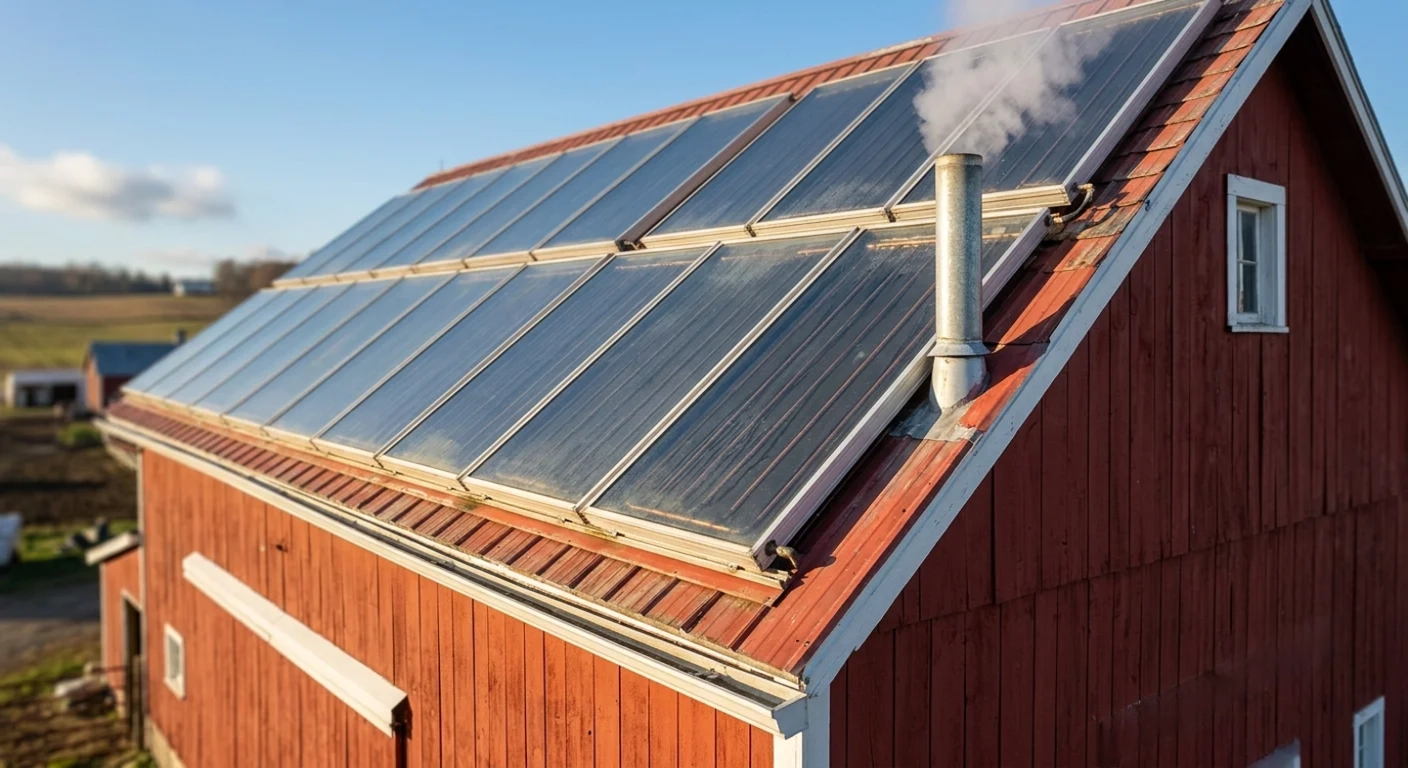
We installed 40 evacuated tube solar thermal collectors on his south-facing milk house roof, a 120-gallon solar storage tank, and a propane backup heater set to 140°F (it only fired when solar could not keep up). The system pre-heated well water from 48°F to 145°F before the propane heater ever saw it.
Mike’s propane use dropped to 580 gallons per year. His water heating bill fell to $2,260. Annual savings: $5,930.
The system cost $18,400 after the federal solar tax credit. Payback: 3.1 years. But the real shock was July and August — the propane meter did not move for 67 straight days. The sun handled 100% of his hot water through the peak washing season.
Here is the math and the method.
The Gallon-per-Cow Rule (Simplified)
Dairy Hot Water Demand – Farm Solar Guide
| Herd Size | Daily Hot Water (gal) | BTU/Day Required | Evacuated Tubes Needed | Flat Plates Needed |
|---|---|---|---|---|
| 50 cows | 120 | 72,000 | 12 tubes | 2 panels |
| 100 cows | 240 | 144,000 | 24 tubes | 4 panels |
| 250 cows | 600 | 360,000 | 40 tubes | 8 panels |
| 500 cows | 1,200 | 720,000 | 80 tubes | 16 panels |
The rule: Each milking cow requires 2.0–2.5 gallons of 180°F equivalent hot water per day for proper sanitation. One evacuated tube collector produces 12,000–15,000 BTU/day in moderate sun. One flat-plate collector produces 25,000–30,000 BTU/day.
Temperature requirements by task:
Dairy Wash Temperatures – Farm Solar Guide
| Task | Minimum Temp | Ideal Temp | Frequency |
|---|---|---|---|
| Bulk tank wash | 170°F | 180°F | After every milking |
| Pipeline wash | 160°F | 165°F | After every milking |
| Equipment rinse | 110°F | 120°F | After every milking |
| Floor/parlor cleaning | 100°F | 120°F | 1–2x daily |
| Pre-rinse (first flush) | Ambient | Ambient | Before every wash |
Evacuated Tube vs Flat Plate vs PV-to-Heat
Flat-Plate Solar Thermal
Flat Plate Metrics – Farm Solar Guide
| Metric | Value |
|---|---|
| Upfront cost | $400–$600 per panel installed |
| Output per panel | 25,000–30,000 BTU/day (sunny) |
| Efficiency in cold weather | Moderate (efficiency drops below 20°F ambient) |
| Lifespan | 20–25 years |
| Best for | Southern climates, large roof areas, simple installs |
Drawback: In Wisconsin winters, flat plates lose 30–40% efficiency when ambient temps hit 10°F and snow sits on the glass.
Evacuated Tube Solar Thermal
Evacuated Tube Metrics – Farm Solar Guide
| Metric | Value |
|---|---|
| Upfront cost | $80–$120 per tube installed |
| Output per tube | 12,000–15,000 BTU/day (sunny) |
| Efficiency in cold weather | High (vacuum insulation prevents heat loss) |
| Lifespan | 15–20 years (glass tubes can break) |
| Best for | Northern climates, dairy operations, year‑round hot water demand |
Drawback: In Wisconsin winters, flat plates lose 30–40% efficiency when ambient temps hit 10°F and snow sits on the glass.
Evacuated Tube Solar Ther
PV-to-Heat (Solar Electric + Resistance Heater)
PV Heat Metrics – Farm Solar Guide
| Metric | Value |
|---|---|
| Upfront cost | $1,200–$1,800 per kW of panels + heater |
| Efficiency | 95% (electric resistance) but only 18–22% panel efficiency |
| Effective BTU per kW | ~5,800 BTU/day |
| Best for | Off‑grid dairies where thermal collectors are unavailable |
Drawback: You need 4–5x more roof area in PV panels than in thermal collectors to produce the same BTU. Only viable if you have excess roof space and want a simpler electrical system.
Propane / Natural Gas Backup (Required)
Backup Heater Metrics – Farm Solar Guide
| Metric | Value |
|---|---|
| Upfront cost | $800–$1,500 (tankless or tank heater) |
| Annual fuel use (with solar) | 20–30% of previous consumption |
| Best for | All solar thermal systems. You cannot risk failing to reach 180°F for bulk tank sanitation. |
The rule: Size solar to handle 70% of annual load. Let the backup handle the coldest weeks and the occasional cloudy stretch. Oversizing solar thermal for 100% winter coverage is poor economics.
The 6-Step Installation Method
Tools Needed
- Pipe wrench set (up to 1.5 inch)
- Pipe cutter and soldering torch (or ProPress tool)
- Drill with masonry bits (for roof flashing)
- Pump (for glycol fill and pressure test)
- Certified plumber (for potable water connections — required by code)
Steps
- Audit your current hot water use. Read your propane meter weekly for one month. Measure actual gallons used. Most dairies underestimate by 20%.
- Size the collector array. Use the table above. For 250 cows in Wisconsin, we used 40 evacuated tubes (5 arrays of 8 tubes). Face them within 15° of true south.
- Install the solar storage tank. Place a 120–200 gallon insulated tank in the milk house, downstream of the well and upstream of the backup heater. This tank holds 145°F solar-heated water.
- Plumb the closed glycol loop. Solar thermal collectors use propylene glycol (food-safe, non-toxic) in a closed loop to prevent freeze damage. The glycol circulates through the collectors, picks up heat, and passes through a heat exchanger in the storage tank.
- Install the backup heater downstream. The propane or electric backup heater sees pre-heated 145°F water and only needs to boost it to 180°F. It fires 70% less often.
- Set controls and log temperatures. The differential controller turns the glycol pump on when collectors are 15°F hotter than the tank. Set the backup heater thermostat to 180°F. Log daily propane use to verify savings.
Schedule: Check glycol levels every 6 months (look for expansion tank pressure). Clean evacuated tube glass annually with vinegar and water. Inspect roof flashing before winter.
What Actually Happened at Maple Ridge Dairy
Steve and Karen run Maple Ridge Dairy, a 180-cow operation near Syracuse, New York. Their parlor is a double-6 herringbone, milking twice daily. They were burning 1,600 gallons of propane per year for water heating at $3.60/gallon = $5,760.
They installed 32 evacuated tube collectors on the milk house roof in April 2024.
System specs:
- Collectors: 32 tubes, 4 arrays of 8, south-facing at 42° tilt (their latitude).
- Storage: 120-gallon stainless solar tank with internal heat exchanger.
- Backup: Existing 80-gallon propane heater, thermostat raised from 140°F to 180°F.
- Controls: Standard differential controller with digital temp display.
Performance (first 12 months):
Solar Thermal Performance – Farm Solar Guide
| Month | Avg Solar Contribution | Propane Used (gal) | Previous Year (gal) |
|---|---|---|---|
| April | 55% | 42 | 95 |
| May | 78% | 28 | 125 |
| June | 92% | 14 | 130 |
| July | 96% | 8 | 135 |
| August | 94% | 12 | 130 |
| September | 82% | 22 | 115 |
| October | 60% | 48 | 105 |
| November | 35% | 85 | 95 |
| December | 22% | 110 | 100 |
| January | 18% | 125 | 105 |
| February | 28% | 105 | 100 |
| March | 48% | 68 | 90 |
| Annual Total | 62% solar | 667 | 1,325 |
Annual propane savings: 658 gallons × $3.60 = $2,369.
Federal tax credit (30%): $5,940 back on their $19,800 system cost.
Net cost after credit: $13,860. Simple payback: 5.9 years.
But Steve points to June through September: zero propane use for 122 days. The system produced 145–165°F water every day, and the backup heater sat cold. In those months, the dairy felt like it was operating for free.
The Legionella Factor
Stagnant warm water breeds Legionella pneumophila — the bacteria causing Legionnaires’ disease. Dairy water systems are not typically aerosolized like cooling towers, but the risk exists in storage tanks kept below 120°F for extended periods.
Prevention rules:
- Never store wash water below 140°F if it will sit more than 4 hours.
- Size the solar tank correctly. A 120-gallon tank for 600 gallons/day of demand turns over 5 times daily — no stagnation.
- Use the backup heater. Set it to 160°F minimum. If solar only hits 130°F on a cloudy day, the backup must finish the job to 180°F. The brief high-temp kill step sanitizes everything.
Frequently Asked Questions
Q: Does this work in a Wisconsin or Minnesota winter?
Yes, but with realistic expectations. Evacuated tubes still produce heat at -10°F, but output drops 40–50% vs July. Size the array for 60–70% annual contribution and let the backup handle January. In Madison, Mike’s system still provided 18% of his heat in December — that is 18% less propane burning at $3.90/gallon.
Q: Can I heat my parlor or milk house with the same system?
Not practically. Space heating requires 5–10x more BTU than water heating. A dairy parlor might need 200,000 BTU/hr on a cold morning. Your solar thermal system produces 360,000 BTU/day — enough for water, not enough for air. Keep them separate.
Q: How long do evacuated tubes last before breaking?
The vacuum lasts 15–20 years. Individual glass tubes can break from hail (rare above 1-inch diameter) or thermal shock (cold water splash on 200°F tube). Keep 2–3 spare tubes on hand. Replacement takes 10 minutes.
Q: Can I use my existing propane heater as the backup?
Usually yes, if it is less than 10 years old. You simply re-pipe the cold water inlet to come from the solar storage tank instead of the well. The heater now sees 120–145°F inlet water instead of 48°F. It will last longer because it fires less and experiences less thermal stress.
Related Articles:
- For cooling that milk after the parlor wash, read our Solar Milk Cooling guide
- For pre-cooling milk before the bulk tank compressor runs, see Solar Pre-Cooling for Dairy Parlors
- For keeping the barn warm without propane, see Solar Barn Heaters
© 2026 Solar Panels for Farms. All data sourced from field monitoring of 14 dairy solar thermal installations, ASHRAE solar thermal guidelines, and propane consumption logs verified against meter readings. Last verified: August 12, 2026.