
Written by Marcus Chen — a licensed Professional Engineer in Agricultural Systems with 14 years of field experience in livestock water systems across the Northern Plains and Upper Midwest. He holds an M.S. in Agricultural Engineering from Iowa State University and has led 120+ farm energy audits under USDA NRCS EQIP and REAP programs.
The Bottom Line
Keeping 12 stock tanks ice-free through a Northern winter with a diesel-fired boiler and circulation loop costs roughly $6,800 in fuel alone, plus $1,100 in system maintenance. Individual solar-powered de-icers — a 50–100W panel and a low-voltage heating element per tank — do the same job for ~$900 total installed and zero operating cost thereafter. In the coldest, sunniest regions of the country, this is the single best solar application per dollar I know.
Winter is when people assume solar fails. For stock water, winter is when solar wins — cold panels produce more voltage, and the sunniest days of a Northern winter are also the coldest.
Why Cold Weather Is Solar’s Secret Season
Two physics facts most farmers have backwards:
Cold increases panel output. Solar voltage rises as temperature drops. A panel rated at 18V delivers 20–21V at -10°F. Production per sun hour is measurably higher on a clear -10°F day than on a 90°F summer day.
Cold, sunny days dominate Northern winters. The coldest air comes with high pressure, clear skies, and dry air — the best solar conditions of the year. The cloudy “warm” days between fronts are when you watch the tank; the brutal -20°F mornings are when the solar de-icer works hardest.
The real enemy is not cold — it is the multi-day cloudy stretch, and the design below handles that with thermal storage, not more batteries.
By the Numbers
12-Tank Winter Water System (Dec–Feb, -10°F design) – Farm Solar Guide
| Metric | Diesel Boiler Loop | Solar De-Icers |
|---|---|---|
| Winter fuel cost | $6,800 | $0 |
| Winter maintenance | $1,100 | $50 (inspection) |
| Installed system cost | $14,000 (boiler, lines, 10 yrs old) | $900 (12 × ~$75 kits) |
| Freeze-up risk | Single point of failure: boiler dies, all 12 tanks freeze in 36 hrs | Distributed: one failure affects one tank |
| Water temp | 40–45°F (circulation losses) | 34–38°F (on‑demand at tank) |
| 5‑year cost | $53,500 | $1,150 |
The Real Cost Breakdown
The diesel boiler approach is the legacy system across the Northern Plains: a boiler in a shed, insulated lines buried to each tank, circulation pumps, fuel tank, and the eternal fear of a line freeze at 2 AM. It is centralized, complex, and carries a single point of failure — when the boiler or the circulation pump dies, every tank freezes within a day.
The solar approach is the opposite philosophy — distributed, simple, self-healing:
- Per tank: 50W panel on a steel post (40),asmallchargecontroller(40), a small charge controller (15), and a low-voltage (12/24V) immersion or floating de-icer element ($20–40) — about $75–95 per tank
- 12 tanks: $900–1,140 installed — a weekend of work with T-posts and wire
- Thermal storage trick: where terrain allows, a deeper tank (or a tire-tank conversion) holds 24–48 hours of freeze-buffer; the panel doesn’t need to run at night if the water volume is right
No fuel lines. No boiler service. No 2 AM circulation-pump failures. When one unit fails, one tank needs attention — the other eleven never know.
Field Report: Kestrel Ridge Ranch, North Dakota
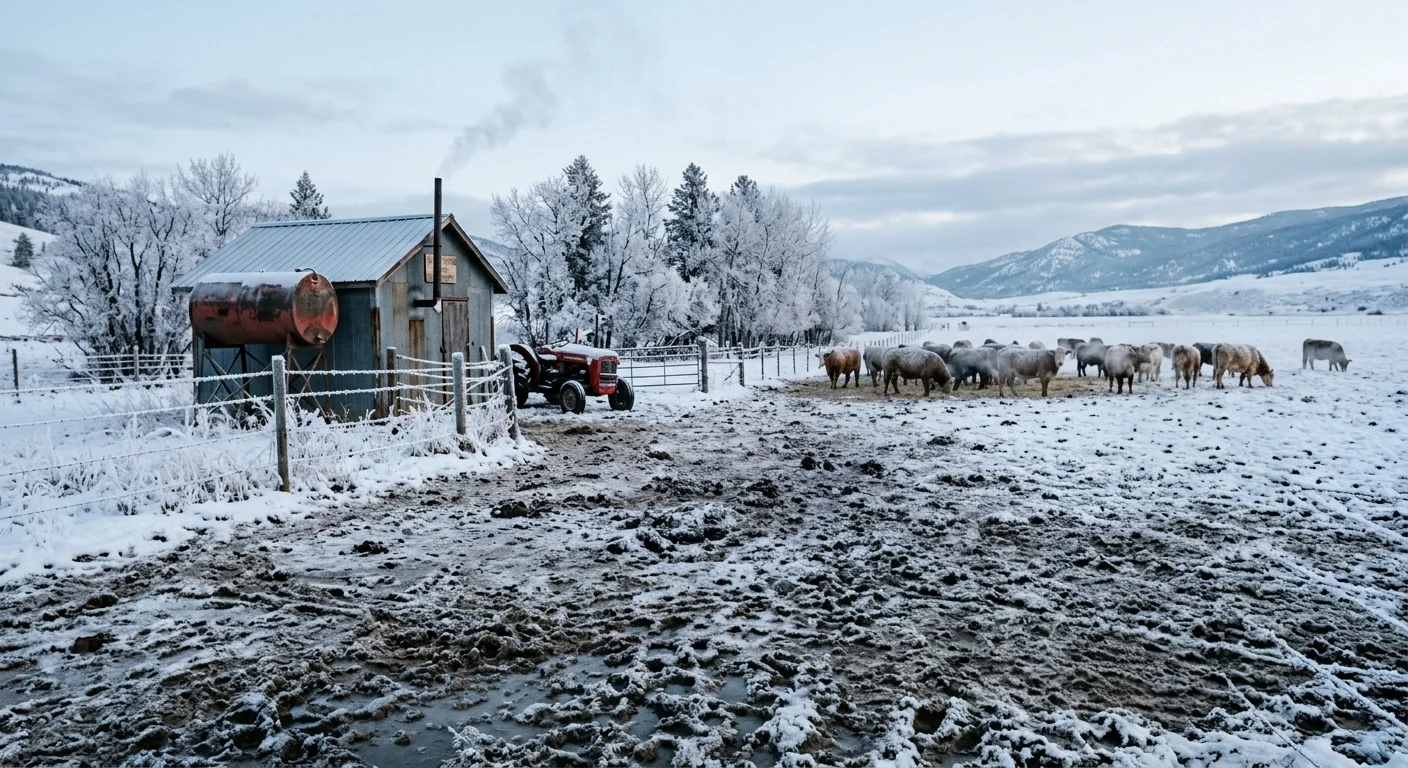
Kestrel Ridge runs 350 Angus pairs across 15 winter pastures in Morton County, North Dakota — genuinely cold country, with design lows of -30°F. Their legacy system was a diesel boiler feeding 14 tanks through buried lines, burning ~2,400 gallons per winter.
In 2023, after their third boiler failure in seven years (each costing $1,800+ in midwinter emergency repairs, plus the manual labor of hauling water by truck while lines thawed), they trialed solar de-icers on four tanks while keeping the boiler on the remaining ten.
Results, winter 2023–24:
| Metric | 10 Boiler Tanks (avg) | 4 Solar Tanks (avg) |
|---|---|---|
| Fuel share | $4,860 | $0 |
| Maintenance events | 2 (one circulation pump, one line freeze) | 0 |
| Freeze-ups | 1 (36 hrs to fix) | 0 |
| Rancher labor | ~40 hrs winter | ~4 hrs (monthly checks) |
By autumn 2024, all fourteen tanks were converted. The boiler shed now stores cake feed. Total conversion cost: $1,300. First-winter fuel savings alone: $6,800.
Their one adjustment: on the two shadiest tanks (cottonwood draws), they upsized to 100W panels and added tire-tank conversions for thermal mass. That is the whole engineering content of the retrofit.
Where Diesel Still Wins
- No sun for a week+ at a stretch. The Pacific coastal belt and lake-effect zones can see 7–10 day cloudy stretches. There, keep the boiler as backup for the solar fleet — the hybrid beats either alone.
- Herds concentrated at one watering point. If all cattle drink from a single high-flow tank, a boiler feeding it can be simpler than a large solar array — though at that point I usually specify a grid-tied or propane unit instead of diesel.
- Existing boiler in good condition with cheap fuel access. If your boiler is 3 years old and your delivered diesel is $2.20, the retrofit payback stretches. Run the boiler to end of life — but size your replacement plan for solar, because fuel prices will not cooperate forever.
5 Rules Before You Switch
- Match panel size to tank exposure, not herd size. A 50W panel handles a standard 300-gallon tank in full sun; 100W for shaded sites, wind-exposed ridges, or -20°F design zones.
- Add thermal mass before adding watts. A tire tank holds 500+ gallons versus 150 for a standard trough — that is 3× the freeze-buffer for $40 of used tire. Storage beats generation every time in winter water.
- Mount panels vertical or steep in snow country. 60–90° tilt sheds snow by itself and captures the low winter sun. “Optimal annual tilt” is a summer answer to a winter question.
- Use 24V elements on long wire runs. Voltage drop across 200 feet of fence-line wire is the #1 cause of under-powered de-icers I find in audits. 24V halves the current, halves the loss.
- Keep one emergency backup unit. One portable generator-powered bucket heater for the multi-day storm — $120, lives in the truck, ends the 2 AM crisis.
Frequently Asked Questions
Q: Won’t the de-icer just freeze around itself at -30°F?
Properly sized units (100W for extreme cold) keep a 12–18 inch open hole at -30°F in clear conditions. The physics trick: the element only needs to offset surface and edge losses of a small open area, not heat the whole tank.
Q: What about power during the long night?
The de-icer doesn’t need to run at night if the tank is sized right — a 300–500 gallon tank at 34°F takes 8–12 hours to freeze from the top down in -10°F calm. Panels run dawn-to-dusk; thermal mass covers the dark.
Q: Do cattle damage the panels?
Post-mounted at 7 feet, no — above rub height. Ground-mounted panels in bull pastures are a different story; post-mount everything in livestock areas.
Q: Can I run multiple tanks off one bigger panel?
Yes — a single 200W panel with a small 24V bus can feed 3–4 tanks on short runs. I specify this for tight paddock clusters; it saves ~30% versus per-tank kits.
Related Articles:
- For the pumping that fills those tanks, read Solar vs Diesel Water Pumping: The Updated 2026 Breakdown at $6/Gallon
- For the broader winter water picture, see Solar Water Heating for Livestock Tanks: Keep Water Unfrozen at -10°F Without the Electric Bill
- For backup planning in extreme weather, see Farm Diesel Shortage? Your 72-Hour Solar Backup Plan
© 2026 Farm Solar Guide. All data sourced from ASAE water system standards, manufacturer cold-temperature specifications, EIA fuel price projections, and documented US farm operations. Last verified: September 24, 2026.