
Written by Dr. Robert Kowalski a Ph.D. in Agricultural and Biological Engineering from Penn State University and has 18 years of experience in livestock facility environmental control systems. He has designed ventilation and heating systems for swine operations ranging from 1,200-head nurseries to 4,800-head finishing barns, and has advised on energy systems for more than 60 swine facilities. He is a licensed Professional Engineer and a member of the American Society of Agricultural and Biological Engineers.
The Problem
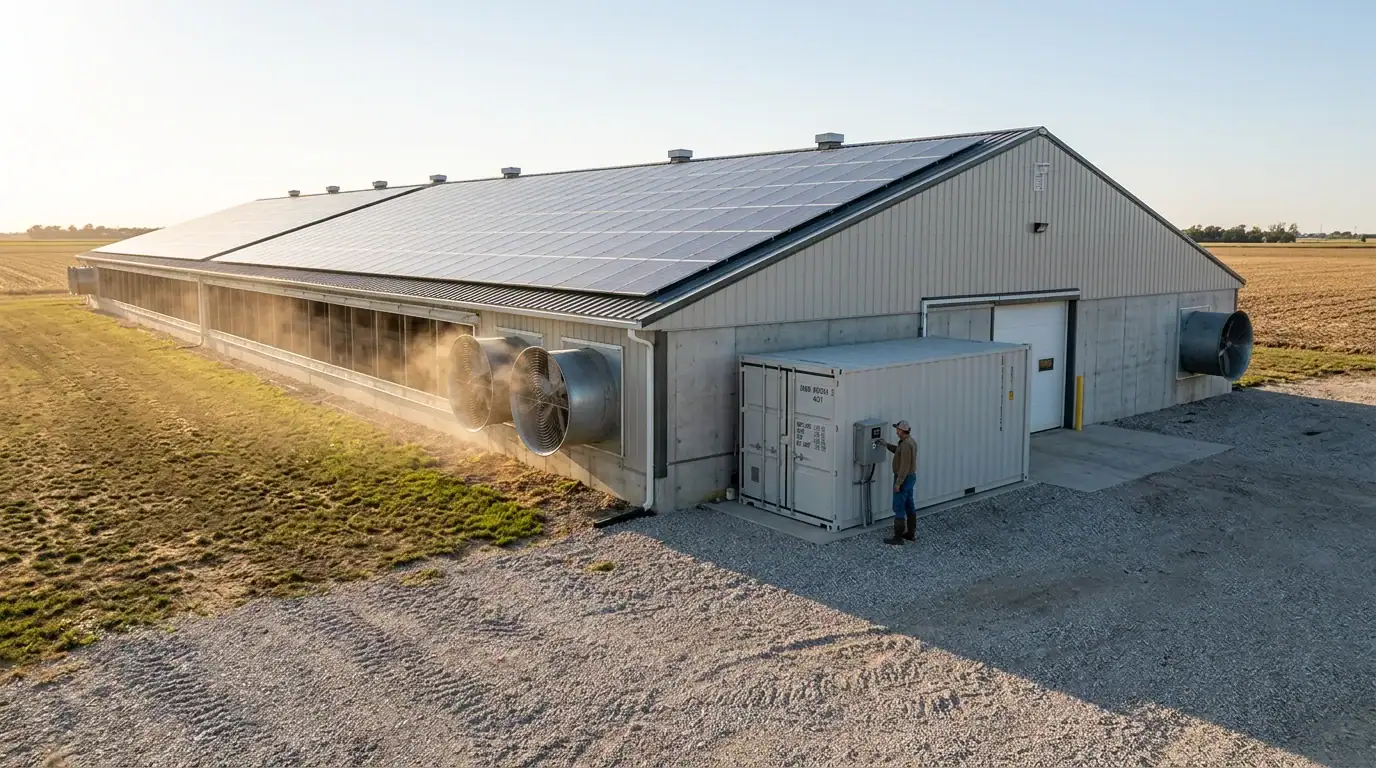
Swine facilities have an energy profile that differs from every other livestock operation, and standard farm solar design advice does not fit them well.
Three loads dominate a swine barn’s electricity consumption.
Ventilation. Swine barns are ventilated continuously, 365 days a year. The ventilation rate is managed to control temperature, humidity, ammonia, and dust. In summer, ventilation rates are at maximum to remove heat. In winter, minimum ventilation rates maintain air quality while conserving heat. A 2,400-head finishing barn may run 10 to 15 kW of fan capacity in summer and 2 to 4 kW in winter, but the fans run continuously regardless of season.
This load is also safety-critical. Swine do not sweat effectively. A ventilation failure in a finishing barn during summer heat can raise interior temperature to lethal levels within two to four hours. Mortality from ventilation failure is not gradual — it is catastrophic and total.
Heating. Nursery and wean-to-finish barns require supplemental heat. Young pigs need 85°F to 90°F in the first weeks after weaning, declining to 65°F to 70°F as they reach market weight. In cold climates, this heating load is substantial — often 8 to 15 kW of electric or propane-fired heat in a nursery barn during winter.
Manure management. Pit pumping, agitation, and in some systems, manure treatment and solids separation have significant but periodic energy demand. A pit pump may draw 15 to 25 kW for several hours during pump-out events, which occur four to eight times per year.
The combination creates a load profile that is unusual: a large continuous base load (ventilation), a seasonal peaking load (heating), and periodic high-power events (manure pumping).
And critically, the ventilation load cannot be interrupted. This is what makes battery backup a design requirement rather than an optional feature.
The Solution: Three System Configurations
Swine facility solar systems fall into three configurations, defined by how they handle the ventilation load during outages and low-sun periods.
Configuration 1 — Solar-Only with Grid Backup
The solar array offsets a portion of the barn’s annual electricity consumption. Ventilation continues to rely on the grid for reliability — if the grid fails, the barn loses ventilation.
Advantages: Lowest cost. Simple design. Standard net metering or self-consumption design.
Disadvantages: Provides no protection against grid failure during a heat event. Grid reliability in rural areas is not guaranteed, and a summer outage during a heat wave is exactly when ventilation is most critical.
Best for: Operations in areas with highly reliable grid service and a functioning backup generator.
Configuration 2 — Solar Plus Ventilation Battery Backup
The solar array offsets annual consumption, and a dedicated battery bank powers the ventilation circuit for a defined period during grid outages.
Advantages: Provides the ventilation reliability that swine operations require. Can be sized specifically to the ventilation load rather than the whole barn, which reduces cost. Battery also provides some load shifting and demand reduction value.
Disadvantages: Higher cost than solar-only. Requires separating ventilation circuits onto a dedicated backup panel.
Best for: Most swine operations. This is the recommended configuration for finishing and nursery barns where ventilation failure is catastrophic.
Configuration 3 — Solar Plus Battery Plus Generator
Full redundancy. The solar array offsets consumption, the battery carries ventilation through short outages, and a generator covers extended outages or battery depletion.
Advantages: Highest reliability. Covers extended outages without depleting the battery. Generator can also serve as a supplement during peak heating periods.
Disadvantages: Highest cost. Requires generator maintenance regardless of whether it is used.
Best for: Large operations where the loss of a single barn represents a six-figure financial event, and for operations in areas with frequent or extended grid outages.
The Numbers Behind the Success: 2,400-Head Finishing Barn
Facility assumptions:
- Capacity: 2,400 head finishing
- Ventilation load: 12 kW summer peak, 3 kW winter minimum, continuous operation
- Heating load: none (finishing barns rely on pig heat)
- Manure pumping: 20 kW, 6 hours per event, 6 events per year
- Lighting and controls: 2 kW continuous
- Annual electricity consumption: 115,000 kWh
- Electricity rate: $0.12 per kWh
- Current annual electricity cost: $13,800
Ventilation backup requirement:
- Ventilation critical load: 12 kW summer (assume worst-case summer outage)
- Required autonomy: 8 hours (allows time to respond and restore power, or to bring in a generator)
- Required battery energy: 12 kW × 8 hours = 96 kWh usable
- LiFePO4 depth of discharge: 85%
- Round-trip efficiency: 92%
- Required nameplate capacity: 96 ÷ (0.85 × 0.92) = 123 kWh
- Battery cost (2026, installed): $500/kWh nameplate
- Battery investment: $61,500
- Federal ITC (30%): –$18,450
- Net battery cost: $43,050
Solar array sizing:
- Target: offset 70% of annual consumption
- Annual consumption: 115,000 kWh
- Target solar production: 80,500 kWh
- Required array (moderate sun, 1,400 kWh/kW/year): 58 kW
- Array cost ($1.60/W): $92,800
- Federal ITC (30%): –$27,840
- Net array cost: $64,960
Total system:
| Component | Gross Cost | ITC (30%) | Net Cost |
|---|---|---|---|
| Solar array (58 kW) | $92,800 | –$27,840 | $64,960 |
| Battery (123 kWh) | $61,500 | –$18,450 | $43,050 |
| Charging/inverter/balance of system | $18,000 | –$5,400 | $12,600 |
| Total | $172,300 | –$51,690 | $120,610 |
Annual financial performance:
| Item | Value |
|---|---|
| Solar production (80,500 kWh at $0.12) | $9,660 |
| Demand charge reduction (estimated) | $1,800 |
| Total annual savings | $11,460 |
| Simple payback | 10.5 years |
25-year net return (flat rates):
- Gross savings: $11,460 × 25 = $286,500
- Net system cost: $120,610
- 25-year net return: $165,890
But the financial case is not the primary justification. The primary justification is the avoided loss event. A ventilation failure in a 2,400-head finishing barn during summer heat represents a potential loss of $400,000 to $500,000 in livestock value. The battery investment of $43,050 net is insurance against that event, and it happens to also reduce electricity costs.
Ventilation Battery Sizing: Why 8 Hours, Not 2
Most battery sizing guidance for farm backup recommends 2 to 4 hours of autonomy. That is adequate for loads that can tolerate interruption or that can be shut down gracefully.
Ventilation is not such a load.
The rationale for 8 hours:
- Response time. When a grid outage occurs, someone must be notified, travel to the site, and assess the situation. In rural areas, that is realistically 1 to 2 hours.
- Generator mobilization. If a generator must be brought in, add 2 to 3 hours.
- Utility restoration uncertainty. Rural distribution outages from storm damage routinely extend beyond 4 hours. Some extend to 12 or more.
- Temperature rise rate. In summer conditions, interior temperature in a fully loaded finishing barn rises rapidly without ventilation. A 4-hour outage in 95°F ambient conditions can be lethal.
Eight hours of ventilation autonomy covers the realistic range of outage scenarios for most operations, with generator backup as the secondary layer for extended events.
| Autonomy | Battery Size (nameplate) | Net Cost After ITC | Scenario Covered |
|---|---|---|---|
| 2 hours | 31 kWh | $10,850 | Brief interruptions only |
| 4 hours | 62 kWh | $21,700 | Short outages, mild weather |
| 8 hours | 123 kWh | $43,050 | Realistic rural outage scenarios |
| 12 hours | 184 kWh | $64,400 | Extended outages, no generator |
Expert Tips
1. Separate ventilation circuits onto a dedicated backup panel. The battery should not have to carry the entire barn. Isolate ventilation, controls, and critical lighting onto a dedicated panel fed by the battery inverter. Water heating, manure pumping, feed systems, and shop loads stay on the main panel and are not backed up. This reduces battery cost by 50% or more.
2. Size the battery for summer peak ventilation, not average ventilation. Winter minimum ventilation may be 3 kW. Summer maximum may be 12 kW or higher. The battery must carry the summer peak, because that is when an outage is most dangerous. Sizing for average ventilation under-sizes the system for the only scenario that matters.
3. Add temperature monitoring with remote alerting. A battery backup is only useful if someone knows the grid has failed and the battery is discharging. Install temperature sensors with cellular or internet alerting so that if the barn approaches a critical temperature threshold, you are notified immediately — even if the battery is functioning as designed.
4. Confirm the ventilation fans are compatible with the battery inverter’s output waveform. Most modern variable-frequency drive fans and electronically commutated motors are compatible with modern battery inverters. But older fans with shaded-pole motors may not run correctly on a modified sine wave output. Verify compatibility with the inverter manufacturer before installing.
5. Understand the ITC treatment of the battery. A battery charged by solar and used for backup power generally qualifies for the 30% ITC when installed in connection with a solar system. Confirm with your CPA — the $18,450 credit on a 123 kWh battery is a material part of the economics.
6. Do not size the solar array to the battery — size it to annual consumption. The battery exists for backup, not for energy storage economics. The array exists to offset consumption. Sizing the array to charge the battery fully each day would dramatically over-size the array for a load that only discharges during outages.
7. If you have a generator, test the transfer sequence under load. The transition from battery to generator is the most failure-prone point in a redundant system. Test it annually under realistic load conditions, not just on a bench test.
Conclusion
Swine facilities have a load profile that makes standard farm solar design insufficient. Ventilation runs continuously and is safety-critical. Heating is seasonal but substantial. Manure pumping creates periodic high-power events.
The critical design decision is not system size — it is ventilation reliability. A solar-only system that offsets 70% of annual consumption but provides no backup during a summer grid outage leaves the barn exposed to a catastrophic loss event. A solar-plus-battery system with 8 hours of ventilation autonomy and a net cost of roughly $43,000 for the battery addresses that exposure directly.
The 25-year financial return on a complete solar-plus-battery system for a 2,400-head finishing barn is approximately $165,000 in net electricity savings. But the financial return is secondary to the operational protection. A single ventilation failure in a fully loaded barn can cost more than the entire battery investment.
Design the system for the ventilation load first. Everything else follows.
Frequently Asked Questions
Q: Can solar power a hog barn?
A: Yes. A solar array can offset a significant portion of a swine barn’s annual electricity consumption — typically 60% to 80% depending on system size and facility load. However, because ventilation in a swine barn is safety-critical and runs continuously, a solar-only system does not provide adequate protection against grid outages. The recommended configuration is solar plus a dedicated ventilation battery backup, which offsets annual consumption while carrying the ventilation load for 8 hours during grid outages. A generator can be added as a third layer for extended outages.
Q: How much does solar cost for a swine operation?
A: For a 2,400-head finishing barn, a complete solar-plus-battery system targeting 70% consumption offset typically costs $170,000 to $180,000 gross, or roughly $120,000 net after the 30% federal ITC. This includes a 58 kW solar array, a 123 kWh battery bank for 8-hour ventilation autonomy, and balance of system. Annual savings are approximately $11,500, giving a simple payback of about 10.5 years and a 25-year net return of roughly $165,000. Costs vary substantially with facility size, climate, and existing electrical infrastructure.
Q: Do I need battery backup for hog barn ventilation?
A: Yes, for any swine facility where ventilation failure would be catastrophic — which includes essentially all finishing and nursery barns. Swine do not sweat effectively, and interior temperatures in a fully loaded barn can reach lethal levels within two to four hours without ventilation during summer heat. A battery sized for 8 hours of ventilation autonomy covers realistic rural outage scenarios: notification time, travel time, generator mobilization, and typical utility restoration. Eight hours is the recommended standard, not the 2 to 4 hours typical of general farm backup guidance.
Related Articles
- Solar Heating for Poultry Houses in Winter: Maintaining 65°F for 20,000 Birds Without the Propane Bill — A closely analogous ventilation and heating load.
- Farm Solar Battery Sizing: The 2026 Complete Guide — The sizing method applied here to ventilation loads.
- Solar Ventilation for Equine Stables: Respiratory Health and Comfort Without the Electric Bill — Another continuous ventilation application.
- Solar Water Heating for Dairy Parlors: Cut Your Hot Water Bill by 70% — Concentrated livestock energy demand in a different operation.
© 2026 Farm Solar Guide. All data sourced from ASAE water system standards, manufacturer cold-temperature specifications, EIA fuel price projections, and documented US farm operations. Last verified: October 21, 2026.