Written by Dr. Robert Kowalski — Ph.D. in Agricultural and Biological Engineering from Penn State University, with 18 years of experience in on-farm electrical systems and energy project management. He has guided farm solar projects from application to commissioning across the Midwest and Northeast. He is a licensed Professional Engineer and a member of the American Society of Agricultural and Biological Engineers.
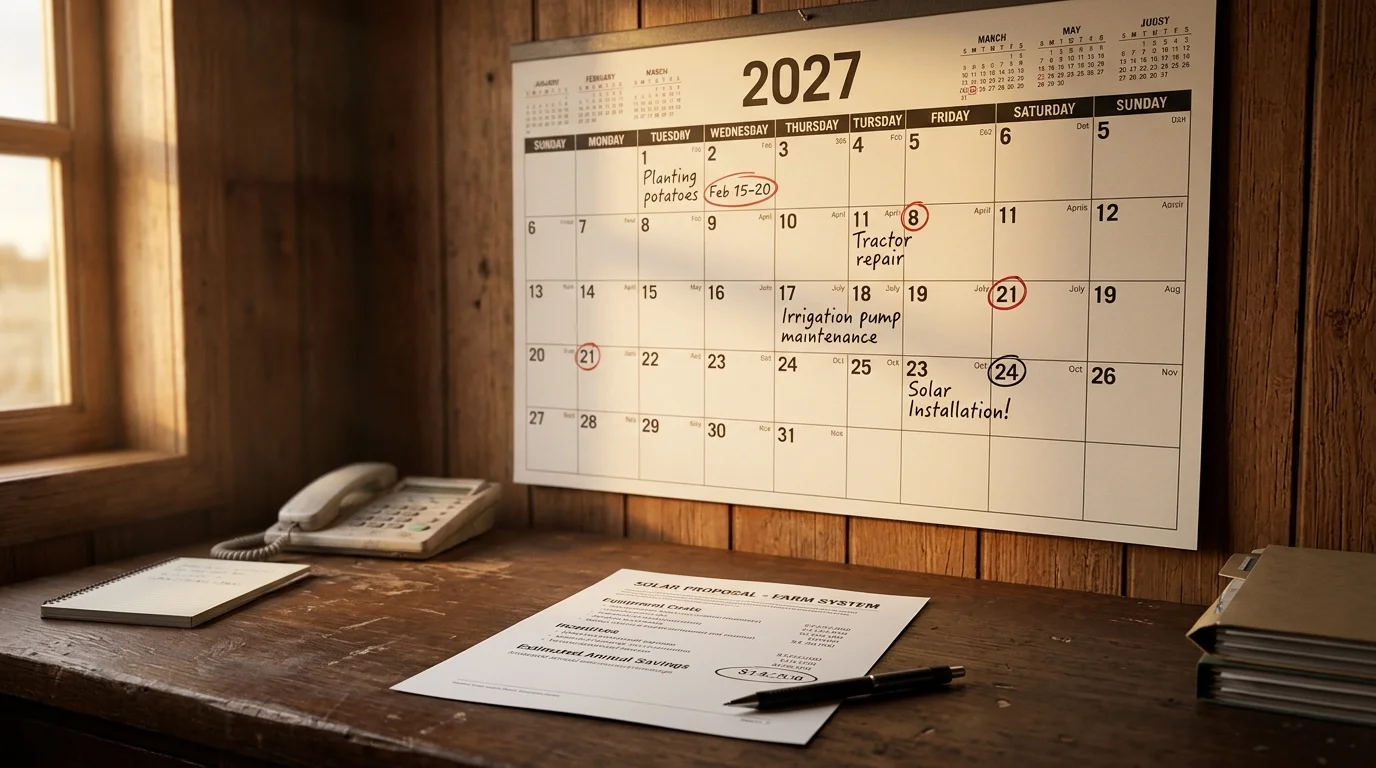
The 30% federal Investment Tax Credit requires your system placed in service by December 31, 2027 — and “placed in service” means inspected, interconnected, and energized, not ordered, not signed, not “panels on the truck.” Working backward through interconnection queues, equipment lead times, and grant cycles, your installer contract needs to be signed by March 2027. Here is the full calendar, month by month.
The Problem
Every incentive deadline in the history of farm energy has ended the same way: a Q4 rush, installers booked solid, utilities drowning in interconnection applications, equipment on allocation — and farmers who started “in plenty of time” watching the deadline pass with a half-wired array.
The farmers who miss are rarely lazy. They miscount the timeline. A farm solar project is not a purchase; it is a construction project with three bureaucracies attached (installer, utility, USDA/IRS), and each one owns a piece of your calendar. Our permitting and interconnection guide details the queue problem: on many rural utilities, interconnection review alone runs 2–5 months — and you do not control it.
So this calendar is built backward from December 31, 2027, with the buffers in the right places.
The Backward Math
| Milestone | Duration | Latest date |
|---|---|---|
| Placed-in-service deadline | — | December 31, 2027 |
| Final inspection + utility permission to operate | 3–6 weeks | Mid-November 2027 |
| Installation + commissioning | 2–6 weeks | October 2027 |
| Equipment delivery (inverters, batteries) | 4–12 weeks | July 2027 |
| Utility interconnection study/approval | 2–5 months | May 2027 |
| Permitting | 2–8 weeks | April 2027 |
| Contract signed + design finalized | — | March 2027 |
| Quotes, vetting, financing, REAP application | 2–4 months | Start now — November 2026 |
Notice what the math says: if you are reading this in late 2026, you are not early. You are exactly on time.
The Month-by-Month Calendar
November–December 2026 — Define and budget. Pull 12 months of utility interval data (every sizing method on this site starts there). Decide the job: bill reduction, backup, expansion? Run your ROI with our calculator. Sketch the budget and the financing route — cash, loan, or the stacked-incentive route from our REAP stacking guide. If pursuing REAP, commission the energy audit now; auditors book out.
January 2027 — Collect quotes and vet hard. Three quotes minimum, from installers with farm references over 12 months old. Run the five-minute verification from our scams guide and the full checklist from our 12 red flags guide. Ask each bidder the deadline question directly: “Guarantee placed-in-service by when, with what penalty?”
February 2027 — REAP window and financing. File the REAP application (see the current cycle dates with your state USDA office — and if you are stacking state grants, sequence per our stacking guide). Lock financing. Do not sign the installer contract until the funding picture is real.
March 2027 — Sign. Contract signed, deposit paid, design finalized, interconnection application submitted by the installer, this month. Confirm the submission in writing. Every week of slip here costs a month at the far end.
April–May 2027 — Paperwork season. Permits filed, interconnection study in queue, equipment ordered with confirmed ship dates. This is the quiet period where projects die of neglect — call the installer every two weeks. “Any word from the utility?” is a question that moves queues.
June–July 2027 — Equipment and site prep. Racking and panels arrive; verify against the invoice (substitutions happen in rush years). Site prep: trenching, ground-mount posts, the service panel work from our upgrade guide. Inspect deliveries before signing the freight receipt.
August–September 2027 — Build window. Installation proceeds. Your jobs: photograph everything (the documentation package from our insurance claims guide starts here), keep the paper trail, and do not let the crew leave without the monitoring system live and your logins in hand.
October 2027 — Inspection and interconnection. Final electrical inspection, utility witness test, permission to operate. If anything on this calendar slips, it will slip into these weeks — which is why they must start in October and not December.
November 2027 — Commission and document. Energize. Verify production against the model. File the documentation package: invoices, permits, inspection sign-offs, interconnection agreement, photos, warranties. Your tax filing and your insurance both start from this folder.
December 2027 — Buffer, not build. This month exists for weather, a failed inspection re-schedule, a backordered inverter. If you are building in December, something upstream went wrong in March.
The Numbers: What the Deadline Is Worth
| System size | Cost | ITC at 30% | Miss the deadline |
|---|---|---|---|
| 25 kW (small farm) | $60,000 | $18,000 | –$18,000 |
| 50 kW (mid-size) | $115,000 | $34,500 | –$34,500 |
| 100 kW (dairy/large) | $240,000 | $72,000 | –$72,000 |
| 250 kW (large operation) | $550,000 | $165,000 | –$165,000 |
The deadline is not a detail. On a mid-size farm system it is the single largest line item after the array itself.
Expert Tips
1. “Placed in service” is a legal term — get your proof. Permission-to-operate letter from the utility, dated inspection sign-off, and photos of the energized system. Your CPA will want all three if the credit is ever questioned.
2. Rush-year substitutions are where quality dies. In deadline years, installers swap panels and inverters to hit dates. Your contract should name equipment and allow substitutions only with your written approval.
3. The interconnection application date is your real place in line. Ask your installer for the submission confirmation and queue position. In a 2027 rush, queue position is destiny.
4. Book the inspector’s calendar, not just the installer’s. Rural inspection offices are thin-staffed. In Q4 2027 their backlogs will be measured in weeks. Early October inspections are scheduled in August.
5. Do not let the deadline talk you into a bad deal. Manufactured urgency is the oldest scam in this industry (our scams guide is built on it). The difference between real urgency and sales pressure: this calendar, in writing, with your dates on it.
6. If you cannot make 2027, say so early. A project that will miss the deadline should be re-optimized, not rushed — smaller scope, phased build, or restructured financing. A rushed array is a decade of problems bought to save a credit.
Conclusion
December 31, 2027 sounds far away until you run the backward math: energized by November, inspected by October, building by August, interconnected by May, signed by March. The farmers who capture the 30% credit are not the fastest — they are the ones who started the paperwork while the deadline still looked distant. That is now.
Frequently Asked Questions
Q: When does the 30% federal solar tax credit expire for farms?
A: The residential credit ends December 31, 2025, but farm and commercial systems retain the 30% ITC for projects placed in service by December 31, 2027 — and “placed in service” means inspected, interconnected, and energized, not purchased or contracted. Working backward through interconnection queues and equipment lead times, the installer contract should be signed by March 2027. Verify current law with your CPA before making decisions on the deadline.
Q: How long does a farm solar project take from signing to switch-on?
A: Six to nine months is realistic for a farm-scale system: 2–5 months of utility interconnection review (the part you do not control), 2–8 weeks of permitting, 4–12 weeks of equipment lead time, 2–6 weeks of installation, and 3–6 weeks of inspection and permission-to-operate. In a deadline year like 2027, pad every estimate — the Q4 rush extends queues, backorders equipment, and books out inspectors.
Q: Can I still apply for a REAP grant for a 2027 project?
A: Yes, if the cycle timing cooperates — REAP runs on application windows with awards weeks to months later, and the grant does not need to be in hand before you build, though it must be secured before reimbursable costs are incurred (verify with your state USDA office). File in the earliest 2027 window you can, sequence any state grants first per our stacking guide, and never let grant timing push you past the interconnection queue dates on this calendar.
Related Articles
- Farm Solar Permitting & Interconnection: The 2026 Timeline Guide — The queue mechanics behind months April through June.
- Farm Solar Tax Credits 2026: ITC, REAP & MACRS Stacking Guide — What the credit is worth and how it stacks with everything else.
- How to Vet a Farm Solar Installer: 12 Red Flags + 8 Credentials — For January: choosing who you sign with in March.
© 2026 Farm Solar Guide. All data sourced from IRS guidance, USDA Rural Development program rules, utility interconnection procedures, and documented US farm projects. Last verified: November 13, 2026