
Written by Dr. Robert Kowalski — Ph.D. in Agricultural and Biological Engineering from Penn State University, with 18 years of experience in on-farm electrical systems and farm equipment electrification. He has evaluated electric tractors, UTVs, and charging infrastructure for farm operations across the Midwest and Northeast. He is a licensed Professional Engineer and a member of the American Society of Agricultural and Biological Engineers.
A farm UTV burns roughly $1,400 a year in gasoline for about 90 hours of actual work — and sits parked the other 8,670 hours, which happens to be exactly when a solar panel could be charging its electric replacement. Here is when the switch pays, when it does not, and how big a panel makes the thing free to run.
The Problem
The farm fleet electrification conversation starts in the wrong place. Everyone debates the 150 HP tractor — we ran that math in our electric tractor guide — while the machine that should go electric first sits by the barn door: the UTV.
Consider the duty cycle. A farm side-by-side makes short trips — fence lines, feed runs, checking pivots — totaling 1–3 hours a day with long parked gaps in between. That is the worst possible life for a gasoline engine (cold starts, short runs, fouled plugs, carburetor varnish) and the absolute best possible life for an electric drivetrain charged slowly by the sun.
Yet farmers hesitate for two reasons, one legitimate and one not. The legitimate one: purchase price — electric UTVs run 13,000–13,000–25,000 against 10,000–10,000–16,000 for gas equivalents. The illegitimate one: range anxiety on a machine that rarely travels 15 miles in a day.
The Real Cost Comparison
| Gas UTV | Electric UTV | |
|---|---|---|
| Purchase price (2026, mid-spec) | $12,000–$15,000 | $14,000–$19,000 |
| Fuel/energy per year (1.5 hr/day) | ~$1,400 gasoline | ~$110 grid electricity / ~$0 solar |
| Annual maintenance | $400–$700 (oil, filters, plugs, belts) | $100–$200 (tires, brakes, little else) |
| Cold-start reliability | Poor — the reason for jump packs | Full torque at -10°F |
| Engine service life | ~5,000–8,000 hrs with maintenance | Motor effectively outlasts the chassis |
| Noise at 6 AM near the house | Everyone knows | Nobody knows |
The gap: roughly 2,000–2,000–4,000 more upfront, against roughly $1,700/year saved in fuel and maintenance. Simple payback on the price premium: 1.5–2.5 years, before counting the value of a machine that starts every single morning.
The Solar Charging Math
A mid-spec electric UTV carries a 10–15 kWh battery and consumes roughly 0.5–0.9 kWh per mile of mixed farm work. The daily energy budget:
| Daily use | Miles | Energy needed | Solar required (4.5 peak sun hrs) |
|---|---|---|---|
| Light (fence checks, feed run) | 8 mi | ~6 kWh | 1.8 kW array |
| Typical mixed farm day | 15 mi | ~10 kWh | 3 kW array |
| Heavy (hauling, hills, full days) | 25 mi | ~18 kWh | 5.3 kW array |
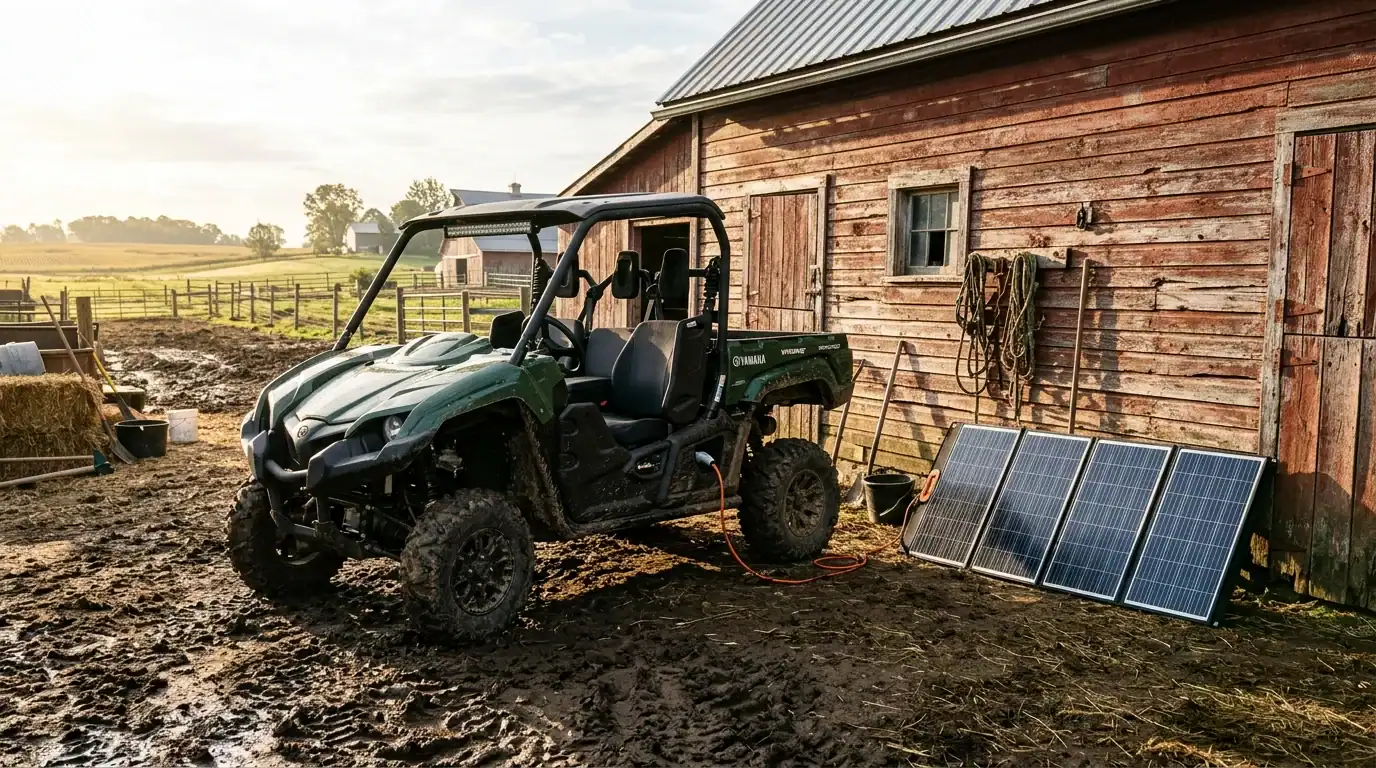
Here is the insight that makes the whole thing click: the UTV is parked 20+ hours a day, so the panel has all day to do the job. A 2–3 kW ground array — or a share of the barn roof system — covers a typical day’s work entirely. Unlike an electric tractor demanding 50–150 kW fast charging, a UTV accepts a slow 120V or 240V charge happily. No service panel upgrade, no demand charges, no drama.
And if your farm already has a solar array, the marginal cost of UTV charging rounds to zero: you are consuming surplus production at midday instead of exporting it for pennies.
What the Vehicles Actually Look Like in 2026
- Purpose-built electric UTVs (Polaris Ranger XP Kinetic and competitors): 80–110 HP equivalent, 40–80 mile range, 10–15 kWh packs. These are real farm tools now, not golf carts.
- Electric ATVs: smaller packs (5–8 kWh), ideal for pasture checks; charge off a single 400–600W portable panel setup.
- Electric yard trucks / compact pickups: 20–30 kWh, for feed and supply runs; want a dedicated 3–5 kW charging share.
- Conversion caution: DIY gas-to-electric UTV conversions exist but rarely survive farm duty; the engineering is in the waterproofing and the suspension loads, not the motor.
Expert Tips
1. Size the charger to the sun, not the spec sheet. The included fast charger is for events; daily charging wants a slow 8–12A draw that a modest array covers without touching your peak demand. Slow charging also extends battery life.
2. Battery chemistry decides winter behavior. Lithium packs lose 15–25% of range at 0°F and some refuse charge below freezing. If the machine lives in an unheated barn, either spec a pack with thermal management or park it in the shop with a small heater on the charging circuit.
3. Keep one gas machine — for now. Long hauling days, multi-day trips away from the barn, and emergencies still favor gasoline. The right fleet for most farms in 2026: electric UTV for daily rounds, gas machine for the exceptions. Sell the second gas machine, not the only one.
4. The quiet is a production feature. Electric UTVs do not spook livestock, do not wake the house, and let you hear the operation — a failing bearing, a dog in the wrong pasture. Farmers consistently rank this higher than fuel savings after one season.
5. Torque is better than the brochure suggests. Electric drivetrains deliver full torque from zero rpm; loaded trailers pull away cleaner than with the gas equivalent, and there is no belt-slip drama on hills.
6. Track the first year honestly. Log hours, miles, and kWh for one season. The number farmers get wrong is their own usage — most discover the machine works less, and charges easier, than assumed. Your log is the business case for the next vehicle.
Conclusion
The UTV is the correct first electrified machine on a farm: short trips, long parked hours, brutal duty cycle for gasoline, trivial charging needs for solar. A 2–3 kW panel share runs it for free, the maintenance bill nearly disappears, and the price premium pays back in under three years. Electrify the machine that sits by the barn door first — the tractor can wait.
Frequently Asked Questions
Q: How many solar panels does it take to charge an electric UTV?
A: A typical farm day (15 miles) uses about 10 kWh, which 5–7 modern 430W panels generate in an average day — roughly 2.5–3 kW of array. Because the vehicle sits parked 20+ hours, charging happens slowly through the day with no special equipment. Light use (8 miles) needs only about 4 panels’ worth of production; heavy use (25 miles) wants 12.
Q: Are electric UTVs powerful enough for real farm work?
A: Yes for daily rounds: current models deliver 80–110 HP equivalent with full torque from zero rpm, tow 1,500–2,500 lbs, and carry 1,000+ lb payloads. The honest limits are range on full-day heavy use (40–80 miles depending on terrain and load) and deep-winter battery performance. For fence lines, feed runs, and livestock checks — 90% of farm UTV hours — they are simply better machines.
Q: What is the real payback on an electric UTV?
A: The price premium over gas runs 2,000–2,000–4,000. Against that, you save roughly $1,400/year in fuel and 300–300–500/year in maintenance — a 1.5 to 2.5 year payback on the premium, faster if the machine replaces a second vehicle or charges from existing solar surplus. Over a 10-year life, the electric machine comes out 12,000–12,000–15,000 ahead, before counting reliability and downtime.
Related Articles
- Solar Electric Tractor Charging: The 2026 Farm Infrastructure Guide — The big-machine counterpart: when tractor electrification works and what it demands.
- Solar Trickle Chargers for Your Diesel Fleet: End Dead Batteries Forever — For the machines staying gas or diesel, keep them starting.
© 2026 Farm Solar Guide. All data sourced from manufacturer specifications, EIA fuel price projections, and documented US farm operations. Last verified: November 4, 2026