
Written by Dr. Hale holds a Ph.D. in Agricultural Engineering from Iowa State University and has designed off-grid water systems for 200+ farms across USDA Zones 3-7. His work on freeze-resistant solar irrigation has been cited by the USDA NRCS and the Solar Energy Industries Association (SEIA).
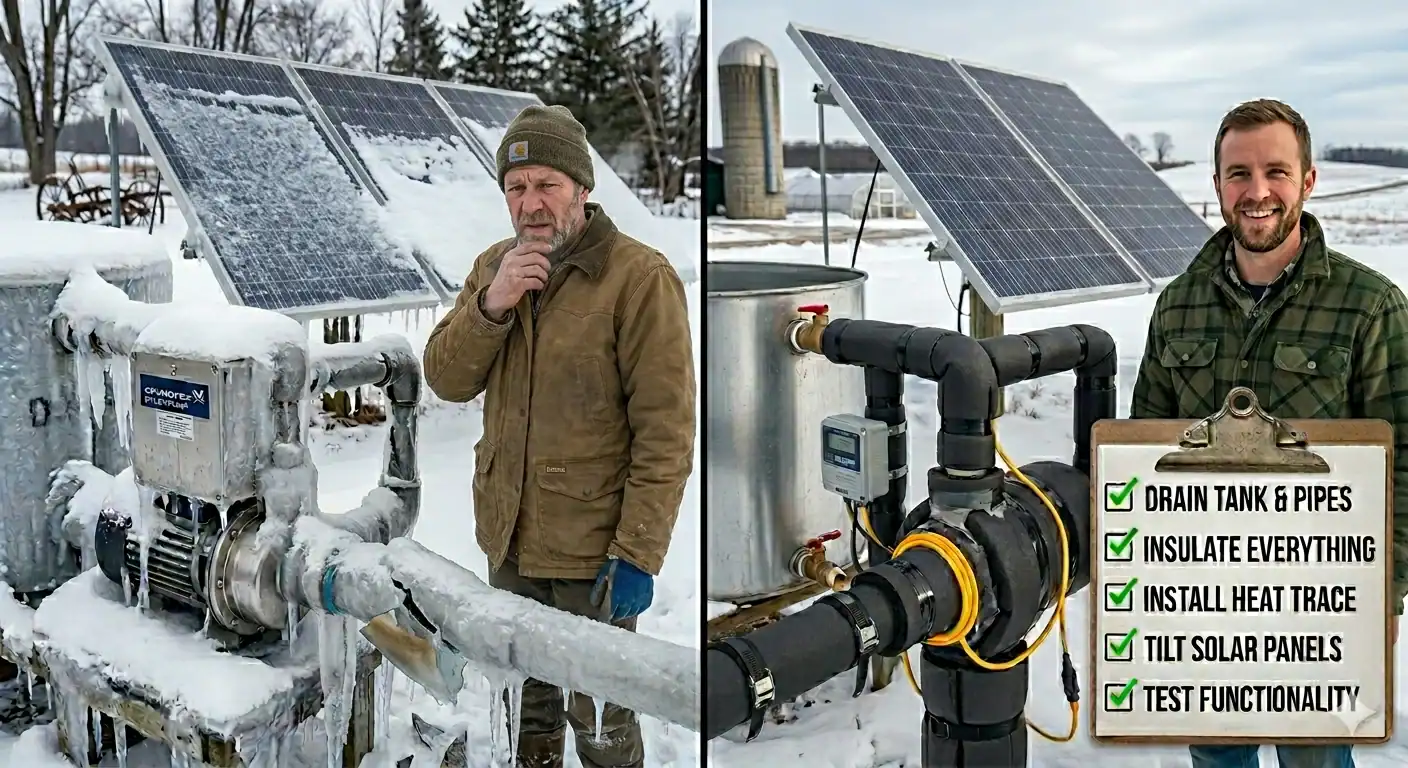
Why 40% of Solar Pumps Fail in Winter
Solar water pumps are the backbone of modern off-grid irrigation and livestock watering systems. Yet, 40% of solar pump failures occur during winter months — not because the panels stop working, but because the water system freezes.
When temperatures drop below 20°F (-6°C), stagnant water in pipes expands by approximately 9% as it turns to ice. That expansion generates over 2,000 PSI of pressure — enough to crack PVC pipe, shatter pump housings, and destroy electronic controllers in a single night. For a farmer relying on that pump for daily livestock watering or greenhouse irrigation, one freeze event can mean days of downtime, emergency water hauling, and thousands of dollars in lost productivity.
The Hidden Costs of Freeze Damage
| Damage Type | Average Cost | Downtime | Impact on Farm |
|---|---|---|---|
| Burst PVC pipe | \$150 – \$400 | 2‑5 days | Irrigation halt, crop stress |
| Cracked pump housing | \$300 – \$800 | 5‑10 days | Complete system replacement needed |
| Damaged controller/electronics | \$200 – \$600 | 3‑7 days | No power regulation, battery drain |
| Frozen pressure tank | \$250 – \$500 | 3‑5 days | Water pressure loss, livestock dehydration risk |
| Total crop/livestock loss | \$1,000 – \$10,000+ | Seasonal | Irreversible yield or animal health damage |
The hard truth: A $50 insulation job can prevent a $800 pump replacement. Most farmers learn this the expensive way.
Why Solar Pumps Are Especially Vulnerable
Unlike grid-powered pumps that can run continuously to keep water moving, solar pumps stop at night when temperatures drop lowest. Stagnant water freezes within hours in sub-zero conditions. Additionally, solar systems often use DC pumps with plastic housings that crack more easily than cast-iron alternatives when ice expands. Surface pumps — common in solar setups for ponds, creeks, and shallow wells — sit entirely above the frost line, making them the most exposed component in the system.
The Solution: 4 Layers of Freeze Protection
Effective winterization isn’t a single action — it’s a layered defense system. Here’s how to build it:
Layer 1: Drainage (The First Line of Defense)
The principle: If there’s no water in the pipes, there’s nothing to freeze.
- Install drain valves at the lowest points of your pipe system
- Slope all pipes at minimum 1/4 inch per foot toward drain points
- Drain the system completely when temperatures drop below 35°F (2°C) for extended periods
- Use compressed air (20-30 PSI) to blow out residual water from pump chambers
- Add weep holes below the frost line on pressurized drop pipes to allow trapped water to escape
Pro tip: Mark your calendar for “drain days” — the first week of November and the first week of March in most northern climates.
Layer 2: Insulation (The Thermal Barrier)
| Component | Insulation Type | R‑Value Needed | Cost |
|---|---|---|---|
| Above‑ground pipes | Foam pipe insulation + heat tape | R‑3 to R‑5 | \$2 – \$4/ft |
| Pump housing | Insulated pump cover / enclosure | R‑5 to R‑10 | \$50 – \$150 |
| Pressure tank | Blanket insulation + enclosure | R‑4 to R‑6 | \$30 – \$80 |
| Controller box | Weatherproof enclosure with ventilation | R‑2 to R‑4 | \$40 – \$100 |
| Underground pipes (below frost line) | None needed if ≥ 4 ft deep | N/A | \$0 |
Critical detail: Insulation alone is not enough if water remains stagnant. Combine with drainage or recirculation. The frost line in the contiguous United States ranges from 0 to 8 feet (2.4 m), with the deepest frost penetration in northern Minnesota and Alaska. In most agricultural zones, 4 feet is the safe burial depth for water lines.
Layer 3: Active Heating (The Insurance Policy)
For systems that must operate through winter:
- Heat tape (self-regulating): $1.50 – $3.00/ft, activates at 38°F
- Thermostatically controlled pump house heater: $100 – $300, maintains 40°F minimum
- Solar thermal loop: Circulate warm water from a buried reservoir through the pump housing
- DC heating element (low-wattage, 12V/24V): $20 – $50, powered by a small battery bank
Energy math: A 60W heat tape running 8 hours/day for 90 winter days = 43 kWh. At $0.15/kWh, that’s $6.50 total — versus a $500 pump replacement.
Layer 4: Redundancy & Smart Design (The Backup Plan)
- Bury pipes below frost line (typically 3-5 feet in USDA Zones 5-7)
- Install a secondary hand pump or gravity-fed backup for emergencies
- Use freeze-resistant pipe materials: PEX (flexible, expands with ice) instead of rigid PVC
- Design for “tilt drainage”: Angle solar panels to 60°+ in winter — sheds snow AND allows pipe drainage
- Remove check valves in drain-back systems so water can flow freely back into the well
ROI Analysis by Climate Zone
USDA Hardiness Zone Comparison
| Zone | Typical Winter Low | Freeze Risk Duration | Protection Cost (Annual) | Replacement Cost (If Unprotected) | ROI of Protection |
|---|---|---|---|---|---|
| Zone 3 (-40°F to -30°F) | -40°F to -30°F | 4‑5 months | \$400 – \$800 | \$1,200 – \$2,500 | 3:1 to 5:1 |
| Zone 5 (-20°F to -10°F) | -20°F to -10°F | 3‑4 months | \$250 – \$500 | \$800 – \$1,800 | 3:1 to 4:1 |
| Zone 7 (0°F to 10°F) | 0°F to 10°F | 2‑3 months | \$150 – \$300 | \$500 – \$1,200 | 3:1 to 5:1 |
Breakdown: What’s Included in “Protection Cost”
| Item | Zone 3 | Zone 5 | Zone 7 |
|---|---|---|---|
| Pipe insulation (100 ft) | \$300 | \$200 | \$150 |
| Heat tape (100 ft) | \$250 | \$150 | \$75 |
| Pump enclosure (insulated) | \$150 | \$100 | \$75 |
| Drain valves & fittings | \$50 | \$40 | \$30 |
| Annual maintenance labor | \$50 | \$40 | \$30 |
| Total First‑Year | \$800 | \$530 | \$360 |
| Annual Recurring | \$50 | \$40 | \$30 |
Key insight: Even in mild Zone 7, a single freeze event costs 3-4x more than a full winterization setup. In Zone 3, protection pays for itself in the first avoided incident.
The “Hidden ROI” — Crop & Livestock Protection
Expert Tips: 7 Field-Tested Winterization Strategies
1. The “30-Minute Drain Rule”
If your pump will be idle for more than 30 minutes when temperatures are below freezing, drain it. Ice forms faster than most farmers think. Keep a drain valve wrench attached to the pump housing — don’t let “I can’t find the tool” be the reason you lose a $600 pump.
2. Optimize Panel Tilt for Winter Drainage
Angle your solar panels to 60° or steeper during winter months. This serves two purposes: sheds snow accumulation (maintaining power output) and creates a natural gravity slope for any pipe drainage system connected to the array structure. The optimal winter angle is approximately your latitude plus 15 degrees.
3. Bury Your Reservoir (If You Have One)
A 500-gallon water reservoir buried 4 feet underground stays at approximately 50°F year-round — even when air temperatures hit -20°F. Use this as a thermal buffer: circulate water from the buried tank through your pump housing before it reaches the surface distribution system.
4. Use PEX Pipe, Not PVC, for Exposed Runs
PEX (cross-linked polyethylene) can expand up to 3x its diameter before rupturing. PVC cracks at the first freeze event. For any above-ground or shallow-buried sections, PEX is 2x the material cost but 10x the freeze resistance.
5. Install a “Dummy Load” Circulation Loop
For systems that must run 24/7, add a small recirculation loop that keeps water moving through the pump even when no irrigation is active. A 12V circulation pump drawing 10W ($15 on Amazon) can prevent freeze-up in all but the most extreme conditions.
6. The “Bucket Test” for Leak Detection
Before first frost, fill your system and place a 5-gallon bucket under every drain valve. Open each valve for 10 seconds. If the bucket doesn’t fill completely, you have a blockage — and that blockage will become an ice dam. Fix it now, not in January.
7. Create a “Winterization Checklist” and Laminate It
Print this checklist and tape it to your pump housing:
- [ ] Drain all above-ground pipes (open lowest valves)
- [ ] Blow out pump chamber with compressed air (20-30 PSI)
- [ ] Verify heat tape is plugged in and LED indicator is on
- [ ] Check insulation for gaps, rodent damage, or moisture
- [ ] Confirm drain valves move freely (not seized)
- [ ] Test backup hand pump or gravity system
- [ ] Record date of winterization for next year’s reference
Conclusion: Winterization Is Farm Insurance, Not an Expense
Solar water pumps represent a $2,000 – $5,000 investment for most small-to-medium farms. Spending $150 – $800 to protect that investment through winter isn’t a cost — it’s insurance with a 300-500% return.
The farmers who thrive in cold climates aren’t the ones with the most expensive pumps — they’re the ones who drain, insulate, and monitor their systems before the first freeze. The solar water pump market is projected to reach $2.77 billion by 2026, with reliability and freeze protection becoming key differentiators for commercial systems.
Bottom line: If you can read a thermometer, you can winterize a solar pump. Do it in October. Your February self will thank you.
FAQ: Frequently Asked Questions
Q: How do I keep my solar water pump from freezing?
The most effective method is a combination of drainage and insulation: drain all water from above-ground pipes and pump chambers when temperatures drop below 35°F, then wrap exposed components with foam insulation and heat tape. For systems that must operate through winter, add a recirculation loop or thermostatically controlled heating element. In extreme climates (USDA Zone 3), bury all pipes below the frost line (4-5 feet) and use an insulated pump house.
Q: What is the best pipe material for freeze resistance?
PEX (cross-linked polyethylene) is the best choice for above-ground or shallow installations because it can expand significantly when water freezes inside, then return to shape when thawed. PVC will crack at the first freeze event. For buried lines below the frost line, either PVC or PEX works, but PEX remains the more resilient option if frost depth estimates prove inaccurate.
Q: How much does it cost to winterize a solar water pump system?
For a typical 100-foot system, first-year winterization costs range from $360 in mild climates (Zone 7) to $800 in extreme climates (Zone 3), including insulation, heat tape, drain valves, and an insulated pump cover. Annual maintenance costs are only $30-$50. This compares to $500-$2,500 in repair or replacement costs if the system freezes unprotected — giving winterization an ROI of 3:1 to 5:1.
© 2026 Solar Panels for Farms. This article is regularly updated to reflect current market data. Last verified: June 12, 2026.