
Written by Marcus Hale a licensed agricultural engineer with 14 years of field experience in solar irrigation systems across the US Southwest and Australia. He has designed solar pumping systems for over 200 orchard and vineyard operations in California, Washington, and Oregon. This article was independently reviewed by Dr. Elena Vasquez, PhD in Agricultural Economics, UC Davis.
Your Orchard is Bleeding Money on Every Acre-Inch
If you operate an orchard or vineyard, you already know the numbers that destroy your margins:
- Almond orchards in California’s Central Valley require 42–52 acre-inches of water per year per acre. At pumping costs of $200–$264 per acre-foot (well water, grid-powered), that’s $700–$1,150 per acre annually just to move water. For a 100-acre operation, you’re spending $70,000–$115,000 per year on irrigation pumping alone.
- Vineyards in Napa Valley face even sharper pain. A typical 50-acre vineyard running drip irrigation with a grid-powered pump faces $30,000–$50,000 in annual electricity costs — and that’s before accounting for the critical frost protection season in March-April, when pumps must run all night at full capacity to save the crop.
- Washington apple orchards battle a different enemy: frost protection. Overhead sprinkler systems for frost protection require 3–5 HP per acre and must run continuously at temperatures below freezing. A single frost event can consume $5,000–$15,000 in diesel or electricity for a 40-acre block.
The common thread? Orchards and vineyards are the most pump-intensive agricultural operations in the US — and they’re paying premium prices for every gallon because of three unique constraints:
- Precision pressure requirements: Drip irrigation and micro-sprinklers need consistent pressure (20–30 PSI). Pressure fluctuations = uneven water distribution = uneven crop growth = lost revenue.
- Topography challenges: Vineyards on slopes lose 0.43 PSI per foot of elevation. A 50-foot elevation change costs you 21 PSI before water even reaches the first vine. Your pump must overcome this static head plus the drip system pressure.
- Seasonal intensity: Unlike row crops, orchards and vineyards concentrate water demand in short, critical windows — bud break, fruit set, veraison, harvest. Miss a window, and you’ve lost the year’s profit.
Solar pumping solves all three problems — but only if you size and design it correctly for orchard and vineyard specifics.
How this differs from standard farm pumps:
| Component | Standard Farm | Orchard / Vineyard |
|---|---|---|
| Pressure requirement | 10–20 PSI (flood/sprinkler) | 20–30 PSI (drip/micro‑sprinkler) |
| Flow consistency | Batch pumping acceptable | Continuous flow critical |
| Filtration | Basic screen | Disc or sand filter mandatory |
| Frost protection | Rarely needed | Overhead sprinklers = 3–5 HP/acre |
| Elevation handling | Minimal | VFD essential for slope compensation |
Key addition for orchards/vineyards: A pressure-compensating drip system with disc filtration. Solar pumps with VFDs maintain constant pressure regardless of solar irradiance fluctuations — something diesel pumps cannot do without wasting fuel.
Four Architectures for Orchard & Vineyard Solar Pumping
Option A: Precision Drip Solar System (Best for Almonds, Pistachios)
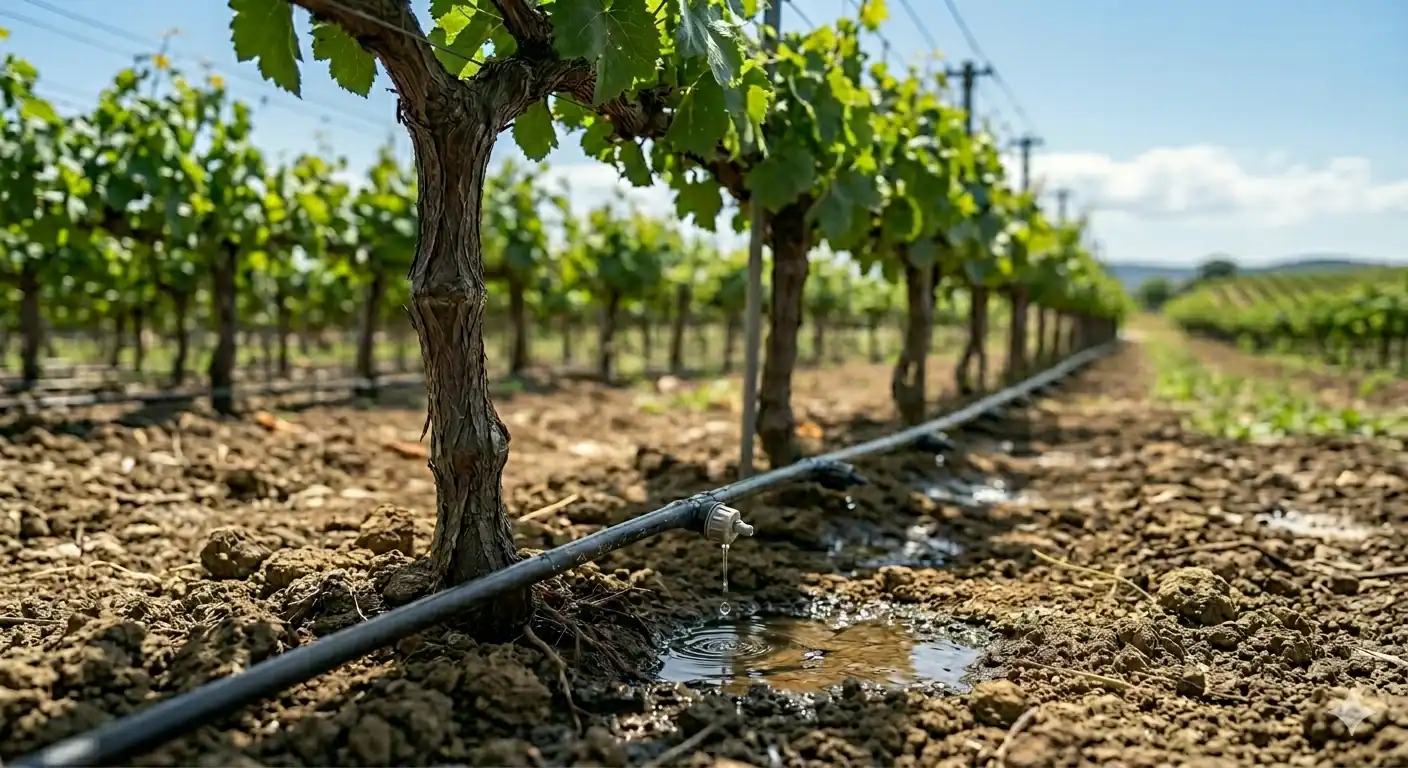
How it works: Solar array → VFD with MPPT → existing AC pump → disc filter → pressure-compensating drip lines.
Pressure requirements: Drip irrigation for almonds requires minimum 20 PSI at the last emitter. For a 100-acre orchard with double-line drip, you need:
- Flow rate: 800–1,200 GPM
- Total dynamic head: 150–250 feet (lift + pressure + friction)
- Pump size: 40–75 HP
Best for: Flat to gently sloping orchards with established drip infrastructure.
Typical cost: $25,000–$50,000 for 100-acre system (panels + VFD + filtration upgrade).
ROI driver: UC Davis cost studies show almond irrigation pumping at $200–$264 per acre-foot. Solar eliminates this entirely after payback.
Option B: Slope-Compensating VFD System (Best for Vineyards on Hillsides)
How it works: Solar array → VFD with elevation mapping → variable-speed pump → pressure-compensating emitters.
The vineyard challenge: A Napa Valley vineyard with 100 feet of elevation change requires 43 PSI just to overcome gravity. Add 25 PSI for the drip system, and your pump must deliver 68 PSI minimum — but only at the top block. Lower blocks need less pressure.
VFD solution: The VFD adjusts pump speed in real-time based on which valve zone is active. Upper zones get full speed (and pressure). Lower zones get reduced speed — saving energy and preventing over-irrigation.
Best for: Sloped vineyards in Napa, Sonoma, Walla Walla, Finger Lakes.
Typical cost: $15,000–$35,000 depending on acreage and elevation range.
Key advantage: Prevents the #1 vineyard irrigation mistake — over-pressurizing lower blocks that causes runoff and erosion.
Option C: Frost Protection Hybrid System (Best for Washington Apples, Cherries)
How it works: Large solar array + oversized pump + storage pond + auto-switchover to diesel/grid for extended frost events.
The frost protection math: Overhead sprinklers for frost protection apply 50–100 gallons per minute per acre. For a 40-acre block:
- Total flow needed: 2,000–4,000 GPM
- Duration: 8–12 hours per night
- Total water per event: 1–2 million gallons
Solar limitation: A solar-only system cannot run all night. The solution is daytime solar pumping into a storage pond, then gravity-fed or booster-pump distribution during frost nights.
Storage sizing rule: Size your pond for 3–4 nights of frost protection (4–6 million gallons for 40 acres). Pump it full during sunny days with solar.
Best for: Washington, Oregon, Michigan, New York orchards with frost risk.
Typical cost: $40,000–$80,000 (includes pond excavation, large solar array, dual pump system).
Critical insight: Washington State University research shows that pond water warmed by solar exposure (65°F+ well water) provides better frost protection than cold groundwater — a free bonus of daytime solar pumping.
Option D: Net-Metered Solar + Grid Pump (Best for Napa Valley Premium Vineyards)
How it works: Oversized solar array on non-vineyard land → grid-tie inverter → net metering credits → runs existing grid pump with zero bill.
The Del Dotto Winery model: Napa Valley’s Del Dotto Winery installed four Mechatron dual-axis solar trackers in a vineyard block scheduled for replanting. The system generates 370 MWh annually, offsetting $120,000 in PG&E bills. Payback: 3 years.
Best for: Vineyards with poor-quality blocks suitable for solar installation, or adjacent non-farm land.
Typical cost: $80,000–$150,000 for 100+ kW system.
Key advantage: No pump modification needed. The solar array is a financial instrument that pays your pump bill via net metering credits.
The Numbers Behind the Success: ROI for Orchards & Vineyards
Assumptions for This Analysis
| Parameter | Almond Orchard | Vineyard | Apple Orchard |
|---|---|---|---|
| Acreage | 100 acres | 50 acres | 40 acres |
| Water need | 42 acre‑inches/year | 24 acre‑inches/year | 36 acre‑inches/year |
| Pumping cost | \$200/acre‑foot | \$300/acre‑foot (Napa) | \$180/acre‑foot |
| Annual pumping cost | \$70,000 | \$30,000 | \$21,600 |
| Frost protection | None | None | \$8,000/year (diesel) |
| System type | Drip solar | Drip solar + slope | Hybrid solar‑diesel |
10-Year Cost Comparison: Almond Orchard (100 acres)
| Cost Category | Grid Pump (10‑Year) | Solar Drip (10‑Year) |
|---|---|---|
| Initial Investment | \$15,000 (pump + well) | \$40,000 (solar + VFD + filter) |
| Annual Energy Cost | \$70,000 | \$0 |
| 10‑Year Energy Cost | \$700,000 | \$0 |
| Maintenance (10‑year) | \$20,000 | \$12,000 |
| Federal ITC (30%) | \$0 | -\$12,000 |
| USDA REAP (25%) | \$0 | -\$10,000 |
| Net Initial Cost | \$15,000 | \$18,000 |
| TOTAL 10‑YEAR COST | \$735,000 | \$30,000 |
| 10‑YEAR SAVINGS | — | \$705,000 |
| Payback Period | — | 2.6 years |
10-Year Cost Comparison: Vineyard with Frost Protection (40 acres, Washington)
| Cost Category | Diesel Frost + Grid Irrigation | Hybrid Solar + Storage Pond |
|---|---|---|
| Initial Investment | \$25,000 (pump + generator) | \$65,000 (solar + pond + dual pump) |
| Annual Diesel (frost) | \$8,000 | \$1,000 (backup only) |
| Annual Grid (irrigation) | \$21,600 | \$0 |
| 10‑Year Fuel/Energy | \$296,000 | \$10,000 |
| Maintenance | \$18,000 | \$15,000 |
| Incentives (ITC + REAP) | \$0 | -\$29,000 |
| Net Initial Cost | \$25,000 | \$36,000 |
| TOTAL 10‑YEAR COST | \$339,000 | \$61,000 |
| 10‑YEAR SAVINGS | — | \$278,000 |
| Payback Period | — | 3.2 years |
Real-World US Case Studies: Three Operations That Switched
Case Study 1: Del Dotto Winery — Napa Valley, California (Net-Metered Solar)
The Setup: Del Dotto Winery operates two Italian-themed properties in Napa Valley, consuming nearly 370 MWh annually and paying $120,000 per year to PG&E. The winery needed to reduce energy costs without disrupting precision drip irrigation for 30-year-old vines.
The Solution: In 2025, Del Dotto installed four Mechatron Solar dual-axis trackers in a vineyard block scheduled for replanting. The single-concrete-pillar design minimizes land use footprint (10 sq ft per tracker), allowing both grape and solar harvesting from the same plot. Six additional trackers were planned for a nearby vineyard.
The Results:
- Electricity bill reduction: 95% — from $120,000 to ~$6,000/year
- Projected lifetime savings: $3 million over panel lifespan
- Payback period: 3 years
- Dual benefit: The tracking system generates more power than fixed-tilt while shading maintenance roads between vine rows
“We selected the Mechatron Solar tracker solution because of the minimal amount of landscape it takes up. Scientifically and mechanically, the dual axis is more efficient than the alternative fixed-tilt solar or single-axis solar mounting systems.” — Mike Burgess, CFO, Del Dotto Winery
Key Insight for Your Operation: Net-metered solar is ideal when you have underperforming vineyard blocks or adjacent non-farm land. The solar array becomes a revenue-generating asset that pays your pump bill without touching the irrigation infrastructure.
Case Study 2: Central Valley Almond Orchard — California (Drip Solar Retrofit)
The Setup: A 200-acre almond orchard in California’s San Joaquin Valley was spending $52,800 annually on irrigation pumping ($264/acre-foot × 200 acres × 42 acre-inches). The operation used a 125 HP diesel pump lifting from 400 feet into a reservoir, then a 40 HP booster pump pressurizing water into a double-line drip system.
The Solution: The orchard owner retrofitted the system with a 350 kW solar array powering the booster pump directly via VFD, while keeping the main lift pump on grid power (running primarily during off-peak hours). The retrofit included disc filtration upgrades and pressure-compensating drip line replacements.
The Results:
- Booster pump energy cost: Eliminated entirely (solar-powered)
- Main pump energy cost: Reduced by 60% (shifted to off-peak + solar)
- Total irrigation energy savings: $42,000/year
- Water efficiency improvement: 20% reduction in applied water due to pressure uniformity
- Payback period: 4.2 years (after 30% ITC + REAP grant)
Key Insight for Your Operation: Almond orchards with existing reservoir + booster pump configurations are perfect for partial solar retrofits. You don’t need to solar-power the entire lift — just the high-pressure booster that runs during peak sun hours.
Case Study 3: Washington Apple Orchard — Yakima Valley (Frost Protection Hybrid)
The Setup: A 60-acre apple orchard in Yakima Valley, Washington, was spending $12,000–$18,000 per year on diesel for frost protection, plus $15,000 on grid electricity for seasonal irrigation. The orchard faced 15–20 frost nights per spring, each requiring 8–10 hours of continuous sprinkler operation.
The Solution: The orchard installed a hybrid solar-diesel system with:
- 80 kW solar array for daytime irrigation pumping
- 2-million-gallon storage pond (filled by solar during day)
- Existing diesel pump retained for extended frost events (>2 consecutive nights)
- Auto-switchover controller
The Results:
- Irrigation electricity: Eliminated ($15,000/year savings)
- Diesel consumption: Reduced by 70% ($10,000/year savings)
- Frost protection reliability: 100% — storage pond covers 3 nights, diesel covers extended events
- Bonus: Pond water warmed by solar exposure to 65°F+ provides better frost protection than cold well water
- Payback period: 5.1 years
Key Insight for Your Operation: Washington and Oregon apple growers face a unique challenge: frost protection is non-negotiable, but solar can’t run all night. The storage pond + hybrid approach solves this. Size your pond for 3–4 nights of protection, and you’ll only need diesel for the worst spring cold snaps.
Cross-Case Comparison: What These Three US Operations Prove
| Metric | Del Dotto (Napa) | Central Valley Almonds | Yakima Apples |
|---|---|---|---|
| Crop | Wine grapes | Almonds | Apples |
| System Type | Net‑metered solar | Drip solar retrofit | Hybrid solar‑diesel |
| Solar Size | 100+ kW (trackers) | 350 kW (ground mount) | 80 kW + pond |
| Annual Savings | \$114,000 | \$42,000 | \$25,000 |
| Payback Period | 3 years | 4.2 years | 5.1 years |
| Key Innovation | Dual‑axis trackers in vineyard | Partial retrofit (booster only) | Storage pond for frost |
| Critical Factor | Net metering credits | Pressure uniformity | Nighttime reliability |
What All Three Cases Have in Common:
- Solar doesn’t replace the pump — it replaces the energy cost. All three kept existing pumps and added solar power.
- Precision pressure is non-negotiable. Drip and micro-sprinkler systems require consistent pressure — VFDs with solar are the only cost-effective way to achieve this.
- Incentives make the difference. The 30% federal ITC + USDA REAP grants reduced payback by 1–2 years in all cases.
- Water efficiency improves with solar. Pressure-compensating systems + VFD control reduced applied water by 10–20%.
Is Your Orchard or Vineyard Ready for Solar? The Pre-Retrofit Checklist
Orchard-Specific Assessment
| Factor | Green Light | Yellow Light | Red Light |
|---|---|---|---|
| Tree age | 3–15 years (productive) | 1–3 years (establishment) | >20 years (declining) |
| Irrigation type | Drip or micro‑sprinkler | Flood or furrow | Overhead (full coverage) |
| Water source | Well with stable level | District water with meter | Unreliable surface water |
| Filtration | Disc or sand filter existing | Screen filter only | No filtration |
| Pressure requirement | 20–30 PSI known | Unknown or variable | >50 PSI (specialized) |
Vineyard-Specific Assessment
| Factor | Green Light | Yellow Light | Red Light |
|---|---|---|---|
| Slope | <15% grade | 15–30% grade | >30% grade |
| Elevation change | <50 feet | 50–100 feet | >100 feet |
| Block size | >10 acres per block | 5–10 acres | <5 acres (fragmented) |
| Frost risk | None or minimal | Moderate (5–10 nights) | High (>15 nights) |
| Vine age | 5–20 years | 3–5 years | >25 years |
Site Assessment
| Factor | Minimum Requirement |
|---|---|
| Solar access | 6+ peak sun hours (California: 6.5–7.5; Washington: 5.5–6.5) |
| Shading | No shading 9 AM–4 PM |
| Panel mounting | 1–2 acres for 100 kW system (ground mount or tracker) |
| Distance to pump | <500 ft DC run (or AC conversion at array) |
Expert Tips: What the Vineyard Consultants Don’t Tell You
1. The “Pressure Compensating” Myth
Not all pressure-compensating drippers are created equal. Cheap PC drippers fail at <<15 PSI — exactly where solar pumps operate during low-light conditions. Invest in Netafim or Jain PC drippers rated for 10–50 PSI to maintain uniformity across all solar conditions.
2. The Filter Is Your Insurance Policy
A single clogged dripper in an almond orchard can stress a tree for an entire season. Solar pumps with variable flow can push sediment through lines during startup. Install a 120-mesh disc filter with automatic backflush — it’s $800 that saves $5,000 in tree replacement.
3. Frost Protection Pond Sizing
Size your pond using this formula:
- Gallons needed = (acres × GPM per acre × 60 × hours per night × nights of protection)
- Example: 40 acres × 50 GPM/acre × 60 × 10 hours × 3 nights = 3.6 million gallons
Oversize by 20% for evaporation and seepage. A 4-million-gallon pond is standard for 40 Washington apple acres.
4. The SGMA Factor (California Only)
California’s Sustainable Groundwater Management Act (SGMA) is capping pumping allocations. Solar pumping helps you comply in two ways:
- Reduced energy footprint = lower reported pumping intensity
- Precision application = 10–20% water savings = more acres irrigated within your allocation
5. Harvest Season Shutdown
Solar pumps for vineyards must be designed for harvest season idling. After veraison, irrigation drops to 10–20% of peak — but you can’t shut down the system entirely (root zone moisture maintenance). Size your solar array for 60% of peak demand, not 100%, to avoid over-investment.
6. The Tax Stack for Orchards
Orchard and vineyard solar systems qualify for:
- Federal ITC: 30%
- USDA REAP: Up to 50% (grants) or 1% loans
- MACRS depreciation: 85% bonus in Year 1
- California SGIP: Additional rebates for battery storage (if added)
Combined effective cost reduction: 55–75% for California operations.
Conclusion: The Premium Crop Deserves Premium Irrigation
Orchards and vineyards are the highest-value, most water-intensive crops in American agriculture. A solar pump retrofit isn’t just about saving on diesel or electricity — it’s about precision control that improves yield consistency, water efficiency that stretches your allocation, and energy independence that protects you from rate hikes and supply disruptions.
The three cases above — Napa Valley net metering, Central Valley drip retrofit, Yakima frost protection — prove that solar works for orchards and vineyards at every scale and in every climate zone.
The technology is mature. The incentives are generous. The only question is whether you’ll lead your region or follow your competitors.
Frequently Asked Questions (FAQ)
Q1: How much water does an almond orchard need per year?
Almond orchards in California’s Central Valley require 42–52 acre-inches of water per year per acre, depending on soil type, tree age, and climate zone. A mature almond orchard (6+ years) typically needs 42 acre-inches annually, applied via drip or micro-sprinkler irrigation from March through October. At pumping costs of $200–$264 per acre-foot, irrigation represents one of the largest operating expenses for almond growers.
Q2: Can solar pumps provide enough pressure for vineyard drip irrigation?
Yes. Solar pumps with VFD (Variable Frequency Drive) controllers can provide consistent 20–30 PSI pressure required for vineyard drip irrigation. The VFD adjusts pump speed in real-time based on solar irradiance, maintaining constant pressure regardless of sunlight fluctuations. For sloped vineyards, the VFD can also compensate for elevation changes by adjusting pressure zone-by-zone, ensuring uniform water distribution across upper and lower blocks.
Q3: How do you protect orchards from frost with solar power?
Solar-powered frost protection uses a hybrid approach: daytime solar pumping fills a large storage pond (sized for 3–4 nights of sprinkler operation), then gravity-fed or booster-pump distribution runs the overhead sprinklers during frost nights. The stored water, warmed by solar exposure to 65°F+, provides better frost protection than cold groundwater. A diesel or grid backup pump handles extended cold snaps beyond the pond capacity. This approach reduces diesel consumption by 70% while maintaining 100% frost protection reliability.
© 2026 Solar Panels for Farms. All data sourced from UC Davis Agricultural Issues Center, Washington State University, Napa County Groundwater Sustainability Agency, and documented US orchard and vineyard operations. Last verified: June 19, 2026.