
Written by Michael A. Stewart, Agri‑Solar Engineering Consultant. 12+ years designing solar irrigation systems for specialty crop operations, including blueberries, hops, raspberries, and other high‑value crops across the United States. Has worked with growers in Michigan, Oregon, Washington, Florida, and the Mid‑Atlantic. Holds a Master’s in Energy Engineering (Delft University) and a certificate in Irrigation System Design from the Irrigation Association.
Specialty Crops Demand Precision — and Solar Delivers It
Blueberries, hops, raspberries, and other high‑value specialty crops are not row crops. They are not orchards. They have their own unique irrigation demands that make solar pumping not just feasible, but often ideal.
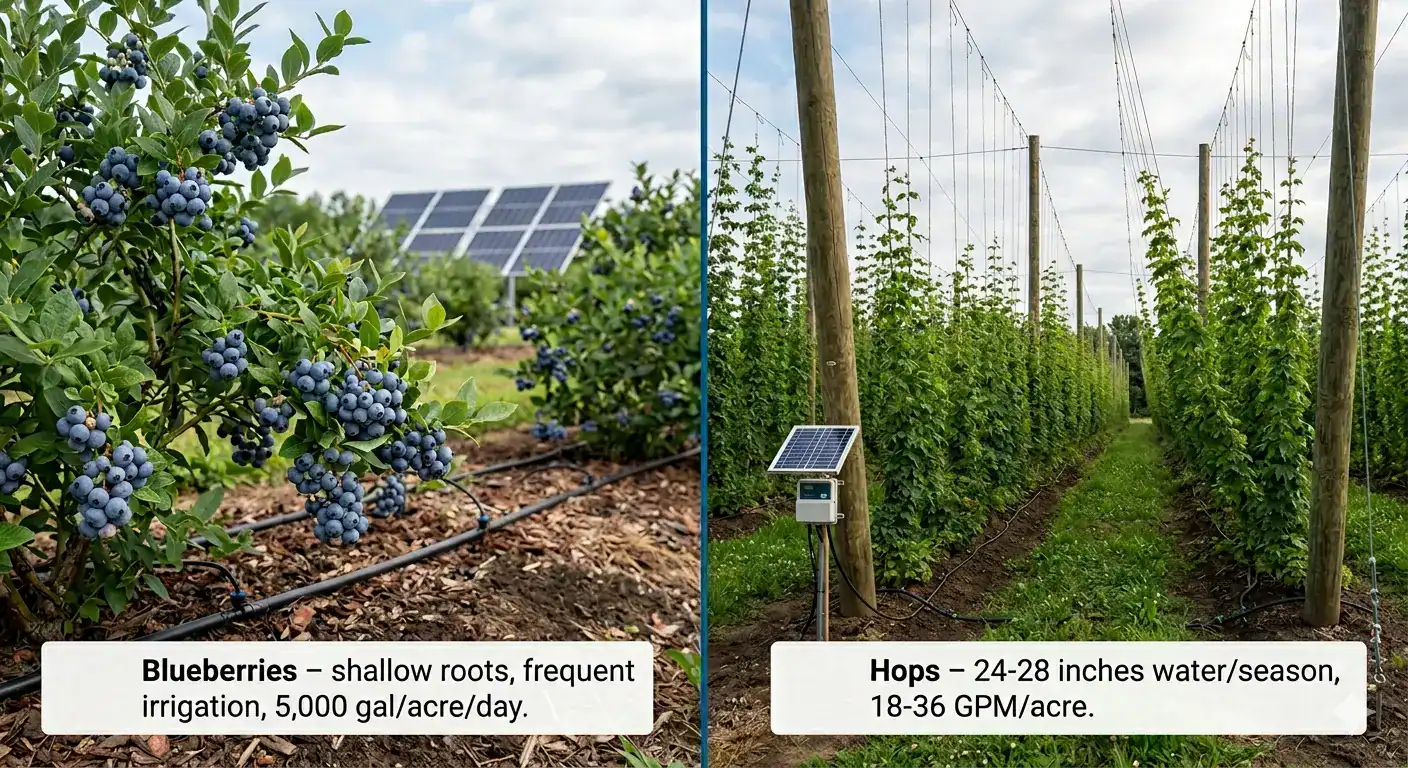
The blueberry challenge: Blueberries have shallow root systems — most roots are in the top 12‑18 inches of soil. They cannot access deep soil moisture, so they need frequent, small irrigations. A mature blueberry bush can use 5‑7 gallons of water per day during peak demand, and a mature planting needs approximately 5,000 gallons per acre per day. Over‑irrigation invites Phytophthora root rot; under‑irrigation reduces berry size and yield. The margin for error is narrow.
The hop challenge: Hops are perennial vines grown on tall trellis systems 15‑20 feet high. They have a dramatic growth curve — 75‑80% of their seasonal water need occurs during July and August, when plants are at peak biomass. Hops require 24‑28 inches of water per growing season in the Pacific Northwest, with irrigation flow rates of 18‑36 gallons per minute per acre depending on dripper spacing. Miss the water window, and you lose cone quality and yield.
Why solar is the answer: Solar pumps are naturally variable‑speed — they produce more water on sunny days when crops need more, and less on cloudy days when evaporation is lower. This matches the precision irrigation needs of specialty crops perfectly. Add a storage tank, and you have 24/7 water availability without batteries.
The Solution: A Crop‑Specific Solar Pumping Framework
Section 1: Crop‑Specific Water Requirements
Blueberries
| Parameter | Value |
|---|---|
| Peak daily water use per mature bush | 5‑7 gallons |
| Peak daily water use per acre | ~5,000 gallons |
| Annual water requirement | ~40 inches (irrigation + rainfall) |
| Root depth | Shallow — 12‑18 inches |
| Irrigation frequency | 2x per week in dry conditions |
| Preferred method | Drip (keeps foliage and fruit dry) |
| Emitter pressure | 8‑15 psi (0.5‑1.0 bar) |
| Water quality | EC < 1.5 dS/m, pH < 6, Cl < 100 ppm |
Key insight: Blueberries are shallow‑rooted and sensitive — they need frequent, small irrigations, not deep, infrequent watering. A mature planting requires approximately 5,000 gallons per acre per day during peak demand.
Plant size‑based water needs:
| Plant size | Daily water per plant |
|---|---|
| Newly planted | 0.25‑0.5 gallons |
| 3‑4 ft plants | 3 gallons |
| Mature plants | 5‑7 gallons |
Hops
| Parameter | Value |
|---|---|
| Seasonal water requirement | 24‑28 inches |
| Peak demand period | July‑August (75‑80% of water) |
| Flow rate per acre (drip) | 18‑36 GPM (depending on spacing) |
| Row feet per acre | ~3,600 ft (at 12‑ft row spacing) |
| Drip emitter spacing | 12‑24 inches |
| Emitter flow rate | 0.4‑0.6 GPH |
| Operating pressure | 9‑60 PSI (pressure‑compensating) |
| Trellis height | 15‑20 feet |
Key insight: Hops have a dramatic growth curve — from emergence in spring to 15‑20 foot bines by summer. Water demand increases with biomass, peaking in July‑August. A well‑designed solar system can match this increasing demand naturally.
Section 2: System Design Considerations
Blueberry Drip System Design
Typical configuration (based on research):
- Row spacing: 3.5 meters (11.5 ft)
- Plant spacing in row: 0.75 meters (2.5 ft)
- Two drip tubes per row
- Dripper spacing: 30 cm (12 inches)
- Emitter flow: 1.1 L/hour (0.29 GPH)
- Operating pressure: 11 meters of water head (1.1 bar / 16 PSI)
Design flow calculation (example — 10 acres):
Plants per acre: 43,560 sq ft ÷ (11.5 ft row × 2.5 ft spacing) ≈ 1,515 plants/acre
Emitters per acre: 1,515 plants × 2 lines × (3.3 emitters per plant) ≈ 10,000 emitters
Total flow: 10,000 emitters × 1.1 L/h = 11,000 L/h = 183 L/min = 48 GPM
Solar pump sizing for 10‑acre blueberry farm:
- Peak daily water: 5,000 gal/acre × 10 = 50,000 gal/day
- Pumping hours: 6 peak sun hours
- Required flow: 50,000 ÷ 6 ÷ 60 = 139 GPM
- Required pressure: 1.1 bar + friction losses + elevation = ~2‑3 bar total dynamic head
- Pump power: approximately 5‑7 HP (3.7‑5.2 kW)
- Solar array: 5‑7 kWp
Hop Drip System Design
- Row spacing: 12 feet
- Row feet per acre: 43,560 ÷ 12 = 3,630 ft
- Single drip line per row
- Emitter spacing: 12‑24 inches
- Emitter flow: 0.4‑0.6 GPH (pressure‑compensating)
- Total emitters per acre: 3,630 ft × (1 emitter/ft) = 3,630 emitters
- Total flow (at 0.5 GPH): 3,630 × 0.5 = 1,815 GPH = 30 GPM
Design flow calculation (example — 10 acres):
Total flow: 10 acres × 30 GPM = 300 GPM
Required pressure: 20‑40 PSI at emitters (pressure‑compensating)
Total dynamic head: 30‑60 meters depending on well depth and elevation
Pump power: 10‑15 HP (7.5‑11 kW)
Solar array: 10‑15 kWp (18‑27 panels at 550W)
Filtration Requirements
| Crop | Recommended filtration | Why |
|---|---|---|
| Blueberries | 120‑150 mesh (disc or screen) | Fine roots and organic matter can clog emitters |
| Hops | 150‑200 mesh (disc preferred) | Fine sand and silt from surface water sources |
| All crops (surface water) | Sand media + screen (two‑stage) | Removes large particles before final polishing |
Pressure regulators and gauges: Maintain consistent pressure within the emitter’s operating range — for drip, typically 8‑15 PSI. Pressure‑compensating emitters are strongly recommended for both blueberries and hops because they maintain uniform flow regardless of pressure variations from solar pumping.
Section 3: Fertigation Integration
Both blueberries and hops benefit greatly from fertigation — applying fertilizer through the irrigation system.
Blueberry Fertigation
| Parameter | Recommendation |
|---|---|
| Nitrogen form | Ammonium‑based (blueberries cannot use nitrate efficiently) |
| pH preference | Acidic (pH < 6) — acidifying fertilizers help |
| Application | Spoon‑feed small amounts frequently, not large applications |
| Avoid | Chloride‑based fertilizers, incompatible mixes |
Why this matters for solar: Solar pumps run for 6‑8 hours daily during sunny periods. This extended runtime is perfect for fertigation — you can inject small, consistent amounts of fertilizer throughout the pumping cycle, matching crop uptake patterns.
Hop Fertigation
| Parameter | Recommendation |
|---|---|
| Nitrogen | Critical during rapid vegetative growth (May‑June) |
| Balanced nutrition | N‑P‑K with micronutrients (B, Zn, Mn) |
| Application | Weekly through drip system |
| Injection timing | Inject at beginning of irrigation cycle, flush with clean water at end |
Fertigation Equipment Options
| Type | Pros | Cons | Best for |
|---|---|---|---|
| Venturi injector | Affordable, simple | Pressure loss, limited precision | Small operations |
| Positive displacement pump | Accurate, consistent regardless of pressure | Higher cost, requires power | Large operations (recommended) |
| Pressure differential tank | Inexpensive, easy | Fertilizer concentration declines over time | Small to medium operations |
Installation note: Fertilizer injection should occur upstream of the filters and downstream of the backflow prevention device. Never inject fertilizer before the pump — it can damage equipment.
Section 4: Sizing a Solar Pump for Specialty Crops
Step‑by‑Step Sizing
Step 1: Calculate peak daily water requirement.
- Blueberries: 5,000 gal/acre/day × acres
- Hops: (18‑36 GPM/acre × 60 minutes × pumping hours) or use 24‑28 inches/season
Step 2: Determine pumping hours.
- Use peak sun hours (typically 4‑6 hours in most US growing regions)
- Design for the month with the shortest days and highest water demand
Step 3: Calculate required flow rate.
- Flow (GPM) = Daily requirement (gallons) ÷ Pumping hours ÷ 60
Step 4: Calculate total dynamic head (TDH).
- TDH = Vertical lift + friction losses + emitter pressure + elevation changes
Step 5: Calculate pump power.
- Hydraulic power (kW) = (Flow GPM × TDH ft) ÷ 3,960 × 0.746
- Pump shaft power = Hydraulic power ÷ Pump efficiency (typically 0.4‑0.6)
Step 6: Size solar array.
- Array size (kWp) = Pump power (kW) ÷ (Motor efficiency × Controller efficiency) × 1.25 safety factor
Sizing Table — Blueberries (10 acres)
| Parameter | Value |
|---|---|
| Daily water requirement | 50,000 gallons |
| Pumping hours (peak sun) | 6 hours |
| Required flow | 139 GPM |
| TDH (well + friction + pressure) | 80‑100 ft (approx. 3 bar) |
| Pump power | 5‑7 HP (3.7‑5.2 kW) |
| Solar array | 5‑7 kWp (9‑13 panels at 550W) |
Sizing Table — Hops (10 acres)
| Parameter | Value |
|---|---|
| Daily water requirement (peak July) | ~50,000‑100,000 gallons |
| Pumping hours (peak sun) | 6 hours |
| Required flow | 300 GPM |
| TDH (well + friction + pressure) | 100‑150 ft |
| Pump power | 10‑15 HP (7.5‑11 kW) |
| Solar array | 10‑15 kWp (18‑27 panels at 550W) |
Section 5: The Math — Cost Comparison and ROI
Blueberry Farm — 10 Acres
Diesel scenario:
- Pump: 7 HP diesel
- Fuel consumption: 1.5 gal/hour × 6 hours/day × 200 days = 1,800 gal/year
- Fuel cost: 1,800 × $1.10 = $1,980/year
- Maintenance: $500/year
- Annual operating cost: $2,480
Solar scenario:
| Component | Cost |
|---|---|
| Solar panels (12 kWp) | $7,200 |
| Pump (15 HP AC + VFD) | $3,000‑4,000 |
| Controller / VFD | $800‑1,200 |
| Mounting, wiring, disconnects | $2,000‑3,000 |
| Installation | $1,500‑2,500 |
| Total solar system | $14,500‑17,900 |
| Scenario | Upfront | 10‑Year Operating | Total |
|---|---|---|---|
| Diesel | $0 | $36,700 | $36,700 |
| Solar | $14,500‑17,900 | $3,000 | $17,500‑20,900 |
| Savings (solar vs. diesel) | — | — | $15,800‑19,200 |
| Payback Period | — | — | 4.3–5.3 years |
Diesel operating cost = 10 × ($2,970 fuel + $700 maintenance) = $36,700.
Savings: $18,700 over 10 years — payback in 4‑5 years.
Section 6: Case Studies
Case Study 1: Michigan Blueberry Farm — 15 Acres
| Detail | Before (diesel) | After (solar) |
|---|---|---|
| Pump | 10 HP diesel | 10 HP AC + VFD (same pump) |
| Annual run hours | 1,200 hours | 1,200 hours |
| Fuel consumption | 1,800 gal/year | 0 |
| Annual fuel cost | $1,980 | $0 |
| Annual maintenance | $600 | $150 |
| Solar system cost | — | $14,000 (8 kWp array) |
| 10‑year savings | — | $20,000+ |
Case Study 2: Romanian Blueberry Farm — Solar Retrofit
A blueberry farm in Brașov County, Romania, previously relied on diesel‑powered pumps for irrigation. The owner switched to solar power with a hybrid solution. After the first system demonstrated stable performance, the customer added a second system in March 2025. This is a growing trend — specialty crop growers are recognizing that solar offers both cost savings and operational reliability.
Case Study 3: Hop Yard — Virginia
A 5‑acre hop yard in Virginia with a 12‑foot trellis system and drip irrigation. The grower installed a 6 kWp solar array with a 7 HP AC pump and VFD. The system provides 30 GPM at 40 PSI, irrigating the hop yard during peak sun hours. The grower reports zero diesel costs and consistent water pressure throughout the growing season.
Expert Tips — What Specialty Crop Pros Know
Tip 1: Pressure‑compensating emitters are non‑negotiable for solar.
Solar pump output varies with sunlight. Pressure‑compensating emitters maintain uniform flow across pressure variations. Without them, you will have uneven irrigation — overwatering at noon and underwatering in the morning.
Tip 2: Use two drip lines for blueberries, not one.
Blueberries have shallow, spreading root systems. Two drip lines per row provide better coverage of the root zone than a single line.
Tip 3: Install a flow meter on each zone.
Specialty crops are high‑value — you cannot afford to guess water application. A $200‑400 flow meter pays for itself in water savings and yield protection. Reduced flow at high pressure indicates a clog; high flow at low pressure indicates a leak.
Tip 4: For hops, time your irrigation to match growth stages.
Hops need 75‑80% of their seasonal water in July and August. Size your solar system for peak demand, not average. A system sized for July will handle the rest of the season with ease.
Tip 5: Test your water quality before designing the system.
Blueberries are especially sensitive to high pH, salinity, and chloride. If your water pH is above 6, you may need acid injection. This affects system design and component selection.
Tip 6: Fertigation through drip is a game‑changer for specialty crops.
Both blueberries and hops respond well to spoon‑feeding nutrients through the irrigation system. Solar pumps run long enough each day to make fertigation practical and effective.
Tip 7: Consider a small storage tank (not batteries).
A 1‑2 day water storage tank provides cloud cover protection and night‑time irrigation without the cost and complexity of batteries. For specialty crops, consistency is everything — storage ensures you never miss a watering window.
Conclusion
Specialty crops like blueberries and hops demand precision irrigation — and solar pumping delivers it. The variable‑speed nature of solar matches crop water needs naturally, while eliminating fuel costs and reducing maintenance.
| Crop | Key takeaway |
|---|---|
| Blueberries | Shallow roots, frequent small irrigations, 5,000 gal/acre/day peak. Design for 5‑7 kWp per 10 acres. |
| Hops | 75‑80% of water needed in July‑August, 24‑28 inches/season. Design for 10‑15 kWp per 10 acres. |
| Both | Pressure‑compensating emitters, 120‑200 mesh filtration, fertigation integration, and a small storage tank. |
Your action plan:
- Calculate your peak daily water requirement (use the tables in Section 1).
- Determine your peak sun hours for your location.
- Size your pump and solar array using the formulas in Section 4.
- Choose pressure‑compensating emitters and appropriate filtration.
- Plan for fertigation if you haven’t already.
- Consider a small storage tank for cloud cover and night irrigation.
- Get quotes from 2‑3 solar pump suppliers.
The sun is free. Your specialty crops deserve precision. Make the switch.
Frequently Asked Questions (FAQ)
Q: How much water do blueberries need per week?
Mature blueberry plants need 1 to 2 inches of water per week during the growing season, applied via drip irrigation in 15-minute pulses, 6 to 8 times per day. A mature plant uses 1.5 to 4 gallons per day depending on canopy size, soil type, and weather. Peak demand occurs in late July to early August, averaging 9 liters per plant per day. USDA-ARS research shows drip irrigation is 42% more efficient than micro-sprays and 56% more efficient than sprinklers for blueberries.
Q: Can solar pumps maintain the pressure needed for drip irrigation in hop yards?
Yes. Solar pumps with VFD (Variable Frequency Drive) controllers can maintain the consistent 20–30 PSI pressure required for hop yard drip irrigation. The VFD adjusts pump speed in real-time based on solar irradiance, maintaining constant pressure regardless of sunlight fluctuations. For hop yards with row lengths over 200 feet, pressure-compensating emitters and zone valves ensure uniform water distribution. A solar system sized for peak hop demand (2 inches per week in July) will be oversized for spring and autumn, allowing surplus energy to power fertigation or be sold via net metering.
Q: How much water does CBD hemp need compared to other crops?
CBD hemp requires 25–30 inches of water per season for full-season varieties (120–140 days), and 20–24 inches for autoflower varieties (70–90 days). Daily water use is 2–8 mm per day (4–5 mm most common), which is lower than the often-quoted 6 gallons per day. Hemp is more drought-tolerant than its appearance suggests, but irrigation during flowering (weeks 4–8) is critical for maximizing secondary and tertiary colas, which represent 30–50% of total CBD yield. Drip irrigation is preferred over overhead to reduce powdery mildew risk.
© 2026 Solar Panels for Farms. All data sourced from USDA-ARS Horticultural Crops Research Unit, Oregon State University Extension, Virginia Tech School of Plant and Environmental Sciences, and documented US specialty crop operations. Last verified: June 23, 2026.