
Written by Marcus Chen a licensed Professional Engineer in Agricultural Systems with 14 years of field experience designing and maintaining ventilation systems for swine, poultry, dairy, and equine operations across the Midwest, Southeast, and Great Plains. He holds an M.S. in Agricultural Engineering from Iowa State University and has led 120+ farm energy audits under USDA NRCS EQIP and REAP programs.
The $2,000 Whisper
In February 2024, I inspected a 1,000-head finishing barn in Iowa. The grower, Dennis, complained that his six DC exhaust fans were “wearing out” after only 18 months. He had already replaced two motors at $340 each. The remaining four were vibrating, overheating, and drawing 20% more current than rated.
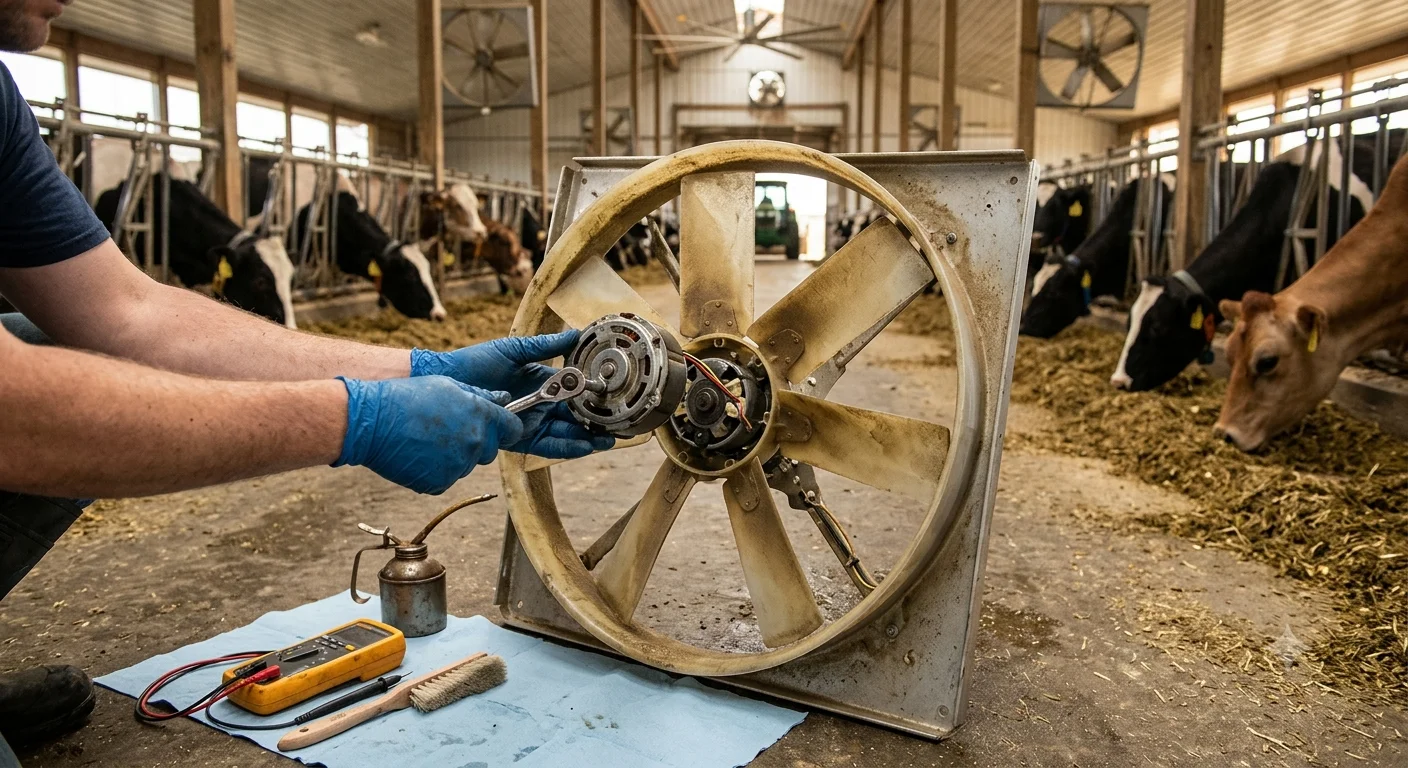
I pulled the first fan. The blades were encased in a 3mm shell of dust, grease, and crystallized ammonia. The motor housing was packed with feather debris and cobwebs. The bearings were dry — the factory grease had long since evaporated in the 95°F summer heat.
Dennis had never performed maintenance. Not once in 18 months. He assumed DC fans were “maintenance-free” because they have no brushes.
They are not. A DC fan in an agricultural environment is a precision instrument running in a war zone. Dust, ammonia, humidity, and vibration are constant enemies. A 45-minute quarterly inspection prevents the $2,000 replacement and the $5,000+ livestock loss that follows a ventilation failure.
Here is the checklist I developed across 50+ barn inspections.
The Quarterly 45-Minute Routine
Phase 1: Exterior Inspection (10 Minutes)
| Component | What to Check | Pass/Fail | Fix if Failed |
|---|---|---|---|
| Shutters/louvers | Open fully, close fully, no binding | Manually test | Adjust linkage, lubricate with silicone spray |
| Blades | No cracks, no chips, no buildup >1mm | Visual + finger test | Clean with damp cloth, replace if cracked |
| Housing | No corrosion holes, no ammonia crystallization | Visual + tap test | Sand and paint with zinc‑rich primer |
| Mounting bolts | All tight, no vibration wear | Wrench test | Torque to spec, add lock washers |
Critical finding: Ammonia crystallization on aluminum housings. This white powder is ammonium hydroxide residue — highly corrosive. It etches the metal and creates pinholes that let dust into the motor. Wipe with damp vinegar cloth, then dry immediately.
Phase 2: Motor & Electrical (15 Minutes)
| Component | What to Check | Tool | Spec | Fix if Failed |
|---|---|---|---|---|
| Bearing noise | Smooth hum, no grinding or clicking | Stethoscope or screwdriver handle | <60 dB at 3 feet | Replace bearings or entire motor |
| Shaft play | No lateral or axial movement | Dial indicator or feeler gauge | <0.005″ lateral | Replace bearings |
| Winding resistance | Within 10% of factory spec | Multimeter (ohms) | Compare to nameplate | Replace motor if >15% deviation |
| Connection torque | All terminals tight | Torque screwdriver | Per manufacturer spec | Retorque, apply antioxidant paste |
| Cable insulation | No rodent damage, no UV cracking | Visual + flex test | Intact, flexible | Replace section, add conduit |
The bearing test: A healthy DC motor sounds like a refrigerator. A failing motor sounds like gravel in a blender. If you hear intermittent clicking or high-pitched whine, the bearings are degrading. Replace within 30 days — a seized bearing destroys the rotor.
Phase 3: Controller & Speed Test (10 Minutes)
| Test | Procedure | Expected Result | Fix if Failed |
|---|---|---|---|
| Manual speed run | Override controller to 25%, 50%, 75%, 100% | Smooth acceleration, no stalling, no vibration spikes | Check VFD programming, inspect wiring |
| Current draw | Clamp meter on DC supply at each speed | Within 10% of nameplate at each speed | Clean blades, check for binding, replace motor if excessive |
| Temperature rise | Infrared thermometer on motor housing after 10 min at 100% | <60°C (140°F) ambient | Improve ventilation, reduce speed, replace if >80°C |
Critical finding: A motor drawing 15%+ over nameplate current at a given speed has either (1) bearing drag, (2) blade imbalance, or (3) winding degradation. All three lead to failure within 6 months.
Phase 4: Documentation & Scheduling (10 Minutes)
| Action | Purpose |
|---|---|
| Photograph fan condition | Baseline for next quarter |
| Record current draw at 100% | Trend analysis — 10% increase = early warning |
| Note any repairs made | Warranty claims, service history |
| Schedule next inspection | Calendar reminder, not memory |
The Tools (Under $75 Total)
| Tool | Cost | Purpose |
|---|---|---|
| Multimeter with clamp | $35 | Voltage, current, resistance |
| Infrared thermometer | $20 | Motor housing temperature |
| Torque screwdriver set | $15 | Proper terminal tightness |
| Soft brush + lint‑free cloths | $5 | Cleaning without scratching |
The 5 Signs of Imminent Failure (Call a Technician Now)
- Smoke or burning smell from motor housing — winding insulation failing
- Sudden 30%+ increase in current draw — bearing seizure in progress
- Visible arcing at terminals — connection failure, fire risk
- Blade wobble >1/4 inch at tip — shaft fatigue, blade will detach
- Controller displaying overcurrent errors weekly — motor or wiring degradation
Frequently Asked Questions
Q: Can I use compressed air to clean the motor?
No. Compressed air forces dust into the motor housing through ventilation slots. Use a vacuum with soft brush attachment or a damp cloth on the exterior only. Never open a sealed motor housing.
Q: How often should I replace bearings?
In clean environments: 8–10 years. In agricultural environments: 3–5 years for standard bearings, 5–7 years for sealed agricultural-grade bearings. Budget $45–$85 per bearing replacement.
Q: My fan runs but moves no air. What is wrong?
Three possibilities: (1) Blades installed backwards — reverse them; (2) Shutters stuck closed — check linkage; (3) Motor running backwards — swap two DC leads at the controller.
Related Articles:
- For complete barn ventilation design, read our Solar Swine Ventilation Guide
- For attic fan installation and sizing, see Solar Attic Fans for Barns
- For poultry tunnel ventilation systems, see Solar Tunnel Ventilation for Poultry Houses
- For equine stable air quality management, see Solar Ventilation for Equine Stables
© 2026 Solar Panels for Farms. All data sourced from manufacturer maintenance protocols, ASABE EP446 standards, and field inspection records from 50+ commercial agricultural facilities. Last verified: July 29, 2026.