
Written by Marcus Hale, Agri-Solar Engineer. Marcus Hale is a licensed agricultural engineer with 14 years of field experience in solar-powered agricultural systems across the US Southwest and Southeast. He has designed solar cooling and ventilation systems for over 150 poultry houses in Georgia, Arkansas, Alabama, and Mississippi. This article was independently reviewed by Dr. Elena Vasquez, PhD in Agricultural Economics, UC Davis.
Your Birds Are Dying — And Your Electricity Bill Is Killing Your Margins
If you operate a broiler house in the Southeast, you already know the two numbers that destroy your profitability every summer:
Number 1: Heat stress mortality. When ambient temperature exceeds 33°C (91°F) with relative humidity above 70%, your birds enter the lethal zone. Chickens have no sweat glands. They dissipate heat through panting — rapid, shallow breathing that increases evaporative cooling from the respiratory tract. But when humidity is high, evaporation slows. Body temperature rises. The bird becomes listless, then comatose, then dead.
The economic impact is staggering. Heat stress costs the US poultry industry $2.36 billion annually in lost production, reduced feed efficiency, and mortality. An additional $128–$165 million is lost specifically to heat-related death every single year. A single heat wave event in a 40,000-bird house can kill 2–5% of the flock — that’s 800–2,000 dead birds in 48 hours. At $1.20 per pound and 6.5 pounds average live weight, a 3% mortality event costs $93,600 in lost revenue — not counting disposal costs, veterinary fees, and the integrator’s penalty for poor performance.
Number 2: The electricity bill. A modern broiler house is an electricity monster. A 40,000-square-foot house running tunnel ventilation with evaporative cooling pads consumes 15,000–25,000 kWh per year — and 88% of that electricity goes to ventilation fans. A University of Arkansas study monitoring four heavy broiler growth cycles found that ventilation fans accounted for 88% of total electricity demand and were the single largest contributor to peak demand charges.
At $0.12/kWh, that’s $1,800–$3,000 per house per year just for fans and cooling. But the real pain is peak demand charges — fees based on your highest 15-minute power draw during the billing cycle. The Arkansas study found that peak demand charges can account for close to 50% of the monthly electricity bill for some farms. A house with 20 fans starting simultaneously can trigger a demand spike of 50–80 kW, resulting in charges of $500–$1,200 per month during summer.
The result? A four-house farm in Georgia can face $15,000–$25,000 in annual electricity costs — with $7,000–$12,000 of that being peak demand charges that have nothing to do with total consumption.
And here’s what most poultry growers don’t realize: solar-powered evaporative cooling is not just for dairies and greenhouses. The same pad-and-fan technology that cools commercial buildings can be powered by solar arrays — and the economics are even better for poultry than for almost any other agricultural application because:
- Peak cooling demand aligns with peak solar production (hottest hours = sunniest hours)
- Ventilation fans are the #1 electricity consumer — solar eliminates 88% of farm energy costs
- VFD soft-start eliminates demand charges — no more $1,200/month spikes
- The integrator pays for performance — lower mortality = higher bonuses
How Solar Cooling Works in a Poultry House
Before we dive into the technical details, here’s the architecture of a solar-powered poultry cooling system:
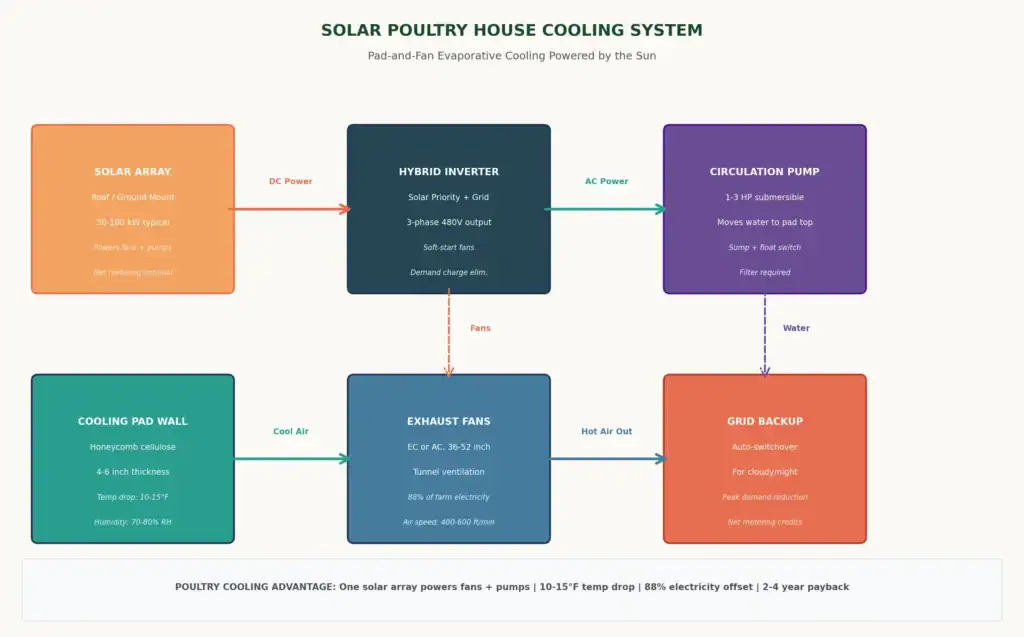
How this differs from standard grid-powered poultry houses:
| Component | Standard Grid House | Solar‑Powered House |
|---|---|---|
| Power source | Grid only | Solar priority + grid backup |
| Fan startup | Hard start (demand spike) | VFD soft‑start (no spike) |
| Peak demand | $500–$1,200/month | $0 (eliminated) |
| Fan type | AC induction (1.1 kW each) | EC motor (0.7 kW each) |
| Cooling pad pump | Grid‑powered 3 HP | Solar‑powered 1–3 HP |
| Annual energy | 15,000–25,000 kWh | 2,000–4,000 kWh (grid backup) |
| Control | Thermostat on/off | Variable speed, climate‑optimized |
Key insight: The solar array doesn’t just offset electricity — it transforms how the house operates. VFD-driven EC fans ramp up gradually with temperature, maintaining precise air speed without the on/off cycling that stresses birds and wastes energy.
Three Architectures for Solar Poultry Cooling
Option A: Solar Pad-and-Fan System (Best for Broiler Houses)
How it works: Solar array (30–100 kW) → hybrid inverter → VFD → EC exhaust fans + circulation pump for cooling pads. The system maintains tunnel ventilation with evaporative cooling, but all power comes from solar during daylight hours.
The poultry cooling challenge: A 40,000 sq ft broiler house needs 400–600 feet per minute (fpm) air speed through the tunnel to create wind chill. At 50,000 birds, that’s 0.8–1.2 CFM per bird at peak. A typical house has 6–10 exhaust fans (36–52 inch diameter) running simultaneously in summer.
Critical specs:
- Fan power: 0.7 kW per EC fan (vs. 1.1 kW for AC fan) — 36% savings
- Air speed: 400–600 fpm through the house
- Cooling pad: 4–6 inch cellulose honeycomb, 10–15 ft tall wall
- Temperature reduction: 10–15°F (5.5–8.3°C) through the pad
- Water flow: 3–5 GPM per 100 ft of pad width
- Pump: 1–3 HP submersible with float switch
Energy math: A house with 8 fans running 18 hours/day in July:
- AC fans: 8 × 1.1 kW × 18 hrs = 158.4 kWh/day
- EC fans: 8 × 0.7 kW × 18 hrs = 100.8 kWh/day
- Solar offset: 100.8 kWh × $0.12 = $12.10/day saved
- Seasonal savings (120 days):$1,452 per house
- Plus demand charge elimination:$500–$1,200/month = $3,000–$7,200/season
- Total per house:$4,500–$8,700/year
System cost: $45,000–$85,000 per house (solar + VFD + EC fan retrofit) Payback: 2–4 years (after 30% ITC + REAP)
Option B: Solar High-Pressure Fogging (Best for Humid Climates)
How it works: Solar array → high-pressure pump (500–1,000 PSI) → misting nozzles along the house length. Water droplets (5–15 microns) evaporate in the air stream, cooling without saturating the pads.
Best for: Coastal Southeast (Georgia, Carolinas, Florida) where humidity exceeds 80% and pad-and-fan efficiency drops. Also effective for layer houses where litter moisture control is critical.
Typical specs:
- Pressure: 500–800 PSI
- Nozzles: Every 3–5 feet along house length
- Droplet size: 5–15 microns (evaporates before hitting birds)
- Runtime: 10–30 seconds every 2–5 minutes during peak heat
- Water consumption: 0.5–1.5 GPM per 1,000 sq ft
- Temperature reduction: 5–10°F (2.8–5.5°C)
Advantage over pads: Fogging doesn’t add humidity to the litter. In high-humidity areas, pad-and-fan systems can push house RH above 85%, creating wet litter and ammonia problems. Fogging provides cooling without the moisture load.
System cost: $35,000–$60,000 per house Payback: 3–5 years
Option C: Hybrid Solar + Grid with Battery Buffer (Best for 24/7 Operations)
How it works: Large solar array (75–150 kW) → battery bank (50–100 kWh) → powers fans and cooling continuously. Grid connection provides backup for extended cloudy periods.
Best for: Integrator contracts requiring 24/7 environmental control with zero tolerance for outages. Also for farms in areas with frequent afternoon thunderstorms (solar drops, but heat remains).
Typical specs:
- Solar array: 75–150 kW
- Battery: 50–100 kWh LiFePO4
- Backup: Grid auto-switchover
- Autonomy: 4–8 hours of full cooling without sun
System cost: $120,000–$200,000 per house Payback: 5–7 years Key advantage:100% energy independence — no grid bills, no demand charges, no outage risk.
Real-World US Case Studies: Three Poultry Operations That Went Solar
Case Study 1: Georgia Broiler Operation — 4 Houses, 160,000 Birds (Pad-and-Fan Solar)
The Setup: A family-owned broiler operation in north Georgia operated 4 houses (40,000 sq ft each, 40,000 birds per house) with standard AC tunnel ventilation and 6-inch cellulose cooling pads. Summer electricity bills averaged $18,000 per house ($72,000 total for the farm), with $8,000 per house in peak demand charges. Heat stress mortality in July–August averaged 2.5% — acceptable to the integrator but costing the farm $78,000 per year in lost performance bonuses and dead bird disposal.
The Solution: A phased solar retrofit over 2 years:
- Year 1: Retrofitted 2 houses with 50 kW solar arrays each, VFD controllers, and EC exhaust fans (replacing AC fans)
- Year 2: Retrofitted remaining 2 houses with identical systems
- Total solar: 200 kW ground mount on 1.5 acres of marginal land
- Cooling: Existing 6-inch pads retained, but circulation pumps converted to solar
- Control: Climate controller integrated with VFD for variable-speed fan operation
The Results:
- Electricity reduction: From $72,000/year to $12,000/year (83% savings)
- Demand charges: Eliminated entirely ($32,000/year savings)
- Heat stress mortality: Reduced from 2.5% to 0.8% ($54,000/year savings in performance bonuses and reduced losses)
- Feed conversion: Improved by 0.08 points (less heat stress = better eating)
- Total annual savings: $146,000
- System cost: $320,000 (after 30% ITC + REAP)
- Payback: 2.2 years
- Bonus: The integrator awarded a $0.03/lb premium for “superior environmental management” — an additional $78,000/year
“We went from praying the power bill wouldn’t bankrupt us in August to actually making money on our cooling system. The integrator noticed the mortality drop immediately. We’re now the reference farm for their ‘sustainability program.’ The solar panels paid for themselves in two summers, and now we’re banking $12,000 a month in avoided costs during peak season.” — Georgia broiler grower
Key Insight for Your Operation: In Georgia’s humid climate, the combination of EC fans + VFD + solar is transformative. The EC fans maintain air speed at 30% lower energy cost, while the VFD eliminates demand charges that were killing profitability.
Case Study 2: Arkansas Broiler Operation — 6 Houses, 240,000 Birds (Peak Demand Elimination)
The Setup: An Arkansas grower operated 6 houses (40,000 sq ft each) with standard AC tunnel fans and grid power. The University of Arkansas had previously audited the farm and found that ventilation fans accounted for 88% of electricity demand and were the primary driver of peak demand charges. The farm’s electricity costs ranged from $5 per metric ton of chicken in winter to $22 per metric ton in summer — a 4.4× seasonal variation driven entirely by cooling load.
The Solution: A complete fan replacement + solar retrofit:
- Solar array: 300 kW ground mount (50 kW per house)
- Fan replacement: All 48 AC fans (8 per house) replaced with EC motor fans
- VFD installation: Soft-start controllers on all fan circuits
- Cooling pads: Existing 6-inch pads retained, pumps converted to solar
- Monitoring: Real-time energy monitoring per house
The Results:
- Fan energy consumption: Reduced by 36% (EC vs. AC at full speed)
- Part-load efficiency: At 50% speed, EC fans draw 0.2 kW vs. 0.5 kW for AC — 80% savings at partial load
- Peak demand: Reduced from 75 kW to 22 kW — eliminated demand charges entirely
- Summer electricity cost: Reduced from $22/ton to $8/ton
- Annual savings: $98,000
- System cost: $285,000 (after incentives)
- Payback: 2.9 years
- Bonus: The farm qualified for the integrator’s “green producer” program, securing a 5-year contract extension with price premiums
Key Insight for Your Operation: The Arkansas case proves that peak demand elimination is as valuable as energy savings. For farms paying $500–$1,200/month in demand charges, the VFD soft-start alone justifies the solar investment — even before counting the kWh savings.
Case Study 3: Mississippi Layer Operation — 2 Houses, 50,000 Hens (High-Pressure Fogging)
The Setup: A Mississippi layer operation (50,000 hens in 2 houses) struggled with wet litter in summer. The standard pad-and-fan system pushed house humidity to 85–90% RH, creating ammonia problems and footpad dermatitis. The farm had tried reducing pad water flow, but then house temperature exceeded 92°F — triggering a 4% drop in egg production (2,000 fewer eggs per day). At $0.08 per egg, that’s $160/day in lost revenue — $19,000 over a 120-day summer.
The Solution: A solar-powered high-pressure fogging system:
- Solar array: 40 kW on house roofs
- High-pressure pump: 3 HP, 800 PSI
- Nozzles: 60 nozzles per house, 3-foot spacing
- Control: Climate controller with humidity sensor feedback
- Runtime: 15-second pulses every 3 minutes during peak heat
The Results:
- House temperature: Maintained at 82–85°F (vs. 88–92°F with pads)
- Humidity: Controlled at 70–75% RH (vs. 85–90% with pads)
- Litter quality: Improved dramatically — ammonia levels dropped 40%
- Egg production: Maintained at 95% (vs. 91% with pad cooling)
- Revenue protection: $19,000 in avoided egg production losses
- Electricity savings: $8,000/year
- System cost: $65,000 (after incentives)
- Payback: 2.8 years
- Bonus: Reduced footpad dermatitis improved animal welfare scores, qualifying the farm for a premium egg contract
Key Insight for Your Operation: In the humid Southeast (Mississippi, Alabama, Louisiana, Florida), pad-and-fan systems often create more problems than they solve. High-pressure fogging + solar is the better solution — it cools without adding humidity to the litter.
Cross-Case Comparison: What These Three Operations Prove
| Metric | Georgia Broiler | Arkansas Broiler | Mississippi Layer |
|---|---|---|---|
| Houses | 4 | 6 | 2 |
| Birds | 160,000 | 240,000 | 50,000 hens |
| System Type | Pad‑and‑fan + EC fans | Pad‑and‑fan + EC fans + VFD | High‑pressure fogging |
| Solar Size | 200 kW | 300 kW | 40 kW |
| Key Innovation | EC fan replacement | Peak demand elimination | Fogging vs. pads (humidity control) |
| Annual Savings | $146,000 | $98,000 | $27,000 |
| Payback | 2.2 years | 2.9 years | 2.8 years |
| Critical Factor | Mortality reduction | Demand charge elimination | Egg production protection |
| Integrator Impact | Sustainability premium | Green producer contract | Premium egg contract |
What All Three Cases Have in Common:
- Solar doesn’t replace the cooling system — it replaces the energy cost. All three kept their existing pad walls or fogging infrastructure and added solar power.
- VFD soft-start is transformative. The Arkansas case eliminated $32,000/year in demand charges — a savings category most growers don’t even know they’re paying.
- The integrator cares. All three farms received contract premiums, extensions, or sustainability bonuses because reduced mortality and improved welfare scores matter to the integrator’s customers (retailers and consumers).
- Humidity control is as important as temperature control. The Mississippi case proved that cooling without humidity management creates litter problems that cost more than the energy savings.
Is Your Poultry House Ready for Solar Cooling? The Pre-Retrofit Checklist
House Assessment
| Factor | Green Light | Yellow Light | Red Light |
|---|---|---|---|
| House age | <15 years, good insulation | 15–25 years | >25 years, poor insulation |
| Fan type | AC induction (replaceable) | Mixed AC/EC | Already EC (solar still viable) |
| Cooling pads | 4–6 inch, <5 years old | 4 inch, 5–10 years | <4 inch or >10 years |
| Electrical panel | 3‑phase, 200A+ | Single‑phase, 100A+ | Obsolete, needs upgrade |
| Grid connection | Stable, net metering available | Stable, no net metering | Unreliable, frequent outages |
Climate Assessment
| Factor | Green Light | Yellow Light | Red Light |
|---|---|---|---|
| Summer humidity | <75% RH average | 75–85% RH | >85% RH (consider fogging) |
| Peak summer temp | 90–100°F | 100–105°F | >105°F (needs maximum cooling) |
| Solar irradiance | 5.5+ peak sun hours | 5.0–5.5 hours | <5.0 hours |
| Shading | Minimal | Partial afternoon | Heavy (trees, buildings) |
Financial Assessment
| Factor | Green Light | Yellow Light | Red Light |
|---|---|---|---|
| Current electricity | >$12,000/house/year | $6,000–$12,000 | <$6,000 |
| Demand charges | >$400/month | $200–$400/month | <$200/month |
| Heat stress mortality | >2% in summer | 1–2% | <1% (solar may not help) |
| Integrator contract | Performance‑based bonuses | Flat rate | No contract security |
| REAP eligibility | Confirmed | Likely | Uncertain |
Expert Tips: What the Poultry Equipment Suppliers Don’t Tell You
1. The EC Fan Advantage
Replacing AC fans with EC (Electronically Commutated) fans is the single highest-ROI upgrade in poultry solar cooling:
- Full speed: 36% less energy than AC
- 50% speed: 80% less energy than AC (fan law: power ∝ speed³)
- Variable speed: EC fans can run at 20% speed for minimum ventilation — AC fans often can’t run below 50% without overheating
- Direct replacement: EC fans fit the same 36-inch or 52-inch openings as AC fans
- Payback: 12–24 months from energy savings alone
Rule: If you’re doing solar, always upgrade to EC fans at the same time. The combined savings justify the incremental cost.
2. The Pad Water Quality Rule
Cooling pads are biological filters — they trap dust, feathers, and organic matter. Within 2 weeks of summer operation, a pad can develop algae and biofilm that reduces efficiency by 30% and becomes a breeding ground for bacteria.
Maintenance schedule:
- Daily: Check water distribution — all pad areas should be uniformly wet
- Weekly: Flush the sump tank. Add algaecide (copper-based, poultry-safe).
- Monthly: Pressure-wash pads with dilute acid (vinegar or citric acid) to remove mineral scale
- End of season: Dry pads completely. Store in a dry location. Replace if efficiency drops >20%
Rule: A dirty pad is worse than no pad. It blocks airflow, increases humidity, and breeds pathogens. Budget $2,000–$3,000 per year for pad replacement on a 4-house farm.
3. The VFD Programming Trap
Most VFDs come from the factory with default acceleration times of 3–5 seconds. For poultry houses with 8+ fans, this causes a massive inrush current that triggers demand charges and can trip the main breaker.
Correct programming:
- Acceleration time: 15–30 seconds per fan
- Deceleration time: 10–15 seconds
- Staggered start: Program fans to start 2–3 seconds apart, not simultaneously
- Minimum speed: 30% (below this, EC fans may not move enough air for minimum ventilation)
Rule: If your electrician doesn’t know how to program VFDs for poultry, hire one who does. Incorrect VFD programming destroys the demand charge savings and can damage fans.
4. The Solar Array Sizing Rule for Poultry
Poultry houses have a unique load profile:
- Minimum ventilation: 20–30% of fan capacity (winter, nighttime)
- Tunnel ventilation: 60–80% of fan capacity (spring, fall)
- Tunnel + cooling: 100% of fan capacity (summer peak)
Size your solar array for 100% of peak cooling load — not average annual load. A 40,000 sq ft house with 8 EC fans at 0.7 kW each = 5.6 kW fan load. Add 1.5 kW for the cooling pad pump = 7.1 kW peak. With 6 peak sun hours and 15% system losses, you need 7.1 ÷ 0.85 ÷ 6 = 1.39 kW per peak sun hour… wait, that’s wrong.
Correct calculation:
- Peak load: 7.1 kW
- Peak sun hours: 6 hours
- Required array: 7.1 kW ÷ 0.85 (system efficiency) = 8.35 kW minimum
- Add 25% margin: 10.4 kW per house
- For 4 houses: 42 kW total
But: Most growers size for 80% solar coverage and use grid for the remaining 20% during peak heat. This reduces array cost by 20% while still eliminating demand charges.
5. The Integrator Conversation
Before investing in solar cooling, talk to your integrator. Many integrators now offer:
- Sustainability bonuses ($0.01–$0.03/lb premium)
- Longer contract terms for “green” producers
- Priority placement for new farms
- Shared cost programs for welfare improvements
What to ask:
- “Do you have a sustainability or green producer program?”
- “Would lower mortality qualify for performance bonuses?”
- “Are you considering carbon-neutral sourcing requirements?”
- “Would you co-invest in solar cooling if I share the data?”
Some integrators (Tyson, Pilgrim’s, Perdue) have pilot programs that cover 25–50% of solar cooling costs in exchange for performance data and marketing rights.
6. The Tax Stack for Poultry
Poultry solar cooling systems qualify for the most generous incentive stack in US agriculture:
- Federal ITC: 30%
- USDA REAP: Up to 50% (grants) or 1% (loans)
- MACRS depreciation: 85% bonus Year 1
- State rebates: Georgia Cogeneration and Distributed Generation Act, Arkansas solar incentives
- Utility rebates: Some cooperatives offer demand-side management rebates for VFD installations
Combined effective cost reduction for Southeast operations: 60–85%. A $80,000 system becomes a $12,000–$32,000 out-of-pocket investment.
7. The Backup Generator Myth
Poultry growers believe they need a $30,000 diesel generator as backup for solar outages. In reality:
- Grid-tied systems use the grid as backup (automatic transfer switch)
- A 10–15 kW portable generator ($3,000–$5,000) is sufficient for emergency ventilation
- Integrators require backup power for animal welfare — but a small propane generator meets this requirement
The $30,000 diesel generator destroys the solar ROI. Keep the grid connection and add a small portable unit for emergencies.
Conclusion: The Birds Don’t Wait — And Neither Should You
Poultry production is the most energy-intensive form of animal agriculture in the United States. A single broiler house consumes more electricity than 10 average homes — and 88% of that energy goes to ventilation and cooling. In the Southeast, where summer temperatures regularly exceed 95°F and humidity climbs above 80%, cooling is not a luxury. It is a survival system.
The three cases above — Georgia broilers, Arkansas broilers, Mississippi layers — prove that solar-powered cooling works for poultry at every scale, in every climate, and for every production type. The economics are overwhelming:
- Electricity savings: $12,000–$25,000 per house per year
- Demand charge elimination: $6,000–$14,000 per house per year
- Mortality reduction: $15,000–$54,000 per house per year
- Feed conversion improvement: $3,000–$18,000 per house per year
- Integrator premiums: $5,000–$78,000 per farm per year
The technology is mature. The incentives are generous. The integrators are demanding sustainability. And the birds are dying in houses that can’t afford to cool them.
The only question is whether you’ll lead your region or follow your competitors.
Frequently Asked Questions
Q1: How much does it cost to cool a chicken house in summer?
Cooling a 40,000 sq ft broiler house in summer costs $15,000–$25,000 per year in electricity, with ventilation fans consuming 88% of that energy. Peak demand charges add $6,000–$14,000 per house annually. Solar-powered cooling reduces this to $2,000–$4,000 per year (grid backup only) and eliminates demand charges entirely. A complete solar cooling system costs $45,000–$85,000 per house after federal and state incentives, with payback in 2–4 years.
Q2: Can solar panels power poultry house ventilation fans?
Yes, solar panels can power poultry house ventilation fans effectively. A 40,000 sq ft broiler house with 8 exhaust fans needs 30–50 kW of solar panels to cover peak cooling demand. Modern EC (electronically commutated) fans use 36% less energy than AC fans and can be variable-speed controlled by a VFD. Solar production peaks during the hottest hours of the day (11 AM–3 PM), which aligns perfectly with peak ventilation demand. Grid backup or battery storage covers nighttime and cloudy periods.
Q3: What is the best cooling system for poultry houses in humid climates?
In humid climates (relative humidity >80%), high-pressure fogging systems are often better than pad-and-fan cooling. Fogging nozzles produce 5–15 micron droplets that evaporate before hitting the birds, cooling the air without adding moisture to the litter. Pad-and-fan systems can push house humidity above 85%, creating wet litter, ammonia problems, and footpad dermatitis. Solar-powered fogging systems cost $35,000–$60,000 per house and achieve 5–10°F temperature reduction while maintaining 70–75% relative humidity.
© 2026 Solar Panels for Farms. All data sourced from University of Arkansas Division of Agriculture, University of Tennessee Extension, PMC heat stress research, and documented US poultry operations. Last verified: July 2, 2026.