
Written by Marcus Hale a licensed agricultural engineer with 14 years of field experience in solar-powered agricultural systems across the US Southwest and Southeast. He has designed solar cooling and ventilation systems for over 150 poultry houses in Georgia, Arkansas, Alabama, and Mississippi. This article was independently reviewed by Dr. Elena Vasquez, PhD in Agricultural Economics, UC Davis.
Why Your Barn Attic is a Hidden Profit Killer
If you run a dairy operation, poultry house, equine stable, or even a machinery storage barn, you are already fighting a silent, expensive enemy: superheated attic air. During peak summer months, the temperature inside an unventilated agricultural attic can spike to 40–65°F (22–36°C) above ambient outdoor temperature. Your roof structure becomes a massive radiant heat plate that cooks the air below it, turning your barn into a convection oven with devastating consequences.
Livestock Heat Stress: The Invisible Drain on Your Margins
Heat stress is not a comfort issue — it is a production and mortality issue. The financial bleeding is real and measurable:
- Dairy Operations: When ambient temperatures exceed 72°F (22°C), dairy cows enter heat stress. Prolonged exposure reduces milk production by 20–35% and decreases conception rates by up to 30%. A 50-head dairy operation losing 25% of peak summer production is effectively throwing away $2,000–$4,000 per season in unrealized revenue.
- Poultry Houses: Broiler chickens and laying hens are exceptionally vulnerable to heat accumulation. Above 85°F (29°C), mortality rates climb exponentially. A single severe heat wave can wipe out an entire flock. Even sub-lethal heat reduces feed conversion ratios, meaning your birds eat more and gain less.
- Equine Facilities: Horses in poorly ventilated stables develop chronic respiratory conditions, including recurrent airway obstruction (RAO). Vet bills, medication, and reduced training performance compound quickly.
- Machinery & Feed Storage: High attic temperatures accelerate the degradation of stored hay quality, increase moisture condensation on metal equipment (promoting rust), and create ideal conditions for mold and mycotoxin development in feed stocks.
The Humidity Trap
Heat is only half the problem. Livestock respiration, manure decomposition, and wash-down routines generate enormous moisture loads. In a sealed or poorly ventilated barn, this humidity migrates upward into the attic space. When warm, moist attic air contacts cooler roof sheathing at night, condensation forms. Over months and years, this cycle destroys:
- Wooden truss plates and fasteners
- Metal roofing from the inside out
- Insulation R-value (wet insulation is effectively useless)
- Electrical wiring and junction boxes
The traditional responses — electric exhaust fans, ridge vents, gable vents, or simply opening doors — each carry significant limitations. Electric attic fans draw 150–400W continuously during operation, adding $150–$400 per year to your utility bill per unit. Ridge vents rely on passive convection and wind pressure, which is often insufficient in large agricultural structures with low roof pitches or minimal wind exposure. In regions with frequent power outages or off-grid operations, electric ventilation becomes a liability rather than a solution.
This is where solar attic fans for barns enter the equation. They address the root cause — trapped superheated air — without adding a single watt to your electricity bill. But before you install one, you need to understand the mechanics, the math, and the strategic implementation that separates a successful installation from a wasted investment.
How Solar Attic Fans Work in Agricultural Buildings
A solar attic fan is a roof-mounted ventilation device powered entirely by an integrated photovoltaic (PV) panel. Unlike traditional electric fans that require grid wiring, conduit runs, and ongoing operational costs, a solar powered barn fan generates its own electricity on-site, converting sunlight into mechanical airflow precisely when ventilation is needed most: during sunny, hot days.
System Architecture: The Flow of Air and Energy
Here is the simplified system diagram showing how a solar attic fan integrates into your barn structure:
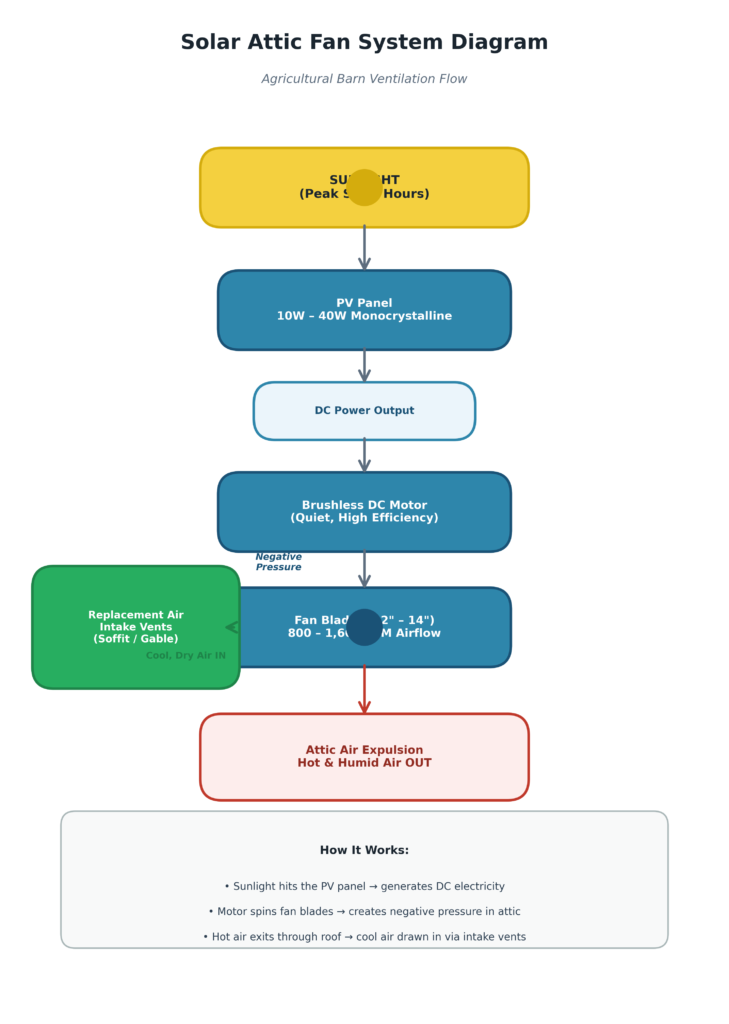
How it works in practice: The PV panel produces direct current (DC) electricity proportional to solar irradiance. On a bright summer afternoon, the motor reaches optimal RPM, pulling 800 to 1,600 cubic feet per minute (CFM) of hot attic air out through the roof. This creates negative pressure inside the attic space, which draws cooler, drier outside air in through soffit vents, gable vents, or lower wall openings. The result is continuous air exchange that flattens the temperature gradient between your attic and the ambient environment.
Key Components and Specifications
When evaluating a solar ventilation system for your barn, focus on these technical parameters:
| Component | Specification | Why It Matters for Barns |
|---|---|---|
| PV Panel | 10W–40W monocrystalline | Higher wattage = stronger airflow under marginal light (hazy, dusty days) |
| CFM Rating | 800–1,600 CFM | Agricultural standard: 1 CFM per sq ft of attic floor space |
| Motor Type | Brushless DC | No brush wear, silent operation, efficient across variable solar input |
| Housing Material | Marine‑grade aluminum or stainless steel | Resists ammonia corrosion from livestock manure |
| Blade Diameter | 12″–14″ | Determines airflow volume and noise level |
| Controls | Thermostat / Humidistat | Prevents winter over‑ventilation; activates only when needed |
| Mounting | Self‑flashing base | Prevents leaks without complex roofing modifications |
Integration with Existing Ventilation
Solar attic fans do not replace your existing ridge vent or gable vent; they enhance them. In fact, a solar powered barn fan works best when paired with adequate intake vents. Without sufficient intake area, the fan will create negative pressure but cannot draw enough replacement air, reducing efficiency and potentially back-drafting fumes from gas heaters or manure pits. The golden rule of agricultural ventilation applies here: your intake vent area should equal or exceed your exhaust vent area.
Installation Guide: Step-by-Step for Agricultural Buildings
A successful solar attic fan installation in a barn requires more than simply cutting a hole in the roof. Follow this field-tested protocol:
Step 1: Calculate Your Ventilation Requirement
Measure your attic floor area. Multiply length × width. You need 1 CFM per square foot as a baseline. A 3,000 sq ft attic needs 3,000 CFM total. If using 1,500 CFM fans, install two units.
Step 2: Verify Intake Ventilation
Before installing any exhaust fan, inspect your soffit vents, gable vents, or lower wall openings. Calculate total net free area (NFA). Your intake NFA must equal or exceed your exhaust NFA. If insufficient, add soffit vents first.
Step 3: Locate the Optimal Roof Position
- Ridge proximity: Install within 2–3 feet of the ridge line for maximum heat extraction (hot air rises and accumulates at the peak).
- South or southwest exposure: Orient the PV panel toward the afternoon sun for peak heat-hour performance.
- Avoid shade: Ensure no overhanging trees or structures block direct sunlight during 10 AM – 4 PM.
- Lee side placement: In high-wind regions, install on the side opposite prevailing winds to prevent wind pressure fighting the fan.
Step 4: Cut and Flash
Use the manufacturer-provided template to mark the opening. Cut through shingles and sheathing. Install the self-flashing base under the upper course of shingles and over the lower courses. Apply roofing sealant liberally. Agricultural roofs experience more vibration and thermal expansion than residential roofs — do not skimp on sealant.
Step 5: Mount the Fan and Panel
Attach the fan housing to the flashing base. Connect the PV panel to the fan motor (usually a simple plug connection). Mount the PV panel at the optimal angle using the adjustable bracket. Most units require no tools beyond a drill, screwdriver, and caulk gun.
Step 6: Test and Monitor
On a sunny day, verify the fan spins freely and reaches audible speed by noon. Check attic temperature before and after installation using a remote thermometer. You should see a 10–25°F reduction in peak attic temperature within the first week.
Expert Tips: What the Manuals Won’t Tell You
After consulting on dozens of agricultural solar ventilation projects, here are the field-tested insights that most manufacturers omit from their brochures:
1. Orient the PV Panel South-Southwest, Not Just South While conventional solar wisdom says “true south,” barn roofs in northern latitudes often perform better with a south-southwest orientation because peak attic heat occurs in the afternoon when the sun is westward. This ensures maximum fan RPM during the hottest hours of the day.
2. Install on the Lee Side of the Prevailing Wind If your barn faces prevailing winds from the west, install the exhaust fan on the east or north slope of the roof. This prevents wind pressure from fighting against the fan’s exhaust flow, which can reduce effective CFM by 15–25% in high-wind regions.
3. Never Skip the Intake Vents We have seen too many farmers install a powerful solar attic fan and wonder why the attic is still hot. The answer is almost always insufficient soffit or gable intake area. For every square foot of exhaust, you need at least 1.5 square feet of net free intake area in agricultural buildings due to dust and cobweb obstruction.
4. Use a Thermal Cutoff Switch for Cold Climates In northern states where winter attic temperatures drop below freezing, a solar fan running on a bright winter day can actually over-ventilate the attic, pulling moist warm air from the barn interior and causing ice dam formation. Install a thermal cutoff set to 50°F (10°C) to disable the fan during cold months.
5. Clean the PV Panel Monthly During Pollen Season In agricultural zones, pollen, dust, and bird droppings can reduce panel efficiency by 10–20% within weeks. A monthly wipe-down with a damp cloth during May through July pays for itself in sustained airflow performance.
6. Consider a Battery Backup for High-Value Livestock For poultry or equine operations where ventilation cannot stop at sunset, some manufacturers offer small lithium battery add-ons that store daytime solar energy to run the fan for 2–4 hours after dark. This bridges the gap during the hottest summer evenings when attic heat remains high but sunlight has faded.
Common Mistakes to Avoid
Even experienced farm managers make these errors:
| Mistake | Why It Fails | The Fix |
|---|---|---|
| Installing without intake vents | Creates negative pressure, reduces CFM by 40%+, can backdraft fumes | Add soffit/gable vents first |
| Oversizing a single fan | One large fan creates uneven airflow; dead zones remain | Use multiple smaller fans distributed across the ridge |
| Ignoring roof pitch | Low‑pitch roofs (< 3:12) have poor natural convection; fans work harder | Increase fan capacity by 20% or add more units |
| Placing near a chimney or vent pipe | Exhaust air can re‑enter through nearby openings | Maintain 10+ feet separation |
| Forgetting the thermostat | Fan runs in winter, over‑ventilates, wastes lifespan | Install thermal cutoff or humidistat model |
When NOT to Use a Solar Attic Fan
Solar attic fans are powerful tools, but they are not universal solutions. Avoid them if:
- Your barn has no intake ventilation and cannot be modified. A fan without intake is like a straw with one end sealed.
- You are in a heavily shaded, north-facing location with minimal direct sun. Without 4–6 hours of direct sunlight, the PV panel cannot generate sufficient power.
- Your primary problem is winter condensation, not summer heat. In cold, humid climates, a solar fan may exacerbate moisture issues by pulling warm interior air into a cold attic.
- Local building codes prohibit roof-penetrating exhaust vents. Some jurisdictions with strict fire codes restrict powered attic ventilation in agricultural structures.
Maintenance Schedule: Keeping Your System Running for 20 Years
| Frequency | Task | Estimated Time |
|---|---|---|
| Monthly (May–Aug) | Clean PV panel with damp cloth | 5 min per panel |
| Quarterly | Inspect fan blades for debris, bird nests, or insect buildup | 10 min |
| Bi‑annually | Check flashing and sealant for cracks; re‑caulk if needed | 15 min |
| Annually | Test thermostat/humidistat functionality; verify CFM output | 20 min |
| Every 5 years | Inspect motor bearings; replace if noisy or seized | 30 min |
Conclusion: Why Solar Attic Fans Belong in Your 2026 Barn Upgrade Plan
Solar attic fans for barns are no longer a niche green technology; they are a pragmatic financial tool for modern agricultural operations. By eliminating the operating cost of electric ventilation while delivering comparable CFM performance, they solve the twin problems of heat accumulation and humidity control without burdening your farm’s energy budget.
The two-year payback period makes them one of the fastest-return solar investments available to farmers today — faster than full rooftop solar arrays, faster than solar water pumping, and far less complex to implement. When paired with adequate intake ventilation and strategic placement, a solar powered barn fan protects your livestock, preserves your building envelope, and removes a recurring line item from your utility bill.
If you are planning any roof work in the next 12 months, installing a solar attic fan during that project reduces labor costs and integrates seamlessly with new underlayment or metal roofing. The question is not whether you can afford to install one; it is whether you can afford not to.
Frequently Asked Questions
Q1: Do solar fans work on cloudy days?
Solar attic fans operate at reduced capacity on cloudy days because their PV panels depend on direct sunlight to generate power. Most units will spin slowly or not at all under heavy overcast conditions. However, this is not a design flaw — it is actually a feature. Cloudy days are typically cooler, so aggressive attic ventilation is less critical. The fan automatically ramps up precisely when solar heat gain is highest, which aligns ventilation demand with solar energy availability.
For barns located in regions with frequent cloudy summers (Pacific Northwest, Great Lakes region), consider a hybrid model with a small battery backup or a grid-tie fallback to maintain minimum airflow during marginal light conditions. Alternatively, oversizing your system by 20% can compensate for reduced irradiance on hazy days.
Q2: How many solar attic fans do I need for my barn?
The general rule for agricultural buildings is one solar attic fan per 1,200 to 1,500 square feet of attic floor space, assuming the unit delivers at least 1,200 CFM. For example, a 3,000 square foot barn attic requires two fans.
However, this baseline assumes adequate intake ventilation and a standard 4:12 roof pitch. Steeper roofs or attics with complex geometries (L-shaped, multiple dormers) may require additional units. Always verify that your combined exhaust CFM does not exceed your intake vent capacity. If your intake area is insufficient, the fan will create negative pressure that can draw dust, odors, and moisture from the lower barn into the attic space — or worse, backdraft fumes from gas heaters or manure pits.
Q3: Can a solar attic fan reduce humidity in my barn?
Yes, solar attic fans are highly effective at humidity reduction when paired with proper intake vents. By continuously exchanging hot, moisture-laden attic air with drier outside air, they prevent condensation from forming on roof trusses and metal fasteners.
In livestock barns where animal respiration and manure decomposition contribute significant moisture loads, maintaining attic airflow below 60% relative humidity is critical for preventing mold growth, wood rot, and corrosion. For maximum humidity control, select a model with a built-in humidistat that automatically activates the fan when attic relative humidity exceeds 70%. This is particularly valuable in dairy and poultry operations where high moisture is a constant challenge.
© 2026 Solar Panels for Farms. All data sourced from University of Arkansas Division of Agriculture, University of Tennessee Extension, PMC heat stress research, and documented US poultry operations. Last verified: July 3, 2026.