
Written by Dr. Michael A. Stewart, Agri‑Energy Systems Specialist. 5+ years of experience in renewable energy systems for agriculture, with a focus on solar thermal and photovoltaic applications in livestock and greenhouse operations. Former researcher at the University of California, Davis, where he led field trials on solar‑assisted heating and cooling for dairy barns and poultry houses. Holds a Ph.D. in Agricultural Engineering from the University of Nebraska‑Lincoln and has published 20+ peer‑reviewed articles on sustainable farm energy systems.
The Hidden Energy Cost of Farm Heating and Cooling
Your farm works hard year‑round — and so does your energy bill.
Heating livestock barns in winter, cooling greenhouses in summer, and maintaining the right temperature for crop storage or milk processing all add up. For many farms, heating, ventilation, and air conditioning (HVAC) can account for 10‑15% of total energy costs. In some cases, it is the second‑largest expense after feed or labor.
Traditional heating systems rely on propane, natural gas, or heating oil — fossil fuels with volatile prices and significant carbon emissions. Conventional cooling systems, meanwhile, draw heavily from the electrical grid, driving up peak‑season demand charges.
The solution? Solar energy.
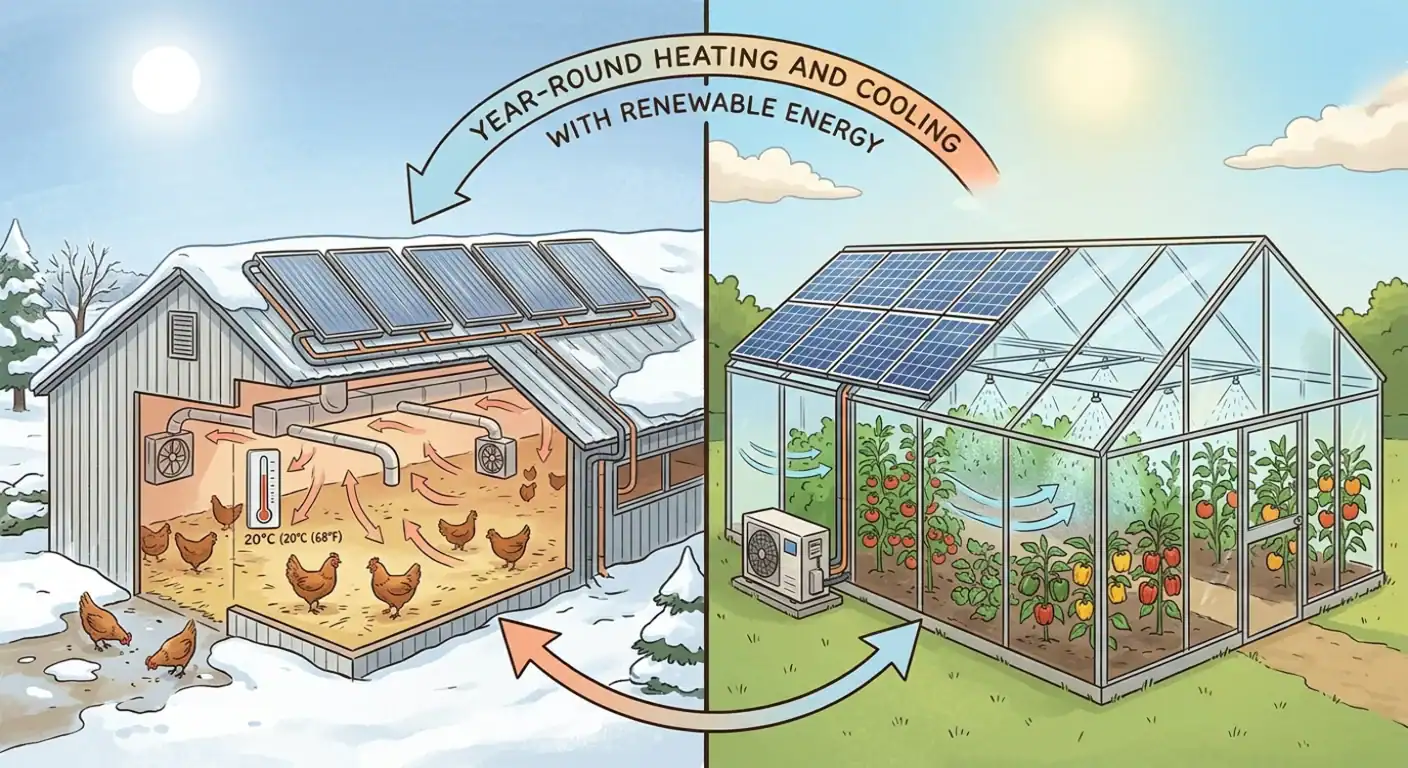
Solar technologies can provide both heating and cooling for agricultural operations — reducing fossil fuel dependence, lowering electricity bills, and improving the comfort and productivity of your animals and crops.
This beginner’s guide introduces the main solar heating and cooling technologies available for farms, explains how they work, and helps you decide which might be right for your operation.
Solar Heating and Cooling Technologies for Farms
Solar energy can address both heating and cooling needs through two main technology pathways :
| Technology Pathway | How It Works | Primary Applications |
|---|---|---|
| Solar Thermal | Captures sunlight to heat air or water directly | Space heating, water heating, drying |
| Solar Photovoltaic (PV) + Heat Pumps | PV generates electricity to power high‑efficiency heat pumps | Both heating and cooling (reverse‑cycle) |
| Hybrid PV‑Thermal (PVT) | Combines PV and thermal capture in one panel | Simultaneous electricity + heat |
1. Solar Thermal Heating
Solar thermal collectors absorb sunlight and convert it directly into heat. The heat is transferred to air or water and circulated through the building.
Applications on farms :
- Livestock barn heating : Warm air circulated through poultry houses, swine nurseries, or dairy barns.
- Greenhouse heating : Solar thermal systems can provide up to 40% of winter heating needs in some climates.
- Water heating : For washdown, cleaning, and milk processing.
- Crop drying : Solar air heaters can dry grains, fruits, and vegetables.
Key benefit : Solar thermal is one of the most cost‑effective ways to generate heat from the sun, especially for low‑temperature applications like space heating and water heating.
2. Solar Photovoltaic (PV) + Heat Pumps
Heat pumps are highly efficient devices that move heat from one place to another. When powered by solar PV, they provide heating in winter and cooling in summer — all from the same system.
How it works :
- Solar panels generate electricity.
- An air‑source or ground‑source heat pump uses that electricity to move heat.
- In winter, the heat pump extracts heat from the outside air or ground and delivers it indoors.
- In summer, the cycle reverses : the heat pump removes heat from the building and rejects it outside.
Efficiency advantage : A ground‑source heat pump (GSHP) can achieve a Seasonal Coefficient of Performance (SCOP) of 4.0–5.6, meaning it delivers 4‑5 units of heat for every unit of electricity consumed. This makes solar PV an ideal partner — one solar panel can power 4‑5 units of heating or cooling.
Applications on farms :
- Livestock buildings : Heating and cooling for swine nurseries, poultry houses, and dairy barns.
- Greenhouses : Year‑round temperature control.
- Storage facilities : Maintaining optimal temperatures for produce, milk, or meat.
3. Hybrid Photovoltaic‑Thermal (PVT) Systems
PVT panels combine photovoltaic and thermal capture in a single unit. They generate electricity while simultaneously capturing waste heat from the panels, which can be used for water or space heating.
Applications on farms :
- Poultry houses : A PVT system optimized for a 1,000‑hen house maintained indoor temperatures of 20–24°C, achieving solar fractions of 25–40% depending on climate.
- Greenhouses : PVT systems can provide both electricity for fans and heat for the greenhouse.
- Combined heating and cooling : PVT panels can feed a heat pump, improving overall system efficiency.
Key benefit : PVT systems make efficient use of roof space, generating both electricity and heat from the same area.
4. Solar‑Assisted Cooling
Cooling farms, especially greenhouses and livestock barns, can be achieved through several solar pathways :
| Cooling Method | How It Works | Best For |
|---|---|---|
| PV‑powered vapor‑compression | Solar electricity runs standard air conditioning or chillers | Any farm with cooling needs |
| Solar thermal adsorption/absorption | Solar heat drives a thermally activated chiller | Greenhouses in hot climates with high solar availability |
| Passive cooling | PV panels on roofs provide shade, reducing heat gain | Livestock barns, storage buildings |
| Evaporative cooling | Solar‑powered pumps and fans operate evaporative pads | Greenhouses in dry climates |
Research highlight : Rooftop PV panels on dairy barns reduced daytime heat flux by 57.7% and lowered indoor temperatures by up to 2.3°C during critical afternoon heat stress periods. This passive cooling benefit is in addition to the electricity the panels generate.
ROI for Solar Heating and Cooling
Example 1 : PV + Ground‑Source Heat Pump for Livestock Barns
| Parameter | Value |
|---|---|
| System | 240 m borehole heat exchanger + dual‑source heat pump + PVT collectors |
| Seasonal Performance Factor | 3.78 (delivers 3.78 units of heat per unit of electricity) |
| Heating demand met | 100% of swine nursery heating needs |
| Conventional system comparison | Would have required 640 m of borehole — a 62% reduction |
| Savings | Reduced fossil fuel use and lower operating costs |
Example 2 : PVT System for Poultry House
| Parameter | Value |
|---|---|
| System | Hybrid PVT with flat‑plate collectors and polycrystalline PV panels |
| Solar fraction (sunny climate) | 40.4% of annual heating/cooling demand |
| Solar fraction (temperate climate) | 25.7% of annual demand |
| NPV (sunny climate) | $967–1,767 over system life |
| IRR (sunny climate) | 17.9%–21.4% — highly feasible |
| Payback (sunny climate) | 4‑6 years (estimated) |
Example 3 : Solar‑Assisted Greenhouse Cooling
| Parameter | Value |
|---|---|
| System | Solar‑assisted adsorption chiller + thermal storage |
| Energy savings from passive measures | Ventilation control + shade cloth reduced energy consumption from 160,448 to 80,540 kWh — a 50% reduction |
| Carbon emissions reduction | 49.8% reduction in CO₂ emissions |
Comparison Table : Solar Heating and Cooling Technologies for Farms
| Technology | Best For | Typical Cost Range | Payback | Key Benefit |
|---|---|---|---|---|
| Solar Thermal (air or water) | Space heating, water heating | $5,000–15,000 | 5‑10 years | Simple, reliable, low maintenance |
| Solar PV + Air‑Source Heat Pump | Small to medium buildings, moderate climates | $10,000–25,000 | 5‑8 years | Cools and heats from one system |
| Solar PV + Ground‑Source Heat Pump | Larger buildings, cold climates | $20,000–50,000+ | 7‑12 years | Highest efficiency (SCOP 4.0‑5.6) |
| Hybrid PVT | Limited roof space, combined needs | $15,000–30,000 | 6‑10 years | Electricity + heat from same area |
| Solar‑Assisted Adsorption Cooling | Greenhouses in hot climates | $20,000–40,000+ | 8‑12 years | Low‑carbon cooling, uses solar heat |
Expert Tips : Getting Started with Farm Solar Heating and Cooling
Tip 1 : Start with passive measures first.
Before investing in active solar heating or cooling, implement low‑cost passive strategies :
- Insulation — Better insulation reduces heating and cooling loads.
- Ventilation control — Proper ventilation can cut energy use by 50%.
- Shade cloth — Reduces solar heat gain in greenhouses.
- Rooftop PV — Even without thermal collection, PV panels provide passive cooling shade.
Tip 2 : Consider dual‑purpose systems.
Technologies like PVT panels or rooftop PV with heat pumps serve multiple functions :
- PV panels generate electricity and provide shade cooling.
- PVT panels generate electricity and capture heat for water or space heating.
- Heat pumps provide both heating and cooling from the same equipment.
Tip 3 : Evaluate ground‑source heat pumps for larger operations.
Ground‑source heat pumps (GSHP) are more efficient than air‑source heat pumps, especially in cold climates. While installation costs are higher (due to borehole drilling), the long‑term efficiency and lower operating costs make them attractive for larger barns and greenhouses.
Tip 4 : Match technology to your climate.
- Sunny, dry climates — Solar thermal and PVT systems perform best.
- Hot‑humid climates — PV + vapor‑compression cooling is often more effective than evaporative cooling.
- Cold climates — Ground‑source heat pumps paired with solar PV provide reliable winter heating.
Tip 5 : Check for USDA and state incentives.
The USDA REAP program (grants up to 50% for renewable energy projects) and EQIP (cost‑share for energy efficiency) can significantly reduce upfront costs. Many states also offer additional incentives for solar heating and cooling installations.
Conclusion : Solar Heating and Cooling — A Year‑Round Investment
Heating and cooling don’t have to be a drain on your farm’s profitability. Solar technologies offer a practical path to reducing energy costs, improving animal welfare, and extending growing seasons — all while cutting carbon emissions.
Key takeaways :
| Takeaway | Why It Matters |
|---|---|
| Solar thermal is the simplest and most cost‑effective way to generate heat from the sun | Ideal for water heating, space heating, and drying |
| Solar PV + heat pumps provide both heating and cooling from one system | Replaces both furnace and air conditioner with renewable energy |
| Passive measures like insulation, ventilation, and shade cloth can cut energy use by 50% | Lowest‑cost first step |
| Ground‑source heat pumps are the most efficient option, especially in cold climates | SCOP of 4.0‑5.6 means 4‑5 units of heat per unit of electricity |
| USDA incentives can cover 25–50% of project costs | Make solar heating and cooling more affordable |
Your action plan :
- Audit your current energy use — identify your biggest heating and cooling loads.
- Implement passive measures first — insulation, ventilation, shade.
- Evaluate solar options — solar thermal, PV + heat pump, or PVT.
- Check incentives — USDA REAP, EQIP, state programs.
- Get a professional assessment — solar heating and cooling systems require careful sizing and design.
Frequently Asked Questions
Q: Can solar energy provide both heating and cooling for my farm?
Yes — solar energy can provide both heating and cooling for farms. The most common approach uses solar photovoltaic (PV) panels to generate electricity that powers a heat pump. Heat pumps are reversible: in winter, they extract heat from the outside air or ground and deliver it indoors; in summer, they remove heat from the building and reject it outside. This single system provides year‑round climate control. Alternatively, solar thermal systems can provide heating directly, while solar‑assisted adsorption chillers use solar heat to drive cooling. The best solution depends on your climate, building size, and specific needs.
Q: What is the most cost‑effective solar heating system for a farm?
For most farms, solar thermal air or water heating is the most cost‑effective option for space heating and water heating, especially for low‑temperature applications like livestock barns and greenhouses. However, for operations that need both heating and cooling, a solar PV‑powered heat pump is often the best value — it provides year‑round climate control from a single system. Ground‑source heat pumps offer the highest efficiency (SCOP of 4.0‑5.6) but have higher installation costs due to borehole drilling. The most cost‑effective choice depends on your climate, building size, and available incentives. Always start with passive measures like insulation and ventilation, which can cut energy use by 50% before adding active solar systems.
Q: What solar cooling options are available for greenhouses?
Greenhouses can be cooled using several solar‑based approaches: (1) PV‑powered vapor‑compression air conditioning or chillers — the most common and proven technology. (2) Solar thermal adsorption or absorption chillers — use solar heat to drive a cooling cycle, particularly effective in sunny climates. (3) Passive cooling from rooftop PV panels — panels shade the roof and reduce heat gain, lowering indoor temperatures by up to 2.3°C. (4) Solar‑powered evaporative cooling — works well in dry climates but is less effective in humid regions. For most greenhouses, a combination of passive shading, ventilation control, and PV‑powered cooling provides the best balance of cost and performance. Evacuated flat‑plate collectors paired with adsorption chillers offer the best performance in hot‑humid climates.
© 2026 Solar Panels for Farms. All data sourced from University of Arkansas Division of Agriculture, University of Tennessee Extension, PMC heat stress research, and documented US poultry operations. Last verified: July 1, 2026.