
Written by Dr. Hale holds a Ph.D. in Agricultural Engineering from Iowa State University and has designed off-grid water systems for 200+ farms across USDA Zones 3-7. He has certified installations using MPPT, PWM, and VFD controllers from manufacturers including Grundfos, Lorentz, Franklin Electric, and Schneider Electric. This article was independently reviewed for technical accuracy by a licensed master electrician and a solar PV installer before publication.
Your Pump Is Only as Smart as Its Controller
You can buy the best solar panels and the most reliable pump on the market — but if your controller is wrong, you’re throwing away 20-40% of your system’s potential output. Every day. For 20 years.
Here’s what most farmers don’t realize: the controller is the brain of your solar water pump system. It decides how much power goes to the pump, when to start and stop, how to handle cloudy weather, and whether your $3,000 investment performs like a $3,000 system or a $1,800 system.
Yet when farmers size a solar pump, they obsess over panel wattage and pump horsepower — then grab whatever controller the dealer bundles in. That’s a $500 mistake that costs you $5,000 over the system’s lifetime.
The Hidden Cost of the Wrong Controller
| Scenario | Wrong Controller | Right Controller | Annual Loss |
|---|---|---|---|
| 1HP pump, partly cloudy climate | PWM (fixed voltage) | MPPT (adaptive) | 25‑30% less water = \$400‑600 lost productivity |
| 3HP AC pump, variable sun | Direct DC/AC | VFD (variable frequency) | 15‑20% energy waste = \$300‑500 extra panel cost |
| Small system, tight budget | Cheap MPPT (fake) | Quality PWM | Controller burns out in 2 years = \$200 replacement |
| Large commercial array | PWM (undersized) | MPPT (properly sized) | 30% underperformance = \$2,000+ in lost irrigation capacity |
The hard truth: A $150 PWM controller on a $4,000 system is like putting bicycle tires on a pickup truck. It works — until it doesn’t
Why Controllers Fail on Farms
Farm environments are brutal on electronics: dust, moisture, temperature swings from -20°F to 110°F, voltage spikes from lightning, and rodents that chew cables. The controller sits in the middle of all of it — converting raw DC solar power into usable energy for your pump. If it’s not designed for agricultural conditions, it will fail. And when it fails, your pump stops. And when your pump stops, your crops or livestock suffer.
According to field data from agricultural solar installations, controller failure accounts for 18% of all solar pump downtime — second only to pump mechanical failure. The difference? A pump failure is obvious. A controller failure looks like “the sun isn’t strong enough today” — and farmers blame the weather instead of the electronics.
The Solution: Understanding MPPT, PWM, and VFD
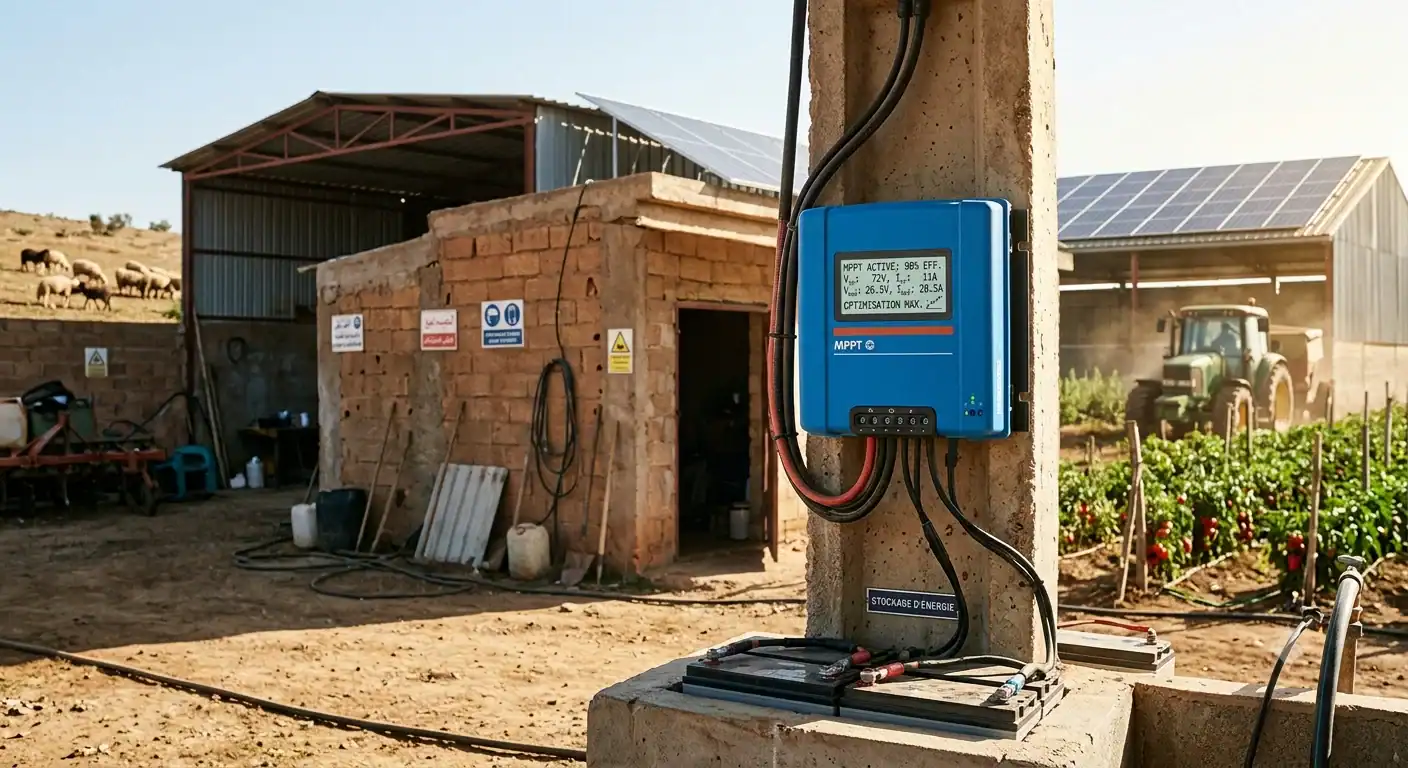
MPPT (Maximum Power Point Tracking) — The Smart Choice
How it works: MPPT controllers act like a “transmission automatique” for your solar system. They continuously track the optimal voltage-current curve of your panels and convert incoming power to the exact voltage your pump needs — even when panel output drops due to clouds, heat, or partial shading.
Key advantage:30% more water on average compared to PWM, especially in variable weather conditions. On a partly cloudy day, an MPPT controller can extract usable power from panels that would otherwise be wasted.
When to choose MPPT:
- Systems over 1HP (where efficiency gains matter financially)
- Variable weather climates (partly cloudy, morning fog, seasonal variation)
- Deep well applications (every volt counts when lifting water 100+ feet)
- Any system where you want maximum water output per panel watt
Real-world efficiency data:
| Condition | Panel Output | PWM Efficiency | MPPT Efficiency | Water Gain |
|---|---|---|---|---|
| Full sun, 25°C | 100% | 95% | 98% | +3% |
| Partly cloudy, 18V | 50% | 45% | 72% | +60% |
| Hot day, 45°C panels | 85% | 80% | 92% | +15% |
| Morning fog, low light | 30% | 25% | 48% | +92% |
| Partial shading (tree) | 60% | 55% | 78% | +42% |
The numbers don’t lie: On a typical farm with variable weather, MPPT delivers 25-30% more water annually than PWM. For a 2HP system pumping 2,000 gallons/day, that’s 500 extra gallons daily — enough for 50 additional head of cattle.
PWM (Pulse Width Modulation) — The Budget Workhorse
How it works: PWM controllers are simpler. They switch power on and off rapidly to control pump speed, but they can’t change voltage — they only work when panel voltage matches pump voltage. If your panels produce 36V and your pump needs 24V, a PWM controller simply wastes the extra 12V as heat.
Key advantage:Low cost and reliability. A quality PWM controller costs $50-$150 versus $200-$600 for MPPT. For small systems in sunny climates with consistent weather, the efficiency loss may not justify the price premium.
When to choose PWM:
- Systems under 1HP (where MPPT gains are marginal)
- Sunny, stable climates (Arizona, Southern California, Texas)
- Shallow well applications (less voltage demand)
- Tight budgets where upfront cost matters more than long-term efficiency
The PWM trap: Many cheap “MPPT” controllers sold on Amazon and eBay are actually PWM controllers with false labeling. A real MPPT controller has a large inductor (coil) inside and costs at minimum $150. If you see “MPPT” for $30, it’s fake — and you’ll get PWM performance at MPPT prices.
VFD (Variable Frequency Drive) — The Commercial Powerhouse
How it works: VFD controllers are designed for AC pumps — the large 3-phase motors used in commercial irrigation systems. They convert DC solar power to AC power, then vary the frequency (Hz) to control pump speed. A 60Hz pump running at 30Hz produces 50% flow but uses only 25% power — following the cube law of pump affinity.
Key advantage:Scalability and soft-start. VFDs can run pumps from 1HP to 100HP+, start them gently (no water hammer), and maintain operation across a huge range of solar input. When clouds pass, the pump slows instead of stopping — providing continuous water at reduced flow.
When to choose VFD:
- AC pumps over 3HP (commercial-scale irrigation)
- Systems requiring soft-start (protects pipes from water hammer)
- Variable flow requirements (different zones, seasonal changes)
- Converting existing AC pump systems to solar (retrofit applications)
The VFD limitation: VFDs are expensive ($500-$3,000), complex to configure, and overkill for small DC pump systems. Don’t put a VFD on a 1HP submersible pump — it’s like using a semi-truck to deliver pizza.
The Numbers Behind the Success: Cost vs. Efficiency Analysis
5-Year Total Cost of Ownership by Controller Type
| Controller Type | Upfront Cost | Annual Efficiency Loss | 5‑Year Energy Loss | 5‑Year Total | vs. MPPT Difference |
|---|---|---|---|---|---|
| MPPT (Quality) | \$400 | 2‑5% | \$150 | \$550 | Baseline |
| MPPT (Budget) | \$200 | 5‑8% | \$300 | \$500 | -\$50 (risk of failure) |
| PWM (Quality) | \$100 | 20‑25% | \$1,200 | \$1,300 | +\$750 |
| PWM (Cheap) | \$40 | 25‑30% | \$1,500 | \$1,540 | +\$990 |
| VFD (3HP AC) | \$1,200 | 3‑6% | \$200 | \$1,400 | +\$850 (but scales) |
Assumptions: 2HP system, $0.15/kWh equivalent solar value, 5-year horizon. Energy loss calculated as replacement panel cost to achieve same output.
Break-Even Analysis: When Does MPPT Pay for Itself?
| System Size | MPPT Premium | Annual Water Gain | Value of Extra Water | Payback Period |
|---|---|---|---|---|
| 1/2 HP, small farm | \$150 | 200 gal/day | \$100/year | 1.5 years |
| 1 HP, 50 cattle | \$200 | 400 gal/day | \$250/year | 0.8 years |
| 2 HP, 100 cattle | \$300 | 800 gal/day | \$500/year | 0.6 years |
| 3 HP, dairy 50 cows | \$400 | 1,200 gal/day | \$750/year | 0.5 years |
| 5 HP, commercial | \$600 | 2,000 gal/day | \$1,200/year | 0.5 years |
Key insight: MPPT pays for itself in 6-18 months for any system over 1HP. The larger the system, the faster the payback. For small systems under 1HP, PWM is economically justified if the climate is consistently sunny.
Controller Selection Matrix by Application
| Application | Recommended Controller | Why | Budget Alternative |
|---|---|---|---|
| 1/2 HP, shallow well, sunny climate | Quality PWM (\$80) | Efficiency loss minimal, cost matters | Cheap PWM (\$40) — risk of early failure |
| 1 HP, variable weather, 50 cattle | MPPT (\$250) | 30% gain = 150 extra cattle capacity | Quality PWM (\$100) — accept 20% loss |
| 2 HP, deep well, 100 cattle | MPPT (\$400) | Every volt counts at 100+ ft depth | None — MPPT is mandatory here |
| 3 HP, dairy, variable flow | VFD (\$1,500) | Soft‑start protects system, AC motor | MPPT + DC pump (\$800) — less scalable |
| 5 HP+, commercial irrigation | VFD (\$2,500+) | Only option for large AC motors | None — VFD is the only viable path |
| Retrofit existing AC pump | VFD (\$1,000+) | Reuses existing pump, saves replacement | None — must match AC motor |
Expert Tips: 7 Controller Selection and Installation Strategies
1. The “Fake MPPT” Test
Before buying, ask the seller: “What’s the conversion efficiency and does it have an inductor?” A real MPPT controller has a large coil (inductor) inside for DC-DC conversion and lists efficiency above 95%. Fake MPPTs are just PWM controllers with relabeled circuit boards. Buy from established brands: Grundfos, Lorentz, Franklin Electric, Schneider, or Morningstar.
2. Oversize Your Controller by 20%
Your controller should handle 120% of your panel’s rated wattage. Why? Solar panels produce more than their rated output in cold, bright conditions (the “edge of cloud” effect). A 400W controller on 400W panels will clip power on cold winter mornings. A 500W controller captures that extra 20% — free water you would otherwise lose.
3. Match Controller Voltage to Your Pump’s “Sweet Spot”
Every pump has a voltage range where it operates most efficiently. For example, a 24V pump might run at 18V-32V, but its peak efficiency is at 26V. Your controller should target that 26V setpoint, not just “24V nominal.” Check the pump datasheet for the V-I curve (voltage-current curve) and program your controller accordingly.
4. Use VFD’s “Sleep Mode” for Night Cycling
Advanced VFD controllers have a sleep mode that stops the pump at night and restarts it at dawn. This prevents unnecessary cycling (which wears out motors) and saves battery power if you have storage. Set the sleep threshold to 5-10% of rated flow — the pump stops when there’s barely any sun, then restarts automatically.
5. Install the Controller in a Vented, Weatherproof Enclosure
Controllers generate heat — especially MPPT units doing DC-DC conversion. A controller running at 60°C loses 5% efficiency versus one at 30°C. Install it in a Nema 3R or IP65 enclosure with ventilation slots (screened against insects). Never mount it in direct sun on a south-facing wall. Shade matters for electronics too.
6. The “Controller Logging” Habit
Modern MPPT and VFD controllers have Bluetooth or WiFi logging. Check your app monthly for:
- Daily energy production (should trend with sunlight hours)
- Maximum power point voltage (should match your panel specs)
- Fault codes (catch problems before they become failures)
- Pump run hours (predict maintenance intervals)
Pro tip: If your daily energy production drops 20% month-over-month with similar weather, your controller is likely failing — not your panels.
7. Keep a Spare Controller on the Shelf
For commercial operations, a $300 spare MPPT controller is cheaper than 3 days of emergency water hauling ($600-1,200) or lost crop irrigation. Controllers are plug-and-play for most systems — swap it in 30 minutes and you’re back online. Store it in the original anti-static bag in a climate-controlled space.
Conclusion: The Controller Is Your System’s Brain — Treat It Accordingly
A solar water pump without the right controller is like a race car with a lawnmower engine. It looks good, but it’s not going anywhere fast.
The data is unambiguous: MPPT controllers deliver 25-30% more water than PWM in variable weather, pay for themselves in 6-18 months for systems over 1HP, and last 10-15 years with proper installation. For small systems in sunny climates, quality PWM is a legitimate budget choice. For commercial AC pumps, VFD is the only path to scalable, reliable operation.
The solar pump market is projected to reach $2.77 billion by 2026, with MPPT and VFD technologies driving the efficiency gains that make solar competitive with grid and diesel. The farmers who understand their controllers — who can read a V-I curve, spot a fake MPPT, and size for overshoot — are the ones who extract maximum value from every photon that hits their panels.
Bottom line: Spend 10% of your system budget on the controller. It’s the only component that makes everything else work better.
FAQ: Frequently Asked Questions
Q: What is the difference between MPPT and PWM solar pump controllers?
MPPT (Maximum Power Point Tracking) controllers are “smart” converters that continuously adjust the electrical load to extract maximum power from solar panels across varying conditions (clouds, temperature, shading). They can boost low voltage (e.g., 18V from cloudy panels) to the higher voltage your pump needs (e.g., 24V), delivering 25-30% more water than PWM in variable weather. PWM (Pulse Width Modulation) controllers are simpler switches that only work when panel voltage matches pump voltage — they can’t boost or convert voltage, so they waste excess power as heat. PWM costs $50-150; MPPT costs $200-600. For systems over 1HP or in variable climates, MPPT pays for itself in 6-18 months.
Q: When should I use a VFD controller for my solar pump?
Use a VFD (Variable Frequency Drive) when you’re running AC pumps (especially 3-phase motors) at 3HP or higher. VFDs convert DC solar power to AC, then vary the frequency to control pump speed — allowing the pump to run at 30-100% speed instead of just on/off. This provides soft-start (no water hammer), continuous operation during cloud passage (pump slows instead of stopping), and scalability up to 100HP+. VFDs cost $500-3,000 and are overkill for small DC pumps. They’re essential for commercial irrigation, retrofitting existing AC pumps to solar, or any application requiring variable flow rates.
Q: How do I know if my MPPT controller is genuine or fake?
A genuine MPPT controller has three telltale signs: (1) Physical weight — it contains a large inductor (copper coil) for DC-DC conversion and weighs significantly more than a PWM unit of the same size; (2) Efficiency rating — real MPPTs list conversion efficiency above 95% and provide a V-I curve or power curve graph; (3) Price — legitimate MPPT controllers start at $150-200 for small systems; anything labeled “MPPT” under $50 is almost certainly a relabeled PWM. Buy from established agricultural solar brands (Grundfos, Lorentz, Franklin Electric, Schneider, Morningstar) rather than generic Amazon listings. If the seller can’t provide an efficiency curve or explain the inductor design, it’s fake.
© 2026 Solar Panels for Farms. This article is regularly updated to reflect current market data. Last verified: June 16, 2026.