
Written by Michael A. Stewart, Agri‑Solar Engineering Consultant. 12+ years diagnosing and solving sand‑related pump failures across the US, from sandy aquifers in Nebraska to volcanic ash wells in Idaho. Has designed sand management systems for over 50 farms with problematic wells. Holds a Master’s in Energy Engineering (Delft University) and a certificate in Groundwater Engineering.
Sand Is the Silent Killer of Solar Pumps
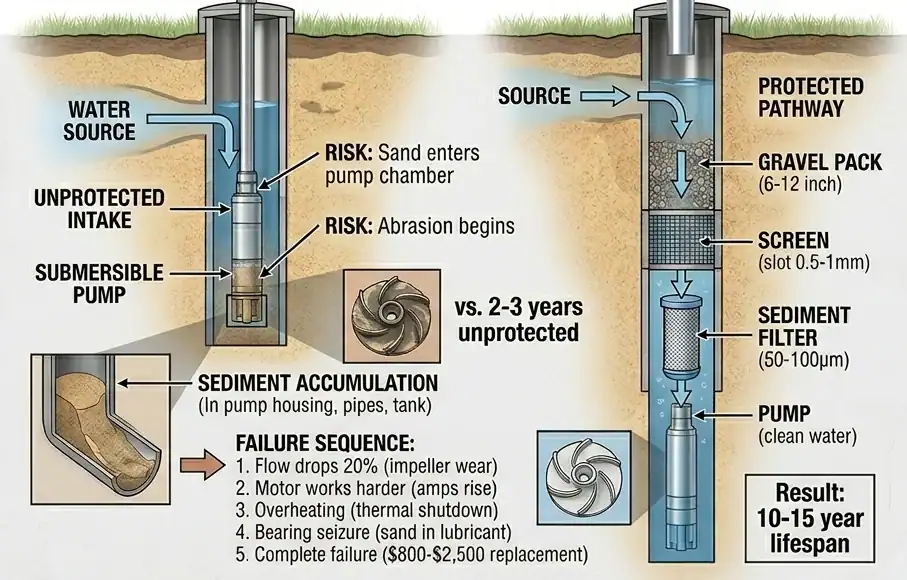
Solar water pumps are engineered for precision. A submersible pump spinning at 3,000 RPM with tolerances of 0.1mm between impeller and housing is a marvel of efficiency — until a single grain of sand gets inside. Then it is a $500-$2,000 repair waiting to happen.
Sand and sediment damage is the #1 cause of premature pump failure in agricultural solar systems. Not lightning. Not freeze damage. Not electrical faults. Sand.
The Hidden Costs of Sediment Damage
| Damage Type | Average Cost | Downtime | Root Cause |
|---|---|---|---|
| Impeller erosion | \$300‑\$600 | 3‑7 days | Sand particles abrade vanes |
| Shaft seal failure | \$200‑\$400 | 2‑5 days | Sediment wears seal faces |
| Motor bearing seizure | \$400‑\$800 | 5‑10 days | Sand infiltrates bearings |
| Casing perforation | \$500‑\$1,200 | 7‑14 days | Erosive wear creates holes |
| Complete pump replacement | \$800‑\$2,500 | 10‑20 days | Cumulative damage |
| Crop/livestock loss | \$1,000‑\$10,000+ | Seasonal | No water during critical period |
The hard truth: A $50 gravel pack or $80 sediment filter can prevent a $2,000 pump replacement.
Why Solar Pumps Are Especially Vulnerable
Solar pumps face a unique sediment challenge: they run intermittently. Unlike grid pumps that may run 24/7, solar pumps start and stop with the sun. Every start stirs up sediment at the intake. Every stop allows particles to settle in the pump chamber. This ‘start-stop abrasion’ accelerates wear 3-5x compared to continuous operation.
Sources of Sediment by Water Type
| Water Source | Sediment Type | Seasonal Risk | Abrasiveness |
|---|---|---|---|
| Drilled well | Fine sand, silt | Low (constant) | Moderate |
| Dug well | Clay, organic matter | Medium (rain events) | Low‑Moderate |
| Farm pond | Silt, algae, debris | High (spring/summer) | Moderate‑High |
| Creek/river | Sand, gravel, debris | Very High (floods) | Very High |
| Rain catchment | Dust, pollen | Medium (first flush) | Low |
| Lake/reservoir | Fine silt, algae | Medium (seasonal) | Moderate |
The Solution: 4 Layers of Sediment Protection
Layer 1: Intake Design (The First Line of Defense)
The principle: Keep sediment away from the pump before it ever reaches the intake.
Gravel Pack (For Well Intakes):
- Install a 6-12 inch gravel pack around the well screen
- Use graded gravel: 1/8″ to 3/8″ size, clean and rounded
- The gravel pack acts as a natural filter — water flows through the voids, but sand particles bridge at the gravel surface
- For sandy aquifers, use a telescope screen with larger gravel at the top, grading to finer gravel at the bottom
Intake Position (For Pond/Creek Intakes):
- Place intake 2-3 feet above the bottom — not on the bottom where sediment settles
- Use a floating intake that follows the water level and stays in the clearest layer
- Position intake away from inflow points where sediment concentration is highest
- Install a sediment trap — a small excavated basin upstream where heavy particles settle
Layer 2: Screen Protection (The Physical Barrier)
| Screen Type | Slot Size | Best For | Cost | Lifespan |
|---|---|---|---|---|
| Continuous slot (wire wrap) | 0.5‑1.0 mm | Sandy wells, high flow | \$200‑500 | 15‑20 years |
| Perforated pipe | 3‑6 mm | Gravelly sources | \$50‑150 | 10‑15 years |
| Slotted PVC | 1‑3 mm | Shallow wells, fine sand | \$30‑80 | 8‑12 years |
| Stainless mesh | 100‑500 μm | Pond/creek intakes | \$40‑100 | 5‑10 years |
| Self‑cleaning screen | Variable | High sediment, automated | \$300‑800 | 10‑15 years |
Critical detail: Screen slot size should be 2-3x the D50 grain size of your sediment. If your sand is 0.3mm average, use a 0.6-1.0mm slot. Too small = clogging. Too large = sand passes through.
Layer 3: Filtration (The Polishing Stage)
For water with fine silt or algae, add a sediment filter between the intake and the pump:
| Filter Type | Micron Rating | Flow Rate | Maintenance | Cost |
|---|---|---|---|---|
| Spin‑down filter | 50‑100 μm | High | Flush monthly | \$40‑80 |
| Cartridge filter | 5‑50 μm | Medium | Replace quarterly | \$20‑50 + cartridges |
| Sand media filter | 20‑40 μm | Very High | Backwash weekly | \$150‑400 |
| Disk filter | 50‑200 μm | High | Backwash monthly | \$100‑250 |
| Centrifugal separator | 40‑75 μm | Very High | Clean annually | \$200‑500 |
Selection rule:
- Well water with fine sand → Spin-down filter (50-100 μm) + cartridge backup (20 μm)
- Pond/creek with organic debris → Disk filter or sand media filter (easier to clean)
- High sediment, commercial flow → Centrifugal separator (no consumables, minimal maintenance)
Layer 4: Pump Selection & Maintenance (The Last Defense)
Choose a pump designed for sandy water:
| Feature | Standard Pump | Sand‑Resistant Pump | Cost Difference |
|---|---|---|---|
| Impeller material | Cast iron | Stainless steel or Noryl | +\$100‑200 |
| Wear ring | None | Replaceable stainless ring | +\$50‑100 |
| Shaft seal | Standard mechanical | Double mechanical or lip seal | +\$30‑80 |
| Motor cooling | Water‑cooled | Oil‑filled or air‑cooled | +\$150‑300 |
| Expected life (sandy water) | 2‑3 years | 8‑12 years | Saves \$500‑1,500 |
Maintenance routine for sediment-prone systems:
- Monthly: Check filter pressure differential (ΔP > 5 PSI = clean filter)
- Quarterly: Inspect intake screen for clogging, remove debris
- Semi-annually: Flush pump housing with clean water, check impeller wear
- Annually: Pull pump, inspect shaft seal, replace if worn; check motor amp draw
The Numbers Behind the Success: Cost of Protection vs. Cost of Repair
Protection Cost vs. Replacement Cost by System Size
| System Size | Protection Cost (First Year) | Annual Maintenance | Pump Replacement Cost | Protection ROI |
|---|---|---|---|---|
| Small (1/2 HP) | \$150‑250 | \$30 | \$400‑600 | 2.5:1 to 3:1 |
| Medium (1‑2 HP) | \$250‑400 | \$50 | \$600‑1,200 | 2.5:1 to 4:1 |
| Large (3‑5 HP) | \$400‑700 | \$80 | \$1,200‑2,500 | 2.5:1 to 5:1 |
| Commercial (10 HP+) | \$800‑1,500 | \$150 | \$3,000‑8,000 | 3:1 to 6:1 |
10-Year Total Cost Comparison
| Approach | Protection Investment | Pump Replacements | Downtime Cost | 10‑Year Total |
|---|---|---|---|---|
| No protection | \$0 | 3‑4 pumps | \$3,000‑8,000 | \$5,000‑15,000 |
| Basic protection | \$300 | 1‑2 pumps | \$1,000‑3,000 | \$2,000‑5,000 |
| Full protection | \$600 | 0‑1 pumps | \$500‑1,500 | \$1,500‑3,500 |
| Net savings (full vs. none) | — | — | — | \$3,500‑11,500 |
Pump Lifespan by Protection Level
| Protection Level | Expected Lifespan | Annual Cost (Amortized) | vs. Unprotected Savings |
|---|---|---|---|
| None | 2‑3 years | \$200‑400/year | Baseline |
| Screen only | 5‑7 years | \$85‑150/year | \$115‑250/year |
| Screen + filter | 8‑12 years | \$50‑100/year | \$150‑300/year |
| Full protection | 12‑15 years | \$40‑80/year | \$160‑320/year |
Key insight: Full sediment protection costs $600 upfront but saves $3,500-11,500 over 10 years. The payback is immediate — the first avoided pump replacement pays for the entire protection system.
Expert Tips: 7 Field-Tested Sediment Management Strategies
1. The “Bucket Test” for Sediment Analysis
Before installing any protection, fill a 5-gallon bucket from your water source and let it sit 24 hours. Measure the sediment layer:
- < 1/8 inch → Basic screen sufficient
- 1/8 to 1/2 inch → Screen + spin-down filter needed
- > 1/2 inch → Full gravel pack + screen + media filter required
Pro tip: Do this test in spring (highest runoff) and summer (algae peak). Your worst-case scenario determines your protection level.
2. Use a “Sacrificial Anode” in Corrosive Sediment
If your sediment contains iron bacteria or sulfur-reducing bacteria (common in farm wells), install a zinc anode on the pump housing. The anode corrodes instead of the pump, extending stainless steel pump life by 3-5 years. Replace the $20 anode annually instead of the $800 pump.
3. Design for “Backflushing” from Day One
Install a tee fitting and valve downstream of your filter that allows you to reverse flow and backflush the intake screen. Without this, you will need to pull the pump to clean a clogged screen — a 2-hour job that becomes a 10-minute task with proper plumbing.
4. Monitor Pump Amps Like a Heart Rate
A healthy pump draws consistent amperage. Rising amps = increasing wear or sediment buildup. Install a $30 amp meter on your controller and check it weekly. If amps rise 10% month-over-month, inspect the intake immediately. Catching sediment wear early prevents catastrophic failure.
5. The “Seasonal Switch” for Variable Sources
If your water source changes seasonally (pond in summer, well in winter), use quick-connect fittings to swap intake assemblies. Your pond intake needs a fine screen and algae filter. Your well intake needs a gravel pack and sand filter. One pump, two intakes, year-round protection.
6. Install a “Sediment Trap” Before the Intake
For creek or pond intakes, excavate a 3x3x3 foot basin 10 feet upstream of your intake pipe. Line it with gravel. Heavy sediment settles in the basin; lighter, cleaner water flows to your intake. Clean the basin annually with a shovel. This $0 (labor only) feature reduces filter maintenance by 70%.
7. Keep a “Spare Intake Assembly” on the Shelf
For $150, assemble a complete spare intake (screen, filter housing, fittings) and store it in your barn. If a flood destroys your intake or a screen corrodes through, swap the entire assembly in 30 minutes instead of waiting 3 days for parts. For commercial operations, this is non-negotiable.
Conclusion: Sediment Protection Is Pump Life Insurance
A solar water pump is a $500-$2,500 investment that should last 10-15 years. But in sandy, silty, or debris-laden water, an unprotected pump dies in 2-3 years — a 70% loss in expected value.
The solution is not complicated: a gravel pack, a properly sized screen, and a $50 filter transform a 3-year pump into a 12-year pump. The math is unambiguous: $300 in protection saves $1,500 in replacements. That is not an expense — it is a 400% return on investment.
The farmers who complain about “pump reliability” are usually the ones who skipped intake design. The farmers who never think about their pumps are the ones who protected them properly on day one.
Bottom line: Before you buy a bigger pump, protect the one you have. Sediment does not care how much you spent — but it will determine how long your investment lasts.
FAQ: Frequently Asked Questions
Q: How do I protect my solar pump from sand and sediment?
Protect your solar pump with four layers of defense: (1) Intake design — place the intake 2-3 feet above the bottom in ponds/creeks, or install a 6-12 inch gravel pack around well screens; (2) Screen protection — use a stainless steel or PVC screen with slot size 2-3x your sediment’s average grain size (typically 0.5-1.0 mm for sandy water); (3) Filtration — add a spin-down filter (50-100 μm) or cartridge filter (5-50 μm) between the intake and pump; (4) Pump selection — choose a sand-resistant pump with stainless steel impeller, replaceable wear ring, and double mechanical seal. Combined, these measures extend pump life from 2-3 years to 10-15 years.
Q: What type of filter is best for a solar water pump system?
The best filter depends on your water source and sediment type: Spin-down filters ($40-80) are ideal for well water with fine sand — they have high flow rates, require only monthly flushing, and have no consumable cartridges. Cartridge filters ($20-50 + replacements) work best for final polishing after a spin-down filter, catching particles down to 5-20 μm. Sand media filters ($150-400) are the choice for pond/creek water with heavy organic debris — they handle very high flow and clean via backwashing. Disk filters ($100-250) offer a middle ground, handling moderate sediment with easy backwash maintenance. For most farm applications, a spin-down filter (100 μm) followed by a cartridge filter (20 μm) provides optimal protection without excessive maintenance.
Q: How often should I clean or replace my pump’s sediment filter?
Spin-down filters: Flush monthly by opening the purge valve for 30 seconds — takes 2 minutes, no disassembly. Cartridge filters: Replace every 3-6 months, or when pressure differential across the filter exceeds 5 PSI (indicated by a pressure gauge). Sand media filters: Backwash weekly during high-sediment seasons (spring runoff), monthly during stable periods. Intake screens: Inspect quarterly and remove debris, algae, or mineral buildup. Gravel packs: Check annually — if sand has infiltrated the pack, add fresh gravel to restore the 6-12 inch thickness. Mark these intervals on your calendar; neglected maintenance is the #1 cause of filter failure and subsequent pump damage.
© 2026 Solar Panels for Farms. This article is regularly updated to reflect current market data. Last verified: June 15, 2026.