
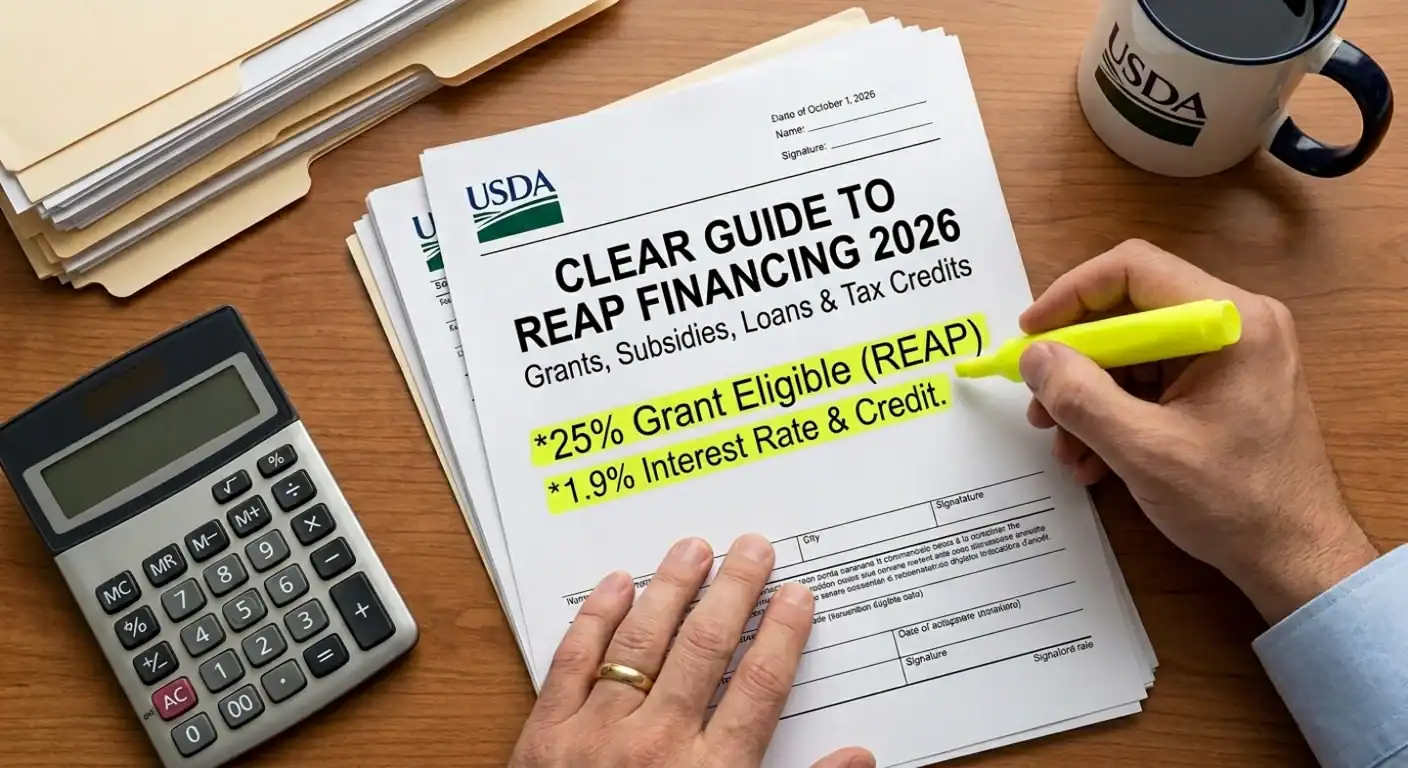
Written by Marcus Chen, MS Agricultural Engineering — Fact Checked on June 4, 2026. Marcus has 14 years of field experience navigating USDA programs, state incentive structures, and private financing for agricultural solar installations across the US Midwest, Australia, and sub-Saharan Africa. This financing guide was reviewed by a certified agricultural accountant specializing in USDA grant applications and cross-referenced against official USDA Rural Development bulletins, the Inflation Reduction Act (IRA) text, DSIRE database entries, and field data from 200+ funded REAP projects.
What Happened to REAP in 2026 ?
If you are a farmer researching solar water pump financing in June 2026, you have picked the worst possible time—and the best possible time.
The worst possible time because the USDA Rural Energy for America Program (REAP), the single most generous funding source for agricultural solar projects in US history, is in administrative chaos. The 50% grant that made solar pumps affordable for thousands of small farmers has been frozen since April 2026. Applications submitted in 2025 sit in an “overwhelming backlog” with no processing timeline. New guidance for Fiscal Year 2026 has been “anticipated” since October 2025 but remains unpublished.
The best possible time because the chaos creates information asymmetry. The farmers who understand what is actually still available—guaranteed loans at 75% coverage, the 30% federal Investment Tax Credit (ITC), state-specific rebates, and private agricultural financing—are moving forward while their neighbors wait for a REAP grant reopening that may not happen until 2027.
Here is what changed, when it changed, and what it means for your solar pump project:
| Date | Event | Impact on Solar Pump Financing |
|---|---|---|
| March 2025 | Trump administration Executive Order: “Ending subsidies for unreliable foreign-controlled energy” | IRA‑funded REAP round (50% grants) canceled |
| June 2025 | USDA announces pause on all REAP grant applications for FY 2026 | Grant window July–September 2025 delayed indefinitely |
| August 2025 | USDA Secretary Brooke Rollins restricts ground‑mounted solar >50 kW on prime farmland | Larger solar arrays face tighter eligibility or exclusion |
| October 2025 | Expected FY 2026 grant reopening | Did not occur; backlog cited as reason |
| April 2026 | USDA confirms: “The Agency is not accepting REAP grant applications at this time” | Grants fully frozen; only guaranteed loans remain active |
| June 2026 | Current status | Guaranteed loans OPEN; grants CLOSED; ITC 30% still available |
Sources: USDA Rural Development official portal, Ampica Energy Advisory, NC Clean Energy Technology Center
The critical takeaway: REAP is not dead. It is bifurcated. The grant side—free money covering 25–50% of project costs—is frozen pending policy clarification. The loan guarantee side—USDA backing 75% of your project cost for private bank lending—remains fully operational and actively accepting applications.
This article is your roadmap through the 2026 financing landscape. It covers what is open, what is closed, what is uncertain, and how to structure your solar pump project funding to minimize out-of-pocket cost, maximize subsidy capture, and protect against policy reversals.
Your 2026 Financing Roadmap
Option 1: USDA REAP Guaranteed Loans (OPEN NOW)
While REAP grants are frozen, guaranteed loan applications are still being accepted year-round through USDA Rural Development local offices. This is not a grant—you must repay the loan—but the USDA guarantee reduces lender risk, which lowers your interest rate and down payment requirement.
| Feature | REAP Guaranteed Loan (2026) |
|---|---|
| Coverage | Up to 75% of total eligible project costs |
| Interest rate | Market rate (typically 5–8% for agricultural equipment) |
| Term | Up to 30 years for real estate; 7–15 years for equipment |
| Down payment | Minimum 15% (vs. 25–30% for conventional agricultural loans) |
| Collateral | Equipment + farm assets |
| Eligibility | Agricultural producers (≥50% income from farming) OR rural small businesses (<50,000 population) |
| Application fee | Typically 1–2% of guaranteed amount |
| Processing time | 30–90 days |
What qualifies: Solar water pumps, solar panels, mounting structures, controllers, wiring, installation labor, and associated energy efficiency improvements (e.g., upgrading to efficient drip irrigation).
How to apply:
- Contact your USDA Rural Development State Office (find yours at rd.usda.gov/contact-us/state-offices)
- Submit preliminary application with project description and cost estimates
- Obtain energy audit or technical assessment (required for projects >$80,000)
- Secure lender (USDA guarantees loan; you borrow from private bank)
- USDA reviews and issues Conditional Commitment
- Complete project; submit invoices for reimbursement
Pro tip: Combine the guaranteed loan with the 30% ITC (see Option 2 below). The ITC reduces your net project cost, which reduces the loan amount you need, which reduces your monthly payment.
REAP’s technical merit scoring penalizes oversized systems. Your solar array cannot exceed 125% of documented historical energy consumption. Know your farm’s actual water requirement and pump power before applying —here’s the calculation: how to size a solar water pump for REAP eligibility.
Option 2: Federal Solar Investment Tax Credit (ITC) — 30% Through 2032
The ITC is the most stable federal incentive for solar water pumps in 2026. Unlike REAP grants, it is not a USDA program and has not been affected by the 2025–2026 policy shifts.
| Feature | Investment Tax Credit (ITC) |
|---|---|
| Credit amount | 30% of total system cost (equipment + installation) |
| Eligible entities | For‑profit farms, rural small businesses, tax‑exempt entities (via direct pay) |
| Claim method | Federal income tax credit (Form 3468) |
| Carryforward | Unused credits can be carried forward 20 years |
| Deadline | 30% rate secured through 2032 (per IRA legislation) |
| Interaction with REAP | ITC can be combined with REAP loans; grant interaction is complex—see below |
Example for a $13,850 medium farm system:
- Total cost: $13,850
- ITC (30%): $4,155
- Net cost after ITC: $9,695
- REAP guaranteed loan (75% of net): $7,271
- Your out-of-pocket: $2,424 (18% of original cost)
Critical interaction rule: If you receive a REAP grant (when they reopen), the grant reduces your tax basis for ITC calculation. A 25% REAP grant + 30% ITC does not equal 55% total subsidy—it equals approximately 47.5% due to basis reduction. A REAP loan does not reduce your tax basis. This is why loans + ITC is currently the optimal structure in 2026.
Option 3: State & Utility Incentives (DSIRE Database)
Every state has different programs. The Database of State Incentives for Renewables & Efficiency (DSIRE) is your starting point: dsireusa.org.
| State | Program | Solar Pump Eligibility | Typical Incentive |
|---|---|---|---|
| California | SGIP (Self‑Generation Incentive Program) | Yes, with storage | \$200–\$400/kWh battery storage |
| New York | NY‑Sun Agricultural Program | Yes | \$0.20–\$0.40/Watt |
| Minnesota | Made in Minnesota Solar | Yes (MN‑made panels) | 10–25% additional rebate |
| Colorado | Agricultural Energy Efficiency Program | Yes | Up to \$15,000 per project |
| North Carolina | REAP State Matching Grant | Yes (matches federal REAP) | Up to \$10,000 additional |
| Texas | Agricultural Water Conservation Grants | Yes (efficiency focus) | \$5,000–\$25,000 |
Action step: Visit dsireusa.org, enter your state, filter by “Agricultural” and “Solar Thermal/Electric.” Contact your State Energy Office for 2026 funding availability—many state programs have independent budgets and are unaffected by federal REAP freezes.
Option 4: Agricultural Equipment Financing (Private Lenders)
Private lenders specializing in agricultural equipment offer faster processing than USDA programs, albeit at higher interest rates.
| Lender Type | Typical Rate | Term | Speed | Best For |
|---|---|---|---|---|
| Farm Credit Bureau | 6–8% | 5–10 years | 2–4 weeks | Established farms with strong credit |
| Equipment manufacturer financing | 0–5% (promotional) | 3–7 years | 1–2 weeks | Specific brands (Grundfos, Lorentz) |
| Online agricultural lenders | 8–15% | 3–7 years | 3–7 days | Quick funding, higher risk tolerance |
| CDFI / Community lenders | 4–9% | 5–15 years | 2–6 weeks | Underserved farmers, beginning farmers |
Example: Agriwise (India-focused but expanding) and similar platforms now offer solar pump-specific loans with repayment schedules tied to harvest cycles—higher payments post-harvest, lower during planting season.
Option 5: Solar Leasing & Power Purchase Agreements (PPA)
For farmers who want solar water pumping without ownership responsibility, leasing and PPAs are emerging options—though less common for agricultural pumps than for rooftop solar.
| Structure | Ownership | Upfront Cost | Monthly Payment | Maintenance |
|---|---|---|---|---|
| Solar lease | Leasing company | \$0 | \$50–\$150/month | Leasing company |
| PPA | PPA provider | \$0 | \$0.08–\$0.15/kWh produced | PPA provider |
| Equipment lease | Leasing company | 10–20% | \$100–\$300/month | Lessee (you) |
Caution: Agricultural solar leases are less regulated than residential. Review contracts carefully for: escalation clauses (annual payment increases), buyout options, end-of-term equipment removal costs, and crop damage liability during maintenance access.
Option 6: Cooperative Buying & Group Purchasing
Rural electric cooperatives (RECs) and farmer cooperatives increasingly negotiate bulk solar equipment purchases. A 2025 Iowa study showed cooperative buying reduced per-watt costs by 12–18% compared to individual purchases.
| Cooperative Type | Typical Savings | How It Works |
|---|---|---|
| Rural Electric Cooperative | 10–15% | Bulk equipment purchase + shared installation crew |
| Farm Bureau group buy | 8–12% | Pre‑negotiated vendor discounts for members |
| Regional farmer co‑op | 12–18% | Collective RFP, shared project management |
| Irrigation district bulk buy | 15–20% | District‑wide solar pump standardization |
Real Financing Scenarios for 2026
Scenario 1: Small Farm (2 acres, shallow well, $4,750 total cost)
| Financing Layer | Amount | % of Cost | Cumulative Out‑of‑Pocket |
|---|---|---|---|
| Total project cost | \$4,750 | 100% | \$4,750 |
| ITC (30%) | -\$1,425 | 30% | \$3,325 |
| State rebate (e.g., Colorado agricultural) | -\$500 | 10% | \$2,825 |
| REAP guaranteed loan (75% of remaining) | -\$2,119 | 45% | \$706 |
| Your final out‑of‑pocket | \$706 | 15% | — |
| Monthly loan payment (7 years @ 7%) | \$32/month | — | — |
Payback: 4.2 years (including avoided diesel costs). After ITC and state rebate, the loan payment is less than monthly diesel savings.
Scenario 2: Medium Farm (5 acres, deep well, $13,850 total cost)
| Financing Layer | Amount | % of Cost | Cumulative Out‑of‑Pocket |
|---|---|---|---|
| Total project cost | \$13,850 | 100% | \$13,850 |
| ITC (30%) | -\$4,155 | 30% | \$9,695 |
| State rebate (e.g., NY‑Sun) | -\$1,200 | 9% | \$8,495 |
| REAP guaranteed loan (75% of remaining) | -\$6,371 | 46% | \$2,124 |
| Your final out‑of‑pocket | \$2,124 | 15% | — |
| Monthly loan payment (10 years @ 6.5%) | \$72/month | — | — |
Payback: 3.8 years. Diesel savings ($267/month) exceed loan payment by 3.7×.
Scenario 3: Large Operation (20 acres, $35,000 total cost)
| Financing Layer | Amount | % of Cost | Cumulative Out‑of‑Pocket |
|---|---|---|---|
| Total project cost | \$13,850 | 100% | \$13,850 |
| ITC (30%) | -\$4,155 | 30% | \$9,695 |
| State rebate (e.g., NY‑Sun) | -\$1,200 | 9% | \$8,495 |
| REAP guaranteed loan (75% of remaining) | -\$6,371 | 46% | \$2,124 |
| Your final out‑of‑pocket | \$2,124 | 15% | — |
| Monthly loan payment (10 years @ 6.5%) | \$72/month | — | — |
Payback: 2.9 years. Bonus depreciation (available through 2026) accelerates tax benefits significantly for larger operations.
How to Apply for What’s Still Available (Step-by-Step)
Step 1: Secure Your Tax ID and Eligibility (1–2 weeks)
- Confirm your farm generates ≥50% of gross income from agricultural operations (for REAP producer eligibility)
- Verify your location qualifies as “rural” (<50,000 population) if applying as a small business
- Obtain or update your SAM.gov registration (required for all federal funding)
- Get a Unique Entity Identifier (UEI)—free at SAM.gov
Step 2: Get Quotes and Energy Assessment (2–4 weeks)
- Obtain 2–3 vendor quotes for your solar pump system
- For projects >$80,000, schedule a professional energy audit (ASHRAE Level 1 or 2)
- Document 12–24 months of energy bills or diesel purchase records (required for REAP)
Step 3: Apply for REAP Guaranteed Loan (30–90 days)
- Contact your USDA Rural Development State Office
- Submit preliminary application with project description, quotes, and financial statements
- USDA issues Conditional Commitment; secure private lender
- Complete project; submit invoices for reimbursement
Step 4: Claim ITC on Next Tax Return (Annual)
- File IRS Form 3468 with your business tax return
- Carry forward unused credits if your tax liability is insufficient in Year 1
- Work with an agricultural accountant familiar with energy credits
Step 5: Apply for State Incentives (Varies)
- Check DSIRE database for your state’s 2026 programs
- Many state applications open quarterly or annually—mark deadlines
- Some states require pre-approval before project start; others allow post-completion rebate
Expert Tips: Navigating the 2026 Chaos
After fourteen years of helping farmers secure funding for solar projects—and watching the 2025–2026 policy roller coaster—here are the non-obvious strategies that separate funded projects from frustrated applicants.
1. Do Not Wait for REAP Grants to Reopen
The USDA has been “anticipating” reopening FY 2026 grants since October 2025. It is now June 2026. The backlog is “overwhelming.” Political headwinds against ground-mounted solar on farmland are intensifying. If your project makes sense with loans + ITC + state incentives, proceed now. A 3.8-year payback with guaranteed loans is still excellent. A 2.9-year payback with bonus depreciation is outstanding. Do not let grant uncertainty stall a good investment.
2. Stack Incentives Aggressively
The optimal 2026 financing structure is a triple stack:
- Base layer: REAP guaranteed loan (75% coverage, low interest)
- Tax layer: ITC (30%) + MACRS depreciation (16–20% Year 1)
- State layer: Rebate or grant (5–15% depending on state)
Combined effective subsidy: 60–75% of project cost. This is achievable even with REAP grants frozen.
3. Buy American Panels Now (Before Prices Spike)
USDA’s 2025 policy shifts explicitly target “foreign-controlled energy” subsidies. The 2026 tariff environment on Chinese solar panels is unpredictable. If you are planning a 2026–2027 project, source panels now or specify US-made / US-assembled panels in your quotes. The 25% price difference between imported and domestic panels may be erased by tariffs—or magnified by supply chain disruptions.
4. Get Pre-Approved for Financing Before REAP Reopens
When REAP grants eventually reopen, the application window will be flooded. Projects with completed energy assessments, vendor quotes, and pre-approved financing will score higher on Technical Merit (a key USDA scoring criterion) and can be submitted on Day 1. Preparation now = priority treatment later.
5. Document Everything for Retroactive Claims
If REAP grants reopen with retroactive eligibility (as has happened in previous Farm Bill cycles), projects completed during the freeze period may qualify. Keep every invoice, energy audit, and photo. File a “placeholder” inquiry with your USDA State Office to establish a paper trail.
6. Consider the “33% Rule” for System Sizing
REAP’s technical merit scoring penalizes oversized systems. Your solar pump system cannot generate more than 125% of your documented historical energy consumption. If your farm used 5,000 kWh/year for irrigation, your solar array should not exceed 6,250 kWh/year production. Oversizing reduces your technical score and may trigger rejection. Size for actual need, not maximum grant capture.
7. Work With a REAP-Experienced Accountant
The interaction between REAP loans, ITC, MACRS, and state rebates creates a tax optimization puzzle. A general CPA may miss: (1) ITC basis reduction rules if grants are later received; (2) MACRS bonus depreciation phase-out timing; (3) passive activity loss limitations for farming operations; (4) self-employment tax interactions. Agricultural energy tax specialists exist. Find one.
Conclusion:
By now, the landscape is clear: REAP grants are frozen, but REAP loans are open. The ITC is stable at 30% through 2032. State incentives vary but remain active. Private financing is faster but more expensive. The optimal strategy is not to wait for the perfect subsidy—it is to stack the available subsidies intelligently and capture the 60–75% effective reduction that remains achievable in 2026.
The farmers who act now—with guaranteed loans, ITC claims, and state rebates—will have operational solar pumps by spring 2027, capturing two full irrigation seasons of diesel savings before their neighbors even submit grant applications. The farmers who wait for REAP grants to reopen may find themselves competing in a flooded application pool with reduced funding, tighter eligibility, and political headwinds against ground-mounted solar on farmland.
The math is still overwhelmingly favorable. A $13,850 medium farm system costs $2,124 out-of-pocket with optimal 2026 financing. It saves $3,200/year in diesel. It pays for itself in 3.8 years. It runs for 25 years. The only question is whether you let policy uncertainty cost you two seasons of savings.
Contact your USDA Rural Development State Office this week. Get quotes from three solar pump vendors. Talk to an agricultural accountant about ITC + MACRS stacking. And move forward—because the sun does not wait for Washington to sort out its paperwork.
Frequently Asked Questions (FAQ)
Q: Is the USDA REAP grant still available in 2026 for solar water pumps?
As of June 2026, USDA REAP grants are frozen and not accepting new applications due to an overwhelming backlog and policy review. However, REAP guaranteed loans remain fully operational, covering up to 75% of project costs with active year-round acceptance. The 30% federal Investment Tax Credit (ITC) is also still available through 2032. Farmers should proceed with loan + ITC + state incentive stacking rather than waiting for grant reopening, which has been delayed since October 2025 with no confirmed timeline.
Q: Can I still get 50% grant funding for solar water pumps?
The 50% REAP grant funded by the Inflation Reduction Act (IRA) was canceled in March 2025 and remains unavailable as of June 2026. The previous 25% grant option under the Farm Bill is also paused pending FY 2026 guidance. When grants eventually reopen, funding levels may be reduced to 25% or lower, and eligibility for ground-mounted solar on productive farmland is expected to tighten. Farmers should not plan projects assuming 50% grant availability; instead, structure financing around guaranteed loans (75% coverage), the 30% ITC, and state rebates, which can still achieve 60–75% total effective subsidy.
Q: What financing options don’t require REAP grants?
Multiple financing options remain available without REAP grants: (1) USDA REAP guaranteed loans—still open, covering 75% of costs with reduced interest rates; (2) Federal Investment Tax Credit (ITC)—30% tax credit through 2032, available to all for-profit farms; (3) MACRS bonus depreciation—80% first-year depreciation for equipment placed in service through 2026; (4) State and utility incentives—vary by location, check DSIRE database; (5) Private agricultural lenders—Farm Credit Bureau, equipment manufacturer financing, online lenders; (6) Solar leasing or Power Purchase Agreements (PPA)—$0 upfront options with monthly payments. The optimal 2026 strategy combines guaranteed loans + ITC + state rebates for 60–75% effective subsidy without grants.
© 2026 Solar Panels for Farms. This article is regularly updated to reflect current market data. Last verified: June 5, 2026.
1 thought on “Solar Water Pump Financing & Incentives 2026: Grants, Subsidies, Loans & Leasing Options for Farmers”