
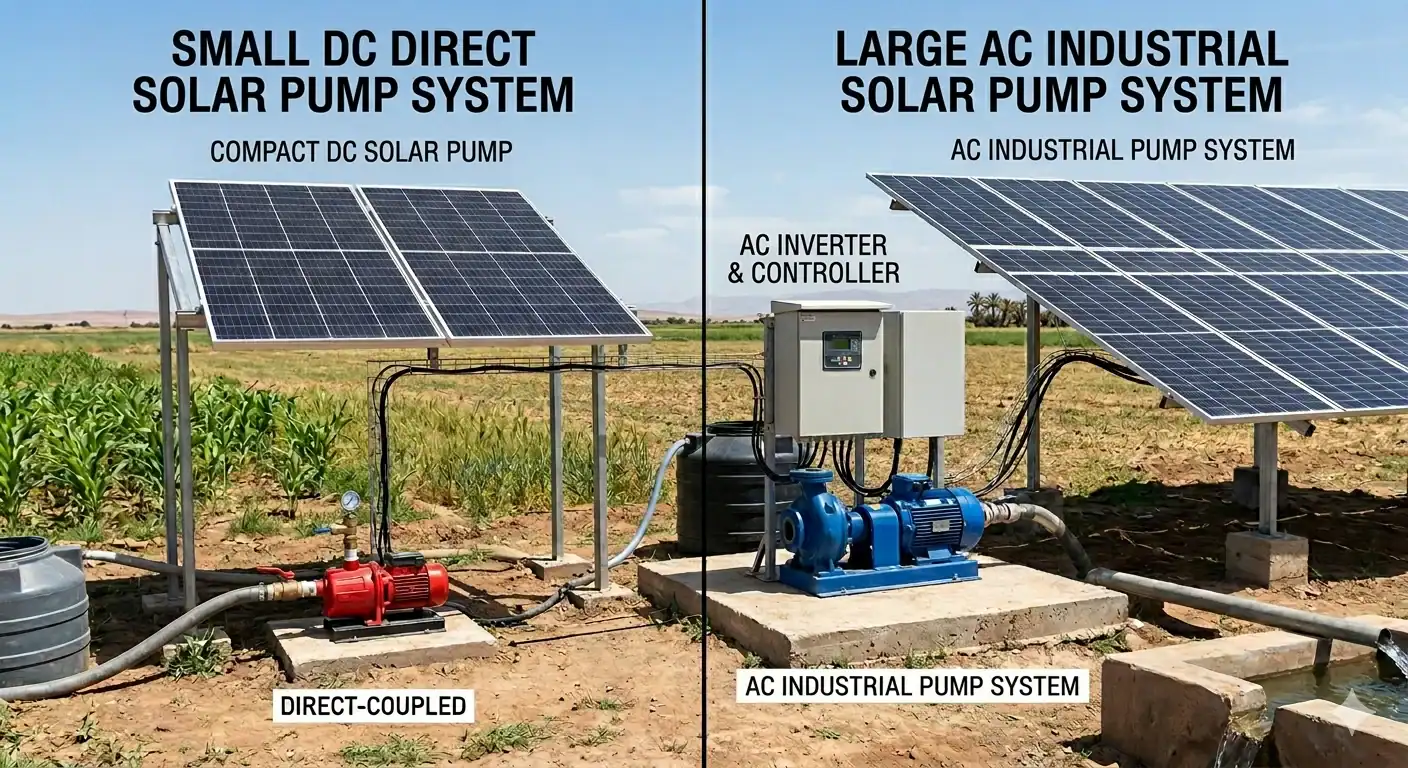
Written by Marcus Chen, MS Agricultural Engineering — Fact Checked on June 5, 2026. Marcus has 14 years of field experience specifying, installing, and troubleshooting both AC and DC solar pumping systems across the US Midwest, Australia, and sub-Saharan Africa. This technical comparison was reviewed against manufacturer specifications from Grundfos, Lorentz, Franklin Electric, and RPS, plus field data from 200+ installations.
The $10,000 Mistake
Buy the wrong pump technology for your farm, and you will pay for it every sunny day for the next 20 years.
A DC pump on a large deep-well system means undersized flow, frustrated crops, and a premature $2,000 replacement. An AC pump on a small shallow system means 30% more panels, a $600 inverter you did not need, and complexity that breaks down when you are 40 miles from the nearest technician.
The choice between AC and DC is not ideological. It is mathematical. This article gives you the numbers, the decision matrix, and the field-tested rules that separate the right choice from the expensive one.
DC vs AC: The Technical Difference
| Feature | DC (Brushless/BLDC) | AC (Induction + VFD) |
|---|---|---|
| Efficiency (panel to water) | 85–90% | 70–75% (after inverter losses) |
| Panels needed for same output | 100% (baseline) | 120–130% (20–30% more) |
| Controller required | MPPT controller (included) | Inverter + VFD (\$400–\$1,200 extra) |
| Pump lifespan | 25,000–30,000 hours | 15,000–20,000 hours |
| Upfront cost (same HP) | 10–20% higher | Baseline |
| Maintenance | Minimal (no brushes, no inverter) | VFD checks, capacitor replacement |
| Soft‑start capability | Native (DC ramp) | Requires VFD (+\$400–\$800) |
| Grid fallback | Not possible without hybrid inverter | Direct grid connection |
| Best application | Small–medium farms, shallow–moderate wells | Large farms, deep wells, grid‑tied |
Sources: SolarBatteryNet field analysis, DIFFUL pump specifications, RPS Solar Pumps technical data.
The efficiency gap is real. A DC pump converts 85–90% of panel energy into water flow. An AC pump loses 15–25% in the inverter conversion from DC (panels) to AC (motor), then another 5–10% in the VFD if soft-start is needed. The result: an AC system needs 20–30% more panels for the same daily water output.
But efficiency is not the only variable. DC pumps excel in simplicity and longevity. AC pumps excel in power and flexibility. The right choice depends on your farm’s scale, well depth, and technical requirements—not on which technology is “better” in a lab.
Which for Your Farm? The Decision Matrix
| Your Situation | DC (Recommended) | AC (Recommended) |
|---|---|---|
| Farm size | 1–10 acres | 10+ acres |
| Well depth | Shallow to moderate (<50 m) | Deep (>50 m) |
| TDH | <60 meters | >60 meters |
| Pump HP needed | 0.5–3 HP | 3–15 HP |
| Existing pump | New installation | Retrofitting existing AC pump |
| Grid access | Off‑grid preferred | Grid‑tied or hybrid desired |
| Technical skill | Limited (simpler system) | Higher (can manage VFD) |
| Budget priority | Long‑term savings (lower O&M) | Lower upfront cost |
Scenario A: Small Farm (2 acres, 15m well, 0.5 HP)
DC wins. You need 2 panels (1.1 kW) vs. 3 panels (1.5 kW) for AC. No inverter. No VFD. No maintenance beyond annual panel cleaning. The 20% higher pump cost ($850 vs. $700) is recovered in Year 2 from avoided inverter cost and reduced panel count.
Scenario B: Large Farm (20 acres, 80m well, 5 HP)
AC wins. A 5 HP DC pump exists but is expensive, specialized, and harder to service. A 5 HP AC pump with VFD is standard, available from every agricultural supplier, and handles the 80m head with proven reliability. The extra 4 panels ($800) are trivial compared to the $3,000 premium for a large DC pump and the risk of limited local service.
Scenario C: Existing AC Pump Retrofit
AC wins—always. If you have a functional 3-phase AC submersible pump in your well, the cheapest solar conversion is a VFD + solar inverter, not a full pump replacement. Keep the pump. Add solar. Save $2,000–$4,000 in well work and pump extraction.
25-Year Cost Reality
| Cost Category | Small Farm (DC, 2 acres) | Small Farm (AC, 2 acres) | Large Farm (DC, 20 acres) | Large Farm (AC, 20 acres) |
|---|---|---|---|---|
| Pump | \$850 | \$700 | \$4,500 | \$2,800 |
| Controller/Inverter | \$450 (MPPT) | \$850 (inverter + VFD) | \$1,200 (MPPT) | \$1,800 (inverter + VFD) |
| Panels (550W) | 2 panels (\$650) | 3 panels (\$975) | 18 panels (\$5,850) | 23 panels (\$7,475) |
| Installation | \$1,200 | \$1,400 | \$4,500 | \$4,200 |
| Maintenance (25 yr) | \$800 | \$1,400 | \$2,800 | \$4,500 |
| Replacement (pump) | \$850 (Year 18) | \$700 (Year 12) | \$4,500 (Year 15) | \$2,800 (Year 10) |
| TOTAL 25‑YEAR | \$4,800 | \$6,025 | \$23,350 | \$23,575 |
| Winner | ✅ DC | — | ⚖️ Tie | — |
Key insight: DC wins decisively at small scale. At large scale, the higher DC pump cost and limited service network erase the efficiency advantage. The break-even point is approximately 3–5 HP depending on local service availability and panel prices.
4 Myths Debunked
Myth 1: “DC pumps don’t need a controller”
False. Every DC solar pump needs an MPPT controller to match panel voltage to motor demand. The difference: a DC MPPT controller is $150–$400 and lasts 15–20 years. An AC inverter + VFD is $400–$1,200 and needs capacitor replacement every 8–10 years. Both need controllers. DC’s is cheaper and simpler.
Myth 2: “AC only needs 2 extra panels”
False. The 20–30% panel penalty is real. For a 5-acre system needing 7 panels with DC, AC requires 9–10 panels. At $325 per 550W panel, that is $650–$975 extra—not “two panels” in a small system, but a 30% array expansion in a large one. The cost adds up faster than most installers admit.
Myth 3: “DC is always cheaper long-term”
False above 3–5 HP. Large DC pumps (5+ HP) are niche products with limited manufacturers, higher prices, and restricted service networks. The 25-year maintenance savings from DC efficiency are consumed by the upfront premium and the risk of extended downtime if the pump fails in a remote region with no DC technician.
Myth 4: “AC pumps can’t run on solar”
False. Variable Frequency Drives (VFDs) have made AC solar pumps standard for large systems since 2018. A VFD converts DC solar power to variable-frequency AC, soft-starts the motor (extending lifespan 30%), and maintains constant pressure regardless of solar intensity. The technology is mature, proven, and dominates the agricultural market above 5 HP.
Conclusion
| If You Have… | Choose… | Because… |
|---|---|---|
| 1–5 acres, well <30m, new install | DC | Simpler, cheaper long‑term, no inverter |
| 5–10 acres, well 30–60m, moderate budget | DC or AC | Either works; DC if off‑grid, AC if grid‑tied |
| 10+ acres, well >60m, existing AC pump | AC | Power, serviceability, retrofit savings |
| Grid‑tied farm, hybrid desired | AC | Direct grid fallback, no battery needed |
| Remote location, limited service | DC | Fewer failure points, longer lifespan |
The AC vs. DC debate is not a religious war. It is a sizing exercise. Small systems favor DC’s simplicity and efficiency. Large systems favor AC’s power and serviceability. The wrong choice costs $2,000–$10,000 over 25 years. The right choice is a 30-second lookup in the matrix above.
Frequently Asked Questions (FAQ)
Q: Which is more efficient: AC or DC solar water pump?
DC solar water pumps are 20–30% more efficient than AC pumps because they eliminate inverter losses. DC pumps convert 85–90% of panel energy directly into mechanical power, while AC pumps lose 15–25% in the DC-to-AC inverter conversion, plus an additional 5–10% if a Variable Frequency Drive (VFD) is used for soft-start. This means an AC system typically requires 20–30% more solar panels for the same water output. However, AC pumps with VFD offer advantages in large systems (5+ HP), deep wells (>60m), and grid-tied applications where their power and flexibility outweigh the efficiency penalty.
Q: Can I convert my existing AC pump to solar?
Yes, existing AC submersible pumps can be converted to solar using a solar inverter combined with a Variable Frequency Drive (VFD). This is often the most cost-effective approach for farms with functional AC pumps in deep wells, as it avoids the $2,000–$4,000 cost of pump extraction and replacement. The VFD converts DC solar power to variable-frequency AC, soft-starts the motor (extending lifespan by 30%), and maintains consistent pressure. For pumps 3 HP and above, AC retrofit with VFD is typically preferred over DC replacement due to lower upfront cost and wider service availability.
Q: Do DC solar pumps need batteries?
No, DC solar pumps do not need batteries for standard irrigation applications. They operate directly from solar panels through an MPPT controller, which matches the panel output to the pump’s motor requirements. Water storage (tank or reservoir) serves as the ‘battery’—the pump fills the tank during sunlight hours, and the tank supplies irrigation by gravity or pressure when the pump is off. Batteries are only needed if night-time or cloudy-day pumping is essential and cannot be met by tank storage. For most agricultural irrigation, a properly sized tank (2–3 days of peak demand) eliminates battery cost and complexity entirely.
© 2026 Solar Panels for Farms. This article is regularly updated to reflect current market data. Last verified: June 8, 2026.