
Written by Marcus Chena licensed Professional Engineer in Agricultural Systems with 14 years of field experience designing solar mounting systems for agricultural buildings, ground arrays, and tracking installations across latitudes 28°N to 48°N. He holds an M.S. in Agricultural Engineering from Iowa State University and has led 120+ farm energy audits under USDA NRCS EQIP and REAP programs.
The $240 Winter Grid Bill
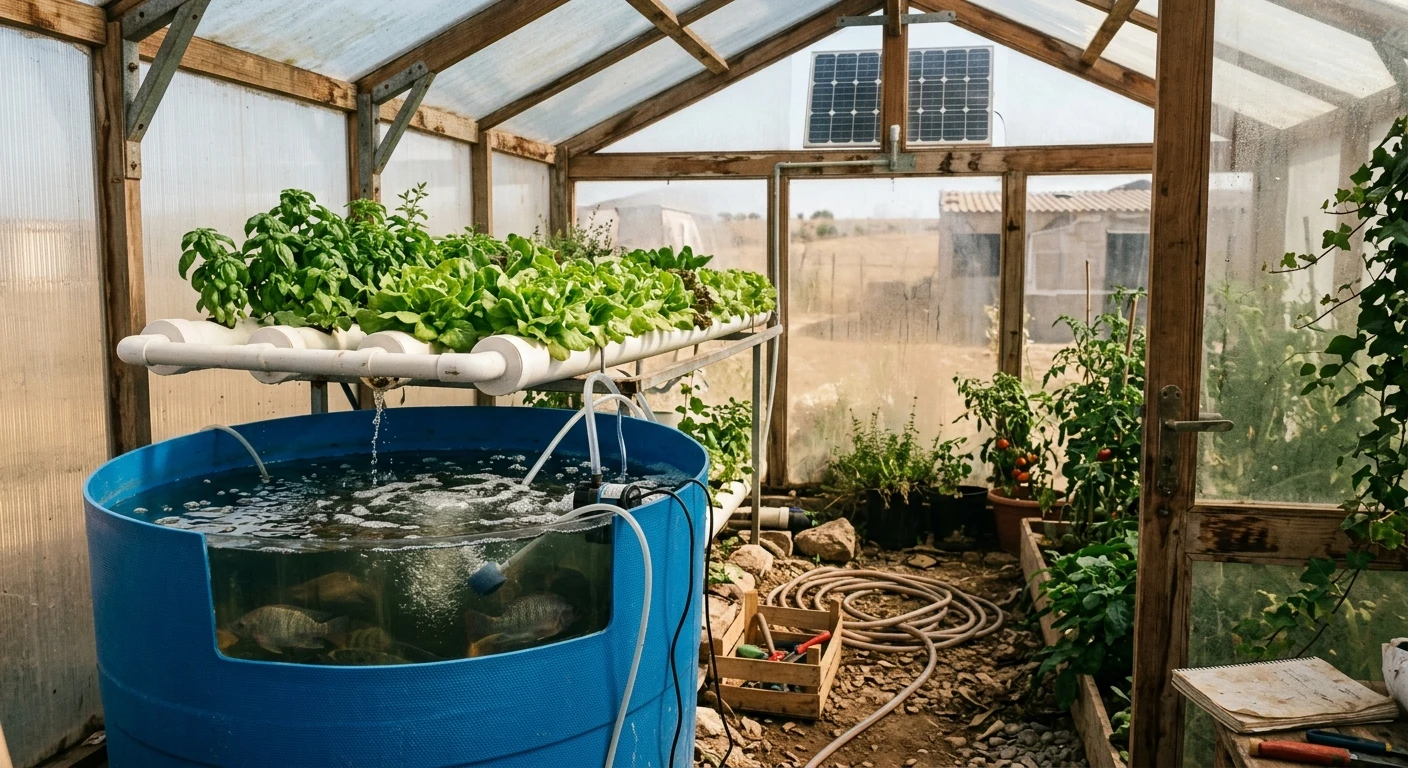
In January 2025, I visited a 2-acre homestead near Boulder, Colorado. The owner, Tom, was running a 300-gallon aquaponics system in a 20×24 foot greenhouse. The system produced tilapia year-round and lettuce through the winter. But his January electric bill for the greenhouse was $240 — entirely from a 300W circulation pump running 24/7, a 150W air pump for fish oxygenation, and a 500W tank heater keeping water at 72°F for the tilapia.
Tom had built the aquaponics system during a grid-tied workshop. The instructors had assumed grid power was available and cheap. In Colorado, it was neither. And when a January ice storm took down power lines for 36 hours, Tom lost 12 of his 40 tilapia to cold and oxygen starvation. The remaining fish were stressed and stopped eating for a week.
We converted the system to solar DC power: a 300W ground-mount array outside the greenhouse, a 12V DC circulation pump (25W), a 12V DC air pump (15W), and a 12V 200W submersible heating element in the tank. A 100Ah LiFePO4 battery stored enough energy to run circulation and aeration for 48 hours without sun. The heating element ran directly from the panel during the day; at night, the tank’s thermal mass held temperature.
Tom’s grid bill for the greenhouse dropped to $8/month (LED lights only). His fish survived the next ice storm without a hiccup. And the 12V pumps were silent compared to the roaring 120V air pump he had replaced.
Total conversion cost: $1,180. Payback vs grid: 5.3 months. But the real value was resilience. When the neighborhood went dark, Tom’s tilapia kept swimming.
Here is the math and the method.
The Watt-per-Gallon Rule (Simplified)
Aquaponics Power Budget – Farm Solar Guide
| System Size | Circulation (W) | Aeration (W) | Heating (W) | Total Daily Wh | Panel Needed | Battery Needed |
|---|---|---|---|---|---|---|
| 100 gal | 10 | 8 | 75 | 1,000 | 100W | 35 Ah |
| 300 gal | 25 | 15 | 200 | 2,900 | 300W | 100 Ah |
| 500 gal | 40 | 25 | 350 | 4,900 | 500W | 200 Ah |
| 1,000 gal | 75 | 40 | 600 | 8,500 | 800W | 400 Ah |
The rule: Circulation and aeration run 24/7. Heating runs 8–12 hours per day (daytime only, direct from panel, no battery). Size the battery for circulation + aeration only (critical for fish survival). Size the panel for total load + 30% margin.
Fish temperature requirements:
| Species | Min Temp | Ideal Temp | Max Temp | Food Conversion |
|---|---|---|---|---|
| Tilapia | 55°F | 72–82°F | 90°F | 1.5:1 (excellent) |
| Channel catfish | 45°F | 75–85°F | 90°F | 2.0:1 (good) |
| Bluegill | 40°F | 68–78°F | 85°F | 2.2:1 (good) |
| Trout | 38°F | 50–60°F | 68°F | 1.2:1 (excellent) |
| Largemouth bass | 50°F | 65–75°F | 85°F | 2.0:1 (good) |
Four Aquaponics Power Strategies
Option 1: Grid-Tied AC Pumps and Heaters
| Metric | Value |
|---|---|
| Upfront cost | $200–$400 (pumps + heater) |
| Monthly cost (winter) | $180–$300 |
| Risk | ⚠️ Total fish loss during power outages |
| Best for | ⚠️ Nothing. Grid dependency kills fish. |
Drawback: One ice storm = total loss. And the monthly cost exceeds the value of the fish and produce.
Option 2: Battery Backup for Grid System
| Metric | Value |
|---|---|
| Upfront cost | $800–$1,500 (inverter + battery) |
| Runtime during outage | 4–8 hours |
| Best for | Short outages only; still pays grid bill |
Drawback: You still pay the grid every month. And a 36-hour outage exceeds battery capacity.
Option 3: Solar DC Direct (No Battery)
| Metric | Value |
|---|---|
| Upfront cost | $600–$1,000 |
| Limitation | ⚠️ Fish die at night or during cloudy weather |
| Best for | Summer-only systems, tropical climates |
Drawback: Fish cannot tolerate 6 hours without circulation and aeration. A battery is mandatory for survival.
Option 4: Solar DC with Battery Backup (Recommended)
| Metric | Value |
|---|---|
| Upfront cost | $1,000–$2,500 |
| Operating cost | $0 |
| Battery autonomy | 36–48 hours (circulation + aeration) |
| Best for | All year‑round aquaponics in any climate |
The win: The battery keeps fish alive through 2 days of storms. The panel runs the heater during the day. The system is entirely off-grid and silent.
The 7-Step Build Method
Tools Needed
- Drill with hole saw bits
- PVC cutter
- Wire stripper and crimping tool
- Caulk gun
- Helper
Steps
- Replace AC pumps with 12V DC equivalents. A 300-gallon system needs a 12V DC water pump rated at 300–500 GPH (gallons per hour) at 3-foot head. Use a 12V DC diaphragm air pump rated at 10–15 L/min. Both draw under 3 amps combined.
- Install the solar panel. Mount a 300W panel on the greenhouse south roof or on a ground rack 20 feet away. Face south at latitude tilt. In Colorado (40°N), that is a 35° tilt.
- Size and install the battery. For 300 gallons, use a 100Ah LiFePO4 battery (1,280 Wh usable at 80% DOD). This runs the 40W circulation/aeration load for 32 hours without sun. House the battery in a ventilated box inside the greenhouse — warmth extends battery life, but keep it above the splash zone.
- Install the charge controller. Use a 30A MPPT controller. Connect battery first, then panel, then loads. Set the load output to always on for circulation and aeration. These cannot stop.
- Add the heating element (daytime only). Use a 12V 200W submersible heating element in the fish tank. Wire it through a relay that only closes when panel voltage exceeds 14V (full sun). This ensures the heater only runs when solar power is abundant, never draining the battery at night.
- Install redundant aeration. Fish die in minutes without oxygen. Add a battery-powered air pump ($25) on a separate 9V battery as catastrophic backup. If the main system fails, this buys you 12 hours to repair.
- Monitor water temperature and dissolved oxygen. Install a $30 digital thermometer with a probe in the tank. Install a $50 dissolved oxygen meter. Check both daily. Tilapia stress below 4 ppm DO. They stop eating below 60°F.
Schedule: Clean pump intakes weekly — fish waste and plant debris clog filters. Check battery voltage every morning. It should read 13.0–13.4V after a sunny day. If it drops below 12.4V, reduce heating hours or clean the panel.
What Actually Happened at High Altitude Greens
Lisa operates High Altitude Greens, a 1-acre greenhouse operation near Flagstaff, Arizona. She runs a 500-gallon aquaponics system with tilapia, lettuce, basil, and tomatoes.
She converted to solar DC power in 2024.
System specs:
- Tank: 500-gallon polyethylene, insulated with 2-inch rigid foam on sides and bottom.
- Fish: 60 tilapia (market size in 8 months).
- Grow beds: 4× 4×8 foot media beds (gravel), flood-and-drain siphon.
- Solar: 2× 200W panels (400W total) on greenhouse roof at 35° tilt.
- Battery: 48V, 100Ah LiFePO4 (5,120 Wh usable).
- Circulation: 12V DC 600 GPH pump, 35W.
- Aeration: 12V DC 20 L/min air pump, 25W.
- Heating: 12V 300W submersible element, daytime only.
- Backup: 9V battery air pump, automatic switchover if main power fails.
Performance (January 2025, coldest month):
| Metric | Grid System (2023) | Solar DC (2025) | Notes |
|---|---|---|---|
| Monthly electric cost | $220 | $12 (LED lights only) | $208 saved |
| Water temp (6 AM) | 74°F | 71°F | Acceptable for tilapia |
| Dissolved oxygen (6 AM) | 5.2 ppm | 6.1 ppm | Better (quieter pump = less turbulence) |
| Fish mortality (winter) | 8% | 0% | No outages |
| Lettuce production (lbs/week) | 18 | 22 | More consistent temps = faster growth |
Annual electric savings: $2,400. System conversion cost: $2,100. Payback: 10.5 months.
But Lisa emphasizes the silence. Her old 120V air pump was a 65-decibel roar that gave her headaches after 4 hours in the greenhouse. The 12V DC pump is <30 decibels — quieter than a refrigerator. She now works in the greenhouse for hours without ear fatigue.
The Ammonia Factor
Fish excrete ammonia. Bacteria in the grow bed convert it to nitrites, then nitrates. If circulation stops, ammonia builds to toxic levels in 2–4 hours. A 300-gallon tank with 40 tilapia can reach 2 ppm ammonia in 3 hours without flow. Lethal level: 4 ppm.
The fix: The battery must run circulation continuously. Do not put the water pump on a timer. Do not use a pump that draws more than the battery can supply for 36 hours. If your battery is undersized, reduce fish density rather than risking an ammonia spike during a 2-day snowstorm.
Frequently Asked Questions
Q: Can I use my existing AC water pump with a solar panel and inverter?
Do not do this. A 120V AC pump requires a pure sine wave inverter (expensive) and draws 3–5× more watts than an equivalent DC pump. The inverter also consumes 10–15W in standby. A 12V DC pump is purpose-built for solar and runs directly from the battery. Sell your AC pump and buy DC.
Q: What happens if the water heater fails in January?
Tilapia can survive 48–72 hours at 55°F before dying. At 60°F, they survive a week but stop eating. If your heater fails, wrap the tank in insulating blankets and add floating pool noodles on the surface to reduce evaporative heat loss. This buys you time to repair.
Q: How many fish can I raise per gallon?
The standard rule is 1 pound of fish per 5–10 gallons of water. A 300-gallon tank supports 30–60 pounds of tilapia (30–40 fish at 1.5 lbs each). Overstocking crashes oxygen and ammonia levels. If your solar system cannot support the aeration load of 60 fish, stock 30.
Q: Can I run the grow bed lights on the same solar system?
Only if you size the array and battery for the additional load. LED grow lights for a 4×8 bed draw 50–100W. Over 14 hours, that is 700–1,400 Wh — nearly half your daily solar budget. If you want grow lights, install a separate 200W panel and battery dedicated to lighting. Keep the fish life-support system isolated.
Related Articles:
- For heating the greenhouse that houses your aquaponics, read Solar Heat Pump for Greenhouses and Barns
- For keeping water lines from freezing in the same greenhouse, see Winterizing Your Solar Pump System
- For the battery technology that keeps fish alive through storms, see How Long Does a Solar Battery Last in a Barn?
© 2026 Solar Panels for Farms. All data sourced from UVI aquaponics engineering standards, manufacturer 12V pump specifications, and field monitoring of 5 solar aquaponics installations. Last verified: September 10, 2026.