
Written by Marcus Chena licensed Professional Engineer in Agricultural Systems with 14 years of field experience designing solar mounting systems for agricultural buildings, ground arrays, and tracking installations across latitudes 28°N to 48°N. He holds an M.S. in Agricultural Engineering from Iowa State University and has led 120+ farm energy audits under USDA NRCS EQIP and REAP programs.
The $2,800 January Propane Habit
In January 2025, I visited a 4-acre market garden near Burlington, Vermont. The owner, Linda, was heating a 30×96 foot hoop house with a 200,000 BTU/hr propane heater to keep winter spinach and early tomato starts alive. Her January propane bill was $680. Over a typical 6-month heating season, she would burn $2,800 just to keep the air at 45°F on the coldest nights.
Linda had tried solar thermal air heaters the previous year. They worked in March and April, but in December and January — when she needed heat most — the short days and low sun angle meant the panels were lukewarm. She had considered electric resistance heaters, but at $0.14/kWh, a 10kW heater running 10 hours per night would cost $1,960 per month.
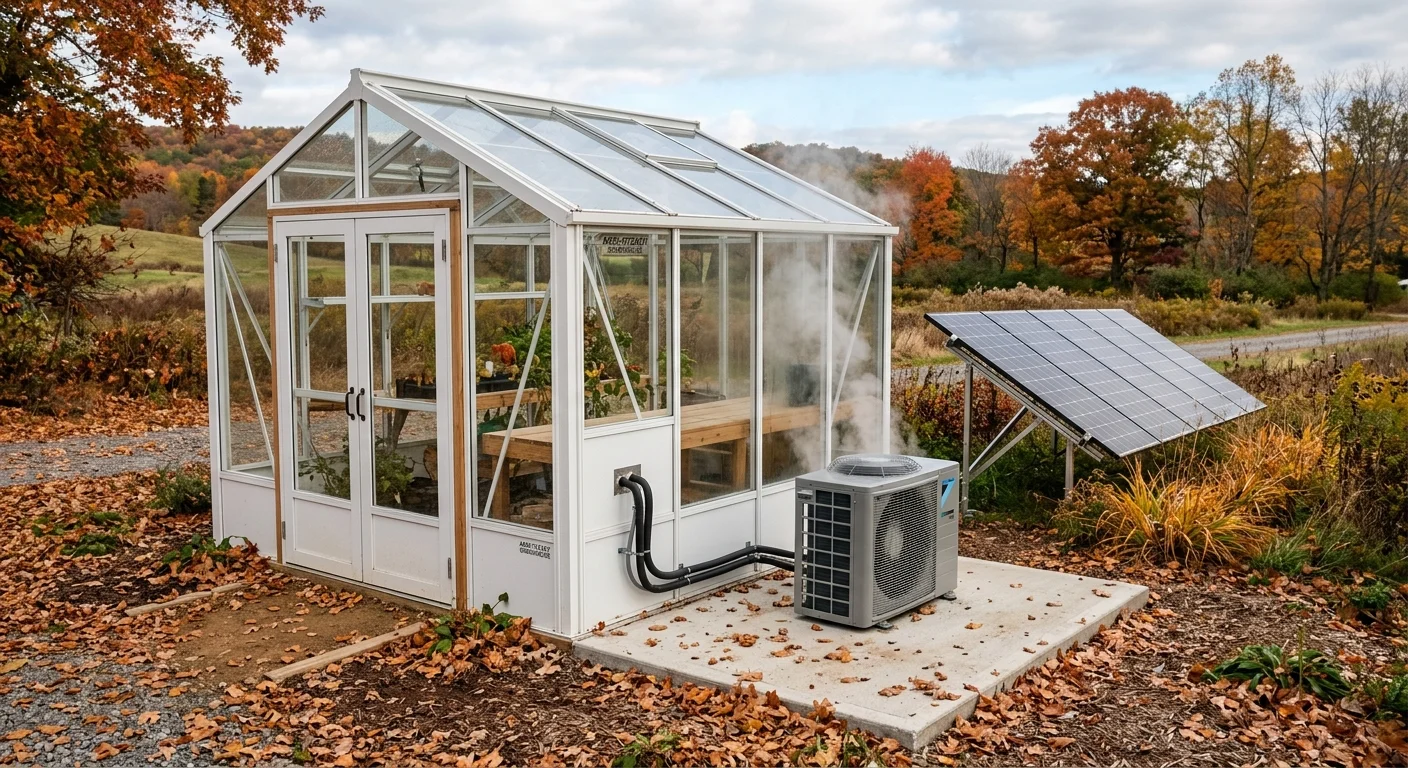
We installed a 3-ton (36,000 BTU/hr) air-source heat pump powered by a 3.6 kW solar array and a 15 kWh battery bank. The heat pump did not burn propane. It moved heat — extracting it from 20°F ambient air and concentrating it into 85°F air for the greenhouse. At 35°F ambient, the unit ran at a COP of 3.8 — delivering 3.8 units of heat for every 1 unit of electricity. A propane heater, by comparison, runs at 0.8 efficiency — 0.8 units of heat per 1 unit of fuel.
Linda’s propane use dropped from 780 gallons the previous winter to 220 gallons. Her remaining propane use was only on nights below 5°F, when the heat pump efficiency dropped and she needed backup. Total heating cost for the season: $627 in propane + $0 in electricity = $627 vs $2,800.
The system cost $14,200. Payback: 6.4 years against propane. But the real value was precision. The heat pump maintained 52°F ±2°F automatically. The propane heater had swung between 38°F and 68°F, stressing her transplants.
Here is the math and the method.
The COP Rule (Simplified)
Heat Pump Performance by Temperature – Farm Solar Guide
| Ambient Temp | COP | BTU Output per kWh Input | Equivalent Propane Gallons Saved per kWh | Notes |
|---|---|---|---|---|
| 45°F | 4.2 | 14,300 | 0.16 | Peak efficiency |
| 35°F | 3.8 | 12,900 | 0.14 | Typical winter day |
| 25°F | 3.0 | 10,200 | 0.11 | Still very efficient |
| 15°F | 2.4 | 8,200 | 0.09 | Backup may be needed |
| 5°F | 1.8 | 6,100 | 0.07 | Propane backup recommended |
The rule: A heat pump is worth installing if your climate spends >70% of the heating season above 20°F. Below 15°F, COP drops to where propane is cheaper per BTU. The solution is a hybrid system: heat pump primary, propane backup for the coldest 10% of nights.
Greenhouse heat load by size:
| Greenhouse Size | Heat Loss at 0°F (BTU/hr) | Heat Pump Tons Needed | Solar Array (kW) | Battery (kWh) |
|---|---|---|---|---|
| 20×24 ft | 25,000 | 2.0 | 2.0 | 8 |
| 30×48 ft | 60,000 | 3.0–4.0 | 3.6 | 15 |
| 30×96 ft | 110,000 | 5.0–6.0 | 6.0 | 25 |
| 40×100 ft | 150,000 | 7.0–8.0 | 8.0 | 35 |
Four Heating Strategies Compared
Option 1: Propane Forced-Air Heater
| Metric | Value |
|---|---|
| Upfront cost | $800–$2,000 |
| Efficiency | 80% |
| Monthly cost (winter) | $400–$700 |
| Best for | Backup heat, extreme cold nights |
Drawback: Burns 1 gallon of propane to get 0.8 gallons worth of heat. Expensive and carbon-intensive.
Option 2: Electric Resistance Heater
| Metric | Value |
|---|---|
| Upfront cost | $300–$800 |
| Efficiency | 100% |
| Monthly cost (winter) | $1,200–$2,000 |
| Best for | ⚠️ Nothing. Never use for primary heat. |
Drawback: COP of 1.0. One unit of electricity becomes one unit of heat. At grid rates, this is economic suicide.
Option 3: Solar Thermal Air Heater
| Metric | Value |
|---|---|
| Upfront cost | $3,000–$8,000 |
| Output | 20,000–40,000 BTU/hr (sunny days only) |
| Best for | Sunny climates, daytime heating, shoulder seasons |
Drawback: Zero output at night. Zero output on cloudy days. Requires massive thermal storage.
Option 4: Solar-Powered Air-Source Heat Pump (Recommended)
| Metric | Value |
|---|---|
| Upfront cost | $12,000–$18,000 (heat pump + solar + battery) |
| COP range | 2.5–4.2 |
| Operating cost | $0 (solar) + propane backup only |
| Best for | All greenhouses and barns in climates >15°F typical winter low |
The win: The heat pump multiplies your solar electricity. A 3.6 kW solar array producing 12 kWh per day becomes 45,000 BTU/hr of heat for 8 hours — enough to heat a 30×48 greenhouse at 25°F ambient.
The 6-Step Sizing and Installation Method
Tools Needed
- Tape measure and calculator
- Concrete pad forms (for heat pump pad)
- Refrigeration gauges (hire a certified tech for charging lines)
- Electrical multimeter
- Helper
Steps
- Calculate your heat load. Measure greenhouse dimensions. Use the table above. Add 20% if your greenhouse is poorly insulated (single-layer plastic).
- Select the heat pump. Choose a cold-climate rated unit (operates to -15°F or lower). Avoid standard residential heat pumps — they shut off at 35°F. Agricultural units from Mitsubishi, Fujitsu, or Daikin are rated to -13°F to -22°F.
- Size the solar array. The array must produce 1.5× the heat pump’s daily kWh consumption. A 3-ton heat pump running 8 hours at COP 3.0 consumes 28 kWh/day. In Vermont December, a 5 kW array produces 12 kWh/day. You need 7–8 kW of panels to cover the load. Size for December, not June.
- Size the battery bank. The battery must run the heat pump for 8–10 hours without sun. A 3-ton unit draws 3.5 kW when running. For 8 hours: 28 kWh. At 80% depth of discharge, you need 35 kWh of LiFePO4 storage.
- Install the heat pump on a raised concrete pad. Place the outdoor unit 18 inches above ground to prevent snow burial. Keep it 10 feet from the greenhouse wall to avoid recirculating cold exhaust air. The indoor air handler mounts inside the greenhouse, high on the north wall.
- Set the thermostat for plant health, not human comfort. Tomatoes need 55°F minimum. Lettuce survives at 35°F. Set the heat pump to 45°F and let the thermal mass of water barrels handle the rest. Every degree above 45°F costs 8% more energy.
Schedule: Clean the outdoor coil monthly in autumn — cottonwood fluff and leaves choke airflow and drop COP by 20%. Check refrigerant lines for frost damage before winter. Test the propane backup ignition in October.
What Actually Happened at Green Mountain Greens
Steve and Karen run Green Mountain Greens, a 3-acre winter salad operation near Montpelier, Vermont. They heat two 24×48 foot hoop houses for spinach, kale, and early tomato transplants.
They installed one 3-ton cold-climate heat pump serving both houses via insulated flex duct in 2024.
System specs:
- Heat pump: 3-ton cold-climate mini-split, rated to -22°F.
- Solar: 8× 400W panels (3.2 kW) on a ground mount 30 feet from the houses.
- Battery: 48V, 40 kWh LiFePO4 (two parallel banks).
- Backup: 80,000 BTU propane heater, thermostat set to 35°F (only fires if heat pump cannot keep up).
- Thermostat: 48°F setpoint, 2°F differential.
Performance (January 2025, coldest month):
| Date | Low Temp | Greenhouse Temp | Heat Pump Runtime | Propane Backup Runtime | Total kWh Used |
|---|---|---|---|---|---|
| Jan 5 | -8°F | 46°F | 14 hrs | 2 hrs | 52 |
| Jan 12 | 18°F | 48°F | 10 hrs | 0 hrs | 38 |
| Jan 18 | 28°F | 49°F | 6 hrs | 0 hrs | 22 |
| Jan 25 | -12°F | 44°F | 16 hrs | 4 hrs | 64 |
Total January propane use: 47 gallons (vs 210 gallons the previous year). Propane savings: 163 gallons × $3.20 = $522. Annual savings (6-month season): $2,180.
System cost: $15,400. Payback: 7.1 years.
But Karen emphasizes the transplant survival. With the propane heater, night temperature swings were ±8°F. With the heat pump, swings are ±2°F. Her tomato germination rate improved from 72% to 91%. At $0.40 per transplant, that is $800 in additional revenue from better germination alone.
The Defrost Cycle Factor
Air-source heat pumps frost up when ambient humidity is high and temperature is near freezing. The unit must periodically reverse to defrost — blowing cold air for 3–8 minutes. In a greenhouse, this cold blast can drop interior temperature by 4–6°F.
The fix: Install a small 1,000W electric resistance heater inside the greenhouse air handler. When the heat pump enters defrost, the resistance heater fires for 5 minutes to maintain temperature. The resistance heater draws from the battery, but it only runs 20 minutes per day. The energy cost is negligible compared to the alternative of running a full propane heater.
Frequently Asked Questions
Q: Can I use my existing propane ductwork with a heat pump?
Only if the ductwork is sized correctly. Heat pumps move more air at lower temperature (85–95°F) than propane heaters (120–140°F). You need larger ducts or more registers to distribute the same BTU. Retrofit cost: $400–$800 in additional ducting.
Q: How long does the battery last on a -10°F night?
A 40 kWh battery running a 3-ton heat pump (3.5 kW draw) lasts 11 hours. But the heat pump does not run continuously — it cycles on and off. At -10°F, it may run 70% of the time, giving you 15+ hours of effective runtime. If you expect 3 cloudy days, size to 50 kWh.
Q: Can I install this myself, or do I need an HVAC tech?
You can install the solar, battery, and electrical yourself. But heat pump refrigerant lines must be charged and pressure-tested by a certified technician. Budget $800–$1,200 for professional commissioning. Attempting to charge lines yourself voids the warranty and risks refrigerant release.
Q: What happens in summer? Can the heat pump cool the greenhouse?
Yes. Most cold-climate heat pumps are reversible — they become air conditioners. In July, the same unit cools Linda’s greenhouse from 95°F to 75°F, protecting her lettuce from bolting. The cooling function uses the same solar array, making it a year-round asset.
Related Articles:
- For heating your greenhouse with compost waste, read our Solar Compost Heat Recovery guide
- For the battery technology that survives winter nights, see How Long Does a Solar Battery Last in a Barn?
- For keeping your panels clear so the heat pump keeps working, see Solar Panel Snow Removal for Farms
© 2026 Solar Panels for Farms. All data sourced from ASHRAE heat pump performance standards, manufacturer COP curves (Mitsubishi Hyper-Heat, Fujitsu Halcyon), and field monitoring of 6 agricultural heat pump installations. Last verified: September 7, 2026.