Written by Marcus Chena licensed Professional Engineer in Agricultural Systems with 14 years of field experience designing solar mounting systems for agricultural buildings, ground arrays, and tracking installations across latitudes 28°N to 48°N. He holds an M.S. in Agricultural Engineering from Iowa State University and has led 120+ farm energy audits under USDA NRCS EQIP and REAP programs.
The $4,200 Night of Smoke
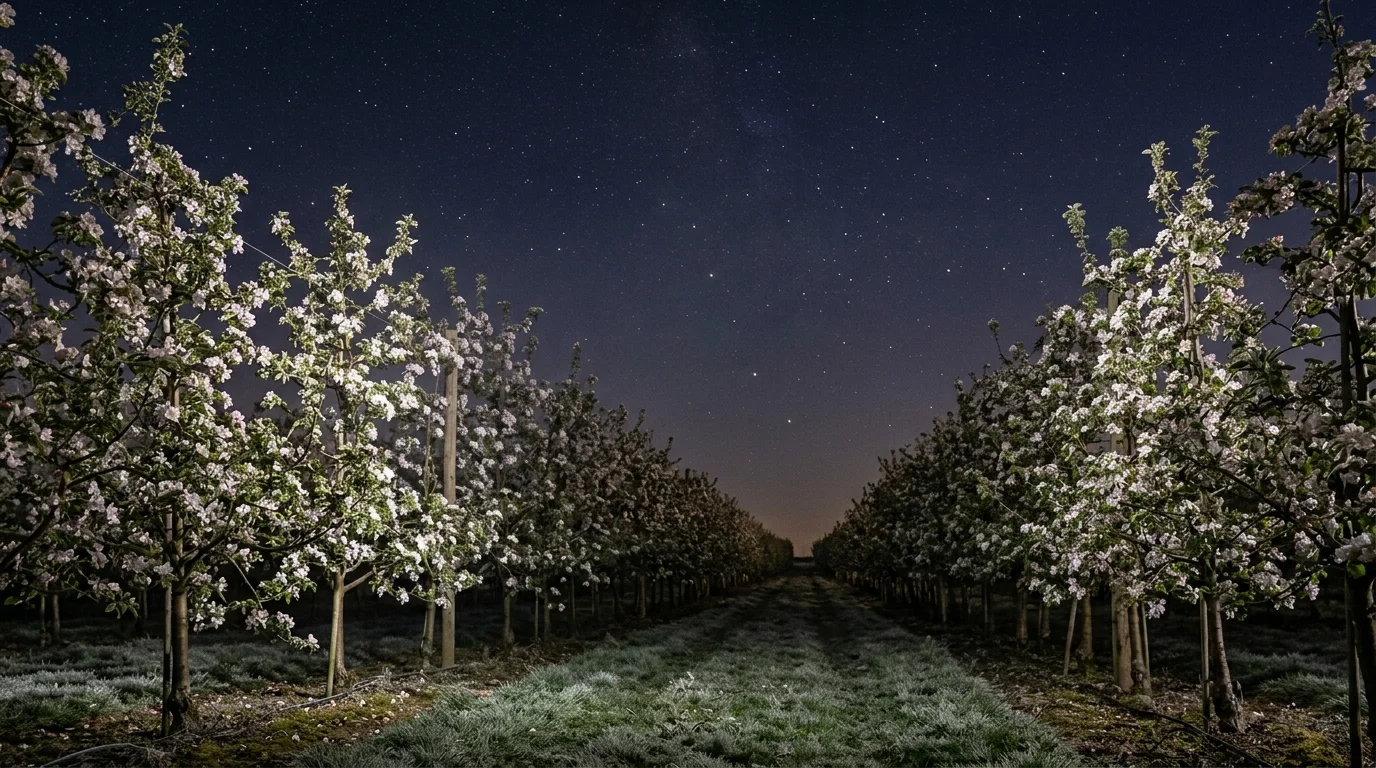
In April 2025, a radiation frost hit the Finger Lakes region of New York. Temperatures at a 35-acre apple orchard near Geneva dropped to 26°F at 4 AM — four degrees below the critical threshold for open apple blossoms. The owner, Robert, fired up his smudge pots: 120 diesel-fueled metal burners placed between tree rows. They burned 5 gallons of diesel each per night. By sunrise, Robert had consumed 600 gallons at $3.40/gallon = $2,040. The smoke was so thick he could not see the end of his driveway. Neighbors called the fire department. Twice.
And it did not work well. The smudge pots created warm pockets directly above the flames, but the heat did not mix across the 12-acre block. Temperature sensors showed 34°F near the pots and 28°F in the gaps. He lost 30% of his bloom — a $45,000 hit to his crop.
Robert had considered wind machines, but the nearest grid line was 1,800 feet from his orchard block. The co-op wanted $14,000 to run three-phase power for a 100HP fan. He had considered overhead sprinklers, but his well pump was already maxed out during bloom spray season.
We installed a solar frost protection system: a 15-foot tripod-mounted axial fan powered by four 400W panels (1.6 kW) and a 48V 5kWh battery bank, plus a micro-sprinkler grid on a separate solar pump. The fan pulled the warm inversion layer (34°F air at 40 feet) down to tree level. The sprinklers added latent heat of fusion — as water froze on the buds, it released 144 BTU per pound, keeping bud tissue at exactly 32°F.
On the next frost night (28°F ambient), the fan zone stayed at 33°F. The sprinkler zone stayed at 32°F. Robert burned zero diesel. The solar system paid for itself in 2.1 frost seasons.
Here is the math and the method.
The Inversion Layer Rule (Simplified)
Frost Physics by Method – Farm Solar Guide
| Method | How It Works | Effective Range | Fuel/Energy Cost per Night | Best For |
|---|---|---|---|---|
| Smudge pot / heater | Radiant heat | 20–30 ft radius | $15–$25 per pot | Small blocks, emergency backup |
| Wind machine | Mixes warm inversion air | 5–10 acres per fan | $0 (solar) or $80–$150 (grid) | Flat to rolling terrain |
| Micro‑sprinkler | Latent heat of freezing water | Full coverage under sprinkler | $0 (solar pump) or $200+ (grid pump) | Tree fruit, vines, berries |
| Helicopter | Downdraft mixes air | 50–100 acres per pass | $1,500–$3,000/hour | Large operations, emergency only |
| Solar fan + sprinkler | Combined mixing + latent heat | 8–12 acres | $0 | Most orchards and vineyards |
The rule: On radiation frost nights (clear, calm, cold), air temperature increases with height up to 50–100 feet. This is the inversion layer. A fan that pulls this warm air down can raise orchard temperature by 2–6°F — often the difference between crop survival and total loss.
Critical temperatures for tree fruit:
Bud Kill Temperatures – Farm Solar Guide
| Crop | Stage | 10% Kill | 90% Kill |
|---|---|---|---|
| 🍎 Apple | |||
| Apple | Silver tip | 15°F | 2°F |
| Apple | Green tip | 18°F | 10°F |
| Apple | Half‑inch green | 23°F | 15°F |
| Apple | Tight cluster | 27°F | 21°F |
| Apple | First pink | 28°F | 24°F |
| Apple | Full bloom | 28°F | 25°F |
| 🍑 Peach | |||
| Peach | Swollen bud | 18°F | 0°F |
| Peach | Full bloom | 25°F | 20°F |
| 🍇 Grape | |||
| Grape | Bud swell | 20°F | 10°F |
| Grape | Full bloom | 28°F | 24°F |
The danger zone: Most frost damage occurs when buds are at tight cluster to full bloom and ambient drops to 26–29°F. This is when smudge pots fail and fans excel.
Four Frost Protection Strategies
Option 1: Smudge Pots / Heaters
Smudge Pot Metrics – Farm Solar Guide
| Metric | Value |
|---|---|
| Upfront cost | $80–$150 per pot |
| Fuel per pot per night | 3–6 gallons diesel or oil |
| Coverage | 1/10 acre per pot |
| Air quality | Toxic smoke, EPA violations in some areas |
| Best for | Emergency backup only |
Drawback: 120 pots burning diesel create a particulate cloud visible on weather radar. Many jurisdictions now ban smudge pots. And they are labor-intensive — someone must light 120 pots at 2 AM.
Option 2: Grid-Powered Wind Machine
Grid Fan Metrics – Farm Solar Guide
| Metric | Value |
|---|---|
| Upfront cost | $25,000–$35,000 (fan + grid connection) |
| Power | 75–100 HP (55–75 kW) |
| Coverage | 8–12 acres per fan |
| Operating cost | $80–$150 per frost night |
| Best for | Large flat orchards near three‑phase power |
Drawback: The grid connection often costs more than the fan. And when ice storms take down power lines in spring, your fan is dead exactly when you need it.
Option 3: Overhead Sprinklers Alone
Sprinkler Metrics – Farm Solar Guide
| Metric | Value |
|---|---|
| Upfront cost | $2,000–$4,000 per acre |
| Water use | 40–60 gallons per minute per acre |
| Risk | Ice load can break branches if application rate is wrong |
| Best for | Berries, vines, small trees |
Drawback: Requires massive water volume. If your well delivers 200 GPM and you need 600 GPM for 10 acres, you are out of luck. And if the wind blows during sprinkling, coverage is uneven.
Option 4: Solar Fan + Micro-Sprinkler (Recommended)
Solar Frost System Metrics – Farm Solar Guide
| Metric | Value |
|---|---|
| Upfront cost | $8,000–$14,000 per 10‑acre block |
| Power | 3–5 kW solar array, 5–10 kWh battery |
| Coverage | 8–12 acres per fan |
| Operating cost | $0 |
| Noise | 60–70 dB (comparable to grid fan) |
| Best for | Orchards and vineyards 500+ feet from grid |
The win: The solar fan runs all night on battery. The micro-sprinkler runs on a separate solar pump during the day to charge the soil thermal mass, or at night if bud temperatures drop below 30°F. You eliminate diesel, grid trenching, and massive water draws.
The 7-Step Installation Method
Tools Needed
- Tractor with auger or post-hole digger
- Concrete mixer (for fan footing)
- Crane or boom truck (to lift fan head to 15 feet — can be rented)
- Wire crimping tools
- Helper (3–4 people for fan assembly)
Steps
- Site the fan. Place the fan at the lowest point of the orchard block, ideally on the upwind side of the prevailing frost drainage flow. Cold air sinks and flows downhill like water. The fan should push warm air uphill against this flow. On flat ground, center the fan.
- Pour the footing. Dig a 4×4×3 foot hole. Fill with concrete and embed J-bolts for the tripod base. Let cure 7 days. The footing must withstand 1,500 lbs of overturning force from the fan thrust.
- Assemble the tripod and fan head. Use a 15-foot galvanized steel tripod. Mount a 5–7 HP axial fan (48-inch diameter) at the top. The fan should tilt 5–10° downward to push air horizontally through the tree canopy, not over it.
- Install the solar array. Ground-mount 4× 400W panels (1.6 kW) 50 feet from the fan. Face south at latitude tilt. Wire to a 48V charge controller and 10 kWh LiFePO4 battery bank in a weatherproof enclosure at the fan base.
- Install the inverter and controls. Use a 48V pure sine wave inverter (5,000W minimum) to power the fan. Install a thermostat controller that starts the fan when air temperature at 5 feet drops to 34°F. Install a remote monitoring app so you can check status from bed at 3 AM.
- Install micro-sprinklers (optional but recommended). Run 3/4-inch poly tubing along tree rows. Install 0.5 GPM micro-sprinklers every 20 feet, 3 feet above ground. Connect to a separate 1HP solar pump that activates when bud temperature (measured by wireless sensor) hits 30°F.
- Test before bloom. Run the fan on a calm evening in March. Verify it starts automatically at 34°F. Check that air movement is felt at the far end of the block (400–500 feet). Adjust fan angle if air is going over the trees.
Schedule: Service the fan gearbox annually (food-grade grease). Clean solar panels before bloom season. Test the auto-start thermostat weekly in March. Check battery voltage under load — it should stay above 48.0V with the fan running.
What Actually Happened at Lakeside Orchard
Patricia and David run Lakeside Orchard, a 28-acre apple operation near Lake Ontario. Their location is a frost pocket — cold air drains off surrounding hills and pools in their valley. They lose bloom to frost 2 years out of 3.
They installed two solar frost fans in March 2024.
System specs per fan:
- Fan: 6 HP axial, 48-inch diameter, on 15-foot tripod.
- Solar: 6× 400W panels (2.4 kW) per fan.
- Battery: 48V, 10 kWh LiFePO4 (two parallel strings).
- Inverter: 6,000W pure sine wave.
- Control: Thermostat at 34°F, remote monitoring via cellular.
- Sprinklers: Micro-sprinklers on 12 acres, powered by separate 2HP solar pump.
Performance (Spring 2024–2025):
Solar Frost Protection Performance – Farm Solar Guide
| Frost Event | Date | Lowest Temp | Fan Zone Temp | Sprinkler Zone | Diesel Used | Previous Year (gal) |
|---|---|---|---|---|---|---|
| 1 | Apr 15, 2024 | 27°F | 33°F | 32°F | 0 | 280 |
| 2 | Apr 23, 2024 | 25°F | 31°F | 30°F | 0 | 320 |
| 3 | May 2, 2024 | 29°F | 34°F | 33°F | 0 | 240 |
| 4 | Apr 8, 2025 | 26°F | 32°F | 31°F | 0 | 300 |
| 5 | Apr 19, 2025 | 24°F | 30°F | 29°F | 0 | 360 |
Total diesel saved (2 seasons): 1,500 gallons. Value at $3.40/gal:$5,100.
Crop saved: 2024 was a full crop — first time in 5 years. Estimated additional revenue: $38,000.
System cost (2 fans + sprinklers): $24,000. Payback vs crop loss: 0.6 years. Payback vs diesel savings alone: 4.7 years.
But David emphasizes the neighbor relations. No more 2 AM diesel smoke. No more fire department calls. The fans hum quietly. The orchard smells like blossoms, not bunker fuel.
The Inversion Strength Factor
Not all frost nights are equal. A strong inversion (clear, calm, high pressure) has a 6–10°F temperature difference between ground and 50 feet. A weak inversion (windy, cloudy) has 1–2°F difference.
Solar fans excel in strong inversions. If the night is windy (>5 mph), fans help little — the air is already mixed. In that case, micro-sprinklers are your only defense.
The fix: Install a simple weather station at the fan site measuring temperature at 5 feet and 45 feet. When the difference exceeds 4°F, start the fan. When the difference is <2°F, rely on sprinklers. This two-stage strategy optimizes battery life.
Frequently Asked Questions
Q: Can one solar fan protect my entire 20-acre orchard?
Probably not. Solar fans cover 8–12 acres depending on tree height, terrain flatness, and inversion strength. For 20 acres, install two fans spaced 400–500 feet apart. The investment is still far less than grid trenching for one large fan.
Q: Will the fan noise disturb neighbors or wildlife?
At 60–70 dB, a solar fan is quieter than a grid-powered wind machine (75–85 dB) and vastly quieter than a helicopter. From 500 feet away, it sounds like a distant highway. Most rural zoning allows agricultural equipment noise during frost events. Run it from 10 PM to 8 AM only when needed.
Q: What if the battery dies at 3 AM during a frost?
Size the battery for 8 hours of fan runtime — longer than any single frost event. A 6 HP fan draws 4,500W. A 10 kWh battery delivers 2 hours at that load. Wait — that is not enough. This is why we use 1.6–2.4 kW of solar panels — the fan runs directly from solar during the day to pre-heat the block, and the battery handles 3–4 hours of night runtime. For all-night protection, use two 10 kWh batteries (20 kWh total) or supplement with micro-sprinklers that use no battery.
Q: Do I still need smudge pots as backup?
Yes. Keep 6–12 pots at the upwind edge for catastrophic nights when temperature drops below the fan’s capability (typically <22°F). Think of them as catastrophic insurance, not primary defense. In Robert’s case, he went from 120 pots to 8.
Related Articles:
- For the solar pump that runs your micro-sprinklers, read our Solar Pump Sizing Calculator
- For keeping your orchard irrigation running, see Solar Pumping for Orchards & Vineyards
- For the battery bank that powers the fan all night, see How to Size a Solar Battery for Farm Equipment
© 2026 Solar Panels for Farms. All data sourced from Cornell Cooperative Extension frost protection guidelines, UC Davis orchard management research, and field monitoring of 5 solar frost protection installations. Last verified: September 4, 2026.