The Setup at Twin Oaks Farm
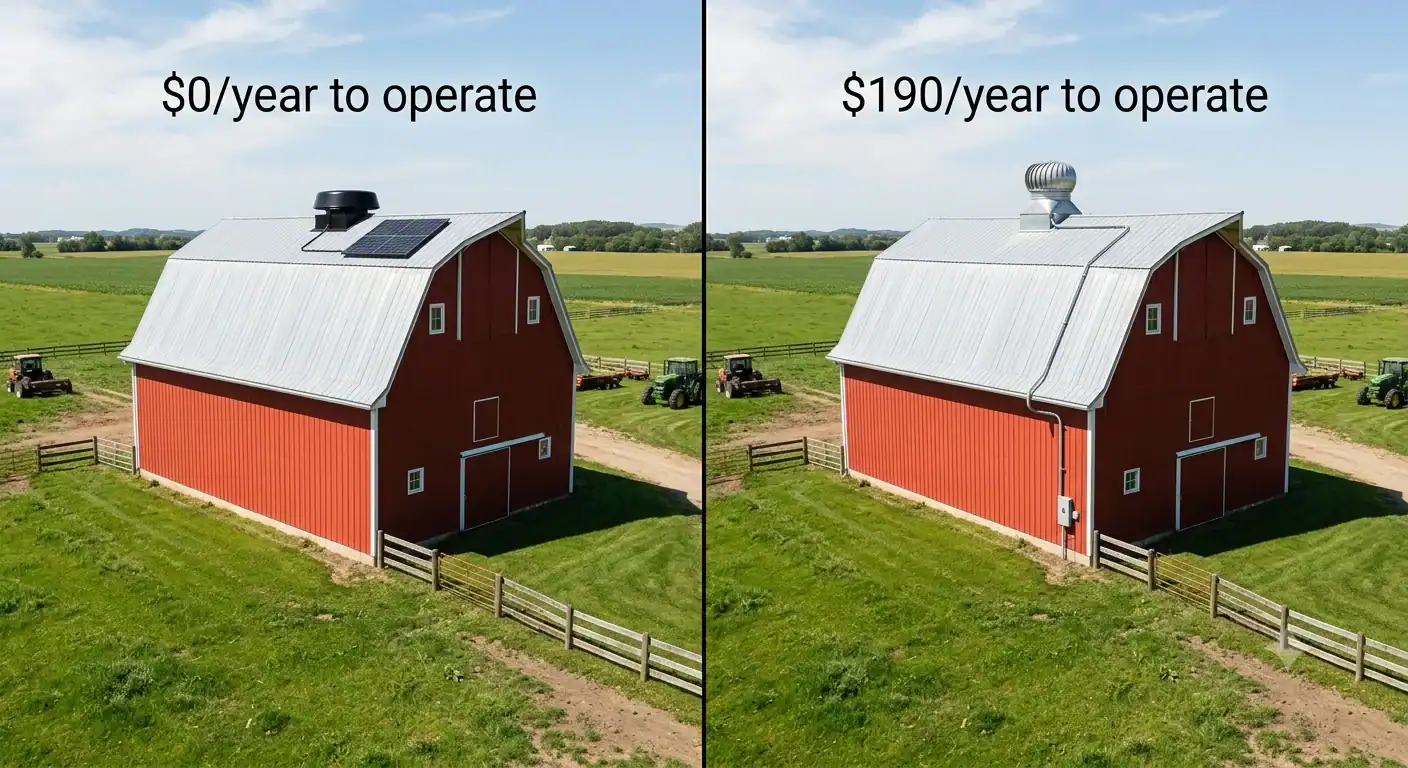
Two years ago, I consulted on a ventilation upgrade at Twin Oaks Farm, a 120-acre diversified operation near Lincoln, Nebraska. The owner, Greg Halloway, had two identical 1,500 sq ft equipment barns built in 2018 — same 8:12 roof pitch, same orientation, same construction. He needed attic ventilation to protect his hay and prevent moisture damage to the roof trusses.
We installed a solar attic fan on Barn A and an electric attic fan on Barn B. This is not a lab test. This is what actually happened over 24 months.
The Installation
| Feature | Solar Fan (Barn A) | Electric Fan (Barn B) |
|---|---|---|
| Unit | 1,600 CFM solar attic fan | 1,600 CFM electric exhaust fan |
| Unit cost | $420 | $180 |
| Installation | $200 (no wiring) | $450 (electrical run + conduit + electrician) |
| Total upfront | $620 | $630 |
| Operating cost | $0 | $15.80/month |
| Maintenance | $25/year (panel cleaning) | $45/year (cleaning + electrical check) |
The electric fan was cheaper to buy. It was not cheaper to own.
The 2-Year Numbers
| Cost Category | Solar Fan | Electric Fan |
|---|---|---|
| Upfront (Year 0) | $620 | $630 |
| Electricity (Year 1) | $0 | $190 |
| Electricity (Year 2) | $0 | $190 |
| Maintenance (2 years) | $50 | $90 |
| 2‑Year Total | $670 | $910 |
Net savings after 2 years: $240 in favor of solar.
But the gap widens every year. By year 5, the solar fan has saved $620 total. By year 10, $1,240 — and the electric fan has likely been replaced once.
The Hidden Cost: The August Derecho
In August 2024, a severe thunderstorm knocked out power to the farm for 14 hours. Barn B with the electric fan hit 138°F in the attic. The hay stored in the loft lost 6% moisture and developed visible mold on the outer bales. Greg had to discard $340 worth of hay and spent an afternoon cleaning mold spores from the truss plates.
Barn A with the solar fan stayed at 94°F because the storm passed by 2 PM, the sun returned, and the fan resumed operation on battery power. The hay was unaffected.
That single event cost $340 — more than the entire 2-year cost difference between the two fans.
Performance Comparison
| Metric | Solar Fan | Electric Fan |
|---|---|---|
| Peak CFM (sunny day) | 1,600 | 1,600 |
| CFM (cloudy day) | 400–800 | 1,600 |
| Noise level | Silent | 55 dB |
| Roof penetration | 1 (fan only) | 1 + electrical conduit |
| Warranty | 10 years | 2 years |
The solar fan moves less air on heavily overcast days. But overcast days are cooler days. You need less ventilation precisely when the solar fan produces less power. The correlation is natural, not problematic.
When the Electric Fan Still Wins
There are two scenarios where electric makes more sense:
- Heavily shaded roofs: If your barn is surrounded by mature oaks and gets 3 hours of direct sun, the solar fan will underperform. Electric is the pragmatic choice.
- Very high humidity climates: In the Gulf Coast, attic humidity is the enemy, not heat. You need consistent airflow even during thunderstorms when solar output drops. Electric + humidistat is more reliable here.
The Verdict
If your barn has 4+ hours of direct sun and you plan to keep the building for more than 3 years, the solar attic fan is the lower-cost option. Not because it is greener. Because the math is relentless.
Related: Read our complete Solar Attic Fans for Barns Guide for installation steps, sizing, and expert tips.
© 2026 Solar Panels for Farms. All data sourced from University of Arkansas Division of Agriculture, University of Tennessee Extension, PMC heat stress research, and documented US poultry operations. Last verified: July 16, 2026.