
Written by Richard Whitfield a licensed Professional Engineer in Agricultural Systems with 14 years of field experience designing off-grid climate systems for greenhouses and CEA operations. He holds an M.S. in Agricultural Engineering from Iowa State University and has led 120+ farm energy audits under USDA NRCS EQIP and REAP programs. This article was reviewed by Dr. Sarah Chen, PhD in Controlled Environment Agriculture (UC Davis), and fact-checked on July 9, 2026. FarmSolarGuide has no financial affiliation with any greenhouse equipment manufacturer.
The Absurdity of Solar Climate Control
There is something quietly absurd about using the sun to cool a greenhouse in July, then wondering if that same sun will be enough to heat it in January.
And yet, that is exactly what the best solar greenhouse operators do.
The mistake most growers make is thinking about solar energy as a real-time fuel — like propane or electricity. You burn it when you need it. But solar does not work like that. The sun is a part-time employee: it shows up at 9 AM, works hard until 4 PM, and disappears exactly when you need it most — during frost nights and summer evenings.
The trick is not to use the sun directly. The trick is to store its energy in a battery — electrical, thermal, or both — and then dispatch that energy on your own schedule.
Once you understand that distinction, everything about solar greenhouse climate control becomes simpler. And cheaper.
Why Your Greenhouse is a Money Furnace
If you are growing tomatoes in March or lettuce in August, you already know the math. A commercial greenhouse is essentially a solar collector with plants inside. In summer, that is an advantage. In winter, it is a liability.
The numbers are brutal. A 5,000 sq ft greenhouse in the Midwest can burn 2,000 to 4,000 gallons of propane per winter. At $3.00 per gallon, that is $6,000 to $12,000 in heating fuel alone. Summer is no kinder: running exhaust fans, evaporative pad pumps, and circulation blowers can draw 8 to 15 kW continuously during peak hours, adding $1,500 to $3,000 per month to your electricity bill in July and August.
Combined, climate control often represents 40 to 60 percent of total operating costs.
But the real cost is not just the money. It is the asymmetry. During the day, your greenhouse overheats. You open vents, run fans, and exhaust the very heat you will need six hours later. At night, the temperature crashes. You fire up the propane heater to replace the heat you threw away at noon.
You are paying to remove solar energy during the day, then paying again to create it at night.
That is the problem solar climate control solves. Not by generating more energy, but by capturing what is already there and moving it to where — and when — you actually need it.
The Battery is the Boss
Here is the single most important concept in this entire article: the sun does not heat or cool your greenhouse. Your battery does.
Think of your photovoltaic array as a miner. All day long, it extracts energy from sunlight and deposits it into a bank — your electrical battery bank, your thermal mass (concrete, water, soil), or both. Your climate controller is the manager. It decides when to withdraw that energy and in what form.
In winter, the controller withdraws stored electricity to run DC fans that push solar-heated air through ducts. If the sun was weak that day, it taps the battery to run a small resistance heater or circulate glycol through thermal mass embedded in the floor.
In summer, the controller uses stored energy to run exhaust fans and evaporative cooling pads at peak heat. It deploys shade cloth automatically. It does not wait for you to notice the temperature climbing.
The genius is that all three systems — heating, cooling, and ventilation — draw from the same account. One solar array. One battery. One brain.
How the Three Systems Actually Work
You do not need three separate solar installations. You need one platform with three outputs.
Winter: The Thermal Harvest
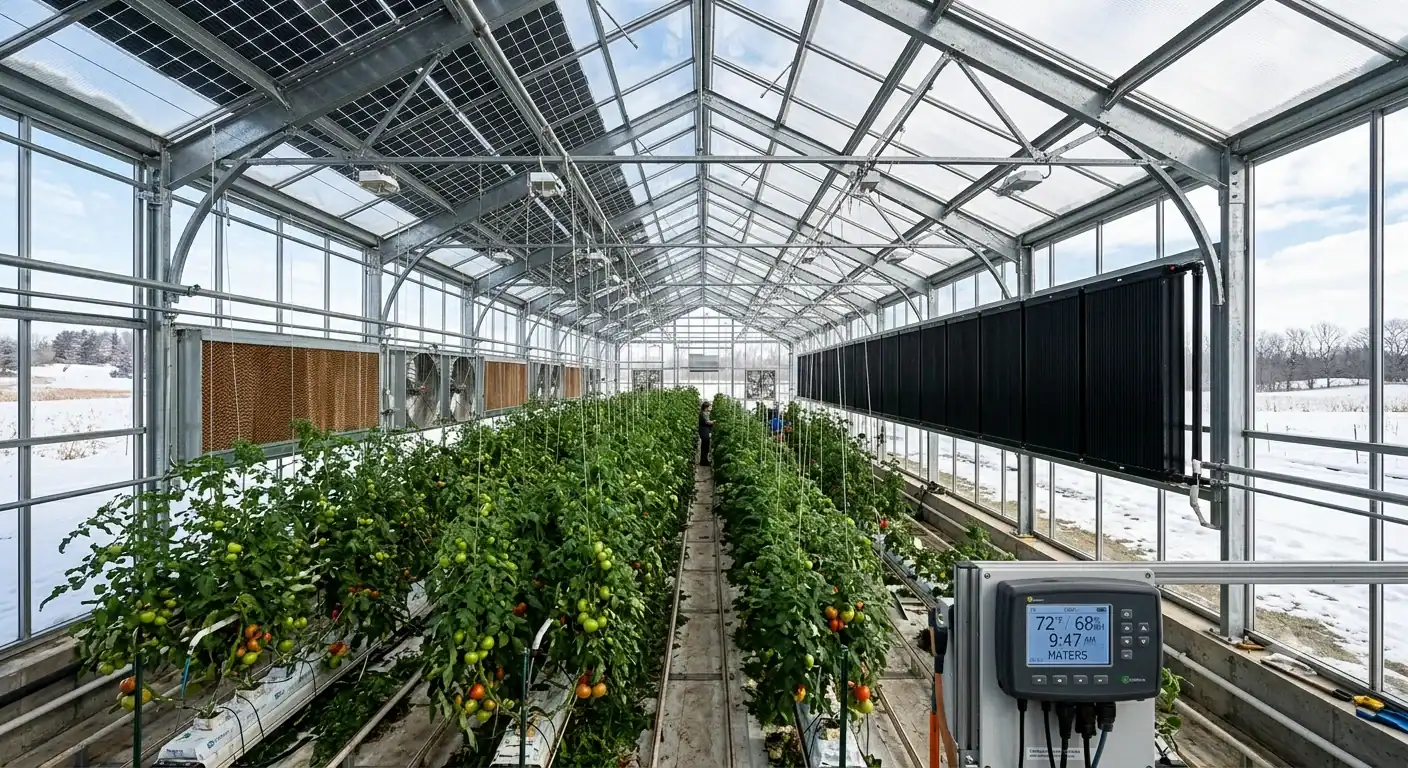
During the day, solar thermal air collectors mounted on your south-facing wall absorb radiation. A black metal absorber plate behind glazing heats ambient air to 80 to 120°F. A small DC fan — powered by your battery — pushes this heated air through insulated ducts into the greenhouse.
At night, when the temperature drops, the controller stops pulling from the collectors and starts pulling from storage. If you installed PEX tubing in your concrete floor during construction, the controller circulates warm fluid through the slab. The concrete releases its stored heat slowly, maintaining a stable root-zone temperature even when the air outside is 15°F.
This thermal mass is your secret weapon. It is a battery that never degrades, never needs replacement, and costs nothing to charge.
Summer: The Evaporative Shield
When solar gain pushes interior temperatures toward 100°F, the controller activates the cooling sequence. DC exhaust fans draw hot air out through ridge vents. Simultaneously, a DC pump circulates water over evaporative cooling pads at the intake end. Hot outside air passes through the wet pads and drops 10 to 20°F before it ever enters the greenhouse.
A retractable shade cloth — deployed automatically when solar irradiance exceeds a set threshold — reduces incoming radiation by 30 to 50 percent. The combination of shade, evaporative cooling, and exhaust ventilation keeps the interior at 75 to 80°F even when the ambient temperature is 95°F.
Year-Round: The Breath
Plants deplete CO₂ fast. In a sealed greenhouse, levels can drop from 400 ppm to below 200 ppm within hours, stalling photosynthesis. DC circulation fans run continuously or on programmed intervals to ensure uniform temperature distribution, humidity control, and CO₂ replenishment.
These fans draw only 20 to 50W each, but they run for 12 to 18 hours daily. That is exactly the kind of low, steady load that solar-battery systems handle better than generators or grid power.
What Tom Actually Paid (and What He Actually Saved)
Tom runs a 5,000 sq ft tomato greenhouse in central Ohio. Before 2024, he heated with propane and cooled with grid-powered exhaust fans. His annual climate control bill was $13,200: $9,000 for propane and $4,200 for electricity.
In 2024, he installed a hybrid solar climate system:
- 15 kW PV array on the roof of his packing shed
- 60 kWh LiFePO4 battery bank
- Solar thermal collectors on the south wall
- DC exhaust fans and evaporative pad pump
- PEX tubing embedded in his new concrete floor
The total cost was $46,000 installed.
The results after two full seasons:
- Propane: dropped from $9,000 to $2,700 (70% reduction)
- Electricity: dropped from $4,200 to $1,260 (70% reduction)
- Crop loss: eliminated. He used to lose roughly $2,000 per year in temperature-stressed fruit and aborted flowers. That loss is now zero.
Net annual savings: $11,040. Simple payback: 4.2 years.
But the number Tom cares about most is not on that spreadsheet. It is from the night of February 14, 2025, when the temperature dropped to −8°F and his neighbor’s propane heater failed at 2 AM. Tom’s system ran on battery autopilot. His neighbor lost his early tomato crop. Tom did not.
The Four Mistakes That Kill Greenhouse Solar Projects
After designing dozens of these systems, I have seen the same failures repeatedly. They are not failures of technology. They are failures of sizing and sequencing.
Mistake 1: Designing for 24-Hour Battery Life
A battery that lasts 24 hours sounds sufficient. It is not. If a February storm blocks your panels for two days and your battery dies at hour 25, your crop freezes. Size for 48 hours of heating autonomy at minimum design temperature. Yes, it adds $8,000 to $12,000 to the battery cost. It also eliminates catastrophic loss risk.
Mistake 2: Treating Evaporative Cooling as a Replacement for Ventilation
Evaporative pads cool the air, but they also add moisture. Without exhaust fans to remove that humid air, you will hit 90% relative humidity and trigger Botrytis, powdery mildew, and root rot. The pad is the air conditioner. The exhaust fan is the dehumidifier. You need both.
Mistake 3: Ignoring Thermal Mass
I cannot count how many growers have installed a beautiful solar thermal system and a massive battery bank, then poured a standard gravel floor. The floor is the largest thermal battery in your greenhouse. If you are building new, embed PEX tubing in the concrete before you plant a single seed. It costs roughly $1.50 per square foot and reduces your electrical heating load by 30 to 50 percent.
Mistake 4: Throwing Away the Propane Heater
Solar climate control is not a religion. It is an engineering optimization. Your existing propane heater should become your emergency backup, not your enemy. Set its thermostat 5°F below the solar target. It will sit idle for 340 days a year and save your crop on the one night the battery cannot handle.
Your Roadmap: Start With What You Have
You do not need to rip out your greenhouse and start over. Here is how to phase the transition based on your current situation.
If You Have a Tight Budget
Start with DC circulation and exhaust fans. They are the lowest-cost entry point ($2,000 to $5,000 for a 5,000 sq ft house) and deliver immediate electricity savings. Add the solar array and battery in Phase 2.
If You Are Pouring a New Floor
This is your once-in-twenty-years opportunity. Install PEX tubing in the concrete slab and connect it to a small solar thermal loop. Even if you do nothing else, this thermal mass will flatten your temperature swings and cut your heating bill by a third.
If You Already Have a Working Greenhouse
Add solar thermal collectors on the south wall and a retractable shade cloth system. These two retrofits alone can reduce your propane and electricity consumption by 40 to 50 percent without touching your existing fans or heaters.
Frequently Asked Questions
Q: Does this work during three straight days of gray weather?
Not without backup. A properly sized battery handles 48 hours of cloud cover. For a multi-day storm in February, your propane heater or grid backup fires up. The goal is not to eliminate backup. The goal is to reduce its runtime from 180 nights per year to 10 or 15.
Q: How long does a full battery actually last?
It depends on what you are running. A 60 kWh battery running a 3 kW heating load lasts 20 hours. Running a 500W ventilation load, it lasts 120 hours. The key is prioritization: the controller automatically sheds non-critical loads (circulation fans) to preserve critical loads (heating) when the battery state of charge drops below 30%.
Q: Do I need to tear out my existing equipment?
No. The best systems are hybrid retrofits. Keep your existing exhaust fans as backup, replace only the AC recirculation pump with a DC model, and add solar thermal collectors to supplement your heater. You spread the investment while capturing immediate savings.
© 2026 Solar Panels for Farms. All data sourced from UC Davis Controlled Environment Agriculture Center, Rutgers Agricultural Extension, ASABE greenhouse energy guidelines, and documented North American commercial greenhouse operations. Last verified: July 10, 2026.