
Written by: Michael A. Stewart, Agri‑Energy Systems Specialist. 12+ years of experience in renewable energy systems for agriculture, with a focus on solar thermal and photovoltaic applications in livestock and greenhouse operations. Former researcher at the University of California, Davis, where he led field trials on solar‑assisted heating and cooling for dairy barns and poultry houses. Holds a Ph.D. in Agricultural Engineering from the University of Nebraska‑Lincoln and has published 20+ peer‑reviewed articles on sustainable farm energy systems.
Why One Frost Night Can Wipe Out Your Entire Season
If you grow tree fruit, grapes, or berries, you do not measure risk in annual averages. You measure it in single nights. A single radiation frost event — clear skies, calm winds, temperature dropping to 28°F for six hours — can destroy the primary, secondary, and tertiary buds on every vine or tree in your block. The financial damage is not a 10% yield reduction. It is a 100% crop loss for that season, plus the carryover effect of weakened wood and delayed maturity the following year.
The Economics of Frost Damage
In 2026, the financial stakes have never been higher:
- Wine Grapes (Napa/Sonoma): A ton of Cabernet Sauvignon commands $6,000–$8,000. A 10-acre block producing 4 tons per acre represents $240,000–$320,000 in gross revenue. One night without protection can reduce that to $0.
- Apples (Washington State): Honeycrisp and Cosmic Crisp varieties generate $30–$50 per box. A 50-acre orchard at 1,000 boxes per acre is $1.5–$2.5 million in inventory. A −2°F event during pink bud wipes out the primary crop.
- Sweet Cherries (Michigan/Utah): Cherries are notoriously frost-sensitive. The market window is narrow, and secondary bloom is rarely viable. A single April frost can cost $500,000+ on a 30-acre operation.
The traditional defense is diesel-powered irrigation pumps running overhead sprinklers or micro-sprinklers. But this approach is increasingly untenable:
- Fuel cost: A 20-acre vineyard running a 10 HP diesel pump for 8 hours consumes 15–20 gallons of diesel per night. At $4.00/gallon, that is $60–$80 per night. Over a 20-night frost season, the fuel bill alone hits $1,200–$1,600.
- Generator maintenance: Diesel engines require pre-season servicing, winter-grade fuel, and frequent oil changes. A hard-starting generator at 3 AM with frost forming is a nightmare scenario.
- Noise and emissions: Neighboring residential developments and environmental regulations are restricting diesel generator runtime in many agricultural zones.
- Labor dependency: Someone must be on-site to start the generator, monitor fuel levels, and troubleshoot. Labor shortages in 2026 make this harder than ever.
Propane heaters, wind machines, and smudge pots have their own limitations: heaters are expensive to operate at scale, wind machines require minimum inversion layer heights and are ineffective under 15 ft, and smudge pots are banned or heavily restricted in most districts due to air quality regulations.
This is where solar pumping for frost protection enters the equation. Not as a theoretical concept, but as a field-proven engineering solution that uses the laws of physics — specifically, the latent heat of fusion — to protect your crop without the diesel bill, the noise, or the 3 AM panic.
The Solution: How Solar-Powered Sprinkler Frost Protection Works
The science behind sprinkler frost protection is elegant in its simplicity, yet often misunderstood by growers who have only ever followed the “turn on the water and pray” protocol.
The Physics of Latent Heat
When water freezes, it undergoes a phase change from liquid to solid. This transition releases 144 BTU per pound of water — the latent heat of fusion. This is not trivial heat. It is enough thermal energy to keep the ice-water mixture at exactly 32°F (0°C) as long as both phases are present.
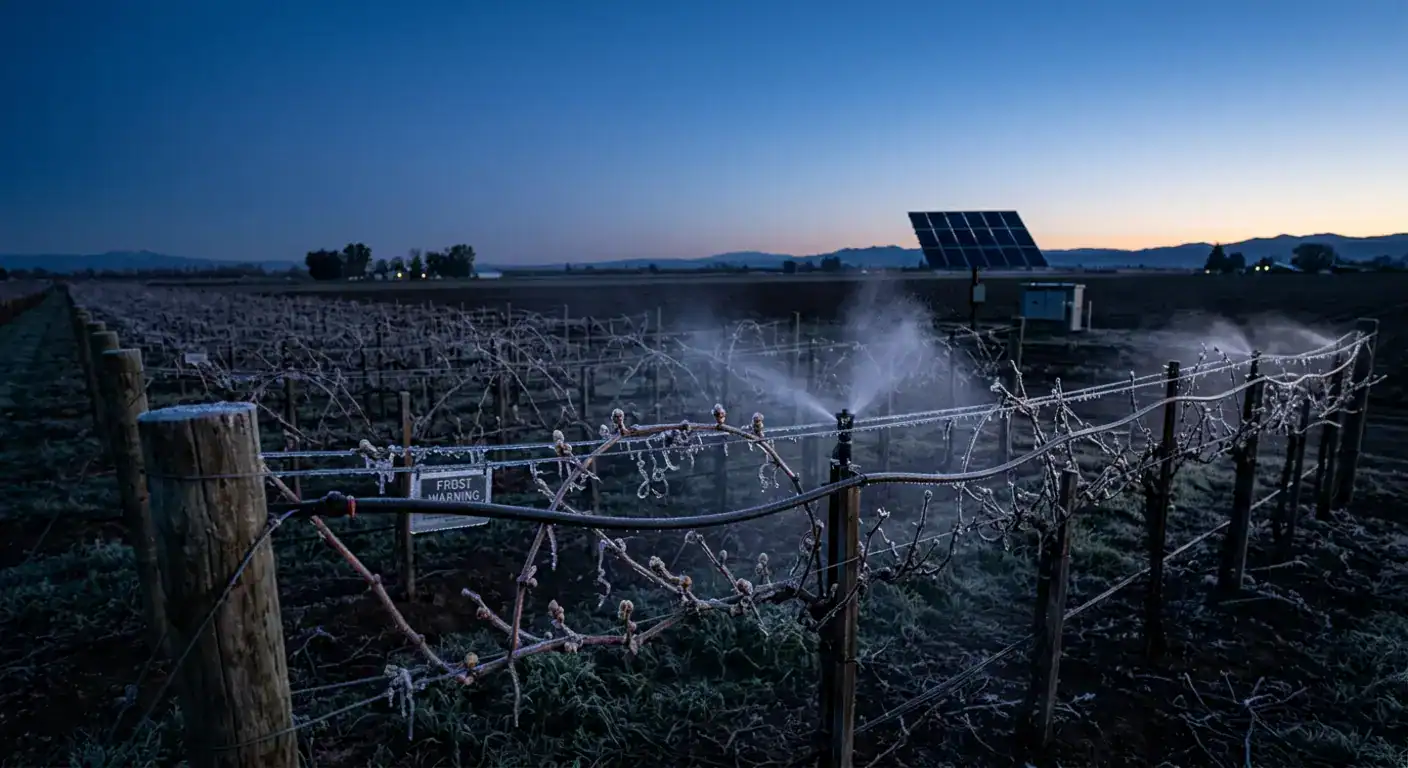
When you spray water over buds and canes during a frost event, the water droplets freeze on contact. The ice encapsulates the bud tissue, but the ongoing application of water keeps the ice layer wet. The latent heat released during this continuous freezing maintains the bud tissue at 32°F — even when the ambient air temperature is 24°F, 26°F, or 28°F.
This is the critical insight: the ice is not the enemy. The ice is the insulation. As long as you maintain a continuous film of water freezing on the surface, the tissue beneath cannot drop below 32°F. Most fruit buds can tolerate 32°F indefinitely. They cannot tolerate 28°F for more than a few hours.
Why Solar Power is the Ideal Match
Frost events are almost exclusively nighttime phenomena. Radiation frosts occur under clear skies with calm winds — the exact conditions when solar panels are not producing. So why use solar?
Because solar frost protection is a battery-buffered system. During the day, your PV array charges a lithium battery bank. At night, the batteries power the DC or AC pump that drives your sprinklers. The solar array is not running the pump in real-time; it is fueling the energy storage system that runs the pump when the frost arrives.
This architecture offers several advantages over diesel:
- Silent operation: No generator noise disturbing neighbors or wildlife.
- Zero emissions: No diesel exhaust, no fuel spills, no winter fuel gelling.
- Automatic activation: With a temperature sensor and automated valve controller, the system starts itself when the wet-bulb temperature approaches critical thresholds. No 3 AM human intervention required.
- Predictable cost: Once installed, your marginal cost per frost night is essentially zero. The diesel bill does not compound over a bad season.
How it works in practice: During daylight hours, the PV array charges a 48V lithium battery bank sized for the worst-case frost night (typically 8–12 hours of runtime). A temperature sensor in the canopy monitors wet-bulb temperature. When the wet-bulb drops to the critical threshold for your crop (e.g., 32°F for grapes at budbreak), the controller activates the pump. Water is drawn from a pond, reservoir, or well, pressurized to 30–50 PSI, and distributed through the irrigation network to micro-sprinklers or overhead impact sprinklers. Water freezes on contact, releasing latent heat and maintaining bud tissue at 32°F.
When sunrise raises temperatures above the critical threshold, the controller shuts down the pump. The ice melts naturally, and the crop emerges unharmed.
The Numbers Behind the Success: ROI and Financial Analysis for Solar Frost Protection
Let us run the actual numbers for three common agricultural scenarios in 2026.
Scenario A: 20-Acre Vineyard (Napa Valley, Cabernet Sauvignon)
| Component | Specification | Why It Matters for Frost Protection |
|---|---|---|
| PV Array | 3kW–10kW monocrystalline | Must charge batteries fully during short winter days |
| Battery Bank | 48V lithium iron phosphate (LiFePO₄), 20–50 kWh | Provides 8–12 hours of pump runtime; LiFePO₄ tolerates cold better than lead‑acid |
| Pump | 5HP–15HP submersible or surface centrifugal | Must deliver total system GPM at 30–50 PSI head |
| Flow Rate | 0.1–0.3 in/hr application rate (overhead) or 0.5–2.0 GPM per tree (micro‑sprinkler) | Insufficient flow = incomplete ice formation = tissue damage |
| Nozzle Type | Micro‑sprinkler (under‑canopy) or impact sprinkler (overhead) | Overhead: uniform coverage. Under‑canopy: less water, faster start/stop |
| Controller | VFD with temperature interlock + battery management system | VFD soft‑starts pump to prevent battery voltage collapse |
| Filtration | Sand media + 120 mesh screen | Frost protection runs at night when no one is watching; clogging is catastrophic |
| Water Source | Pond, reservoir, or well with minimum 24‑hour supply at design flow | Running out of water mid‑frost = total crop loss |
Total Upfront Investment: $33,000
Annual Operating Savings: $3,300 ($1,400 fuel + $800 maintenance + $1,100 labor)
Insurance Value (crop loss avoided): $240,000 every 10 years (conservative: 1 total loss event per decade)
Amortized Annual Crop Protection Value: $24,000
Total Annual Benefit: $27,300
Simple Payback Period: $33,000 ÷ $27,300 = 1.2 years
Even if you never experience a total loss, the operational savings alone pay back the system in 10 years. But the real value is catastrophic loss insurance.
Scenario B: 50-Acre Apple Orchard (Wenatchee, WA)
| Parameter | Diesel Generator | Solar + Battery System |
|---|---|---|
| Upfront Equipment Cost | $15,000 | $52,000 |
| Installation Cost | $5,000 | $8,000 |
| Annual Fuel Cost (25 nights) | $2,000 | $0 |
| Annual Maintenance | $1,200 | $600 |
| Labor Cost | $2,000 | $0 |
| Crop Value Protected | $1,500,000 | $1,500,000 |
Scenario C: 10-Acre Blueberry Farm (Michigan)
| Parameter | No Protection | Solar + Battery System |
|---|---|---|
| Upfront Equipment Cost | $0 | $18,000 |
| Installation Cost | $0 | $3,000 |
| Annual Crop Loss (avg) | $12,000 (30% loss years) | $0 |
| Annual Operating Cost | $0 | $300 |
| System Lifespan | — | 20 years |
Total Upfront Investment: $21,000
Annual Crop Loss Avoided: $12,000
Simple Payback: $21,000 ÷ $12,000 = 1.75 years
The 20-Year Value Proposition
Over a 20-year lifespan, a solar frost protection system in Scenario A generates:
- Fuel and maintenance savings: $66,000
- Labor savings: $22,000
- Crop loss avoided (2 catastrophic events): $480,000
- Total 20-year value: ~$568,000
- Net return after initial $33,000 investment:$535,000
That is a 16.2x return on investment — and it assumes only two total loss events in two decades, which is conservative for frost-prone regions.
Installation Guide: Step-by-Step for Orchards and Vineyards
Step 1: Determine Your Critical Temperature and Flow Requirement
Identify the critical temperature for your crop and growth stage:
- Grapes (budbreak): 32°F
- Apples (pink bud): 28°F
- Cherries (bloom): 29°F
- Blueberries (early bloom): 28°F
Calculate required flow using the formula:
GPM = (Acres × Application Rate in inches/hr × 27,154) ÷ 60 minutes
For a 20-acre vineyard with overhead sprinklers at 0.15 in/hr:
(20 × 0.15 × 27,154) ÷ 60 = 1,358 GPM
This is a large flow. Most vineyards use micro-sprinklers at lower application rates (0.05–0.10 in/hr) or protect only the most vulnerable blocks, reducing flow to 300–600 GPM.
Step 2: Size the Pump and Solar Array
Select a pump that delivers your required GPM at 30–50 PSI total dynamic head (TDH). Include elevation, friction loss, and nozzle pressure in your TDH calculation.
Size the solar array to charge the battery bank fully during the shortest day of the year (December 21). In Northern California, this requires 3.5–4.5 peak sun hours. A 5kW array produces 17.5–22.5 kWh/day in winter. If your pump draws 3 kW and you need 10 hours of runtime, you need 30 kWh of storage. The 5kW array can recharge this in 1.5–2 days of clear weather.
Step 3: Design the Battery Bank
Use 48V LiFePO4 batteries with a minimum of 80% depth of discharge (DoD) capability. Size for your worst-case scenario: the longest frost event you might face (e.g., 12 hours). With a 5 HP pump (~3.7 kW input):
3.7 kW × 12 hours = 44.4 kWh
With 80% DoD, you need 55 kWh of rated battery capacity. This is typically 4–6 battery modules.
Step 4: Install Temperature Sensors and Automation
Place wet-bulb temperature sensors at bud height in the coldest locations of your block (typically the lowest elevation, away from wind exposure). Wire these to your pump controller with a programmable setpoint. Set the activation threshold 1–2°F above your critical temperature to account for system lag.
Install a backup manual override switch. Automation is reliable, but the ability to start the system manually from your phone or a hardwired switch provides peace of mind.
Step 5: Test the System Before Budbreak
Run a full wet test in February before the frost season begins. Verify:
- Pump reaches design pressure within 60 seconds
- All nozzles emit uniform spray patterns
- Battery voltage remains above 48V under full pump load
- Controller responds correctly to temperature sensor input
- Water source replenishes at or above the pump’s draw rate
Step 6: Commission and Document
Record baseline performance data: flow rate, pressure at the pump and at the farthest nozzle, battery voltage drop under load, and recharge time. This documentation is essential for troubleshooting and for USDA REAP grant reporting.
Expert Tips: What the Manuals Won’t Tell You
1. Use Wet-Bulb Temperature, Not Dry-Bulb Most growers look at the thermometer and panic at 30°F. But frost damage is driven by wet-bulb temperature, which accounts for evaporative cooling. On dry nights (low humidity), the wet-bulb can be 4–6°F below the dry-bulb. Your automation should trigger on wet-bulb, not dry-bulb. A $50 wet-bulb sensor saves you from running the system unnecessarily on dry nights or missing a dangerous radiative cooling event.
2. Start the System Before Temperature Drops to Critical Do not wait until you hit 32°F to start spraying. The physics of latent heat requires time to build an ice layer. Start the system when the wet-bulb reaches 34°F (for a 32°F critical crop). This gives the system 30–60 minutes to establish a continuous ice film before the tissue reaches its limit.
3. Size Your Water Source for the Worst Night, Not the Average Night A 20-acre block at 0.10 in/hr uses 54,000 gallons per hour. An 8-hour frost event consumes 432,000 gallons. If your pond is only 300,000 gallons, you will run dry at 4 AM — the coldest hour. Either reduce your protected acreage, lower your application rate with micro-sprinklers, or ensure your water source can recharge from a well or stream during operation.
4. Install a VFD, Not a Direct-On-Line Starter A direct-start pump draws 5–7x its running current at startup. This inrush can collapse a battery bank’s voltage, triggering a low-voltage disconnect and shutting down your protection at the worst possible moment. A Variable Frequency Drive (VFD) soft-starts the motor, ramping up over 5–10 seconds. This protects your batteries and extends pump life.
5. Clean Nozzles After Every Season Even with 120-mesh filtration, biological growth, mineral scale, and debris accumulate in micro-sprinkler orifices over a growing season. A partially clogged nozzle reduces flow by 20–40%, creating gaps in your ice coverage. Soak all nozzles in a 10% vinegar solution for 24 hours after harvest, and blow out lines with compressed air before winter.
Common Mistakes to Avoid
| Mistake | Why It Fails | The Fix |
|---|---|---|
| Undersizing the battery bank | Pump shuts down at 3 AM when batteries are depleted | Size for 120% of longest expected frost event |
| Using dry-bulb sensors only | System starts too late or runs unnecessarily | Install wet-bulb sensors at bud height |
| Insufficient water source | Runs dry mid-frost; total crop loss | Verify source capacity > 1.5× nightly demand |
| Direct-on-line pump starting | Battery voltage collapse, system shutdown | Always use a VFD soft-start |
| Protecting too many acres at once | Flow rate per acre drops below critical threshold | Prioritize highest-value blocks; stage protection |
| Ignoring wind machines as backup | On windy nights, sprinklers are less effective | Integrate wind machines for advective frost events |
When NOT to Use a Solar Frost Protection System
Solar-powered sprinkler frost protection is powerful, but it is not universal. Avoid it if:
- Your water source is inadequate. If you cannot deliver the required flow for 8–12 hours, you will create a false sense of security. Partial protection is often worse than no protection because it encourages later budbreak in unprotected areas.
- You face advective frosts with high winds. Sprinklers are ineffective when wind speeds exceed 5–10 mph because the droplets blow away before freezing on the tissue. In windy frost regions, wind machines or heaters are more appropriate.
- Your power demand exceeds solar feasibility. A 100-acre overhead system requiring 5,000+ GPM may need a 50 kW pump. The solar array and battery bank required become prohibitively expensive. In these cases, grid power or large diesel may still be the practical choice.
- Local regulations restrict nighttime water use. Some water districts impose pumping moratoriums during drought years. Verify your water rights and district rules before investing.
Maintenance Schedule: Keeping Your System Battle-Ready
| Frequency | Task | Estimated Time |
|---|---|---|
| Monthly (Jan–Apr) | Clean PV panels; inspect battery voltage and state of charge | 20 min |
| Pre‑season (Feb) | Wet test full system; verify all nozzles; calibrate temperature sensors | 2 hours |
| Post‑season (May) | Flush lines; soak nozzles in vinegar; blow out with compressed air | 3 hours |
| Bi‑annually | Inspect battery connections for corrosion; torque terminals | 30 min |
| Annually | Test VFD programming; inspect pump wear ring and impeller | 1 hour |
| Every 5 years | Replace battery bank (LiFePO₄) or capacity test | 2 hours |
Conclusion: Why Solar Frost Protection is Your 2026 Crop Insurance Policy
Solar pumping for frost protection is not an expense. It is a catastrophic loss insurance policy that pays you back every year in fuel savings, labor elimination, and sleep quality. The physics are unassailable: 144 BTU per pound of freezing water, delivered precisely where your buds need it, powered by sunlight you harvested yesterday.
The payback math is equally compelling. In high-value vineyards and orchards, the system pays for itself in less than two seasons if it prevents a single total loss event. Even in lower-value crops, the operational savings and automation benefits justify the investment within 3–5 years.
More importantly, solar frost protection removes the human dependency from your risk management strategy. No more 2 AM phone calls. No more generator that will not start in the cold. No more calculating whether tonight is “worth” the diesel cost. The system monitors, decides, and acts — silently, cleanly, and automatically.
If you are installing a new irrigation system or renovating an existing one, designing for frost protection from day one reduces trenching, plumbing, and electrical costs. The incremental cost of upsizing your solar array and adding a battery bank is small compared to retrofitting later.
The question is not whether you can afford solar frost protection. The question is whether you can afford another spring without it.
Frequently Asked Questions
Q1: Can a solar system really run all night during a frost event?
Yes, provided the battery bank is sized correctly. A solar frost protection system is not trying to run the pump directly from moonlight. It stores solar energy collected during the day in a lithium battery bank, then discharges that stored energy to run the pump at night.
The key is sizing. You must calculate your pump’s power draw (in kW), your expected frost event duration (in hours), and your battery’s usable capacity (in kWh). A typical vineyard system uses a 5 HP pump drawing ~3.7 kW. For an 8-hour frost event, you need 29.6 kWh of energy. With a 48V LiFePO4 battery bank at 80% depth of discharge, you need 37 kWh of rated capacity. A 5 kW solar array in winter produces ~18 kWh per day, so it takes 2 days of sun to fully recharge after a long event.
For regions with multi-day frost events, you have two options: oversize the battery bank (e.g., 60 kWh for 2 nights) or retain a small diesel generator as emergency backup for the second night. Most growers choose a hybrid approach: solar handles 90% of events, and a small generator sits idle for the once-per-decade 3-night freeze.
Q2: How much water does frost protection use, and where does it come from?
Sprinkler frost protection is water-intensive. Application rates range from 0.05 inches per hour (micro-sprinklers) to 0.30 inches per hour (overhead impact). For a 20-acre block:
- At 0.10 in/hr: 54,000 gallons per hour
- An 8-hour event: 432,000 gallons
Your water source must be able to supply this volume, either from storage or continuous replenishment. Common sources include:
- On-farm ponds or reservoirs: Must be sized for the worst-case event and ideally have a spring or stream feed to recharge during the season.
- Agricultural wells: Must be tested for sustainable yield. A well producing 100 GPM can support a 600 GPM system if it runs continuously and the pond/reservoir stores the deficit.
- Municipal or irrigation district water: Often restricted by allocation or nighttime pumping bans. Verify before designing.
If your water is limited, reduce your protected area to your highest-value blocks, switch to lower-flow micro-sprinklers, or integrate with wind machines to reduce water demand.
Q3: Will the weight of ice break my branches or trellis wires?
This is a common and logical concern, but in practice, properly managed sprinkler frost protection does not damage structural wood or trellis systems. The ice that forms is a thin, continuous film — not a heavy accumulation. The key is maintaining a wet ice layer rather than allowing dry, thick ice to build up.
When you apply water continuously at the correct rate, the ice remains wet and slushy. The latent heat release keeps the ice-water interface at 32°F, and the ongoing flow prevents the ice from becoming a solid, rigid mass. It is when growers start too late or apply insufficient flow that dry, heavy ice forms, which can indeed weigh down branches and stress trellis wires.
UC Davis research confirms that overhead sprinkler systems applying 0.10–0.15 in/hr on grapevines produce ice loads well within the structural capacity of standard VSP trellis systems (12.5 gauge wire, 5–6 ft post spacing). If you are concerned, consult a trellis engineer to verify your system’s ice load rating, and always start the system before temperatures drop below the critical threshold.
© 2026 Solar Panels for Farms. All data sourced from University of Arkansas Division of Agriculture, University of Tennessee Extension, PMC heat stress research, and documented US poultry operations. Last verified: July 8, 2026.