
Written by: Michael A. Stewart, Agri‑Solar Engineering Consultant. 12+ years designing off‑grid and hybrid solar water pumping systems. Specializes in storage optimization for irrigation and livestock. Holds a Master’s in Energy Engineering (Delft University) and has designed over 50 storage‑integrated systems across the US.
You Pump Water When the Sun Shines – But Your Crops Need Water When?
Solar pumps are wonderful during sunny hours. But what about early morning before sunrise? What about cloudy stretches? What about the afternoon when you need to irrigate but the sun is already fading?
You have two fundamentally different ways to solve this mismatch:
- Store energy – Use batteries to capture solar electricity and run the pump anytime.
- Store water – Pump water into a tank during sunny hours, then use gravity or a small secondary pump to irrigate whenever needed.
Both work. But they have vastly different costs, lifespans, maintenance requirements, and operational characteristics. Choosing wrong can mean spending $10,000 on batteries that die in 5 years when a $2,000 tank would have done the job – or ending up with a tank on flat land that provides no pressure and leaves you still needing a pump.
This guide gives you a clear, numbers‑based framework to decide which storage method (or combination) is right for your farm.
The Solution: Two Storage Philosophies – Water vs. Batteries
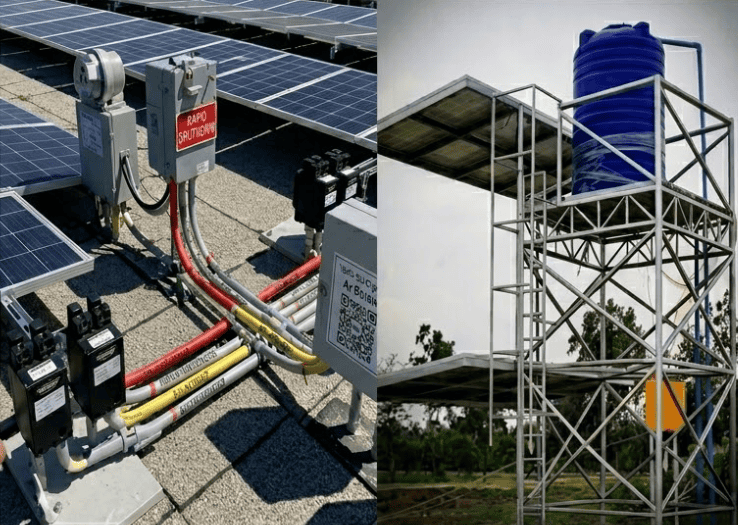
Let us start with a clear diagram of how each system works.
Section 1: Water Storage – The Simple, Durable Workhorse
Water storage means pumping water into a tank during sunny hours and using that water when needed – typically by gravity if the tank is elevated, or with a small secondary pump if the tank is at ground level.
Advantages
| Advantage | Why It Matters |
|---|---|
| Low cost per stored unit | A 50,000 liter (13,000 gallon) tank costs \$2,000‑4,000 – about \$0.04‑0.08 per liter of storage. Batteries cost 10‑20x more per usable kWh equivalent. |
| Extremely long lifespan | Galvanized steel or concrete tanks last 20‑30+ years. Plastic (poly) tanks last 15‑20+ years if UV‑protected. |
| Near‑zero maintenance | Clean the tank every 2‑3 years. No electronics, no cooling, no balancing. |
| No energy conversion losses | Water pumped up stays up. Gravity release is 100% efficient (minus friction). |
| Works with any pump | DC, AC, submersible, surface – all can fill a tank. |
| Provides pressure without electricity | Elevation creates pressure – 10 meters of height = 1 bar (14.5 psi), perfect for drip irrigation. |
Disadvantages
| Disadvantage | Mitigation |
|---|---|
| Requires elevation for gravity feed | Build a small tower (5‑10 m) or use a hill. Flat land? Use a ground tank with a small booster pump powered by a tiny solar panel (adds \$500‑1,000). |
| Large footprint | A 50,000 L tank has a diameter of 3‑4 m. Plan your site. |
| Water quality concerns | Covered tanks prevent algae. Filters at outlet protect drip emitters. |
| Not suitable for high‑pressure systems | If you need 4‑5 bar for sprinklers, gravity alone won’t suffice. Use a booster pump. |
Types of Water Storage Tanks (2026 US Market)
| Material | Lifespan | Cost (per 10,000 L) | Best for |
|---|---|---|---|
| Galvanized steel (bolt‑together) | 20‑25 years | \$800‑1,200 | Permanent installation, large volumes |
| Polyethylene (UV‑stabilized) | 15‑20 years | \$500‑800 | Small to medium farms, easy to move |
| Concrete (poured or precast) | 30+ years | \$1,500‑2,500 | Permanent, very large volumes (over 100,000 L) |
| Fabric (bladder) tank | 5‑10 years | \$300‑600 | Temporary or seasonal use |
Section 2: Battery Storage – Flexible but Complex
Batteries store electricity. You can run your pump (and other loads) anytime – night, cloudy days, even multiple days with sufficient capacity. But this convenience comes with significant trade‑offs.
Advantages
| Advantage | Why It Matters |
|---|---|
| 24/7 pumping capability | Irrigate at night when evaporation is lower. Respond to unexpected dry spells. |
| No elevation needed | Works perfectly on flat land. No tower or hill required. |
| Supports other loads | Same battery can power lights, tools, electric fences, controllers. |
| Scalable | Add more battery modules as your farm grows. |
Disadvantages
| Disadvantage | Why It Hurts |
|---|---|
| High cost per stored kWh | Lithium batteries \$300‑500 per usable kWh (after depth‑of‑discharge). Lead‑acid cheaper upfront but shorter life. |
| Limited lifespan | Lithium: 5‑10 years (2,000‑5,000 cycles). Lead‑acid: 3‑5 years (500‑1,000 cycles). |
| Maintenance & monitoring | Lithium requires BMS (battery management system). Lead‑acid requires watering, equalization, terminal cleaning. |
| Temperature sensitivity | Below freezing? Lithium needs heating. Above 40 °C (104 °F)? Need cooling. |
| Efficiency losses | Round‑trip efficiency: lithium 85‑92%, lead‑acid 70‑80%. You lose 8‑15% of your solar energy. |
| Safety concerns | Thermal runaway (lithium), hydrogen gas (lead‑acid). Requires proper ventilation and installation. |
Battery Types for Solar Pumps (2026)
| Type | Lifespan (cycles) | Depth of Discharge | Round‑trip Efficiency | Cost per kWh usable | Best for |
|---|---|---|---|---|---|
| Lithium iron phosphate (LiFePO₄) | 3,000‑5,000 (10‑15 years) | 80‑90% | 92‑95% | \$400‑600 | Long‑term, daily cycling, cold climates (with heating) |
| Lithium NMC | 2,000‑3,000 (5‑8 years) | 80% | 90‑92% | \$350‑500 | Smaller budgets, moderate cycling |
| Sealed lead‑acid (AGM/Gel) | 500‑1,000 (3‑5 years) | 50% | 80‑85% | \$200‑300 | Low upfront cost, occasional use |
| Flooded lead‑acid | 500‑800 (3‑5 years) | 50% | 70‑80% | \$150‑250 | Very low budget, regular maintenance acceptable |
Section 3: The Math – 20‑Year Cost Comparison
Let us compare a 5 HP solar pump system that needs to deliver 150 m³/day (about 40,000 gallons) for irrigation, with storage to cover 8 hours of non‑sunlight pumping (e.g., night irrigation).
Scenario: You want to run the pump 6 hours during the day (sunny) and 2 hours at night (or cloudy periods). The pump draws 4 kW (5 HP). Two hours of night pumping requires 8 kWh of usable stored energy.
Water Storage Solution
- Build an elevated tank (10 m height) with capacity for 2 hours of pumping at 30 m³/h = 60 m³ storage.
- 60 m³ tank (plastic, UV‑stabilized): ~$3,500
- Tower (10 m steel structure): ~$4,000 (can be cheaper if you use a hill)
- Pipe, fittings, pressure regulator: ~$800
- Total upfront: $8,300
- Annual maintenance: $50 (tank cleaning, valve checks)
- 20‑year cost: $8,300 + ($50 × 20) = $9,300
Battery Storage Solution (Lithium)
- Required usable storage: 8 kWh (for 2 hours of night pumping at 4 kW)
- Lithium iron phosphate (LiFePO₄) with 80% depth of discharge: rated capacity needed = 8 kWh ÷ 0.8 = 10 kWh
- Cost of 10 kWh LiFePO₄ battery (2026): ~$4,500‑5,500 (plus BMS included)
- Inverter (if AC pump) or DC‑compatible controller: $1,000‑1,500
- Temperature management (if needed): $200‑500
- Total upfront: $6,000‑7,500
- Annual maintenance: $100 (BMS checks, terminal cleaning)
- Expected lifespan: 10 years (3,500 cycles at 80% DoD – borderline for daily use)
- 20‑year cost: purchase two battery systems (one replacement at year 10) = $6,500 × 2 = $13,000 + ($100 × 20) = **$15,000**
Battery Storage Solution (Lead‑Acid – Lowest Upfront)
- 8 kWh usable at 50% DoD = 16 kWh rated capacity
- Flooded lead‑acid batteries: ~$200 per kWh rated = $3,200
- Inverter/controller: $1,500
- Total upfront: $4,700
- Lifespan: 3‑4 years (800 cycles at 50% DoD is optimistic)
- Replacements at years 4, 8, 12, 16: 4 additional batteries
- 20‑year cost: $4,700 + (4 × $3,200) + ($200 × 20 maintenance) = $4,700 + $12,800 + $4,000 = $21,500
Comparison Table – 20‑Year Horizon (5 HP pump, 8 kWh nightly need)
| Parameter | Water Tank (elevated) | Lithium Battery | Lead‑Acid Battery |
|---|---|---|---|
| Upfront cost | \$8,300 | \$6,500 | \$4,700 |
| Replacement cycles | None (20+ years) | 1 replacement at year 10 | 4 replacements (years 4,8,12,16) |
| 20‑year total cost | \$9,300 | \$15,000 | \$21,500 |
| Annual maintenance | \$50 | \$100 | \$200 |
| Energy efficiency | ~100% (gravity) | 90% round trip | 75% round trip |
| Requires elevation? | Yes (10 m tower) | No | No |
| Works in freezing? | Yes (insulate pipes) | No (needs heating) | Yes (keep charged) |
| Lifespan | 20‑30 years | 10‑15 years | 3‑5 years |
Key takeaway: Water storage is cheaper, longer‑lasting, and more efficient – if you have a way to elevate the tank (hill or tower). On perfectly flat land where a tower is too expensive, lithium batteries may be the only practical option, but they cost nearly twice as much over 20 years as an elevated tank. Lead‑acid is a false economy – it looks cheap upfront but costs more than lithium over two decades due to frequent replacements.
Section 4: Decision Matrix – Which Storage Method for Your Farm?
Answer these four questions honestly:
| Question | Yes → | No → |
|---|---|---|
| Do you have a hill, slope, or can you build a 5‑10 m tower? | Water storage is ideal | Consider batteries or ground tank + booster |
| Do you need to pump water at night or during multi‑day cloudy periods? | Storage needed | No storage needed (pump only sunny hours) |
| Is your pump <5 HP (3.7 kW) and daily storage need <20 kWh? | Batteries may be affordable | Batteries become expensive; water storage better |
| Do you already have other electrical loads (lights, tools, fence)? | Batteries serve multiple purposes | Dedicated water storage is simpler |
Summary Recommendations
| Farm Profile | Best Storage | Why |
|---|---|---|
| Hilltop or sloped land, any size | Water tank (gravity) | Lowest 20‑year cost, zero maintenance, perfect pressure for drip |
| Flat land, small pump (<3 HP), night pumping needed | Small lithium battery | Affordable for small kWh needs; no tower cost |
| Flat land, large pump (>7 HP), night pumping needed | Ground tank + booster pump | Batteries would be huge & expensive. Store water, then use a small AC pump (powered by a tiny solar panel) to pressurize |
| Farm with existing battery bank (e.g., off‑grid home) | Extend battery bank | Marginal cost is low; share the storage |
| Cloudy region (Pacific Northwest, etc.) | Oversize tank + panels | Batteries struggle with multi‑day clouds. Store 3‑5 days of water, pump aggressively on sunny days |
| Drip irrigation only (low pressure) | Water tank (elevated) | 10 m height gives perfect 1 bar for drip. No pump needed at outlet |
Section 5: The Hybrid Approach – Best of Both Worlds
Many farms find that a small battery + large water tank is the optimal solution.
How it works:
- A small lithium battery (1‑2 kWh) powers the pump controller, zone valves, and a simple timer.
- During sunny hours, the solar pump fills an elevated water tank (no battery needed for the pumping itself).
- At night or on cloudy days, gravity feeds water from the tank. The small battery just opens valves and runs the controller – negligible energy use.
- Result: You get 24/7 water availability with a tiny battery that costs $500‑1,000 and lasts 10+ years because it cycles very lightly.
Cost example (for the 5 HP farm above):
- 60 m³ elevated tank + tower: $7,500
- 1 kWh LiFePO₄ battery: $500
- **Total: $8,000** – far less than a 10 kWh lithium bank ($6,500) plus tower? Wait – the hybrid still needs the tower. Actually, if you have elevation, hybrid is marginally more expensive than pure water storage because you add a small battery. But if you are on flat land and need night pumping, hybrid means a ground tank + booster pump + small battery for controls – still cheaper than a large lithium bank.
Real hybrid recommendation for flat land:
- Ground tank (no tower): $3,500
- Booster pump (0.5 HP, 120V AC): $300
- Small solar panel (200W) to run booster: $150
- Small battery (0.5 kWh) to run controller: $300
- Total: $4,250 – delivers night irrigation without a large battery bank.
This is what I recommend for most medium‑sized farms on moderate terrain.
Section 6: Expert Tips – What Storage Engineers Know
Tip 1: Always oversize your water tank by 20‑30%.
Your farm will grow, or you will have a drought year. A larger tank costs only marginally more (materials) but saves you from running out of water.
Tip 2: For flat land, a ground tank + small booster pump is cheaper than a tall tower.
A 5‑meter steel tower costs $3,000‑5,000. A ground tank ($2,000) plus a small 0.5 HP AC pump ($300) plus a 200W solar panel ($150) costs half as much and is easier to maintain.
Tip 3: Never use lead‑acid batteries for daily deep cycling.
They claim 500 cycles, but in real farm conditions (heat, irregular maintenance), you will get 2‑3 years. Lithium pays for itself within 5‑7 years.
Tip 4: If you do choose batteries, oversize by 20% for depth‑of‑discharge reserve.
Running batteries to 100% DoD every day cuts cycle life by 50% or more. Keep lithium between 20‑80% for 5,000+ cycles.
Tip 5: Insulate your battery box in cold climates.
Lithium batteries should not be charged below 0°C (32°F). A simple insulated box with a small heating pad (powered by the battery itself) costs $100‑200 and prevents permanent damage.
Tip 6: Cover your water tank.
Algae grows quickly in clear poly tanks exposed to sun. A black tank or a cover reduces cleaning frequency and keeps water quality high.
Tip 7: Install a float switch in your tank to automate pump shutoff.
When the tank is full, the pump should stop. A simple float switch ($30‑50) prevents overfilling and pump wear. This is the cheapest and most effective automation you can add.
Conclusion
The choice between water storage and battery storage is not about which is universally “better.” It is about matching the storage method to your farm’s physical layout, water needs, and budget.
- If you have elevation (hill, slope, or can build a modest tower), water storage is almost always the winner – lower cost, longer life, zero complex electronics.
- If you are on perfectly flat land with a small pump and need night pumping, a small lithium battery or hybrid solution makes sense.
- For large pumps on flat land, ground tank + small booster pump beats huge battery banks every time.
- Never assume you need batteries just because you want water at night. Many farmers discover that a simple timer and an elevated tank solve their problem for a fraction of the cost.
Your action plan:
- Assess your land – do you have any natural elevation?
- Calculate your nightly water requirement (m³ or hours of pumping).
- Compare the 20‑year cost of an elevated tank vs. a battery bank using the tables above.
- Consider the hybrid approach (small battery + tank) as your default.
- Install a float switch and pressure gauges to monitor system health.
The sun is free. Gravity is free. Batteries are expensive. Use the simplest storage that meets your needs.
Frequently Asked Questions (FAQ)
Q: Is it better to store water or electricity for a solar pump?
For most farms, storing water in an elevated tank is better than storing electricity in batteries. Water storage costs 80‑90% less per usable unit over 20 years, lasts 20‑30 years without replacement, requires almost no maintenance, and gravity delivery is 100% efficient. Battery storage (lithium) costs $400‑600 per usable kWh, lasts 10‑15 years, loses 8‑15% of energy to heat, and requires temperature management. The only cases where batteries win are: (1) perfectly flat land where a tower is too expensive, (2) when you need to run other electrical loads (lights, tools), or (3) very small storage needs (<2 kWh per day). For most medium and large farms, an elevated water tank is the smarter financial and operational choice.
Q: What size water tank do I need for solar drip irrigation?
The ideal water tank size for solar drip irrigation depends on your daily water requirement and how many hours you want to irrigate without the sun. A common rule: size the tank to hold 1‑2 days of irrigation water. For example, if your crops need 50 m³/day, choose a 50‑100 m³ tank. This allows you to pump during sunny hours and irrigate at night or during cloudy periods without interruption. For drip irrigation specifically, place the tank at least 5‑10 meters above the fields to generate 0.5‑1.0 bar of gravity pressure – perfect for most drip tape. On flat land, use a ground tank with a small booster pump. Always add 20‑30% extra capacity for future expansion or drought reserves
Q: How long do solar pump batteries last compared to water tanks?
Water tanks (galvanized steel, concrete, or UV‑stabilized polyethylene) last 20‑30+ years with minimal maintenance – often the life of the farm itself. By contrast, lithium iron phosphate (LiFePO₄) batteries last 10‑15 years under ideal conditions (daily cycling, temperature‑controlled). Lead‑acid batteries last only 3‑5 years with regular maintenance. This lifespan difference is the primary reason water storage is cheaper over 20 years: a water tank is a single purchase, while batteries require one or two replacements over the same period. For example, a $6,000 elevated tank costs $9,300 over 20 years including maintenance. A $6,500 lithium battery bank costs $15,000+ over 20 years because you need to replace it at year 10. Water tanks also have no efficiency losses, no temperature sensitivity, and no complex monitoring.
This guide is based on engineering principles and 2026 market estimates. Last verified: June 11, 2026.