Written by Dr. Robert Kowalski — Ph.D. in Agricultural and Biological Engineering from Penn State University, with 18 years of experience in on-farm electrical systems. He has reviewed hundreds of farm solar proposals and contracts, and has served as an independent expert in installer disputes across the Midwest and Northeast. He is a licensed Professional Engineer and a member of the American Society of Agricultural and Biological Engineers.
If a salesman tells you the federal solar tax credit expires next month and you must sign today — hang up. Farm country is now a primary target for the worst actors in residential solar, because farms have big roofs, big electricity bills, and landowners who answer their own gate. Here is the complete 2026 playbook they use, and the five-minute verification routine that filters out 95% of them.
The Problem
Rural solar fraud follows the money, and the money moved. The 30% federal credit, REAP cost-share, and farm-scale electricity bills make a farmgate signature worth 100,000–100,000–500,000 per project — ten times a suburban rooftop. The same national sales organizations that generated tens of thousands of consumer complaints in the suburbs have discovered that a farmer’s trust, once earned, closes bigger deals faster.
The tactics are not new. They are adapted. Every pitch below has been documented in rural markets within the last two years — and each one maps to a specific lie about a real program, which is what makes it convincing.
The Seven Lies That Cost Farmers the Most
Lie 1: “The 30% credit expires next month — sign today.”
The ITC is law, not a promotion, and its actual step-down schedule is public. The urgency is manufactured to prevent you from doing exactly what you should do: get three quotes and check references. Any deadline attached to your signature rather than to a real program date is a pressure device.
Lie 2: “Your utility will pay you — this system makes money.”
Export compensation in most states now pays a fraction of retail (see our net metering guide). A system sized to overproduce is a system sized to the salesman’s commission, not your ROI. If the proposal shows the utility sending you checks, ask to see the export rate in writing — on utility letterhead, not the proposal.
Lie 3: “This lease/PPA is basically free — the government covers it.”
A 25-year PPA with a 2.9% annual escalator quietly doubles your price per kWh by year 20. “Free” farm solar with a lien on your barn is not free; it is a mortgage on your electricity. Our buy/lease/PPA cash-flow guide runs the 25-year math — demand the salesman run it too.
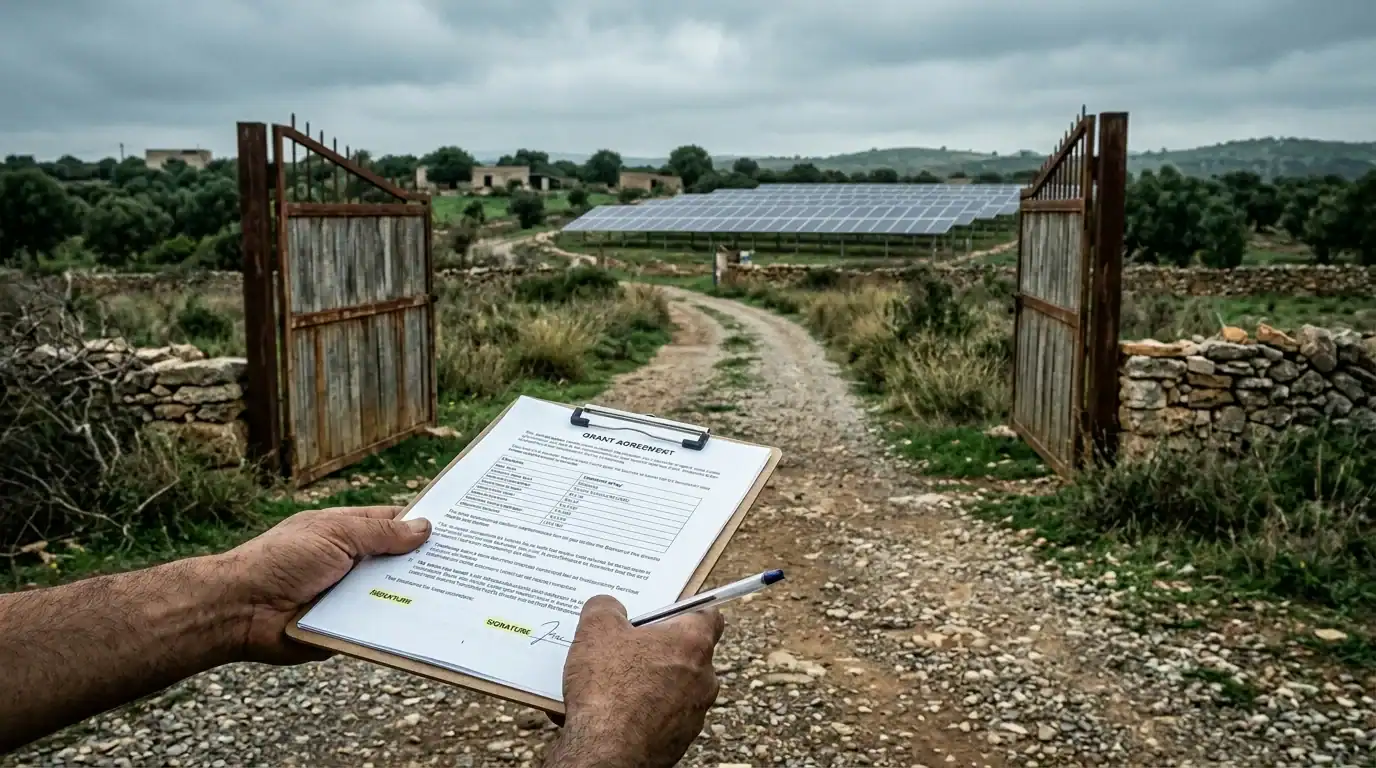
Lie 4: “We’ll handle the REAP grant for you — guaranteed approval.”
Nobody can guarantee a competitive federal grant. “Guaranteed REAP” means one of two things: they inflate the contract price to absorb the expected grant (you capture nothing), or they take an assignment of the grant and you never see it. REAP applications can be professionally prepared — but the grant belongs to you, and anyone claiming guaranteed approval is lying about a federal program.
Lie 5: “Your neighbor signed up — here’s their system.”
The neighbor is often invented, or is three counties away. Rural social proof is the strongest close in the book, which is exactly why it is faked. Verify independently: call the neighbor yourself, on a number you looked up.
Lie 6: “No money down, cancel anytime.”
The financing documents say otherwise. Third-party lender agreements signed at the kitchen table routinely include automatic payment schedules, arbitration clauses, and — worst of all — mechanic’s liens or UCC filings against farm property. “Cancel anytime” refers to a cooling-off period measured in days, and the paperwork clock starts before you have read it.
Lie 7: “We’re a local company — my family farms.”
Check the contractor license. A large share of “local” farm solar brands are sales fronts for national installers; the actual installation is subcontracted to whoever bids lowest, and warranty service evaporates when the brand dissolves. Our 12 red flags guide covers this — the short version: the name on the license must match the name on the contract.
The Five-Minute Verification Routine
Run this before any second meeting. It filters 95% of bad actors:
- Contractor license lookup (state licensing board website, 90 seconds). Active, matching legal name, no discipline history.
- Secretary of State business search (60 seconds). Years in business, registered agent, any “administratively dissolved” predecessors — serial brand dissolvers leave a trail.
- BBB + state attorney general complaint search (60 seconds). You are not looking for zero complaints; you are looking for unresolved patterns about liens, grants, and refusal to service.
- NABCEP certification of the actual system designer (60 seconds). Ask for the name, look it up in the NABCEP directory.
- Three completed farm references, over 12 months old (90 seconds to request). Systems in year two or three of operation. If they cannot produce three, they have not finished three.
Any company that balks at any of these five has told you everything you need to know.
The Contract Terms That Actually Hurt You
| Clause | What they say it means | What it actually does |
|---|---|---|
| PPA escalator (2–3.9%/yr) | “Small inflation adjustment” | Doubles your kWh price by year 20–25 |
| Assignment of incentives | “We handle the paperwork” | They take your ITC/REAP/depreciation value |
| UCC-1 / fixture filing | “Standard financing form” | Lien on your barn, land, or equipment |
| Auto-renewing 25-year term | “You can always extend” | You cannot sell the farm cleanly without buying out |
| Estimated production guarantee | “Guaranteed output” | Guarantee void if you miss vague “maintenance duties” |
| Mandatory arbitration + class-action waiver | “Faster dispute resolution” | You cannot sue, and cannot join others who were scammed |
If You Already Signed
- The 3-day federal cooling-off rule (FTC) applies to door-to-door sales — and many states extend it to 5–10 days. Act in writing, by certified mail, immediately.
- Document the pitch. Write down every verbal claim while you remember it. Verbal misrepresentations about tax credits and grants are the strongest basis for state AG complaints and contract rescission.
- Contact your state attorney general’s consumer protection office and your state contractor licensing board. Both act on rural solar complaints; both move faster with documentation.
- Check your title. A UCC search at your county recorder shows whether a fixture filing exists. Discovering it at a land sale is the worst possible timing.
Conclusion
Farm solar itself is not the scam — done right, with a vetted installer, it is one of the best capital investments available to a working farm. The scam is the manufactured urgency: expiring credits that are not expiring, guaranteed grants that cannot be guaranteed, and “free” systems with 25-year liens attached. The defense is boring and total: five minutes of public-records verification, three old references, and a flat refusal to sign anything the same day it is offered. The legitimate installers will still be there next week. The others will not.
Frequently Asked Questions
Q: Is the federal solar tax credit really expiring?
A: Not the way salesmen describe it. The ITC is established in federal law with a publicly defined placed-in-service deadline and step-down schedule — it does not expire “next month,” and no signature deadline exists. Any rep attaching urgency to your contract signing rather than to an actual statutory date is manufacturing pressure. Verify current credit rules in our tax credits guide or with your CPA before believing any deadline claim.
Q: A company offered me “free solar” through a lease — what’s the catch?
A: The catch is usually threefold: an annual price escalator (2–3.9%) that doubles your cost per kWh over 25 years, an assignment clause handing your tax credits and grant value to the company, and a UCC fixture filing that puts a lien on your farm property. Some leases are fair deals, but “free” is never accurate — run the full 25-year cash flow (our buy/lease/PPA guide does this) before signing anything with a lien attached.
Q: How do I report a farm solar scam?
A: Start with your state attorney general’s consumer protection office and your state contractor licensing board — both track rural solar complaints and can act on unlicensed or fraudulent operators. File with the FTC for deceptive sales practices, and the USDA Office of Inspector General if anyone misrepresented the REAP program. Document verbal claims in writing immediately; misrepresentations about tax credits and federal grants are the strongest grounds for contract rescission.
Related Articles
- How to Vet a Farm Solar Installer: 12 Red Flags + 8 Credentials — The full verification checklist, including license lookup and reference checks.
- Farm Solar: Buy, Lease, or PPA? The 2026 25-Year Cash Flow Math — Run this math on any “free solar” offer before signing.
- Farm Solar Tax Credits 2026: ITC, REAP & MACRS Stacking Guide — What the tax credit rules actually say, so no salesman can lie to you about deadlines.
© 2026 Farm Solar Guide. All data sourced from FTC consumer protection documentation, state attorney general enforcement records, USDA program rules, and documented US farm operations. Last verified: October 30, 2026