
Written by Dr. Robert Kowalski — Ph.D. in Agricultural and Biological Engineering from Penn State University, with 18 years of experience in on-farm electrical systems, refrigeration, and energy storage. He has designed battery-backed cooling systems for produce, dairy, and cold storage operations across the Midwest and Northeast. He is a licensed Professional Engineer and a member of the American Society of Agricultural and Biological Engineers.
A compressor failure at 2 AM costs a mid-size produce farm 8,000–8,000–15,000 in lost inventory before sunrise. Cold storage is the one farm load where “the grid is usually reliable” is not a plan. Here is the exact PV + battery sizing for a cooler that cannot go down — and the $200 component that matters more than the panels.
The Problem
Cold storage is a trap load. It looks small on the bill — a typical 8×12 walk-in cooler draws 1–2 kW — so farmers undersize the backup. But the cost of failure is not the electricity; it is the inventory, and it is asymmetric in the worst direction: failures happen during heat waves and storms, exactly when the cooler works hardest and the grid is most likely to be down.
The other trap is the starting surge. A compressor that runs at 1,500W may pull 6,000–9,000W for a fraction of a second at startup. Size the inverter to the running load and the system trips every time the compressor kicks on. This is the cold-storage version of the C-rate problem we covered in our battery sizing guide — and it kills more DIY cooler systems than any other error.
The Cold Storage Load Profile
| Cooler size | Running load | Startup surge | Daily energy (summer) | Typical inventory value |
|---|---|---|---|---|
| 6×8 walk-in (CSA farm) | 0.8–1.2 kW | 3–5 kW | 10–16 kWh | $3,000–$8,000 |
| 8×12 walk-in (market farm) | 1.5–2 kW | 6–9 kW | 20–30 kWh | $8,000–$15,000 |
| 12×20 cooler + freezer | 3–4 kW | 12–18 kW | 45–70 kWh | $20,000–$50,000 |
| Refrigerated container (used reefer) | 3–6 kW | 15–20 kW | 50–90 kWh | $15,000–$40,000 |
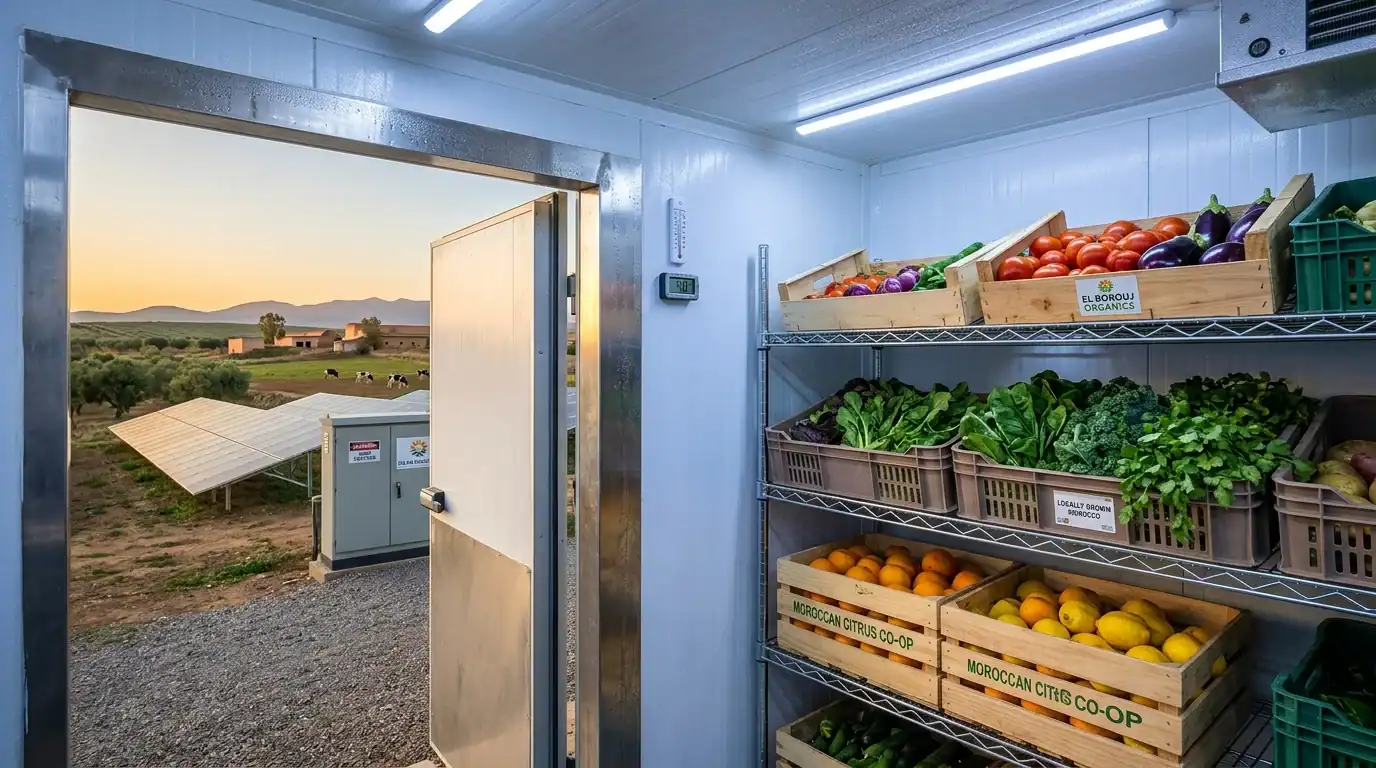
Note the daily energy column: a walk-in cooler runs its compressor 12–18 hours per day in July. That is a large, perfectly predictable daytime load — which makes it an excellent solar match if the backup is sized for the nights and storms.
The Sizing Method
Step 1 — Separate the two questions: bill savings and survival. The array answers the first; the battery and inverter answer the second. Mixing them produces systems that save money but cannot ride an outage, or vice versa.
Step 2 — Size the inverter to the surge, not the running load. Inverter continuous rating ≥ compressor running load × 2; surge rating ≥ locked-rotor draw. For a 2 kW cooler, that means a 4 kW continuous / 9+ kW surge inverter. A soft-start kit on the compressor (150–150–300) cuts the surge 60–70% and can drop you one inverter size class — usually the cheapest $300 in the project.
Step 3 — Size the battery for thermal autonomy, not electrical autonomy. A loaded cooler is a thermal battery: at 38°F with the door shut, a well-insulated 8×12 cooler coasts 4–8 hours before product temperatures move. You do not need to power 24 hours of compressor — you need to bridge the outage minus the coasting time. For most farms: battery usable capacity = compressor running kW × (target outage hours – coasting hours) × 1.25 safety factor.
Step 4 — Size the array to the summer daytime load. Array kW ≈ cooler daily kWh ÷ (peak sun hours × 0.75). An 8×12 cooler using 25 kWh/day in a 5-sun-hour region needs roughly 6.5–7 kW — which will also carry your fans, lights, and a workshop load most days.
The Numbers: 8×12 Walk-In, Worked Example
| Parameter | Value |
|---|---|
| Compressor running load | 1.8 kW |
| Startup surge | 8 kW |
| Summer daily energy | 25 kWh |
| Inventory at risk | ~$12,000 |
| Thermal coasting time (loaded, door shut) | 6 hours |
| Target outage coverage | 24 hours |
| Required battery discharge time | 18 hours |
| Usable battery capacity | 1.8 × 18 × 1.25 = 40.5 kWh |
| Nameplate LiFePO₄ (85% DoD, 92% RTE) | ~52 kWh |
| Inverter | 4 kW continuous / 10 kW surge |
| Array (5 peak sun hours) | 6.5–7 kW |
| Installed cost (2026) | $34,000–$44,000 |
Now the part that changes the math: a $12,000 inventory loss every 3 years is a $4,000/year hidden insurance premium. Against that, the battery pays for itself on risk reduction alone — the bill savings are the bonus. And if a real 24-hour battery stretches the budget, a 12-hour battery plus a small auto-start generator covers the tail risk for half the price.
Expert Tips
1. A soft-start kit is the highest-ROI component in the system. Cutting compressor surge 60–70% lets you buy a smaller inverter and a smaller battery. $300 now routinely saves 3,000–3,000–5,000 in equipment.
2. Insulation is a battery that never degrades. Adding one inch of polyiso (R-6.5) to an 8×12 cooler cuts compressor runtime 10–15% and extends coasting time 1–2 hours. Spend on insulation before lithium.
3. Pre-cool before the storm. When a severe-weather warning hits, drop the setpoint 3–4°F and top off with ice jugs. You are charging the thermal battery for free. Make it a checklist item, like fueling the generator.
4. Temperature alarms are not optional. A cellular temperature alarm (150–150–250) texts you when the cooler crosses a threshold. It converts a silent 2 AM failure into a salvageable situation. We consider it mandatory equipment on any solar-backed cooler.
5. Refrigerant choice matters for solar retrofits. Modern R-448A/R-449A systems run more efficiently than legacy R-404A. If your cooler is over 15 years old, a condensing-unit replacement may pay back faster than the solar array itself.
6. Do not forget the defrost cycle. Electric defrost elements can draw 2–3× the compressor load. Confirm your inverter sizing covers defrost + compressor simultaneously, or lock defrost to off-peak hours.
Conclusion
Cold storage solar succeeds or fails on three numbers: the startup surge, the coasting time, and the inventory value. Size the inverter to the surge, the battery to the outage minus the thermal coasting, and the array to the summer daytime load — then spend the $300 on the soft-start and the $200 on the alarm before you spend another dollar on panels.
Frequently Asked Questions
Q: How long will a walk-in cooler stay cold without power?
A: A loaded, well-insulated cooler with the door kept shut coasts 4–8 hours before product temperatures rise meaningfully; a half-empty cooler may coast only 2–3 hours. Thermal mass works for you — full coolers hold temperature far better than empty ones. Keep ice jugs in dead space and treat the door as a bank vault during outages.
Q: Can I run a walk-in cooler entirely off-grid on solar?
A: Yes, and it is one of the few farm loads where off-grid is genuinely practical, because the load is predictable and the thermal mass forgives. Budget roughly 7 kW of PV and 50 kWh of LiFePO₄ for an 8×12 cooler with 24-hour autonomy, plus a generator for multi-day storm events. The inverter must handle the compressor surge — that specification decides success or failure.
Q: Is a battery or a generator cheaper for cooler backup?
A: For outages under 12 hours, a battery wins — silent, instant, no fuel. For multi-day outages, a generator wins on cost per hour. The robust design is both: a battery sized for the common short outages (which handles the surge and the overnight hours) plus a small auto-start generator for the rare long ones. The battery also saves money daily by self-consuming solar; the generator only sits there.
Related Articles
- Winterizing Your Solar Pump System: The 6-Step Checklist Before the First Hard Freeze — Cold-weather protection logic that applies equally to cooler equipment.
- Solar Heat Pump for Greenhouses and Barns: The 3-Ton System That Cuts Propane by 70% — The heating-side companion to solar-powered refrigeration.
© 2026 Farm Solar Guide. All data sourced from ASAE standards, manufacturer compressor and battery cold-temperature specifications, and documented US produce operations. Last verified: October 28, 2026
1 thought on “Solar-Powered Cold Storage and Walk-In Coolers: Sizing for the Load That Cannot Fail”