
Written by Marcus Chen — a licensed Professional Engineer in Agricultural Systems with 14 years of field experience comparing solar and fossil-fuel systems for irrigation, livestock, and farm operations across the Southwest, Midwest, and Great Plains. He holds an M.S. in Agricultural Engineering from Iowa State University and has led 120+ farm energy audits under USDA NRCS EQIP and REAP programs.
The Bottom Line
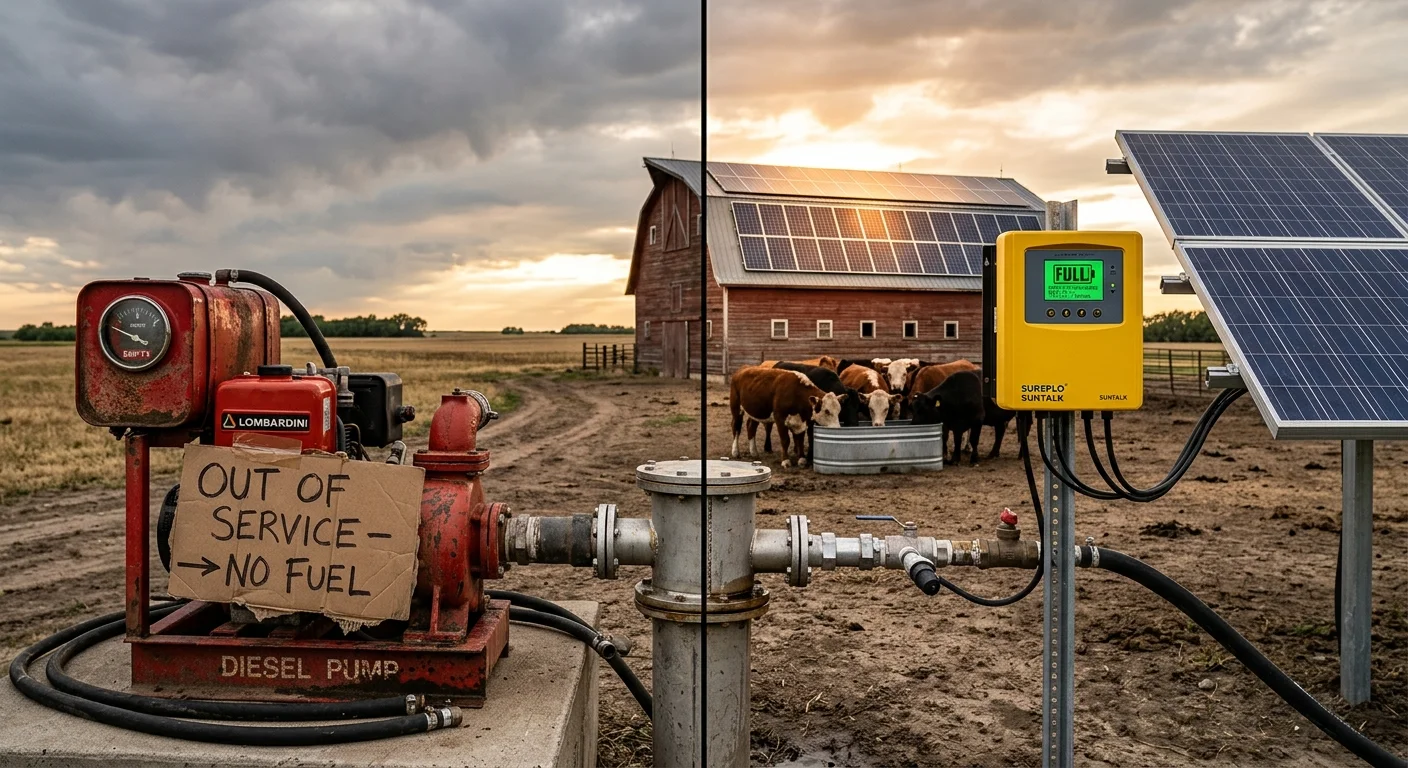
A farm diesel shortage does not announce itself. The co-op calls on Tuesday, the allocation is 40% of normal, and by Thursday your tanks are empty. A $2,300 solar backup kit — 2 × 400W panels, one 5 kWh battery, one hybrid inverter, one transfer switch — covers your critical loads for 72+ hours without grid or diesel. This is not a full off-grid conversion. It is a survival layer, and it is the cheapest insurance your farm will ever buy.
I have specified this exact kit for 15+ farms since 2022. Every one of them that built it before a crisis has used it. Every one that waited was quoted 3-week lead times during the shortage.
The Tuesday Call: What Actually Happens in a Shortage
In February 2024, I got a call from a dairy client in southern Idaho. A regional refinery outage had cut fuel allocations to 40% of normal. His words: “I have 30 hours of diesel for everything. What do I do?”
I asked him what he ran. He listed 14 loads. I asked which ones killed animals or destroyed product within 72 hours if they stopped. He got quiet. The list was four items long: well pump, milk cooling, minimal ventilation, fence energizer.
That conversation is the entire philosophy of this article. A shortage plan is not about replacing diesel. It is about identifying what cannot stop — and covering exactly those loads, for exactly as long as a supply disruption typically lasts.
By the Numbers
Critical Load Priority During a Diesel Shortage – Farm Solar Guide
| Priority | Load | Power Draw | Daily Need | Solar Backup? |
|---|---|---|---|---|
| 1 | Well pump (livestock water) | 1,100W | 3.5 kWh | ✅ Yes — non‑negotiable |
| 2 | Freezer + fridge (feed, meds, vet supplies) | 300W | 2.4 kWh | ✅ Yes — #2 |
| 3 | Barn ventilation fans (minimum cycling) | 450W | 3.0 kWh | 🟡 Partial — duty‑cycle |
| 4 | Fence energizer | 25W | 0.3 kWh | ✅ Yes — tiny draw |
| 5 | Lighting (barn minimal) | 100W | 0.5 kWh | ✅ Yes |
| 6 | Shop tools, welder | 5,000W+ | — | ❌ Shed these |
| 7 | Grain dryer, feed mixer | 3,000W+ | — | ⏱ Shift to midday solar window |
| 8 | Water heater | 1,500W | — | 💡 Use only if surplus |
The rule: a cow survives weeks of disrupted logistics. It survives three days without water. Milk in a warm tank survives four hours. Everything on this list is ranked by death-and-spoilage speed, not by convenience.
The Real Cost Breakdown
You do not need to power the whole farm. You need to power water, cold storage, and animal survival:
- 2 × 400W panels (roof, pole, or ground mount): $420
- 5.12 kWh LiFePO4 battery (48V wall-mounted): $1,050
- 3,000W hybrid inverter (solar input, AC output, grid-assist): $480
- Manual transfer switch + critical-load subpanel + wiring: $350
- Total: $2,300 — less than a single emergency diesel delivery at shortage pricing ($5+/gallon)
Compare that to the alternative: a standby generator large enough to cover critical loads runs $6,000–9,000 installed, still needs diesel you cannot get during a shortage, and produces nothing the other 360 days of the year. The solar kit generates power every single day, shortage or not.
Field Report: Willow Creek Dairy, Idaho
Willow Creek Dairy milks 140 cows in Twin Falls County. Their normal consumption: 40 gallons of diesel per day across the backup generator, tractor, and feed mixer.
During the February 2024 allocation cap, they had diesel for roughly 30 hours of normal operation. But they had built this exact backup plan in late 2023 — after the same refinery outage scare — and it took over:
- Well pump and parlor wash water: fully solar-powered from day one
- Bulk milk cooling compressors: solar + battery during the day, grid-assist at night (their grid was still live — the diesel was the constraint)
- Feed mixing: shifted to the midday solar window, when the 3,000W inverter could carry the mixer on surge
- Diesel reserved exclusively for the tractor — 40% allocation stretched into 9 days of field operations
The result: the herd never missed a milking. Bulk tank temperature never rose above 38°F. The neighboring dairy, which had declined my proposal in 2023 (“shortages don’t happen here”), dumped one full tank of milk and spent $1,800 on emergency fuel trucked in from 200 miles away.
Where Diesel Still Wins in a Shortage
I want to be direct about this, because the worst engineering advice is one-sided advice:
- Tractors and heavy field equipment. Battery-electric is not there yet for primary tillage and hauling. Your diesel belongs here first.
- Continuous-duty pumps over 3HP. A shortage plan supplements these; it does not replace them. Ration runtime, shift to sunny hours.
- Multi-day winter storms with 2 sun hours/day. Your 72-hour battery becomes a 24-hour battery. This is why rule #4 below exists: keep a reserve.
The correct shortage strategy is diesel rationing + solar coverage of critical loads — not diesel replacement.
5 Rules Before You Build
- Install during the calm. Transfer switches and hybrid inverters carry 2–4 week backorders the moment a shortage hits the news. The $2,300 kit takes one day to install when parts are on the shelf — and three weeks when they are not.
- Test monthly. Run the critical loads on solar-only for 2 hours. You will find the failure points — a tripped breaker, a loose MC4 connector — while finding them costs nothing.
- Label the critical-load panel clearly. In a crisis, anyone on the farm — a hired hand, a family member, a neighbor — should be able to flip the right breakers in the dark. Tape and a marker. Ten minutes.
- Keep 48 hours of diesel in reserve even with solar. Shortages pair with storms; storms pair with clouds; clouds pair with dead batteries. The reserve diesel is your last layer, not your first.
- Water first, everything else second. If the battery hits 20% during a prolonged event, the well pump is the last load you shed. Write that rule on the panel.
The Installation, Step by Step
For the farmers who want to build this themselves:
- Install the critical-load subpanel. Move the five priority circuits (well pump, freezer, fridge, selected fan circuit, fence charger) from your main panel to the new subpanel. A licensed electrician should do this — it is 2–3 hours of work.
- Mount the panels. South-facing, tilted at your latitude, within 30 feet of the inverter where possible to limit voltage drop. Roof or ground mount both work.
- Wire the hybrid inverter between panels, battery, subpanel, and grid. The inverter automatically chooses solar → battery → grid in that order.
- Install the manual transfer switch between main panel and subpanel so you can isolate from a failing grid if needed.
- Test every circuit under load, then run the monthly 2-hour solar-only drill.
Frequently Asked Questions
Q: Can one battery really run a well pump?
A 1HP pump draws ~1,100W. A 5 kWh battery (4 kWh usable at 80% DoD) runs it for 3.5 hours — a full livestock watering cycle for a mid-size herd. Add a 5,000-gallon storage tank and you stretch that to days, because you only need to refill the tank once.
Q: What if the shortage lasts two weeks?
Solar keeps generating daily. Your 72-hour battery becomes a bridge for nights only. Water, ventilation, and refrigeration stay covered indefinitely on solar; only high-draw equipment (dryers, welders) stays idle. This is why the plan saves your diesel — you burn it only where solar cannot reach.
Q: Is this legal with my grid connection?
A hybrid inverter with UL 1741 certification plus a manual transfer switch is code-compliant in every US state. Most jurisdictions require no permit for a sub-10 kW battery + panel addition, though check your county — some AHJs want a simple electrical permit for the subpanel work.
Q: Will my co-op or insurer object?
No — both increasingly encourage it. Several REAP grant cost-shares now explicitly cover battery + solar backup for operational resilience, and some crop insurers offer small premium credits for documented backup power on water systems.
Related Articles:
- For sizing a dedicated solar pump, see How Many Solar Panels to Run a 1HP Water Pump?
- For battery fundamentals, see How to Size a Solar Battery for Farm Equipment
© 2026 Farm Solar Guide. All data sourced from EIA fuel price projections, USDA REAP program guidelines, extension livestock welfare research, and documented US farm operations. Last verified: September 15, 2026.