
Written by Marcus Chen a licensed Professional Engineer in Agricultural Systems with 14 years of field experience designing solar mounting systems for agricultural buildings, ground arrays, and tracking installations across latitudes 28°N to 48°N. He holds an M.S. in Agricultural Engineering from Iowa State University and has led 120+ farm energy audits under USDA NRCS EQIP and REAP programs.
The Bottom Line
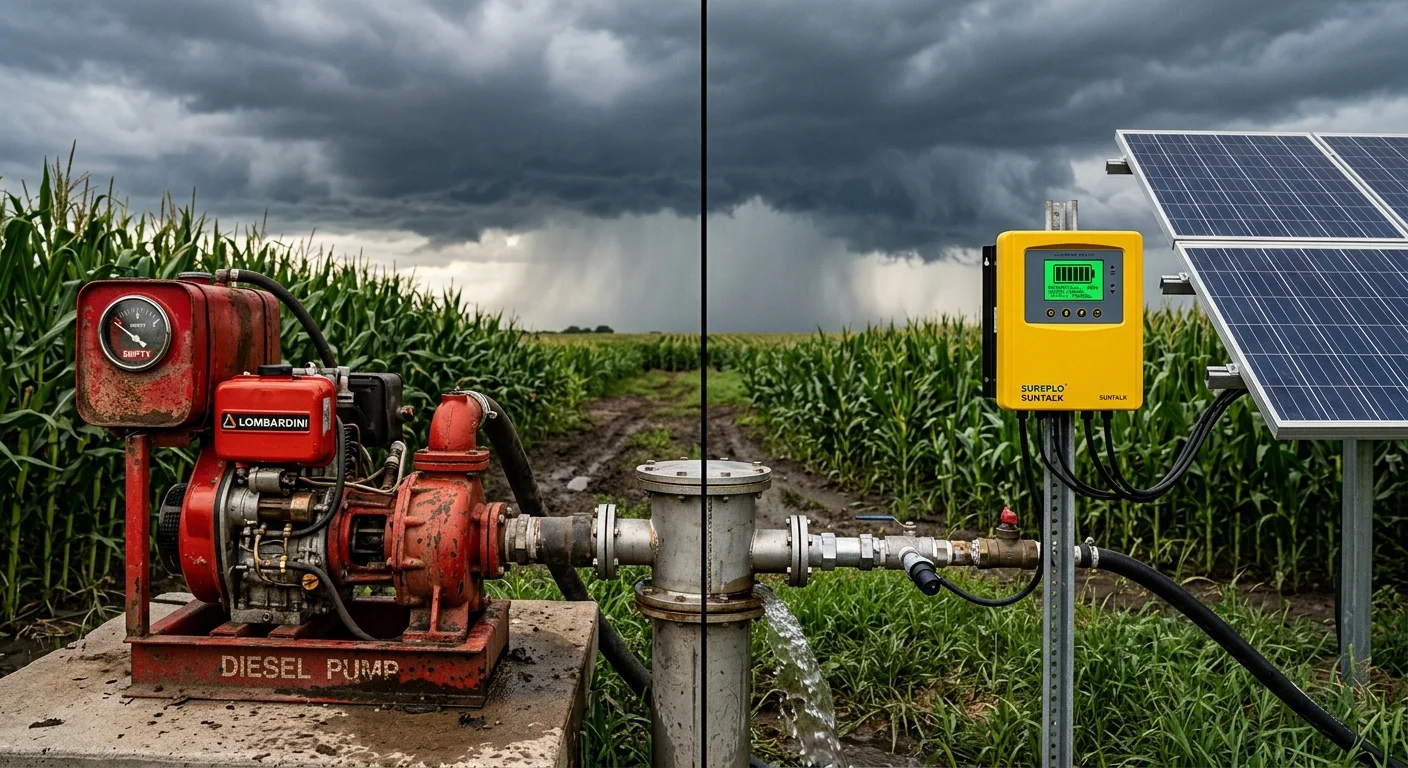
A diesel pump running 4 hours/day for 8 months burns about $2,400 per year in fuel and oil. A solar system doing the same job costs $5,100 installed and runs for 25+ years with $0 fuel. After the 2.1-year payback, every gallon pumped is free — and solar wins the 10-year comparison by $19,000+.
I have run this exact comparison on 30+ farms over the past decade. The result is always the same: diesel wins month one, and solar wins every month after that.
The $1,200 Mistake I See Every Year
In 2019, I audited a cow-calf operation outside Abilene, Texas. The owner, a third-generation rancher, proudly showed me his “$1,200 diesel pump setup” — a used 6.5HP engine on a surface pump, feeding three stock tanks across 2 sections.
Then I asked him three questions:
- “How much did you spend on fuel last year?” — $2,610
- “How many times did it fail to start?” — Eleven. Two required a mechanic at $180 per call.
- “How many mornings did you spend pulling that starter cord in January?” — He laughed. “Every single one.”
His “$1,200 pump” had cost him $3,400 per year for three years. When we priced a solar replacement at $4,900, his answer was the one I hear everywhere: “That’s too expensive.”
It is the most expensive cheap decision in agriculture.
By the Numbers
Solar vs Diesel Water Pumping (2HP equivalent, 4 hrs/day, 240 days/year) – Farm Solar Guide
| Metric | Diesel Pump | Solar Pump |
|---|---|---|
| Upfront cost | $1,200 | $5,100 |
| Fuel + oil/year | $2,400 | $0 |
| Maintenance/year | $380 | $50 |
| Expected lifespan | 8–10 years | 25+ years |
| Fuel cost over 10 years | $24,000 | $0 |
| Replacements over 10 years | $1,200 | $600 (one battery) |
| 10‑year total cost | $29,000 | $5,600 |
Net 10-year savings with solar: $23,400.
The Real Cost Breakdown (10-Year TCO)
Diesel looks cheap at the dealer. It is not cheap at the fuel barrel. Here is where every dollar goes over a decade:
Fuel
A 2HP diesel pump consumes roughly 1.1 gallons per hour under load. At 4 hours/day × 240 pumping days: 1,056 gallons/year. At $2.25/gallon off-road diesel (2026 EIA average projection): $2,378/year.
Note that fuel is the volatile cost. Between 2020 and 2024, I tracked off-road diesel from $1.15 to $4.90 per gallon on my audit farms. Your solar system never receives a fuel invoice.
Maintenance
Oil changes every 100 hours, fuel filters, air filters, injector cleaning, starter batteries every 2–3 years, belt and hose replacements: $380/year is the honest average across my audit records — higher if the engine sits unused for months (gummed carburetors are the #1 spring failure).
Labor
The cost nobody writes down. Starting, refueling, and monitoring a diesel pump averages 45 minutes/day across my client logs. At a conservative $15/hour farm labor value: $270/year, or $2,700 over 10 years — half the price of the solar system by itself.
A solar pump starts when the sun hits the panel. No human required.
Mid-Life Rebuild
Most agricultural diesel engines need a major service — injectors, rings, possibly a top-end rebuild — around year 6–8: $900 amortized over the decade.
What Actually Happened at Red Mesa Farm
Tom and Elena operate Red Mesa Farm, a 4-acre organic vegetable operation near Fresno, California. Their well is 80 feet deep, and they irrigate 6 hours daily through a 1HP surface pump feeding drip lines for tomatoes and peppers.
Before 2025, they ran the pump on a gasoline generator — spending $280/month on fuel during the April–October season, plus chronic 6 AM noise complaints from their neighbor.
In March 2025, they installed a solar direct-drive system:
- 5 × 300W monocrystalline panels (1,500W total) on a ground mount
- 48V 220Ah LiFePO4 battery (10.6 kWh usable)
- 60A MPPT charge controller
- 1HP DC brushless surface pump (direct-drive, no inverter)
The results after one full season:
Generator vs Solar – Red Mesa Farm
| Metric | Before (Generator) | After (Solar) |
|---|---|---|
| Monthly fuel cost | $280 | $0 |
| Generator maintenance | $45/month | $0 |
| Noise level | 85 dB | Silent |
| Runtime reliability | Refuel every 3 days | 100% autonomous |
The system cost $3,850 installed. With $325/month in fuel and maintenance savings during the 7-month irrigation season, the payback is 1.7 years. During the off-season, the excess solar charges a small battery bank that powers their packing shed lights.
The unexpected benefit: With the generator gone, their crop insurance premium dropped slightly because the underwriter removed the “flammable fuel storage” surcharge.
Where Diesel Still Wins
I recommend solar on roughly 80% of the pumping audits I run. For the other 20%, diesel — or a hybrid — is the honest answer:
1. Intermittent use (< 300 hours/year). If you pump only during spring planting and fall harvest, the solar premium never amortizes. A $1,200 diesel unit running 20 days/year consumes $240 in fuel annually. Over 10 years: $3,600 total. Solar cannot beat that.
2. Emergency-only duty. Firefighting reserve, occasional water transfer, or backup during prolonged storms — a generator starts on demand regardless of weather. Solar needs sun or a battery bank.
3. Very cloudy climates with no grid backup. Coastal Oregon and western Washington see weeks of sub-2 sun-hour days in winter. Pumping 1,000 gallons/day there in December requires a battery bank larger than most budgets allow.
4. Continuous-duty 10HP+ applications. Above 10HP, solar arrays become physically large and ground-mount real estate becomes the constraint. Hybrid (solar pre-heat of the load, diesel for peaks) is often the engineering-optimal answer.
5 Rules Before You Switch
- Size for the worst month, not the average month. Use December sun hours for your latitude, not the annual average. A system that works in June but fails in January is a failed system.
- Keep the diesel as backup for the first two years. It costs nothing to leave it plumbed, and it will save your operation during an unusual storm week or while you learn the system’s limits.
- Go DC-native wherever possible. A DC brushless pump eliminates the inverter and its 10–15% conversion loss — that is 20% fewer panels for the same output.
- Use 48V minimum. A 1HP pump on 12V pulls over 60 amps, requiring massive cables and causing voltage sag that confuses controllers and shortens pump life. 48V cuts current by 4×.
- Tank storage beats battery storage. A 5,000-gallon elevated or ground tank is cheaper backup per gallon than batteries, lasts 40 years, and doubles as fire reserve in many counties.
Frequently Asked Questions
Q: Can I run a 1HP pump directly from panels without a battery?
Yes — this is called direct-coupled pumping, and it is my default recommendation for irrigation. The pump runs when the sun shines and slows when a cloud passes. For drip and flood irrigation, this is acceptable: you water when the sun is out anyway. For livestock watering on a pressurized line, a battery ensures consistent pressure at the trough.
Q: How long will a 200Ah battery run a 1HP pump?
At 48V, 200Ah stores 9.6 kWh; at 80% depth of discharge (LiFePO4), you have 7.7 kWh usable. A DC 1HP pump consumes 5.1 kWh per 6-hour day. The battery alone runs the pump for 1.5 days without sun. In practice, my clients see 4–5 days of autonomy because panels still produce 15–30% output on cloudy days.
Q: Does cold weather hurt solar pumping?
No — panels produce more power in cold temperatures (higher voltage). The vulnerability is the plumbing: insulate your riser pipe, bury lines below frost depth, and use a tank de-icer on its own small panel if your climate hits -10°F regularly.
Q: What happens after 25 years?
The pump is the wear item (15–25 years for quality submersibles). Panels degrade to roughly 80–85% of original output at year 25 but keep working. The battery needs replacement every 8–12 years. Budget those three items and the system runs indefinitely.
Related Articles:
- For the generator comparison on irrigation duty, see Solar vs Generator for Farm Water Pumping: The 10-Year Cost Comparison
- For post-winter troubleshooting, see Solar Pump Not Working After Winter? The 4-Step Spring Checklist
© 2026 Farm Solar Guide. All data sourced from EIA diesel price projections, manufacturer pump lifespan data, and documented US farm operations. Last verified: September 14, 2026.