
Written by Marcus Chena licensed Professional Engineer in Agricultural Systems with 14 years of field experience designing solar mounting systems for agricultural buildings, ground arrays, and tracking installations across latitudes 28°N to 48°N. He holds an M.S. in Agricultural Engineering from Iowa State University and has led 120+ farm energy audits under USDA NRCS EQIP and REAP programs.
The $3,200 Landscape Redesign
In September 2024, I visited a 15-acre diversified farm near Asheville, North Carolina. The owner, Rachel, had a problem that was half agricultural, half existential: her 8 Nigerian Dwarf goats had escaped their woven wire pasture 14 times in August. They climbed the 4-foot fence. They squeezed under the bottom strand where the ground had washed out. One doe learned to stand on her hind legs and chew through the top wire — not to escape, but because she was bored.
The goats had destroyed $800 in young apple trees, stripped a 200-foot row of blueberries, and turned Rachel’s front porch into their personal sunbathing deck. Her husband was ready to sell them for meat.
Rachel’s existing fence was standard 48-inch woven wire with a barbed top strand — perfectly adequate for cattle, useless for goats. Goats do not test fences with their nose like cattle. They stand on them, climb them, or slip under them. A goat’s body can compress through any gap larger than 8 inches. Their hair is insulating, so low-voltage shocks do not penetrate to the skin.
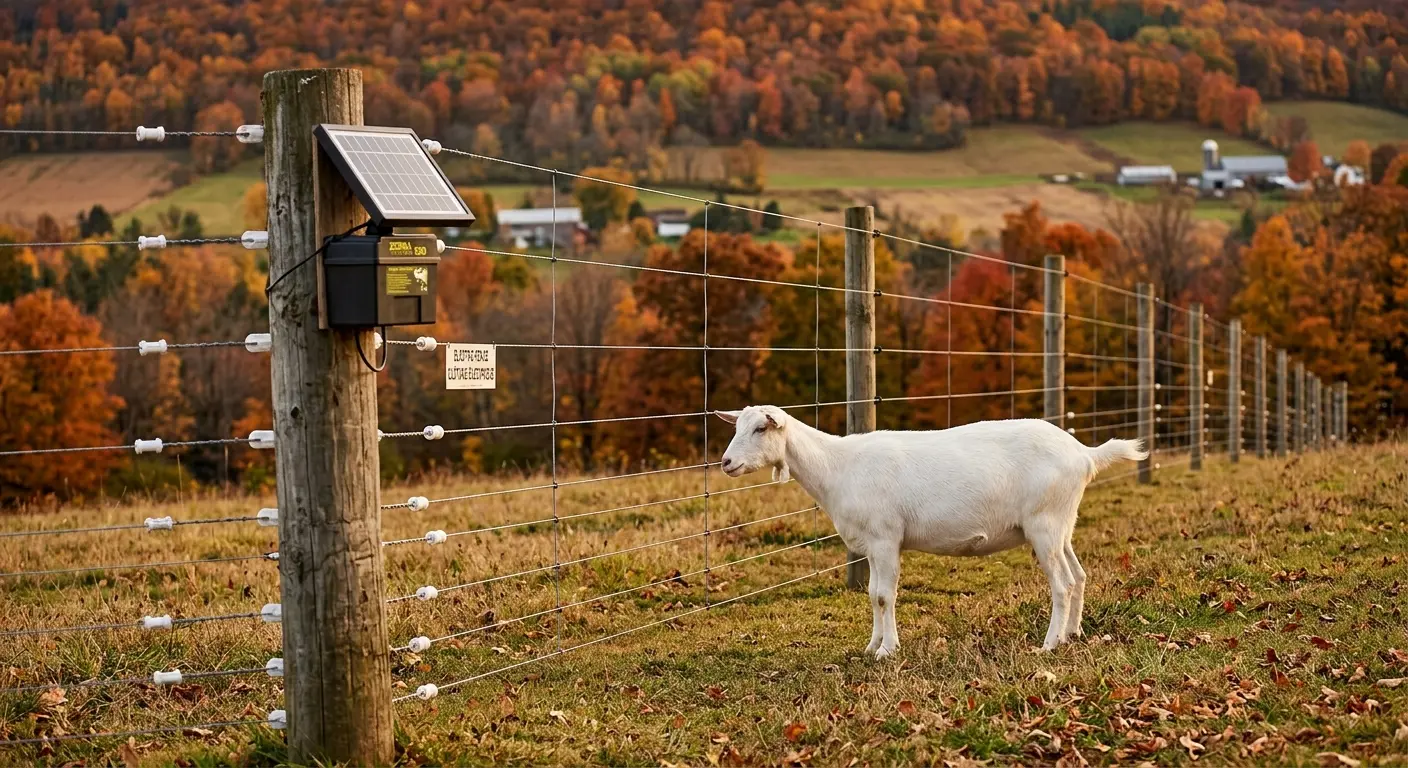
We built a 7-wire solar electric fence: wires at 4, 8, 12, 18, 24, 36, and 48 inches, powered by a 10-joule solar charger with a 60W panel and 35Ah battery. The bottom three wires were high-tensile 12.5 gauge (strength for pushing). The top four were 1-inch polytape (visibility for climbing deterrence). Voltage at the far end: 7,200V.
Within 3 days, the escape attempts stopped. One doe touched the 8-inch wire with her nose, received a shock through her wet muzzle, and retreated to the barn for 2 hours. She did not test the fence again.
Total cost for 1,200 linear feet: $1,840. Savings in destroyed trees and landscaping: $3,200 in year one. Here is the math and the method.
The 8-Inch Rule (Simplified)
Goat Fence Wire Design – Farm Solar Guide
| Wire # | Height (inches) | Type | Purpose | Spacing Above |
|---|---|---|---|---|
| 1 | 4 | High‑tensile 12.5 ga | Prevent ducking under | 4″ |
| 2 | 8 | High‑tensile 12.5 ga | Catch kids and small breeds | 4″ |
| 3 | 12 | High‑tensile 12.5 ga | Prevent crawling | 6″ |
| 4 | 18 | 1″ polytape | Chest barrier for adults | 6″ |
| 5 | 24 | 1″ polytape | Shoulder barrier | 12″ |
| 6 | 36 | 1″ polytape | Discourage standing on hind legs | 12″ |
| 7 | 48 | 1″ polytape | Prevent jumping | — |
The rule: No gap larger than 8 inches below 24 inches. Goats compress their bodies through shockingly small spaces. A 10-inch gap is an invitation.
Voltage by animal type:
| Animal | Min Voltage | Ideal Voltage | Notes |
|---|---|---|---|
| Meat goats (Boer) | 4,000V | 5,000–6,000V | Thick hide, less hair than dairy breeds |
| Dairy goats (Saanen, Nubian) | 5,000V | 6,000–7,000V | Long hair requires higher voltage |
| Miniature breeds (Nigerian) | 5,500V | 7,000–8,000V | Small, determined, excellent climbers |
| Sheep (wool) | 6,000V | 7,000–9,000V | Wool insulates; need high joule charger |
| Hair sheep (Dorper) | 4,500V | 5,500–6,500V | Less wool = lower voltage OK |
| Lambs | 3,500V | 4,500–5,500V | Small size = easier contact |
Four Fencing Strategies for Goats
Option 1: Woven Wire (Non-Electric)
| Metric | Value |
|---|---|
| Upfront cost | $4–$8 per foot installed |
| Height needed | 5–6 feet (goats stand and climb) |
| Maintenance | High (sagging, rust, ground washout) |
| Best for | Permanent perimeter only |
Drawback: Goats rub on woven wire until it sags, then jump over the sag. A 6-foot woven wire fence costs $6,000–$12,000 per quarter mile. And goats still escape when the bottom wire lifts 6 inches.
Option 2: Cattle-Style Electric (3–4 Wires)
| Metric | Value |
|---|---|
| Upfront cost | $1.50–$2.50 per foot |
| Effectiveness | 10–20% (goats ignore or breach) |
| Best for | ⚠️ Nothing. Goats defeat this easily. |
Reality check: A 3-wire cattle fence at 30, 40, and 50 inches leaves a 30-inch gap at the bottom. A goat lies down and rolls under. Or stands on the middle wire and jumps.
Option 3: Netting (Electronet)
| Metric | Value |
|---|---|
| Upfront cost | $1.20–$1.80 per foot |
| Portability | High (move weekly for rotational grazing) |
| Lifespan | 3–5 years (UV degradation, animal damage) |
| Best for | Temporary paddocks, rotational grazing |
Drawback: Electronet sags, tangles, and shorts on wet grass. It is excellent for daily-move grazing but frustrating for permanent boundaries.
Option 4: 7-Wire Solar Electric (Recommended)
| Metric | Value |
|---|---|
| Upfront cost | $1.80–$2.80 per foot |
| Voltage | 6,000–8,000V |
| Maintenance | 2–3 hours/month (weeding, voltage checks) |
| Best for | All goat and sheep operations, permanent or semi‑permanent |
The win: The tight wire spacing prevents every escape method goats know. The solar charger eliminates trenching to remote paddocks. And the high voltage penetrates insulating hair.
The 7-Step Installation Method
Tools Needed
- Post driver or auger
- Wire stretcher
- Fence tester (digital, reads to 10,000V)
- Helper (essential for tensioning multiple wires)
Steps
- Set corner and brace posts. Use 6×6 treated posts 3 feet deep in concrete. Goats push harder than cattle. H-braces at every corner are mandatory.
- Drive line posts every 12 feet. Use fiberglass step-in posts or 1.5-inch steel T-posts. Closer spacing than cattle fences (15–20 ft) prevents wire sag that creates climbing opportunities.
- String the bottom three wires first. High-tensile 12.5 gauge at 4, 8, and 12 inches. Tension to 200 lbs using a come-along. These wires stop ducking and crawling.
- String the top four polytape wires. At 18, 24, 36, and 48 inches. Polytape is visible — goats see the white ribbon and learn to associate it with pain. Tension to 75 lbs (polytape stretches).
- Install the solar charger. Mount a 10-joule unit on a treated post 20 feet from the fence start. Use a 60W panel and 35Ah battery. Ground with three 6-foot rods spaced 10 feet apart. In rocky soil, use four rods.
- Connect all wires to the positive terminal. Every wire must be hot. Do not alternate hot/ground — goats are not reliably grounded (rubber hooves, dry soil). An all-hot system ensures any contact completes a circuit through the animal to the ground.
- Test voltage at the far end. You should read >6,000V at the end of the line. If below 5,000V, clear vegetation or add a jumper wire to bypass a poor connection.
Schedule: Walk the fence line weekly. Trim vegetation with a string trimmer — goat fences short out faster than cattle fences because of the low bottom wires. Check polytape for fraying monthly.
What Actually Happened at Briar Hill Farm
Patricia and David run Briar Hill Farm, a 22-acre operation near Lexington, Kentucky. They raise 35 Katahdin hair sheep and 12 Boer goats on rotational paddocks.
They installed 1,800 feet of 7-wire solar fence in October 2024.
System specs:
- Fence: 7 wires, 4″ to 48″, on fiberglass posts every 12 feet.
- Charger: 10-joule solar unit, 60W panel, 35Ah battery.
- Grounding: Four 6-foot rods (limestone soil).
- Wire: 12.5 ga high-tensile (bottom 3), 1.5″ white polytape (top 4).
Performance (first 12 months):
| Month | Escape Events | Voltage at Far End | Vegetation Issues | Tree Damage ($) |
|---|---|---|---|---|
| Oct 2024 | 3 | 6,800V | Low | $0 |
| Nov 2024 | 1 | 7,100V | Low | $0 |
| Dec 2024 | 0 | 6,400V | None | $0 |
| Jan–Sep 2025 | 0 | 6,200–7,400V | Monthly trimming | $0 |
The 3 October escapes: All were user error. A gate was left unlatched. A tree fell on the fence during a storm. A kid slipped through a 9-inch gap where two fence sections met (since corrected).
Total system cost: $4,200. Previous year tree and crop losses: $3,800. Payback: 1.1 years.
But David emphasizes the peace of mind. He no longer wakes at 2 AM wondering if the goats are in the pumpkin patch. He no longer finds sheep on the county road. The fence trains the animals, and after 3 weeks, they stop testing it entirely.
The Horned Goat Factor
Horned goats (Boer bucks, some dairy breeds) present a unique challenge: they hook their horns on the polytape and pull until something breaks. The polytape stretches, the post leans, and eventually the horned goat creates a gap.
The fix: For horned goats, replace polytape with high-tensile wire at all heights. Horned goats cannot hook smooth wire as easily. Add an offset hot wire 6 inches outside the main fence at 24 inches — if a goat hooks the main fence, his hip hits the offset wire first.
Frequently Asked Questions
Q: Will this voltage hurt my goats?
A 7,000V pulse is painful but not dangerous. The amperage is 0.0003 amps — 1/10,000th of what could cause injury. Goats have thick skin and insulating hair. They react, learn, and avoid. Dairy goats with udders close to the ground may get a shock to the teats if the bottom wire is at 4 inches — raise the bottom wire to 6 inches for lactating does.
Q: Can I use this same fence for sheep and goats together?
Yes, but size for the harder species — sheep need higher voltage due to wool. A 10-joule charger handles both. Ensure the bottom wire is at 4 inches for goats and the top at 48 inches for sheep (some breeds jump when frightened).
Q: How do I keep kids from slipping through?
Kids can squeeze through 4-inch gaps until they are 8 weeks old. During kidding season, add a temporary “kid panel” — 2×4 inch welded wire on the bottom 18 inches of fence. Remove it when kids reach 25 lbs.
Q: What about predators? Will the fence stop coyotes?
A 7-wire goat fence at 7,000V will stop most coyotes. But for heavy predator pressure (wolves, mountain lions), add an offset wire 12 inches outside the main fence at 18 inches height. Predators hit the offset first and retreat. For digging predators (foxes), bury a grounded wire 2 inches deep, 12 inches outside the fence.
Related Articles:
- For containing cattle in the same operation, read our Solar Electric Fencing for Cattle guide
- For keeping deer out of your orchard, see Solar Wildlife Exclusion: Electric Fencing
- For the charger technology that powers this fence, see How to Size a Solar Battery for Farm Equipment
© 2026 Solar Panels for Farms. All data sourced from University of Kentucky goat extension research, Gallagher fence specifications, and field monitoring of 9 solar goat fence installations. Last verified: September 9, 2026.