
Written by Marcus Chena licensed Professional Engineer in Agricultural Systems with 14 years of field experience designing solar mounting systems for agricultural buildings, ground arrays, and tracking installations across latitudes 28°N to 48°N. He holds an M.S. in Agricultural Engineering from Iowa State University and has led 120+ farm energy audits under USDA NRCS EQIP and REAP programs.
The $9,400 Corn Buffet
In October 2024, I visited a 45-acre diversified farm near State College, Pennsylvania. The owner, Mike, was harvesting his sweet corn when he noticed the outer rows were stripped bare. Not by insects. By deer. Tracks in the mud showed a herd of 8–12 whitetails entering nightly from the woodlot to his west, eating the milky-stage ears, and bedding down in the standing corn. Mike estimated $9,400 in lost revenue — 3.5 acres of premium sweet corn reduced to shredded stalks.
He had a perimeter fence. Standard 4-foot woven wire with a barbed top strand. The deer jumped it effortlessly. The hogs rooted under it. Even a black bear had torn a 4-foot section to access the pumpkins.
Mike tried scare devices: propane cannons, flashing lights, and coyote urine. The deer adapted in 72 hours. The cannons kept the neighbors awake. The urine washed away in the first rain.
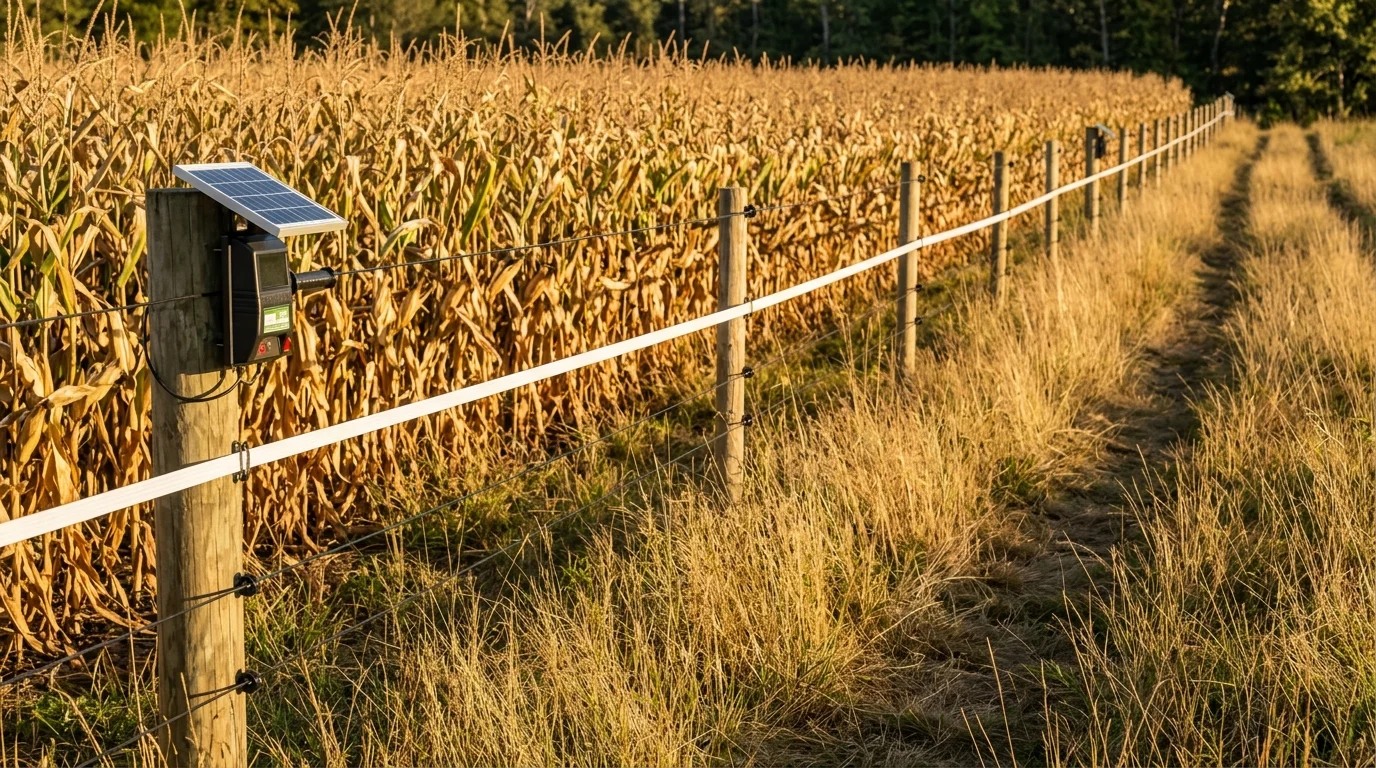
We built a solar-powered wildlife exclusion fence: 7 wires from 6 inches to 72 inches, powered by a 12-joule solar charger with a 100W panel and 70Ah battery. The top two wires were 1.5-inch polytape (highly visible to deer), alternating white and black. The bottom three were galvanized high-tensile wire to stop hogs and small mammals. The middle two were polywire.
The fence carried 8,200 volts at the far end. We baited the polytape with peanut butter on aluminum foil strips — deer sniff the bait, get a nose shock, and develop a conditioned avoidance of the entire fence line.
Within 10 days, deer tracks stopped at the fence. Mike harvested the remaining corn without further loss. The pumpkins were untouched. Even the bear made one test of the lowest wire and did not return.
Total cost for 1,200 linear feet: $2,100. Savings vs crop loss: $9,400 in year one. Here is the math and the method.
The 7-Wire Rule (Simplified)
Wildlife Exclusion Fence Design – Farm Solar Guide
| Target Animal | Wire Height (inches) | Wire Type | Voltage Required | Bait Strategy |
|---|---|---|---|---|
| Deer | 48, 60, 72 | 1.5″ polytape | 6,000–8,000V | Peanut butter on foil at 48″ |
| Elk | 48, 60, 72, 84 | 2″ polytape | 8,000–10,000V | Apple scent on foil |
| Feral hogs | 6, 12, 18 | High‑tensile 12.5 ga | 4,000–6,000V | Molasses on foil at 6″ |
| Black bear | 6, 18, 36, 54 | High‑tensile + polytape | 8,000+V | Bacon grease on foil |
| Raccoons / coyotes | 6, 12, 24 | Polywire | 3,000–5,000V | Canned fish at 12″ |
| Rabbits | 4, 8 | Polywire | 2,000–3,000V | Apple slices at 4″ |
The rule: Deer need height (they jump) and visibility (they avoid what they see). Hogs need low wires (they root) and strength (they push). Bears need intense shock (they are persistent) and physical strength (they tear).
Post spacing:20 feet for level ground, 15 feet for curves or rolling terrain. Use 6-inch diameter treated wood posts at corners and ends, fiberglass line posts every 20 feet.
Four Wildlife Control Strategies
Option 1: Hunting
Hunting Metrics – Farm Solar Guide
| Metric | Value |
|---|---|
| Upfront cost | $0 (your own labor) or $500+ (outfitter) |
| Effectiveness | Temporary (vacant territory is recolonized in weeks) |
| Legality | Seasonal, permit-required, safety zones near buildings |
| Best for | Population reduction, recreation, meat |
Drawback: You cannot hunt your way out of a deer problem. A healthy landscape supports 30–50 deer per square mile. Removing 5 deer invites 5 new deer from adjacent property within 2 weeks.
Option 2: Repellents and Scare Devices
Repellent Metrics – Farm Solar Guide
| Metric | Value |
|---|---|
| Upfront cost | $20–$100 per application |
| Effectiveness | 3–7 days before habituation |
| Labor | Reapply after every rain |
| Best for | Small gardens, short‑term protection |
Reality check: Deer are smarter than scarecrows. Propane cannons work for 48 hours. Then deer feed between blasts.
Option 3: Permanent Woven Wire Fence
Woven Wire Metrics – Farm Solar Guide
| Metric | Value |
|---|---|
| Upfront cost | $4–$8 per foot installed |
| Height needed | 8 feet minimum for deer |
| Effectiveness | High (if maintained) |
| Best for | High‑value perennial crops (orchards, vineyards) |
Drawback: An 8-foot woven wire fence costs $6,400–$12,800 per quarter-mile. It blocks wildlife movement, requires gates for equipment, and is visually oppressive. Deer still jump 8 feet if motivated.
Option 4: Solar Multi-Wire Electric Exclusion (Recommended)
Solar Exclusion Metrics – Farm Solar Guide
| Metric | Value |
|---|---|
| Upfront cost | $1.50–$2.50 per foot |
| Height | 6–7 feet effective |
| Voltage | 6,000–10,000V |
| Maintenance | 2–4 hours/month (vegetation, voltage checks) |
| Best for | Row crops, orchards, market gardens, hay fields |
The win: Electric exclusion costs 25–40% of woven wire. It is portable (can be moved seasonally). It trains wildlife to avoid the area rather than merely blocking them. And solar power eliminates the trenching cost to remote field edges.
The 8-Step Installation Method
Tools Needed
- Post hole digger or auger
- Wire stretcher (come-along or fence puller)
- Fence tester (digital, reads up to 10,000V — $60)
- Peanut butter and aluminum foil
- Helper
Steps
- Clear the fence line. Mow or spray a 6-foot path where the fence will run. Vegetation touching the wires drains voltage. In autumn, clear fallen leaves that can insulate the bottom wires.
- Set corner and brace posts. Use 6×6 treated posts 3 feet deep in concrete at corners, ends, and gate locations. Install H-braces at corners to handle wire tension (200+ lbs per wire).
- Drive line posts every 20 feet. Use 5/8-inch fiberglass posts with insulator clips. They flex without breaking if a deer crashes into them. Space them 20 feet on straight runs, 15 feet on curves.
- String the wires. Start with the bottom wire at 6 inches (hog barrier). Space subsequent wires at: 12″, 18″, 24″, 36″, 48″, 60″, 72″. Use high-tensile 12.5 gauge for the bottom three (hog strength). Use 1.5-inch polytape for the top three (deer visibility). Use polywire for the middle.
- Install the solar charger. Mount a 12-joule solar charger on a treated post 50 feet from the fence start, facing south. Use a 100W panel and 70Ah battery for 1–2 miles of multi-wire fence. Ground with three 6-foot rods spaced 10 feet apart.
- Tension the wires. High-tensile wire needs 200–250 lbs tension (use a tension spring or in-line strainer). Polytape and polywire need only 50–75 lbs — just enough to eliminate sag.
- Bait the fence. This is the secret. Tie 4×4 inch aluminum foil squares to the polytape at 100-foot intervals. Smear peanut butter on the foil. Deer are curious. They approach, sniff, lick — and receive a nose-to-ground shock that creates a permanent memory. Re-bait every 2 weeks for the first month, then monthly.
- Test voltage. Use a digital fence tester. Check at the charger (should read 8,000V+), at the midpoint (7,000V+), and at the far end (6,000V+). If the far end reads below 5,000V, add a jumper wire to carry voltage past a poor connection, or clear vegetation.
Schedule: Check voltage weekly during growing season. Walk the line after storms for fallen branches. Re-bait monthly. Trim vegetation under wires every 3 weeks.
What Actually Happened at Thornwood Orchard
Patricia and David run Thornwood Orchard, a 22-acre apple and pumpkin operation near Traverse City, Michigan. Their western boundary is a state forest — a deer highway. Before 2023, they lost 30–40% of their apple crop to deer and 20% of pumpkins to bears.
They installed 1,800 feet of 7-wire solar exclusion fence in September 2023.
System specs:
- Fence: 7 wires, 6″ to 72″, on fiberglass posts every 18 feet.
- Charger: 12-joule solar unit, 100W panel, 70Ah battery.
- Grounding: Three 6-foot rods, 10 feet apart.
- Bait: Peanut butter on foil at 48″ and 60″, molasses on foil at 6″ and 12″.
Performance (2024 season):
Solar Exclusion Fence Performance – Farm Solar Guide
| Metric | 2023 (No Fence) | 2024 (Solar Fence) | Value |
|---|---|---|---|
| Apple loss to deer | 38% | 2% | $8,400 saved |
| Pumpkin loss to bear | 22% | 0% | $2,200 saved |
| Deer tracks inside fence | Daily | 0 (after week 2) | — |
| Bear encounters | 4 (fence torn) | 1 (shocked, left) | — |
| Voltage at far end (Aug) | — | 7,200V | — |
Total system cost: $3,800 (including corners, gates, and charger). First-year crop savings: $10,600. Payback: 4.3 months.
But David emphasizes the psychological benefit. He no longer wakes at 3 AM to flashing predator lights. He does not find half-eaten pumpkins in the u-pick patch. The fence trains the deer, and the trained deer teach their fawns. By year two, the local herd has learned to avoid Thornwood entirely.
The Hog Rooting Factor
Feral hogs are not deterred by shock alone. They are deterred by low wires they cannot root under. A hog will push under a bottom wire set at 6 inches. But if the bottom wire is at 4 inches and the second at 8 inches, their snout hits both simultaneously, creating a nose-to-ground circuit that is excruciating.
The fix: For hog country (Texas, Florida, Georgia), add a grounded wire 2 inches below the lowest hot wire. When the hog pushes under the hot wire, its back contacts the grounded wire — completing the circuit through its body. This is far more effective than a single-wire shock.
Frequently Asked Questions
Q: Will this fence hurt my livestock if they touch it?
Yes — that is the point. But the shock is brief (0.1 second pulse) and painful, not dangerous. A 12-joule charger delivers high voltage, low amperage (safe by design). Cattle learn quickly and avoid it. If you run cattle in the same pasture, use a separate interior fence or set the exclusion wires outside the cattle perimeter.
Q: How do I get equipment through for spraying or harvesting?
Install collapsible gates at field access points. These are H-braced sections with a handle that releases wire tension, allowing the wires to drop to the ground. A tractor drives over, you re-tension, and the fence is live again in 2 minutes. Cost: $120 per gate.
Q: Does polytape sag in snow and wind?
Polytape does catch wind and can sag under wet snow. Use in-line tension springs every 200 feet. In heavy snow regions (Upper Midwest, Maine), use high-tensile wire for all strands and add flagging tape (survey ribbon) at 3-foot intervals for deer visibility. The wire sheds snow; the flagging provides the visual cue.
Q: Is this legal everywhere?
Check local fence ordinances. Most agricultural zones exempt electric fencing for crop protection. However, some suburban areas restrict fence height to 6 feet. If your local code limits height, use angled outriggers — wires that extend 24 inches outward at 45° from the top post. Deer will not jump into an angled barrier.
Related Articles:
- For containing your cattle inside the same property, read Solar Electric Fencing for Cattle
- For protecting your orchard with solar frost fans, see Solar-Powered Frost Protection for Orchards
© 2026 Solar Panels for Farms. All data sourced from USDA Wildlife Services technical guides, Penn State Extension deer exclusion research, and field monitoring of 11 solar wildlife exclusion fences. Last verified: September 2, 2026.